Logo & Visual Identity Design: Secret Behind Brands People Never Forget

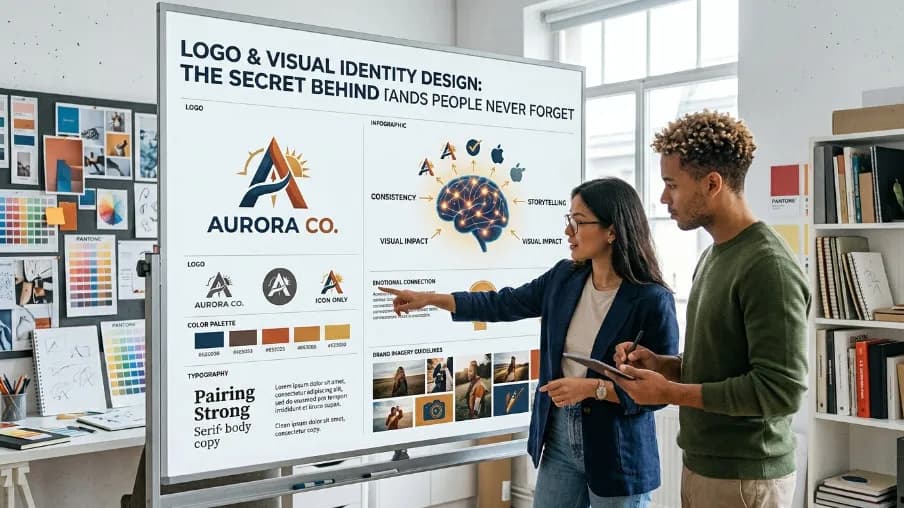
You walk into a coffee shop. No name on the door. No sign. Just a plain white cup on the table. Would you trust that coffee?
Probably not.
That's exactly what happens when a business has no clear logo or visual identity. People walk away fast.
I've worked with dozens of brands, and I see the same mistake over and over. Business owners think a logo is "just a design." They treat it like decoration. Something they'll fix later.
But here's the truth: your logo and visual identity are the first things people judge you on. In just 10 seconds, someone forms an opinion about your brand based on what they see.
Ten seconds. That's all you get.
In today's competitive market, a strong visual identity isn't just about looking good. It's a key driver of trust, recognition, and long-term digital growth. The brands that stand out online are often the ones people remember instantly.
In this guide, I'm going to walk you through everything you need to know about logo and visual identity design. What it is. Why it matters more than you think. How to get it right. And what happens when brands get it wrong.
By the end, you'll see your brand's visual identity in a completely new way and understand how the right design choices can support your business's digital growth for years to come.
What Is Logo & Visual Identity Design
Most people think a logo is just a picture. A little icon in the corner of a website.
That's only part of the story.
A logo is a symbol a mark that represents your business. It can be a wordmark (your company name styled in a unique font), an icon, or a combination of both.
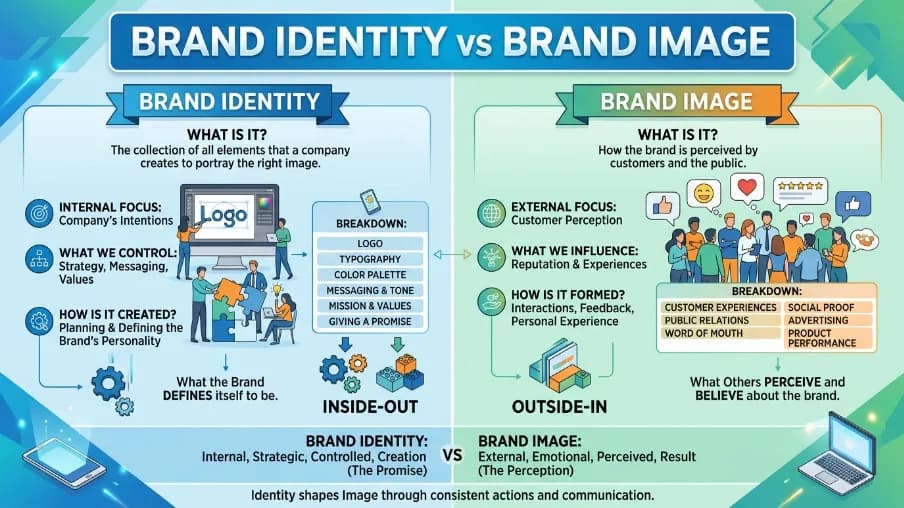
Visual identity design goes much deeper. It's the complete visual language of your brand. It includes:
- Your logo and its variations
- Your color palette
- Your typography (fonts)
- Your imagery style
- Your design patterns and graphic elements
- How all of these work together across every platform
Think of it like this. Your logo is your face. Your visual identity is your whole personality how you dress, how you speak, how you carry yourself.
Nike's swoosh is a logo. But the bold black colors, the powerful photography, the clean typography, and the attitude in every ad that's Nike's visual identity. And it took decades to build.
Why the Importance of Brand Identity Goes Far Beyond Looks
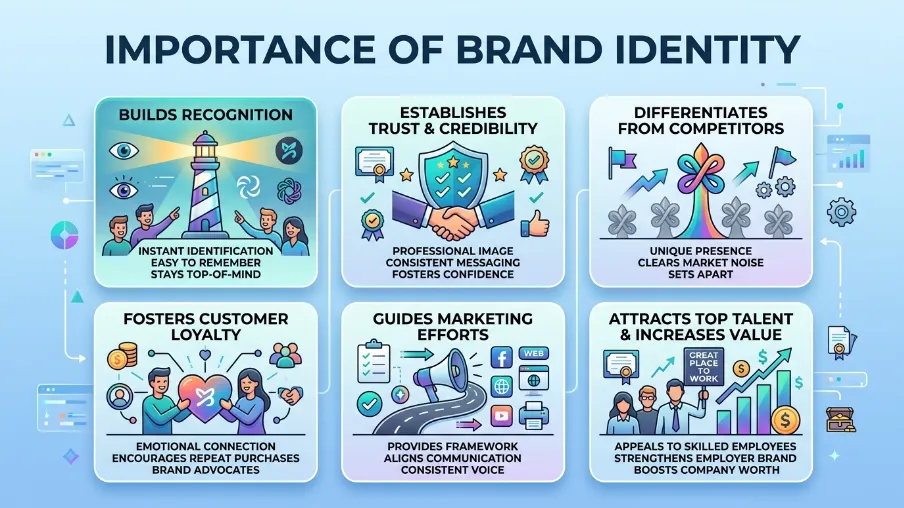
Here's where most businesses miss the point entirely. They think visual identity is about looking pretty. But really, it's about building trust at scale. Let me give you some numbers that stopped me in my tracks.
Consistent branding across all platforms can increase revenue by up to 23%. That's not a small number. For a business making $500,000 a year, that's an extra $115,000 just from being consistent.
<cite index="11-1">Color alone can enhance brand recognition by 80%.</cite> Your color choices are not decoration. They are a strategic tool.
<cite index="16-1">The human brain processes visuals 60,000 times faster than text</cite>, which is why a strong logo builds recognition far quicker than any tagline or description ever could.
And this one really hit me: <cite index="13-1">it takes only 7 seconds for people to form an impression of your brand</cite>. But it takes 5 to 7 repeated impressions before someone actually remembers your logo.
That means every time your visual identity is inconsistent different colors on your website vs. your Instagram vs. your business card you're resetting that clock. You're starting over.
Brand identity is not a cost. It is an investment that pays back with every customer touchpoint.
The 5 Core Elements of a Strong Visual Identity
I want to break this down simply. Because when I talk to small business owners, they often feel overwhelmed. Where do you start? What matters most?
Here are the five building blocks I always start with.
1. A Purposeful Logo Design
Your logo needs to do three things: be simple, be memorable, and work everywhere from a tiny app icon to a giant billboard.
<cite index="6-1">75% of consumers recognize a brand just by its logo.</cite> That's the power of a well-crafted mark.
The best logos feel effortless. But behind them is serious strategic thinking. What emotion should this logo trigger? What does the shape say? What does the color communicate?
Apple's bitten apple. McDonald's golden arches. Nike's swoosh. These weren't accidents. They were decisions.
2. A Meaningful Color Palette
Color is psychology. It's emotion. It's memory.
<cite index="11-1">39% of Fortune 500 companies use blue in their logos</cite> because blue communicates trust, reliability, and professionalism. It's not a coincidence that banks, tech giants, and healthcare brands lean on blue.
Pick your colors intentionally. Ask yourself: what do I want people to feel when they see my brand?
3. Typography That Tells a Story
The fonts you choose say a lot about who you are.
A clean sans-serif font feels modern and approachable. A strong serif feels established and trustworthy. A handwritten font feels personal and warm.
In 2025 and beyond, <cite index="1-1">custom typefaces are carrying brand storytelling in their very letterforms</cite>. Your typography is not a background detail it's a voice.
4. Consistent Imagery Style
The photos and illustrations you use should feel like they belong to the same family. Same mood. Same light. Same energy.
If your website uses bright, cheerful lifestyle photos but your social media uses dark, moody stock images your brand feels confused. And confused brands don't build trust.
5. Brand Guidelines That Lock It All Together
This is the piece most small businesses skip. And it's a huge mistake.
Brand guidelines are a document or a digital hub that defines exactly how your visual identity is used. It shows the correct logo versions, the exact color codes, the approved fonts, the spacing rules.
<cite index="14-1">68% of companies reported that consistent branding contributed 10–20% to their revenue growth.</cite> That consistency doesn't happen by accident. It happens because there are clear rules everyone follows.
What Happens When You Get Your Visual Identity Wrong
I need to tell you about Tropicana. Because this story should scare every business owner straight.
In 2009, Tropicana redesigned its iconic orange juice packaging. They replaced the beloved "orange with a straw" image with a plain, modern glass of juice. Clean. Minimal. Modern.
<cite index="7-1">The redesign alienated their customer base and led to a 20% drop in sales</cite>, forcing the company to return to the original design just weeks later.
Twenty percent.
One design decision. Twenty percent of sales gone in weeks.
The lesson? Your visual identity is deeply emotional for your customers. They don't just see your logo. They feel it. They have memories attached to it. They trust it.
Change it carelessly, and you break that trust.
<cite index="16-1">91% of consumers believe that a logo redesign should maintain some connection to the brand's previous identity.</cite> People want evolution, not revolution.
Logo & Visual Identity Design Trends Shaping 2025 and 2026
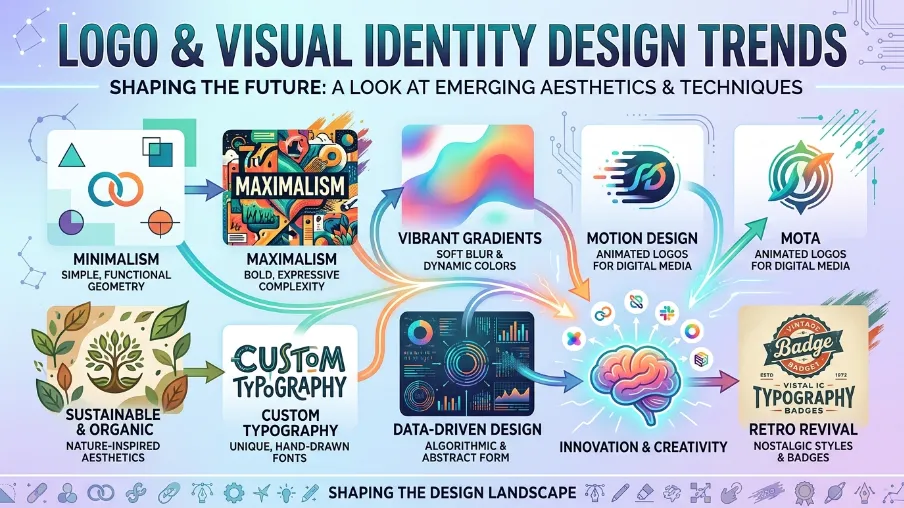
The world of brand design is moving fast. Let me tell you what's happening right now and what it means for your business.
Adaptive and Fluid Logos
<cite index="2-1">Visual identity is moving beyond static design. It is becoming more adaptive, more tactile, and more expressive.</cite>
Logos today need to work in motion. On apps. On social media. On physical packaging. On giant screens.
A single static image is no longer enough. Smart brands are creating flexible identity systems a core logo with variations that adapt across platforms without losing recognition.
Bold Typography Takes Center Stage
<cite index="3-1">Typography takes center stage in 2025. Designers mix sans serif, serif, and slab serif typefaces. Hand-drawn letters add a human touch. Custom glyphs boost brand recognition.</cite>
If your brand is still using a default font from a free website builder, this is your wake-up call.
Authentic and Purpose-Driven Design
<cite index="8-1">In 2025, design isn't just aesthetic it's expressive of brand mission. Consumers increasingly buy from companies whose values align with their own.</cite>
People don't just buy products anymore. They buy beliefs. They buy stories. Your visual identity needs to communicate what you stand for not just what you sell.
Kinetic and Motion Branding
<cite index="9-1">Kinetic logos are becoming the preferred identifier for mainstream brands, using quirky animation and interactivity to bring greater depth to branding on digital interfaces.</cite>
When a logo moves when it breathes and responds it feels alive. And alive brands hold attention.
How to Build Your Brand's Visual Identity: A Simple Starting Framework
I know this can feel overwhelming. So let me give you a practical place to start.
Step 1: Define your brand personality first: Before you pick a single color or font, write down three to five words that describe how you want your brand to feel. Trustworthy? Bold? Playful? Elegant? Those words will guide every design decision.
Step 2: Research your competition: Look at the visual identities of your top three to five competitors. Identify patterns. Then ask: how can I be different while still fitting the category?
Step 3: Choose a color palette with intention: Pick a primary color, one or two secondary colors, and a neutral. Keep it simple. Four to five colors maximum.
Step 4: Select two to three fonts: A headline font. A body font. Maybe an accent font. They should feel like they belong together but offer enough contrast to create visual hierarchy.
Step 5: Design the logo: Whether you hire a professional designer or use a well-built AI tool, your logo should be simple, scalable, and meaningful. Test it at small sizes. Test it in black and white. It needs to work everywhere.
Step 6: Create your brand guidelines: Document everything. Treat this document as sacred. Share it with every designer, developer, and marketer who touches your brand.
Step 7: Apply consistently: Roll it out everywhere at once website, social media, business cards, email signatures, packaging. Consistency from day one is what builds recognition.
Your Visual Identity Is Your Biggest Competitive Advantage
Here's what I want you to walk away knowing: your logo and visual identity are not just design decisions. They are business decisions. They shape how customers feel about you before they ever speak to you. They build trust at a distance. They tell your story without words.
It takes 5 to 7 impressions for people to remember a brand. Every single impression is an opportunity or a missed one. Every inconsistency is a step backward.
This is why the importance of brand identity cannot be overlooked. A strong and consistent visual identity helps businesses create recognition, build credibility, and establish emotional connections with their audience.
The brands that win in today's crowded market are not the ones with the biggest budgets. They are the ones with the clearest, most consistent, and most emotionally resonant visual identity.
You don't have to be Nike. You just have to be unmistakably, consistently you.
So ask yourself this: when someone sees your logo today, what do they feel? Does it build trust? Does it communicate your values? Does it stand out or blend in?
If you're not sure about the answer, that's exactly where to start.
Most Common Questions About Logo & Visual Identity Design
What is the difference between a logo and a brand identity?
A logo is one element the visual mark or symbol that represents your business. Brand identity is the complete visual system: your logo, colors, fonts, imagery style, and design patterns working together consistently across all platforms. Think of your logo as one instrument in an orchestra. Your brand identity is the whole orchestra playing in harmony.
How much should I invest in logo and visual identity design?
It depends on your stage and goals. A freelance designer might charge $500–$5,000 for a complete brand identity package. A mid-tier branding agency might charge $10,000–$50,000. Enterprise brands spend far more. But here's the key insight: <cite index="8-1">a solid brand identity directly impacts customer acquisition, shortens the sales cycle, and builds trust making it a high-ROI investment</cite> at every level. Start with what you can afford, but don't skip it entirely.
How often should I update my logo or visual identity?
<cite index="13-1">Most companies consider rebranding once every 7 to 10 years, with more minor refreshes in between.</cite> You don't need to reinvent yourself constantly. Small refinements a slightly updated color, a cleaner font can modernize your brand without breaking what customers already recognize and trust.
Can I use AI tools to design my logo?
Yes, and the quality of AI design tools has improved dramatically. But here is my honest advice: use AI as a starting point, not an ending point. <cite index="8-1">Generative AI tools can produce high-quality, on-brand visuals quickly</cite>, but the strategic thinking your brand personality, your positioning, your values that still has to come from you. AI can execute. Strategy requires a human.
Why do some logo redesigns fail?
They fail when they abandon the emotional connection customers already have. <cite index="16-1">53% of major brands that changed their logos faced initial backlash from loyal customers.</cite> The most common reason is that the redesign prioritized trends over brand equity. Always ask: what are we keeping? What are we losing? What would our customers miss?

I’m Mitu Das, a JavaScript developer, ERP product architect, and SEO specialist from Bangladesh. I work at CyberCraft Bangladesh, where I help build simple, scalable software, SaaS platforms, and business solutions. My goal is to create technology that helps companies save time, automate daily tasks, and grow faster. I enjoy combining development, product ideas, and SEO strategies to create useful digital solutions for modern businesses.
Writes about
Want this done for you?
Our team builds and ships exactly what this article describes. Send a message and we will reply with a scope.

.webp&w=3840&q=75)