
Importance of Brand Identity in Building Customer Trust and Loyalty

Mitu Das
super admin
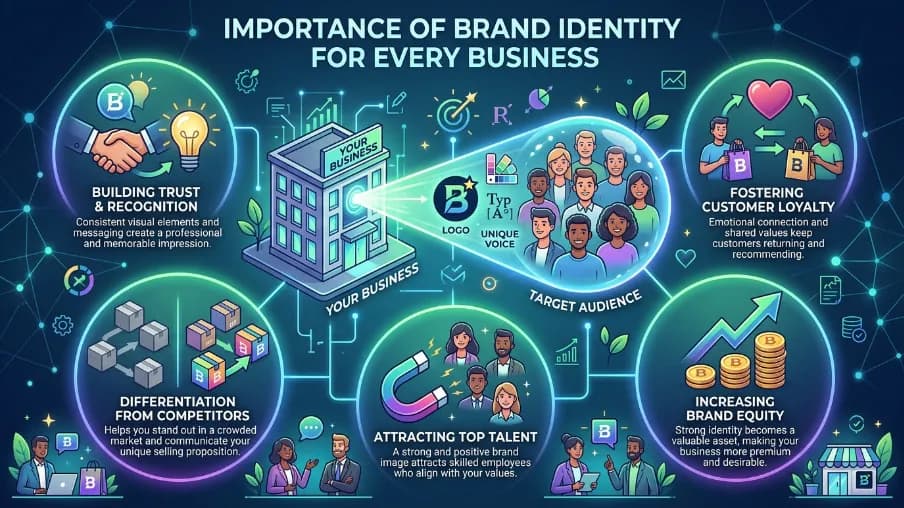
Think about the last time you walked into a café you had never visited before or switched to a different phone brand. The importance of brand identity becomes clear in moments like these you likely already had a feeling about that business before you even stepped through the door. That feeling, quietly shaped by colors, language, reputation, and dozens of other signals, is brand identity doing its job.
Brand identity is a cornerstone of any business, whether you are a solo consultant, a local retailer, or a growing enterprise. When developed with care, it becomes one of the most valuable assets you will ever own. When ignored or handled inconsistently, it works against you, eroding confidence and causing you to lose customers you never even knew you were losing.
In this guide, we will walk through exactly why brand identity goes far beyond aesthetics, how each of its components contributes to real business outcomes, and what you can do right now to start building something stronger.
What Is Brand Identity
Brand identity is the complete set of visual elements, messaging, values, and personality traits a company uses to present itself to the world. It includes everything from the logo and color palette to tone of voice and core brand promise. Understanding the importance of brand identity means recognizing that an effective and consistent presence not only builds trust and credibility but also strengthens a company’s digital growth strategy. A strong brand identity drives customer loyalty, sets you apart from competitors, and plays a key role in supporting long-term financial performance.
What Brand Identity Actually Includes
Brand identity is often reduced to a logo or a color palette. In reality, it is the entire system that shapes how customers interact with your brand across every single touchpoint.
Core Elements That Make Up Brand Identity Design
Effective brand identity design brings together several interconnected components:
- Visual design: Logo, color palette, typography, imagery style, and iconography that make your brand instantly recognizable
- Brand personality: The human traits your brand projects, whether bold, approachable, authoritative, or playful
- Values: The principles that guide your decisions and define what your company genuinely stands for
- Tone of voice: How you communicate in writing and speech, consistently, across every channel
- Brand promise: The commitment customers can rely on every time they engage with you
- Positioning: The specific space you occupy in the market relative to your competitors
When these elements work together, they do not just look good. They create a coherent experience that customers recognize, remember, and trust. Consistency across all touchpoints is what transforms individual design decisions into a commercially powerful brand.
Brand Identity vs. Brand Image
It helps to draw a clear distinction here. Brand identity is what you deliberately project. Brand image is how the market actually perceives you. Brand identity development is crucial precisely because it closes the gap between the two. When your identity is clear and applied consistently, perception aligns with intention rather than drifting in a direction you never planned.
Brand Recognition and Differentiation: Getting Noticed and Staying Noticed
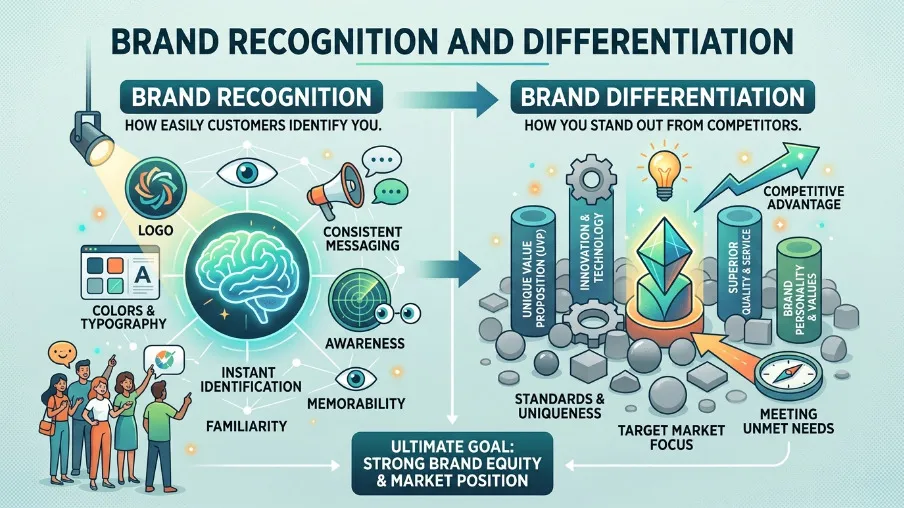
One of the most direct and measurable benefits of investing in brand identity is visibility. Brand identity helps customers recognize a brand instantly, before they read a single word of copy. When someone spots a particular shade of red on a can or a distinctive mark on a sneaker, they already know what they are looking at. That kind of instant brand awareness and recognition is worth an enormous amount of commercial value, and it does not happen by accident.
It takes an average of five to seven impressions before someone remembers a brand. A consistent visual identity dramatically accelerates that process and keeps you top of mind long after the first encounter.
How a Strong Identity Helps You Stand Out from Other Brands
Brand identity gives your business the ability to develop a unique position in the market. In nearly every industry, customers are faced with choices that look nearly identical on price, quality, and features. The brands that win over time are not usually the cheapest or even the best performing. They are the ones that stand for something specific.
A well-crafted identity communicates clearly: "We are not just another option. We are the right option for you." That clarity is what helps you stand out from other brands in a way that no discount or feature upgrade can easily replicate, because it is rooted in meaning rather than mechanics.
Creating a company identity that genuinely differentiates the brand starts with two honest questions: What do we stand for that our competitors do not? And who, specifically, are we here to serve? The answers to those questions are the foundation everything else is built on.
Builds Trust and Credibility: Commercial Case for Consistency
Trust is the currency of commerce. No matter how strong your product is, customers who do not trust your business will not buy, and they certainly will not return. A strong brand identity enhances the credibility of the business in ways that are both rational and emotional, and often more powerful than any single marketing campaign.
Why Consistency Is the Most Underrated Trust Signal
Consistent messaging and strong values shape brand identity in a way that tells customers: this company knows who it is. When every touchpoint, from website to packaging to social media to customer service, tells the same story in the same voice, customers unconsciously conclude that the business is well run and reliable. That confidence is built silently, interaction by interaction.
Inconsistency does the opposite. A polished website paired with amateurish packaging. A warm social media tone paired with cold, bureaucratic emails. Each mismatch plants a small seed of doubt, and those seeds grow. An effective brand identity not only builds trust. It actively protects it by making inconsistency structurally harder to fall into.
The numbers reflect this reality:
- 81% of consumers say they need to trust a brand before making a purchase
- Businesses with consistent brand presentation see 3 to 4 times revenue uplift on average
- Consistent branding across all platforms can increase revenue by up to 23%
Emotional Connection and Loyalty: Beyond the Transactional Relationship
People do not form emotional connections with products. They form them with brands, with the personalities, values, and meanings those brands represent. Influencing recognition, trust, and loyalty through identity is arguably the highest-value outcome of brand work, and the hardest for competitors to reverse-engineer.
Psychology Behind Why Customers Stay
When customers feel that a brand genuinely understands them, that it shares their values or represents something they aspire to, they stop being transactional buyers and become loyal advocates. They recommend you without being asked. They defend you in conversations where you are not present. They identify with you. That kind of loyalty is not manufactured through discounts. It grows from authentic emotional connection.
Brand personality is the engine of that connection. A brand that feels genuinely human, with recognizable opinions, a consistent character, and a voice that sounds like a real person, invites the kind of relationship we build with people we respect. Tone of voice carries that personality into every email, every packaging insert, every post, and every support interaction.
Sets Expectations and Delivers on Them
Brand identity also functions as a standing promise. A premium brand identity tells customers what quality and experience they should expect every time. When that expectation is consistently met, loyalty compounds naturally. When it is broken, even once in a high-stakes moment, rebuilding takes far more effort than maintaining it would have required.
This is why sets expectations is not just a passive byproduct of brand work. It is an active commitment that the entire organization has to be aligned around.
Supports Marketing Efforts: Making Every Dollar Work Harder

Marketing without a clear brand identity is expensive, slow, and forgettable. One of the most practical reasons to invest in brand identity is that it is an easy way to send your marketing efforts in the right direction. It acts as a strategic compass that ensures every campaign, every content piece, and every paid placement reinforces the same core message.
Clarity Drives Efficiency
When your brand identity is well defined, your team does not start from zero on every brief. The tone is established. The visual rules are clear. The audience and their motivations are documented. That clarity produces faster work, more consistent quality, and campaigns that land more precisely, all of which reduce cost per acquisition over time.
A Strong Brand Attracts More Customers Prepared to Spend More
This is worth dwelling on. A strong brand identity attracts more customers prepared to spend more money. When customers perceive a brand as credible, distinctive, and aligned with their values, they stop shopping primarily on price. They are making a choice based on trust and identity, and that shift dramatically changes the economics of your business.
It gives you pricing power. It lowers churn. It generates organic referrals that cost you nothing. Brand identity drives financial performance not as a side effect but as a direct, measurable outcome of consistent investment over time.
Practical marketing advantages of a strong brand identity:
- Faster content production: Documented brand guidelines reduce decision fatigue on every project
- Higher ad recall: consistent visual identity makes your ads more memorable with less frequency
- Stronger word of mouth: Loyal customers actively recommend brands they feel connected to
- Better SEO performance: A recognized brand earns more direct searches and editorial backlinks
- Higher organic social engagement: Brands with genuine personality outperform generic accounts consistently
Internal Alignment and Talent Acquisition: Brand Identity From the Inside Out
Brand identity is not only an external asset. It shapes the internal culture and operational efficiency of a business just as powerfully, and this is a dimension that many founders do not fully appreciate until they are trying to scale.
A Shared Identity Means Faster, Better Decisions
When a company's values, personality, and purpose are clearly articulated, employees have a shared frame of reference. They know what the brand would and would not do. They know how to communicate on its behalf. They know how to make judgment calls in ambiguous situations without escalating everything to a manager. Internal alignment like this reduces friction, accelerates decision-making, and ensures that every customer interaction, regardless of who is handling it, feels consistent with the brand.
Talent Acquisition: The Recruiting Advantage Nobody Talks About Enough
Branding is important not just for winning customers but for winning talent. A compelling, authentic brand identity communicates who you are as an employer as clearly as it communicates who you are as a vendor. People want to build their careers inside organizations whose values they respect and whose mission they find meaningful. A strong brand identity gives candidates a genuine reason to choose you, even when you cannot always win on compensation alone. And the people who join for reasons of values and culture tend to stay longer and perform better.
Brand Identity Drives Financial Performance: Long-Term Business Case
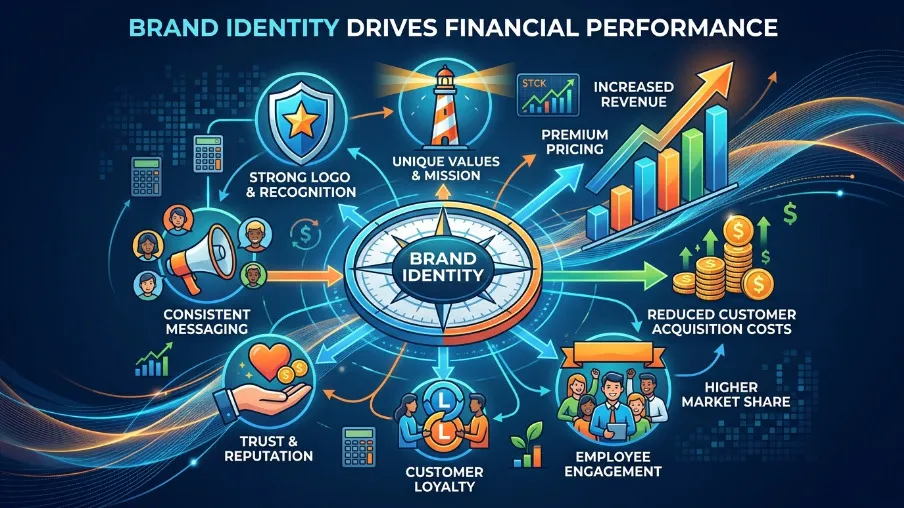
Every benefit discussed so far, recognition, trust, loyalty, marketing efficiency, internal alignment, ultimately flows through to the financial health of your business. Brand identity drives financial performance in ways that are compounding, durable, and increasingly hard for competitors to overcome once established.
Brand Equity Is a Real Asset
Large public companies assign explicit monetary value to their brand equity because it genuinely exists on the balance sheet. A recognized, trusted brand commands premium pricing, faces less competitive threat, earns organic traffic and word-of-mouth referrals, and can expand into new categories at lower launch risk. For smaller businesses, the same dynamics apply at a proportional scale. Brand equity built today is commercial leverage you can draw on for years.
Compounding Return on Brand Investment
Unlike most marketing spend, which produces results only while a campaign is live, investment in brand identity is cumulative. Every consistent customer interaction adds a small deposit to your brand equity account. Over months and years, those deposits compound into a market position that becomes progressively more expensive for competitors to challenge.
This is why brand identity development is crucial to treat as a long-term strategic investment rather than a one-time creative project. The businesses that understand this, and that reinforce their identity with discipline across every channel and touchpoint, are the ones that build genuinely defensible positions in their markets.
Conclusion
Brand identity is not a luxury for large companies with dedicated marketing teams and big budgets. It is a practical business tool, one that shapes how customers interact with your brand at every single touchpoint, from the first glance at your logo to the follow-up message after a purchase.
When built with intention and applied with consistency, a strong brand identity does something remarkable. It creates recognition that travels ahead of you, trust that opens doors before you speak, loyalty that keeps customers returning without constant incentives, and marketing efficiency that compounds over time. It sets expectations clearly and meets them reliably. It attracts the right customers, the right employees, and the right opportunities.
Brand identity is a cornerstone of any business that wants to grow on its own terms. The question has never really been whether you can afford to invest in it. The question is whether you can afford to keep operating without it.
To learn more about brand identity, you can visit CyberCraft Bangladesh.
Frequently Asked Questions About Importance of Brand Identity
Q: What is the importance of brand identity for a small business?
Brand identity is a cornerstone of any business, regardless of size. For small businesses in particular, it levels the playing field. A distinctive, consistent identity helps smaller companies stand out from other brands, attract customers who genuinely value what they offer, and command pricing that reflects their quality without needing to compete on budget or scale.
Q: How does brand identity help customers recognize a brand?
Brand identity helps customers recognize a brand through repeated exposure to consistent visual and verbal signals. When the same colors, typography, imagery style, and tone of voice appear across every touchpoint, customers begin to associate those signals with your brand automatically, without needing additional context. That recognition builds brand awareness and eventually becomes a form of trust in its own right.
Q: What is the difference between brand identity and brand image?
Brand identity is what you intentionally communicate, the visual design, values, personality, and tone of voice you project. Brand image is how the market actually perceives you as a result of all their interactions with your business. A strong brand identity closes the gap between the two, aligning perception with intention rather than leaving it to chance.
Q: How does brand identity influence recognition, trust, and loyalty?
Influencing recognition, trust, and loyalty is the primary commercial function of brand identity. Recognition grows from consistent visual and verbal cues applied repeatedly over time. Trust develops when that consistency signals reliability and professionalism at every touchpoint. Loyalty forms when customers feel an authentic emotional connection to the brand's personality and values, transforming a purchasing relationship into something closer to genuine affiliation.
Q: What should I prioritize when starting brand identity development?
Start with strategy before design. Clarify your values, your positioning, and the specific audience you are serving before you commission a logo or choose a color palette. Once those foundations are in place, invest in a cohesive visual identity and a documented tone of voice guide. These two assets will make every subsequent marketing decision faster, more consistent, and more effective, which is exactly how brand identity becomes the easy way to send your marketing efforts in the right direction.



FAQ
Frequently Asked Questions
We offer end-to-end digital solutions including website design & development, UI/UX design, SEO, custom ERP systems, graphics & brand identity, and digital marketing.
Timelines vary by project scope. A standard website typically takes 3-6 weeks, while complex ERP or web application projects may take 2-5 months.
Yes - we offer ongoing support and maintenance packages for all projects. Our team is available to handle updates, bug fixes, performance monitoring, and feature additions.
Absolutely. Visit our Works section to browse our portfolio of completed projects across various industries and service categories.
Simply reach out via our contact form or call us directly. We will schedule a free consultation to understand your needs and provide a tailored proposal.