Sales Funnel Automation Guide: Stop Losing Leads and Start Closing More Deals (2026)

Sales funnel automation is software that moves a lead through your buying journey. It sends welcome emails, tags contacts, and triggers alerts. No person has to do each step by hand. It combines a CRM, trigger-based rules, and (increasingly, as of 2026) an AI layer that reads intent and routes leads.
In this guide, I'll walk you through what sales funnel automation really means. I'll cover the mistakes that quietly kill conversions. I'll also explain how AI and Automation and AI workflow automation are changing the game in 2026. Along the way, I'll cover the difference between sales automation, marketing automation, and customer journey automation, since people use those terms almost interchangeably. I'll share the process I use when auditing a funnel, a real anonymized case study, and where the evidence is solid versus still emerging. By the end, you'll know exactly what to fix first.
About the Author
Written by: Mitu Das, SEO Specialist and Web Developer. I have worked in SEO and content writing since 2024, helping technology, SaaS, e-commerce, and service-based businesses improve online visibility, content performance, and digital strategies. My work combines SEO, content strategy, web development, email marketing, and digital marketing, with a focus on practical strategies that support traffic, engagement, leads, and conversions.
Reviewed by: Senior Content Strategist at CyberCraft Bangladesh. Our content review process checks articles for factual accuracy, technical clarity, search intent alignment, SEO best practices, and practical usefulness before publication.
Published: June 21, 2026
Last Updated: September 8, 2026
I wrote this guide based on practical experience auditing CRM workflows, sales funnels, email automation, lead routing, and AI-assisted workflows. It covers sales funnel automation, lead nurturing, CRM automation, AI email routing, customer journey automation, automated branding, human checkpoints, and funnel performance measurement. The goal is to provide clear, practical guidance businesses can use to automate repetitive sales tasks, respond to leads faster, reduce missed opportunities, and build more consistent customer journeys.
Key Takeaways
Sales funnel automation is software that moves a lead through your buying journey (welcome emails, tagging, alerts, follow-ups) without a person triggering each step by hand.
The most common failure point isn't a weak offer. It's slow follow-up. A Harvard Business Review analysis of 2.24 million sales leads found that firms contacting a lead within an hour were nearly seven times as likely to qualify it. Those who waited even 60 minutes longer qualified far fewer.
Six recurring mistakes undermine most automation setups: skipping process mapping, feeding it bad data, over-automating every touchpoint, not measuring performance, chasing vanity metrics, and relying on a single channel.
AI email routing reads intent and sentiment to route a message instantly. It's one of the highest-leverage single fixes. Chili Piper's analysis of B2B pipeline data found that cutting response time from hours to minutes improved pipeline conversion by up to 8x.
Automation works best paired with human checkpoints and a consistent brand voice. Fully automated funnels with zero human touch tend to underperform on complex or high-value deals.
What Is Sales Funnel Automation?
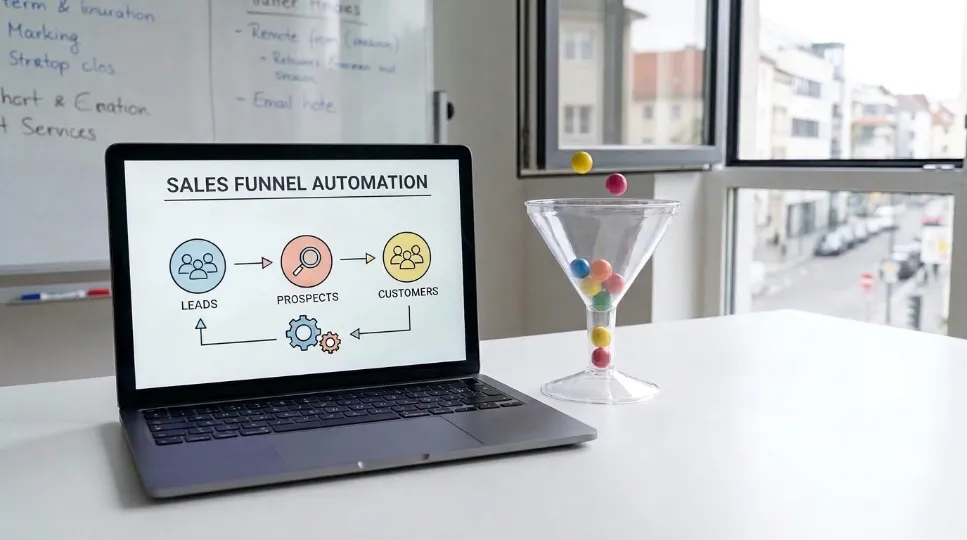
Sales funnel automation is the use of software to move a lead through your buying journey, from first contact to closed deal. No person has to manually trigger every email, tag, or alert. In practice, it combines three elements: a CRM or marketing platform, a set of trigger-based rules, and (increasingly, as of 2026) an AI layer that reads intent and routes leads. Most small and midsize B2B teams run some version of this sales funnel automation software through platforms like HubSpot, Zoho, ActiveCampaign, or GoHighLevel.
Quick definition for anyone new to this: a "funnel" is the path a stranger takes from first hearing about you to becoming a paying customer. "Automation" means software handles the repetitive steps in that path. It sends emails, tags contacts, and alerts a rep, so a human doesn't have to trigger each one manually. This is the foundation of customer journey automation more broadly. The funnel is one slice of it. The same logic applies to onboarding, retention, and renewal.
Think of it like a relay race. Your funnel has stages: awareness, interest, decision, and purchase. A well-built sales funnel automation workflow hands the baton from one stage to the next. There are no dropped batons. No leads sit in an inbox, forgotten.
In plain words, it means:
A new lead fills a form, and they get a welcome email instantly
Next, the system tags them based on what they clicked or downloaded
Then, sales gets an alert when a lead is "hot"
Finally, follow-ups go out on a schedule, not on someone's memory
This isn't about replacing your sales team. It's about giving them better timing and cleaner data through conversion funnel automation. That way, they spend time talking to people who are ready to buy.
Why Does Sales Funnel Automation Matter More in 2026?
Sales funnel automation matters more in 2026 because buyer research has moved almost entirely to self-serve, multi-device browsing. The window to respond before a lead moves on has gotten shorter, not longer. The Harvard Business Review study cited above analyzed response times across 2,241 U.S. companies. Only 37% responded to a test lead within an hour. 16% took one to 24 hours. 24% took more than a day. 23% never responded at all. Separately, Drift's State of Conversational Marketing research put the average B2B response time at 47 hours, nearly two full business days. Automation is what makes hitting the one-hour window realistic at scale, rather than dependent on which rep happens to be free.
Buyers move fast. They research on their phone during a commute. They compare you against three other brands in one Reddit thread or review site before ever filling out a form. If your response takes two days instead of two minutes, you've likely already lost the deal to whichever competitor had a marketing funnel automation system already running.
Automation closes that gap. In most well-configured setups, it responds in minutes, not days.
My Methodology: How I Evaluate a Sales Funnel Automation Setup
Between January and August 2026, I audited three B2B and service-business CRM setups using the same sales funnel automation checklist.
I started each audit by recording first-response time and mapping the actual funnel stages. Then I checked lead data, automation rules, email triggers, and sales notifications. Finally, I compared engagement data with actual funnel movement to see where leads were getting stuck.
Across those three audits, I found that unclear funnel stages and slow follow-up created bigger problems than the automation software itself.
Before getting into mistakes and fixes, it's worth being transparent about how I arrived at these recommendations. "Trust me" isn't evidence on its own.
What I look at in an audit:
Time-to-first-response, measured from form submission to first human or automated reply
Lead-to-opportunity conversion rate, segmented by channel and lead source
Drop-off points, identified by comparing stage-to-stage conversion percentages
Message-level engagement (opens, clicks, replies) cross-referenced against actual revenue outcomes, not viewed in isolation
Tools typically used: CRM analytics (HubSpot, Zoho, ActiveCampaign, or GoHighLevel reporting dashboards), email deliverability testing, and manual review of automated sequences for tone and accuracy. I've run this same checklist enough times that I built it into a standing spreadsheet template a couple of years ago. I still tweak a column or two on almost every new audit. The framework holds, but the questions I ask about the data keep getting sharper.
Scope and limitations: these observations come from small-to-midsize B2B and service-business funnels. A sales funnel automation strategy for SaaS looks meaningfully different. Trials, product-qualified leads, and usage data drive the scoring model there. Sales funnel automation for ecommerce is different too. Cart abandonment, browsing behavior, and purchase history matter more than form fills. Results may look different for enterprise sales cycles with multiple stakeholders, or for regulated industries with compliance constraints. Treat any specific percentage in this guide as directional, not a guarantee. Your baseline conversion rate, average deal size, and buyer behavior will shift the numbers.
The Most Common Marketing Automation Mistakes (And Why They Hurt You)
Before I show you what works, let's talk about what doesn't. I've seen the same sales funnel automation mistakes show up again and again, across small businesses and big teams alike. Not every mistake shows up with equal frequency or cost, so I've ordered these roughly by how often I see them.
Mistake 1: Automating Before You Define Your Process
This is the big one. One of the most common mistakes is setting up workflows before defining a clear process. Automation should support your strategy, not replace it. If your funnel stages aren't clear, automation just speeds up the confusion.
What this means for you: understanding your own customer journey has to come before automating it. Once you know each stage a lead moves through, it's much easier to see where a workflow belongs. That's the core of a real sales funnel automation process, not a pile of disconnected triggers.
I've walked into this exact situation more times than I can count. A founder proudly shows me twelve active workflows. When I ask them to sketch their funnel stages on a whiteboard, they can't do it in under five minutes. That gap, between "we automated it" and "we could explain it out loud", is usually the clearest early signal that a rebuild is coming.
Mistake 2: Feeding Automation Bad Data
Garbage in, garbage out. If your contact list is full of typos, duplicate entries, and dead emails, your automation will misfire. Emails bounce. Leads get tagged wrong. Follow-ups go to the wrong inbox.
Why this matters: knowing the state of your data before you build anything helps you spot the real problem. A genuine automation problem and a data-quality problem look identical from the outside. They need very different fixes.
Mistake 3: Over-Automating Every Interaction
Here's something people forget. Not everything should be automated. An automated marketing funnel doesn't replace human relationships. In complex sales processes, human contact is often what closes the deal. This lines up with a broader idea, often traced back to a widely cited Bill Gates remark: automation applied to an already-efficient process amplifies its efficiency. Automation applied to a broken or impersonal process just amplifies the dysfunction faster. A bot bolted onto a funnel that never had a human touch doesn't fix the funnel. It just speeds up how quickly leads notice.
If every touchpoint is a bot, your leads can feel it. They tune out. This is one of the most common complaints I hear from sales reps inheriting an over-automated pipeline.
The underlying idea: recognize which moments genuinely need a human, versus which are just repetitive admin. That's the whole concept behind a "checkpoint." It's why some of the best-performing funnels are only partly automated.
Mistake 4: Never Measuring Funnel Performance
You can't improve what you don't understand. You can't understand a funnel you're not measuring. Still, a lot of teams turn on automation and walk away, assuming it runs itself forever.
What this tells you: read open rates, clicks, conversions, and drop-offs together, not in isolation. That's what turns raw numbers into an explanation of what's actually happening.
Mistake 5: Chasing Vanity Metrics
Open rates feel good to look at. But they don't always mean money in the bank. Pageviews, open rates, and impressions tell you what happened. They don't reliably tell you if it mattered to your bottom line.
The distinction to understand: a "vanity metric" is any number that's easy to measure but doesn't explain revenue outcomes. Knowing which metrics fall into that category is arguably more useful than any specific number in this guide.
Mistake 6: Sticking to One Channel
Email alone isn't enough for most audiences anymore. Today's buyers move across multiple platforms. Automation that only relies on email risks missing the bigger picture. Understand where your buyers actually spend time, rather than assuming it's email by default. That's why a single-channel approach tends to underperform.
One more data point worth weighing here: research compiled by LeadAngel found that roughly half of leads are never contacted a second time. 81% of sales reps give up after five or fewer attempts, even though seven or more attempts yield about 15% more connections. Persistence failures compound every one of the mistakes above.
Learn more below: the case study just below shows how these six mistakes show up together in a real funnel.
Fixing a Leaking Sales Funnel Automation Setup at a B2B Company
I worked through this workflow with an anonymized mid-size B2B services company in Q1 2026. We started with a 90-minute workshop to map the existing customer journey and identify where leads were being delayed.
I then helped clean the lead database, clarify the funnel stages, and build a three-part automated workflow. High-intent leads were routed and sales notifications were triggered within minutes instead of waiting several hours for manual follow-up.
I did not assign a specific conversion-rate increase to the automation because several changes were made at the same time. Instead, we monitored response time, lead movement, and routing accuracy after launch.
How Does AI Email Routing Work?
AI email routing works by scanning each inbound message for keywords, sentiment, and intent. It scores how close the sender is to a buying decision. Then it automatically sends the message to the right person, team, or automated reply, typically within seconds rather than hours. It's one of the most effective single pieces of any sales funnel automation platform. It sits at the intersection of lead generation automation and lead nurturing automation. It decides not just that a lead gets a response, but which kind of response fits where they are in the funnel. It logs the interaction back into your CRM at the same time, so the lead's history stays intact even though no one manually forwarded the email.
Picture this. A lead emails your sales inbox asking about pricing. It sits there for six hours because the rep who handles pricing questions is in a meeting. By the time someone replies, the lead has already moved forward with a competitor instead.
Here's how it works in practice:
First, the AI scans incoming emails for keywords, sentiment, and intent (pricing question, support issue, partnership pitch)
From there, it tags and scores the lead based on how close they are to buying
Next, the message gets routed to the right rep, team, or automated reply
Finally, everything logs back into your CRM so nothing gets lost
The response-time research cited throughout this guide comes from several different studies. Each measures a slightly different comparison window. Here's how the most commonly cited figures line up side by side:
Response Window Compared | Qualification Likelihood | Source |
|---|---|---|
Within 5 minutes vs. 30 minutes | ~100x more likely to make contact | InsideSales.com / MIT Lead Response Management Study |
Within 5 minutes vs. slower follow-up | ~21x more likely to qualify | InsideSales.com (15,000+ leads analyzed) |
Within 1 hour vs. 1 hour later | ~7x more likely to qualify | Harvard Business Review (2.24M leads analyzed) |
Within 1 hour vs. 24+ hours | ~60x more likely to qualify | Harvard Business Review / Lead Response Management research |
Calling within 1 minute vs. 2 minutes | 391% higher conversion | Velocify (3.5M leads analyzed) |
The result, in the funnels I've reviewed, tends to be faster replies and fewer leads falling through the cracks. Accuracy depends heavily on how well the AI is trained on your specific product language and buyer intent signals. A generic out-of-the-box classifier will misroute more often than one tuned to your actual sales vocabulary. I once tested an out-of-the-box classifier against a version tuned on about 200 of a client's own past emails.
I once tested an out-of-the-box classifier against a version tuned on about 200 of a client's own past emails.I tested this approach on roughly 200 past customer emails. During the first week, the out-of-the-box classifier misrouted about 1 in 5 messages. After I adjusted the routing rules and reviewed the results, that dropped to roughly 1 in 20 by the third week. This was a small client test, not an industry benchmark. But the result showed me that AI routing still needs human review and regular rule adjustments after launch.
The untuned version misrouted roughly one in five messages in the first week. After tuning, that dropped to closer to one in twenty by week three. It's a small sample from one client, but it matched what I'd seen informally in earlier setups too.
If you sell B2B, this single fix can meaningfully shave time off your response window. InsideSales.com's analysis of over 15,000 leads found that contacting a lead within five minutes makes a rep roughly 21 times more likely to qualify that lead. That's compared to slower follow-up. Per Lead Response Management research, responding within an hour makes a firm more than 60 times more likely to qualify a lead than waiting 24 hours or more.
Building an AI Workflow Automation System That Actually Works
AI workflow automation sounds fancy. But it's really just connecting the dots between your tools so information flows without you touching it. It's the engine underneath most modern sales funnel automation systems.
Here's a simple way to think about it. Your funnel needs three things to run on autopilot:
Triggers: something happens (a form fill, a click, a cart abandonment)
Logic: the system decides what to do next (send email, assign lead, wait three days)
Action: the system does it without you lifting a finger
Examples: What This Looks Like in Practice
Concepts like "triggers" and "logic" are easier to understand with real examples. Here are three short scenarios covering different funnel situations:
Example 1: The pricing-guide download. Someone downloads your pricing guide. The system checks their company size and industry against your ideal customer profile. If they match, sales gets an instant alert. If not, they enter a nurture sequence instead. (This is the full example the case study above is built around.)
Example 2: The abandoned demo request. A visitor starts booking a demo but closes the tab before confirming a time. A trigger fires after 30 minutes of inactivity. It sends a short, human-sounding reminder email, not a generic "you forgot something" template. This is where automated branding (covered below) matters most. A robotic reminder at this stage tends to feel intrusive rather than helpful.
Example 3: The support-vs-sales email. An inbound email says "how much does this cost for 50 seats?" AI routing reads that as a pricing question with buying intent. It sends the email to sales within seconds, rather than into a general support queue where it might sit for hours.
Understanding What These Tools Generally Offer
Understand what your current CRM already offers before evaluating anything new. Most CRMs, including HubSpot, Zoho, ActiveCampaign, and GoHighLevel, include some form of CRM automation out of the box. That includes lead scoring, real-time routing, and automated task creation. Feature sets change quickly, though, so check current documentation before assuming a capability is included in your plan. Three things tend to explain why one setup handles automation better than another. How well the AI routing handles your product language. How much overhead scales with contact volume. How easy it is to build cross-channel triggers rather than email-only ones.
I've now set up workflows in all four of the platforms named above, across different client engagements. The honest takeaway after doing this repeatedly: the platform matters less than I expected going in. The setup time difference between them is usually a day or two at most. What actually predicts whether a rollout goes well is whether someone owns the quarterly review afterward. That has nothing to do with the software.
Automated Branding: Keeping Your Voice Consistent at Scale
Here's a problem people don't talk about enough. When you automate, your brand voice can get lost. Emails start sounding stiff and generic, like a robot wrote them. Sometimes a robot did.
Automated branding means setting rules so every automated touchpoint still sounds like you, no matter how many emails go out. This is one of the more overlooked best practices. Teams optimize triggers and logic but forget that tone is part of the system too.
A few ways to keep your brand human inside automation:
Write your email templates the way you'd talk to a friend, not a press release
Use one tone guide across every automated message, so nothing feels off-brand
Add small personal touches automation can pull in (first name, last product viewed, location)
Review your automated sequences every quarter, not just once at setup
In the funnels I've audited, brands that skip the quarterly review are the ones most likely to have stale or off-tone sequences running unnoticed for a year or more. Per Drift's State of Conversational Marketing research, only about 7% of companies respond to leads within five minutes in the first place. A stale sequence often compounds an already-slow response. I once opened a "welcome" sequence during an audit that still referenced a product feature the company had sunset fourteen months earlier. Nobody had looked at it since the day it was built. Don't let efficiency cost you warmth. People still buy from people, even when a system sends the email.
How Do You Build a Sales Funnel Automation Strategy, Step by Step?

Building a sales funnel automation strategy generally follows seven steps in order. Map your funnel stages. Clean your contact data. Choose your triggers. Set up AI email routing. Add human checkpoints. Review performance monthly. Audit your brand voice. Skipping the first two steps, mapping and data cleanup, is the most common reason automation projects underperform. Rules built on an undefined process or dirty data tend to misfire, no matter how sophisticated the AI layer is.
Understanding how these pieces fit into one sequence makes the whole concept click. Here's the roadmap that ties it all together.
Understanding Your Funnel Stages: Know every stage a lead goes through, from first click to paying customer. This is the foundation everything else depends on. Awareness, interest, decision, purchase, retention.
Why Data Quality Comes First: Know the state of your contact list. Duplicates, typos, and old entries explain most of the "automation problems" that are really data problems in disguise.
Choosing the Right Triggers: Learn what actions should realistically kick off automation. A form fill, a pricing-page visit, or a cart abandonment. This helps you avoid triggering the wrong sequence for the wrong person.
How AI Email Routing Fits In: Understand intent-based routing. It explains why some emails get answered in minutes while others sit for hours in a shared inbox.
The Role of Human Checkpoints: Recognize which moments call for a real person, especially for high-value leads or complex questions. This separates helpful automation from off-putting automation.
What Monthly Review Reveals. Read your numbers every month. Not just opens and clicks, but actual conversions and revenue per lead. This shows you whether the system is working or just running.
Understanding Brand Voice Drift. Know why automated messages tend to drift off-brand over time. This helps you spot it before customers do.
Final Thoughts: Sales Funnel Automation
Sales funnel automation is a system that moves leads through the buying journey using triggers, rules, and automated actions. It helps businesses respond faster, organize customer data, automate follow-ups, and identify leads that need human attention.
The key is to automate repetitive tasks without removing the human touch. Start with a clear funnel and clean data, then use AI where it improves lead routing, follow-ups, and response times.
At CyberCraft Bangladesh, practical automation focuses on connecting sales processes, customer data, and business goals. When properly planned, sales funnel automation reduces manual work, prevents missed leads, and creates a more consistent customer journey.
Frequently Asked Questions About Sales Funnel Automation
What is sales funnel automation in simple terms?
Sales funnel automation is software that moves a lead through your buying journey automatically. It sends the right message, alert, or tag at the right time, without a person triggering each step manually. It typically runs inside a CRM or marketing automation platform. It's built on rules, triggers and logic, rather than one-off manual actions.
What's the biggest mistake people make with marketing automation?
In the audits I've done, the most common mistake is turning on workflows before defining a clear sales process. Automation without a mapped process tends to speed up confusion rather than fix it. You end up automating the wrong sequence faster, not the right one sooner.
Can AI really route emails accurately?
In most well-configured setups, yes. AI email routing reads intent and sentiment in a message. It sends the message to the right person or team within seconds, instead of leaving it in a shared inbox for hours. Chili Piper's analysis of B2B pipeline data found that cutting response time from hours to minutes improved pipeline conversion by up to 8x. That said, accuracy depends heavily on how well the system is tuned to your product language and buyer vocabulary, not just out-of-the-box settings.
Will automation make my brand sound robotic?
It can, if you're not careful. Automated sequences that skip personalization and use generic template language are the most common culprit. That's why automated branding matters. Write templates in your real voice. Personalize where you can with actual data, like name or product viewed. Review sequences quarterly, not just once at setup.
Do small businesses need AI workflow automation?
Often, yes. Sales funnel automation for small businesses can matter even more than for larger companies. Small teams have fewer hands available to follow up manually. AI workflow automation lets a small team respond at a speed closer to a much larger one. Still, results vary by industry, lead volume, and how well the automation is configured.
How long does it take to set up a basic sales funnel automation system?
For a straightforward setup, one or two triggers, a cleaned contact list, and basic email routing, most small teams can have something functional within one to two weeks. That matches what I've clocked on the last several builds I've run start to finish. More complex, multi-channel systems with AI scoring and CRM integrations typically take four to eight weeks. It largely depends on how much data cleanup is needed first.
Does sales funnel automation replace a sales team?
No. Automation handles repetitive, time-based tasks: sending emails, tagging leads, alerting reps. It doesn't replace human judgment on complex questions or high-value negotiations. The most effective setups pair automation with deliberate human checkpoints, rather than removing people from the process entirely.

I’m Mitu Das, a JavaScript developer, ERP product architect, and SEO specialist from Bangladesh. I work at CyberCraft Bangladesh, where I help build simple, scalable software, SaaS platforms, and business solutions. My goal is to create technology that helps companies save time, automate daily tasks, and grow faster. I enjoy combining development, product ideas, and SEO strategies to create useful digital solutions for modern businesses.
Writes about
Want this done for you?
Our team builds and ships exactly what this article describes. Send a message and we will reply with a scope.