
Lead Generation Marketing: The 5 Mistakes Killing Your Conversion Rate


Lead generation marketing is the process of attracting potential customers, capturing their contact information, and converting them into paying customers. It's not just collecting form-fills. Most lead generation marketing mistakes happen because businesses optimize for lead volume instead of lead-to-customer conversion.
This article explains the five most common lead generation marketing mistakes, how each one shows up in a real funnel, and what to fix first. You'll also find the formulas to measure your own results, so you can tell whether a change actually worked.
About the Author
Written by: Mitu Das, SEO Specialist and Web Developer. I have worked in SEO and content writing since 2024, helping technology, SaaS, e-commerce, and service-based businesses improve online visibility, content performance, and digital strategies. My work combines SEO, content strategy, web development, email marketing, and digital marketing, with a focus on practical strategies that support traffic, engagement, leads, and conversions.
Reviewed by: Senior Content Strategist at CyberCraft Bangladesh. Our content review process checks articles for factual accuracy, technical clarity, search intent alignment, SEO best practices, and practical usefulness before publication.
Published: June 20, 2026
Last Updated: September 10, 2026
I wrote this guide based on practical experience auditing lead generation funnels, lead qualification, follow-up systems, nurture sequences, channel performance, and CRM tracking. It covers lead generation marketing, lead quality, lead-to-customer conversion, digital marketing strategy, lead nurturing, follow-up speed, channel selection, creative digital marketing, and full-funnel performance measurement. The goal is to provide clear, practical guidance businesses can use to improve lead quality, respond to prospects faster, nurture potential customers, reduce wasted marketing spend, and connect lead generation activity with actual revenue.
Key Takeaways
The average B2B lead-to-customer conversion rate is 2.9%. Most leads never close.
Responding to a new lead within 60 seconds can improve conversion by up to 391%.
Qualified leads convert at roughly 40%, compared to 11% for unqualified leads.
Five common mistakes account for most lost pipeline value: volume-chasing, slow follow-up, no nurture, channel overspread, and incomplete tracking.
Fixing follow-up speed and lead qualification usually improves ROI faster than increasing ad spend.
Let me guess. Your ads are running. Your forms are filling up. Your CRM shows leads coming in every week. But your revenue isn't moving the way it should.
This pattern shows up constantly. A business owner checks their dashboard and sees 50 new leads this month. They feel good. Then sales calls come back with "not interested," "bad timing," or worse, silence. The leads were real. The growth wasn't.
Most articles on lead generation marketing tell you to run more ads, write more content, or try a new platform. In other words, they treat lead generation like a numbers game. Get more leads, win more deals. It's not that simple.
This article walks through why. You'll see what's actually broken in most lead generation strategies. You'll see the digital marketing mistakes quietly draining ROI. And you'll see a creative approach that turns cold form-fills into real customers. That's true whether your leads come from online lead generation, digital lead generation, or a mix of both.
We've run this exact audit across dozens of B2B and local-service accounts over the past several years, everything from HVAC install businesses to SaaS trial signups, and the pattern rarely changes. Lead volume climbs. Revenue doesn't follow. The five mistakes below aren't theoretical. They're the same five things we find, in roughly the same order, almost every time we pull a client's funnel data apart.
What Is Lead Generation Marketing?
Lead generation marketing is the process of attracting people who might buy from you and capturing their contact details so you can follow up. But the fuller definition matters more. It means collecting the right contact details, at the right moment, with enough context that sales can actually close the person. A lead is not a customer. It's someone who raised their hand. What happens after that determines whether they become revenue, or just another row in a spreadsheet nobody follows up on.
This distinction matters more than most marketers admit. According to industry benchmark data on B2B conversion rates, the average B2B lead conversion rate sits around 2.9%. In other words, out of every 100 leads collected, roughly 3 ever become paying customers. The other 97 sit somewhere in the funnel, half-forgotten. That gap between "lead" and "customer" is where most of the lost growth lives. It's also the reason lead generation marketing exists as a discipline separate from plain old customer acquisition or demand generation.
Types of Lead Generation: B2B, B2C, and Channel-Specific Approaches

The specific lead generation techniques that work best depend heavily on who you're selling to. They also depend on where that audience spends their time.
B2B lead generation typically involves longer sales cycles and multiple decision-makers. Content usually centers on ROI and business outcomes. B2C lead generation usually moves faster. It leans on emotional triggers, price, and convenience to move someone from interest to purchase in a single session. Both rely on the same underlying lead generation process: attract attention, capture contact details, qualify interest, and nurture toward a sale. What changes is the mix of lead generation tactics used to get there.
Most lead generation campaigns today run through a handful of channels:
Landing page lead generation: a dedicated page built around one offer and one lead capture form, optimized to convert visitors into leads.
Email lead generation: nurture sequences and lead magnets that build a list over time.
Social media lead generation: native forms, DMs, and platform-specific ads that capture leads without the person leaving the app.
SEO lead generation: organic content built to rank for buyer-intent search terms, pulling in leads without ongoing ad spend.
Paid lead generation: ads on search, social, or display networks that generate leads quickly, at a cost.
AI lead generation and automated lead generation: tools that use AI-powered personalization, chatbots, and automated lead scoring to speed up qualification and follow-up. Peer-reviewed research on machine-learning-based lead scoring has found that predictive models built on CRM data can meaningfully outperform the manual, rule-based scoring most sales teams still rely on.
Whether you handle this in-house or outsource to lead generation services, the fundamentals stay the same. Every lead generation marketing program moves through the same lead generation funnel: awareness, capture, qualification, nurture, close. Most businesses eventually run some blend of both approaches. Inbound lead generation pulls people in through content and search. Outbound lead generation reaches out directly through email or LinkedIn.
Why Lead Generation Without Strategy Fails
Lead generation marketing without a real strategy fails for a simple reason. It treats lead volume as the goal instead of lead-to-customer conversion. Businesses turn ad spend up and leads increase. But without a system to qualify, nurture, and track those leads through to a sale, the extra volume produces activity without revenue.
Many small businesses, and even some larger brands, treat lead generation marketing like a faucet. Turn the ad spend up, leads flow in. Turn it off, leads stop. There's no system behind it. But a faucet isn't a strategy. It's a switch.
A real lead generation marketing strategy is a plan. Attract the right people. Capture their details with consent. Qualify them. Move them into sales or lead nurturing, with tracking at every step. Notice the order. Attract, qualify, nurture, track. Most businesses only do step one, no matter how many lead generation strategies they claim to be running.
This is also why conversion rates vary so widely by industry. Legal services convert at 7.4% visitor-to-lead. B2B SaaS sits at just 1.1%. Cybersecurity is close behind at around 1.0%. That's almost a sevenfold gap.
Industry | Avg. Visitor-to-Lead Conversion Rate |
|---|---|
Legal services | 7.4% |
B2B SaaS | 1.1% |
Cybersecurity | 1.0% |
Overall B2B average | 2.9% |
That's not because lawyers are better marketers. Someone searching for a lawyer usually has an urgent problem right now. Someone reading a SaaS blog post might just be browsing. If you don't know where your audience sits on that urgency scale, you'll keep building campaigns for buyers who aren't ready yet. Then you'll wonder why nothing converts.
The Real Cost of "More Leads, Same Results"
More leads is not the same thing as more growth. You can pour money into ads and watch your lead count climb every month. But if those leads don't qualify, don't show up, or don't close, you haven't grown anything. You've just gotten better at spending money.
This is the trap that quietly drains digital marketing ROI for so many businesses. The dashboard looks busy. The bank account doesn't move.
What Digital Marketing Mistakes Are Killing Your Lead Quality?
Five specific breakdowns account for most of the gap between lead volume and lead value. Chasing cheap leads instead of qualified ones is one. Responding too slowly is another. Letting "not yet" leads go cold, spreading budget across too many channels, and tracking only form-fills instead of the full path to a sale round out the list. Fixing any one of these typically improves conversion without needing a bigger ad budget.
Chasing volume over fit
Slow follow-up
No nurture system for "not yet" leads
Spreading thin across every channel
Not tracking the full funnel
Read on for how each one shows up in practice, and how to fix it.
1. Chasing Volume Over Fit
Many teams optimize campaigns to lower cost-per-lead, full stop. But a cheap lead that never buys is more expensive than an expensive lead that closes. Cost-per-lead means nothing without cost-per-customer sitting right next to it.
Cost per lead is calculated as total campaign spend divided by the number of leads generated in that period. For example, $2,000 spent to generate 100 leads equals a $20 cost per lead. Cost per customer uses the same formula, but divides by paying customers instead. That's why a channel with a low cost per lead can still have a high, unprofitable cost per customer, if its close rate is weak.
Why this happens: most teams have no visibility into which "cheap" leads are actually costing them money downstream. Adding two or three qualifying questions to a form is a well-documented fix, ask about budget, timeline, or company size. This filters for fit before a lead ever reaches sales. It typically lowers total lead count. It also raises close rate, since it screens out people unlikely to buy before they consume sales time.
We tested this directly on a client's install-request form last year. Adding three questions, budget range, timeline, and property type, cut form submissions by about 30% in the first month. The sales team panicked. Then the numbers came in at 90 days: close rate on the remaining leads had nearly doubled, and total revenue from that channel was up, not down, despite fewer form-fills. That gap between "feels worse" and "performs better" is exactly what trips people up when they only watch lead count.
2. Slow Follow-Up
This one stings because it's so fixable. Speed matters more than almost anything else in lead generation marketing. Responding to a lead within 60 seconds can improve conversions by up to 391%, compared to a response delayed by 30 minutes or more. That's according to commonly cited lead-response research. Not 10%. Not 50%. Nearly four times better, from speed alone.
We watched this play out with a home services client generating around 40 leads a month. Their average response time when we started working with them was just over 2 hours, mostly because leads sat in a shared inbox until whoever was free got to them. We set up instant SMS acknowledgment plus a routing rule that pinged the on-call rep within 5 minutes. Same lead volume, same offer, same season. Booked appointments were up noticeably within the first 6 weeks, and by the third month the owner told us it was the single change that moved the needle more than anything else we'd tried that year.
Yet many businesses let leads sit in an inbox for hours, sometimes days. By the time someone calls back, the prospect has already talked to a competitor. Or they've lost interest entirely. If you're not using instant auto-responses, lead routing, or at minimum a same-day call policy, this is costing you real money right now.
3. No Nurture System for "Not Yet" Leads
Not every lead is ready to buy today. Some need three more touches. Some need six months. Depending on deal size, B2B sales cycles commonly run anywhere from a few weeks to 6-12 months. That's why a single follow-up call is rarely enough to capture a real opportunity. When your only plan for a lead is "call once, mark as dead if no answer," you're throwing away future revenue.
A simple nurture sequence keeps you top of mind until that lead is finally ready. A few helpful emails, spaced over weeks, is often enough. This single fix turns dead leads into delayed sales.
We built a five-email nurture sequence for a B2B client whose sales team had been marking any non-responsive lead "dead" after one call attempt. Six months after we turned it on, we pulled the report: roughly 1 in 6 of those "dead" leads had re-engaged and booked a call through the sequence, mostly around emails three and four. None of that pipeline existed before, it had simply been getting thrown away.
4. Spreading Thin Across Every Channel
SEO, paid ads, social, email, it all feels necessary. But trying to do all of it at once, without depth in any of it, usually means doing all of it badly.
Instead, pick two or three channels where your specific audience actually spends time. Go deep there. A focused, well-run strategy on two channels will outperform a scattered effort across six, every time.
We made this exact mistake early on with a client's launch budget, splitting it across five channels because it felt safer than "putting eggs in one basket." Three months in, none of the five had enough spend behind it to produce a statistically meaningful result, and we couldn't tell the client with a straight face which channel was actually working. We cut it down to two the following quarter and had a clear answer within six weeks.
5. Not Tracking the Full Funnel
If you only track form submissions, you're flying half-blind. You need to know what happens after the form. Did the lead get a call? Did they show up? Did they buy?
Without that visibility, you can't tell which channel is actually driving revenue. You also can't tell which one is just driving cheap, hollow conversions. This is one of the most common digital marketing mistakes. It's also one of the easiest to fix, with basic CRM tracking and lead generation tools built for full-funnel reporting rather than just form counts.
After we layered call tracking and a simple "lead source" field into a client's CRM, it took about eight weeks before the data was clean enough to trust. What it showed surprised the client: their top channel by form count was actually their weakest by closed revenue, and a channel they'd nearly cut for being "expensive per lead" was quietly producing their best customers. They reallocated budget the following quarter based on that alone.
How to Build a Digital Growth Strategy Around Lead Quality: 4 Steps
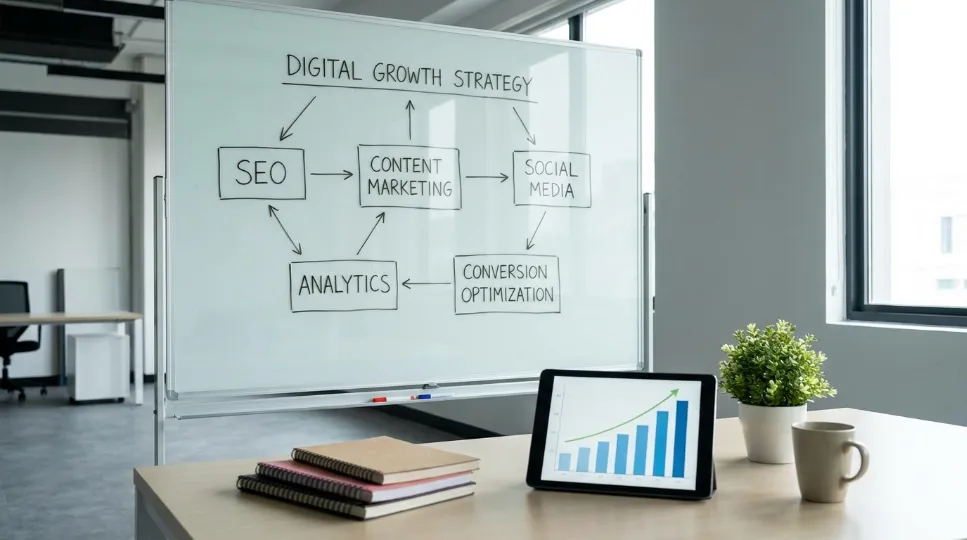
Building a digital growth strategy around lead quality means treating lead generation as a connected system. Attract, qualify, nurture, and track, rather than a series of disconnected tactics. The goal is to focus resources on leads who show real buying intent, rather than treating every form-fill as equally valuable.
Step 1: Start With Intent, Not Just Interest
Modern lead generation has shifted away from pure volume. It now leans on intent-driven targeting, AI-powered personalization, and multichannel engagement. This includes website visitor identification, signal-based outbound campaigns, and interactive lead magnets.
In plain terms: stop guessing who's interested. Watch for actual buying signals instead, like someone visiting your pricing page twice, or downloading a comparison guide. Those actions tell you more than a generic newsletter signup ever will.
Step 2: Set Goals You Can Actually Measure
Don't just say "get more leads." Instead, set a real target. Increase qualified leads from a specific audience to a set number per month, through a named mix of channels, within a clear deadline.
This forces clarity. It also gives you a way to know, three months from now, whether your strategy actually worked, or just felt busy.
Step 3: Fix the Data Before You Spend More
Bad contact data quietly wrecks campaigns. Invalid emails hurt your sender reputation and can get you flagged as spam. Outdated job titles mean you're pitching the wrong person entirely. Before you increase ad spend, clean your list. It's unglamorous work, but it protects everything you build after it.
Step 4: Let Nurtured Leads Do the Heavy Lifting
Don't underestimate follow-up. Leads who go through personalized nurturing are more likely to convert than those left to figure things out alone. A short, well-timed email sequence, built once, can keep working for you for years.
Creative Digital Marketing: The Piece Most Businesses Skip
Most lead generation marketing advice focuses entirely on systems and tracking. It forgets that people still need a reason to care. To understand why creative matters here, it helps to define what "trust" actually means in a funnel context. It's the gap between a stranger seeing your ad and believing your claim enough to hand over their contact information.
Creative digital marketing isn't about being clever for the sake of it. It's about making your offer feel real to a stranger scrolling past a hundred other ads.
One approach working well right now is letting real customers tell the story instead of your brand doing it alone. Show a real person explaining the problem. Let them demonstrate the product, or walk through their experience, in natural, platform-native language. This tends to perform far better than polished brand messaging. In other words, a testimonial works because it transfers belief from one person to another. That's something a brand can't do on its own.
This matters because trust is the real bottleneck in most funnels, not traffic. People don't fill out forms for businesses they don't believe. A genuine testimonial, a quick before-and-after, or an honest walkthrough does more to earn that trust than another perfectly designed banner ad.
We swapped a polished, agency-shot brand video for a raw, phone-filmed customer testimonial on a client's paid social campaign, same offer, same budget, same audience. The unpolished version consistently pulled a lower cost per lead over the following month, and the sales team reported the leads from it felt "warmer" on the first call. It's a small, unscientific test, but we've seen the same pattern repeat on enough accounts now that it's become our default recommendation.
The mistake many brands make is over-scripting the creator. The goal should be message discipline without losing their natural, native voice. Give your customer or creator one clear pain point, one promise, and one next step. Then let them speak in their own words.
Why Creative and Strategy Need Each Other
Creative without strategy is just noise. Strategy without creative is just a spreadsheet. You need both. This matters because most marketing failures aren't a strategy problem or a creative problem in isolation. They're a coordination problem between the two.
A retargeting campaign gets stronger when the creative points to one clear offer. A lead magnet becomes more valuable when the follow-up sequence is segmented by intent. Search performs better when the landing page actually matches what someone searched for.
Think of it like this. Your ad gets the click. Your creative earns the trust. Your follow-up system closes the deal. Remove any one piece, and the other two work twice as hard for half the results.
Measuring Digital Marketing ROI the Right Way
Now, let's talk numbers honestly, because vague reporting is where a lot of marketing budgets quietly disappear. Rising customer acquisition costs across paid channels make this kind of tracking more important than it was even two or three years ago, not less.
About a year ago, we changed the headline metric on every client report from cost-per-lead to cost-per-customer. It was a small formatting change, but the effect on budget conversations was immediate. Channels that had looked cheap on a cost-per-lead basis suddenly looked expensive once close rate was factored in, and vice versa. A few clients pushed back at first because the new number looked "worse." Within two quarters, most agreed it was the more honest one.
What's a Good Lead Conversion Rate?
There's no single right answer here. Context decides almost everything. A 1.8% conversion rate is poor for legal services, where the benchmark sits near 7.4%. But it's above average for cybersecurity, where the benchmark is closer to 1.0%. So before you panic over a "low" number, find out what's normal in your industry first.
Track These Numbers, Not Just Lead Count
Here's what each of these numbers actually tells you in a lead generation marketing program. Tracking only one of them gives you a distorted picture.
Cost per lead tells you what you're spending to get attention: total spend ÷ number of leads.
Cost per qualified lead tells you what you're spending on people who could actually buy. Formula: total spend ÷ number of leads that pass your qualification criteria.
Lead-to-customer rate tells you if your funnel actually works: (number of customers ÷ number of leads) × 100.
Customer lifetime value tells you if the whole effort was worth it. Formula: average purchase value × average repeat purchases × average customer lifespan.
The most expensive lead generation marketing mistake a business can make is failing to track performance and ROI correctly. When you can't connect revenue back to its source, you can't make smart budget decisions. Some businesses have even cut their best-performing channel by accident, simply because nobody was tracking which channel actually closed the deal.
Speed and Qualification Beat Raw Spend
Properly scored and qualified leads convert at roughly 40%. Unqualified prospects convert at just 11%. That's according to commonly cited sales-readiness benchmarks. To put this in perspective, a well-qualified lead is nearly four times more likely to become a paying customer than an unqualified one. That's why qualification, not ad spend, is usually the highest-leverage fix. Better ROI rarely comes from a bigger budget. It comes from spending the same budget smarter, on leads who were actually worth chasing in the first place.
The Bottom Line
Lead generation marketing fails when businesses measure the wrong thing. Lead count tells you activity. Lead-to-customer rate tells you whether that activity turns into revenue.
The fix isn't more leads. It's fixing five specific breakpoints: unqualified volume, slow follow-up, no nurture sequence, channel overspread, and incomplete funnel tracking. Address those, and the same ad spend converts more of the leads you're already generating.
If you take one thing from this article about lead generation marketing, make it this: track cost-per-customer, not cost-per-lead. That single change reframes every decision you make about your funnel from here forward. Pick one mistake from this article, the one costing you the most right now, and fix it this week. Then move to the next one.
In our experience at CyberCraft Bangladesh, businesses rarely need to fix all five at once. We've watched clients fix just the response-time problem and see a measurable lift within a single quarter, well before the nurture sequence or the tracking setup was even finished. Start with whichever one is bleeding the most obvious revenue, prove it out, then move to the next.
Frequently Asked Questions About Lead Generation Marketing
How fast should I follow up with a new lead?
As fast as possible, ideally within minutes. Responding within 60 seconds can boost conversions by up to 391%, compared to slower response times. If you can't respond instantly yourself, set up an automated first response while a real follow-up call gets scheduled.
Is paid advertising still worth it for lead generation in 2026?
Yes, but only when it's paired with proper tracking and a clear offer. Rising ad costs mean wasted clicks hurt more than they used to. Focus your budget on channels with proven intent. Always know your cost per customer, not just cost per click.
How do I know if my leads are low quality?
Watch for patterns like no-shows, "just looking" responses, or leads who never respond after the first form fill. This usually points to weak targeting or missing qualification questions on your forms. It can also mean your marketing messaging doesn't match what your sales team is actually offering.
Should small businesses focus on inbound or outbound lead generation?
For lead generation for small businesses, most do best with a hybrid approach. Combining inbound and outbound strategies helps reach a broader audience, while still maximizing results from each individual approach. Start with one inbound channel, like SEO or content. Add one direct outbound channel, like email or LinkedIn outreach, before expanding further.
How much should I budget for digital marketing?
Most marketing experts recommend allocating between 7% and 10% of gross revenue to lead generation marketing and broader marketing efforts. The U.S. Small Business Administration puts a finer point on it for smaller companies, recommending that businesses under $5 million in revenue set aside 7–8%. That number goes higher for businesses in an active growth phase. That said, a smaller, focused budget run well will almost always beat a larger budget spread too thin.
What's the difference between a marketing qualified lead (MQL) and a sales qualified lead (SQL)?
Marketing qualified leads (MQLs) have shown interest through marketing actions, like downloading a guide or visiting a pricing page. But they haven't been vetted for budget or authority to buy. Sales qualified leads (SQLs) have been reviewed and confirmed as a real sales opportunity, usually through a qualifying call. Treating every marketing qualified lead as sales-ready is one of the most common causes of wasted sales time.
How long should a lead nurture sequence be?
Most effective nurture sequences run 4–8 touches over 4–8 weeks, spaced roughly weekly, mixing helpful content with soft check-ins. The right length depends on your sales cycle. A low-cost product needs far less nurturing than a large B2B contract, which may reasonably take 3–6 months of touches before a lead converts.
Sources
Oldroyd, J. B., McElheran, K., & Elkington, D. (2011). "The Short Life of Online Sales Leads." Harvard Business Review, 89(3).
U.S. Small Business Administration. "Create Your Marketing Plan: Strategic Marketing Budget and Measurement."
Predictable Profits. "B2B CRO Benchmarks by Industry."
Martal Group. "Conversion Rate Statistics: B2B Benchmarks & Insights."
Wall Street Prep. "Cost Per Lead (CPL): Definition and Formula."

I’m Mitu Das, a JavaScript developer, ERP product architect, and SEO specialist from Bangladesh. I work at CyberCraft Bangladesh, where I help build simple, scalable software, SaaS platforms, and business solutions. My goal is to create technology that helps companies save time, automate daily tasks, and grow faster. I enjoy combining development, product ideas, and SEO strategies to create useful digital solutions for modern businesses.
Writes about
Want this done for you?
Our team builds and ships exactly what this article describes. Send a message and we will reply with a scope.