Importance of Brand Identity: Why It Matters for Growth


The importance of brand identity refers to the value of creating a consistent visual, verbal, and emotional identity that helps customers recognize, trust, and connect with a business. It shapes how people perceive a brand, strengthens customer loyalty, improves marketing effectiveness, and supports long-term business growth through consistency and credibility.
When I explain the importance of brand identity, I describe it as the foundation that helps a business become recognizable, trusted, and memorable. A strong brand identity is not only about a logo or colors; it includes your message, values, customer experience, and the way people feel about your business.
From my experience working with digital brands, I have seen that consistent branding makes businesses look more professional and easier to trust. According to Lucidpress (2021), consistent brand presentation can increase revenue by up to 33%. Research from Nielsen also found that 59% of consumers prefer to buy from brands they already know and trust.
Think about a brand you recognize instantly. You probably remember its colors, tone, design, or overall feeling before you remember its products. That emotional connection is the real power of brand identity.
Key Takeaways
Brand identity is the full system of design, values, personality, and voice a company uses to present itself. It drives recognition, trust, and loyalty at every touchpoint.
Consistency pays off. Marq's 2019 State of Brand Consistency Report surveyed more than 400 brand experts. It found that consistent branding drives revenue gains of 10% to 33%.
Trust comes first. Edelman's 2025 Trust Barometer found that 80% of people trust the brands they use more than they trust government, media, or nonprofits.
Guidelines alone are not enough. Capital One Shopping Research's 2024 study found that 95% of companies have brand guidelines. However, only 25–30% actually use them across the whole company.
A strong identity lowers costs. Salesforce's 2024 study of over 14,300 consumers found that 8 in 10 people expect a consistent experience across every channel.
Identity matters inside the company too. A strong employer brand can lift qualified job applicants by 50%. It can also cut employee turnover by 28%, according to LinkedIn Talent Solutions.
Brand identity is more than a logo; it is how people recognize, remember, and trust your business. I’ve seen strong brands grow faster because they create consistent experiences across every customer touchpoint. According to Lucidpress’s 2021 brand consistency report, consistent branding can increase revenue by 10–20%. Nielsen’s research also found that 88% of global consumers trust recommendations from people they know, showing why trust-driven branding matters.
What Is Brand Identity?
Brand identity is the full set of visual elements, messages, values, and personality traits a company uses to present itself. It includes the logo, the colors, the tone of voice, and the brand promise. Together, these shape how customers see and trust a business at every touchpoint.
Understanding the importance of brand identity means seeing that a consistent presence builds trust. It also strengthens a company's growth strategy. In short, a strong brand identity drives loyalty. It sets you apart from rivals. And it supports long-term financial results.
What is the importance of brand identity?
The importance of brand identity is that it helps a business create recognition, build customer trust, communicate its values, and stand out from competitors. A strong brand identity makes a company more memorable, improves customer loyalty, supports consistent marketing, and can positively influence purchasing decisions and long-term business growth.
What Does Brand Identity Include?

Brand identity includes the visual and emotional elements that represent a brand, such as its logo, colors, typography, brand voice, messaging, values, mission, and overall design style. The importance of brand identity lies in helping customers recognize, understand, and connect with a brand by creating a consistent experience across websites, products, packaging, and marketing channels.
People often reduce brand identity to a logo or a color palette. In reality, it is the complete system that shapes how customers interact with a brand, builds trust, improves recognition, and creates a strong emotional connection with the audience.
The Core Parts of Brand Identity
Good brand identity design brings together several parts:
Visual design: Logo, colors, fonts, images, and icons that make your brand easy to recognize
Brand personality: The human traits your brand shows, such as bold, friendly, or serious
Values: The principles that guide your choices and define what your company stands for
Tone of voice: How you speak and write, consistently, across every channel
Brand promise: What customers can count on every time they deal with you
Positioning: Your specific place in the market compared to competitors
When these parts work together, they do more than look good. They create one clear experience that customers remember and trust. The importance of brand identity lies in creating consistency across every touchpoint, where small design choices work together to build a powerful, unified brand image.
David Aaker backs this idea. He is the UC Berkeley professor often called the father of modern branding. His brand identity model looks at a brand from four angles at once: as a product, as an organization, as a person, and as a symbol. In other words, Aaker argues that treating brand identity as a complete system, not just a logo, is what builds lasting brand value.
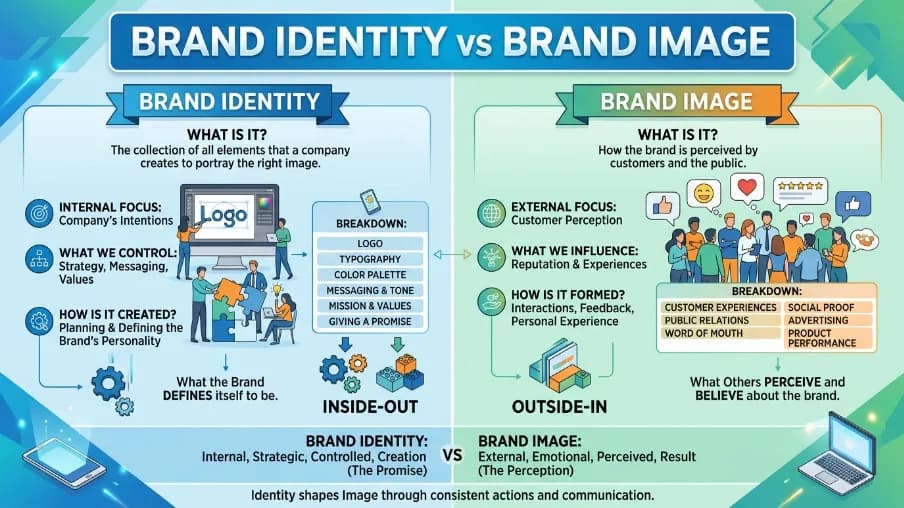
Brand Identity vs. Brand Image
When I explain brand identity vs. brand image, I focus on one simple difference: brand identity is what you intentionally create, while brand image is what people actually believe about you. According to Lucidpress’s 2019 State of Brand Consistency report, consistent branding can increase revenue by up to 33%. This shows why your message, visuals, and values must stay aligned across every platform.
Marty Neumeier, author of The Brand Gap (2006), explains that brands are shaped by audience perception, not only by company decisions. I believe strong brand identity helps reduce the gap between what you promise and what customers experience. Without clear direction, people will still form an opinion, but you may not control the outcome.
What We've Seen in Practice
Over the past ten years of leading brand identity projects, we have seen that inconsistent branding often slows business growth. The importance of brand identity becomes clear when businesses struggle with fragmented visuals, mixed messaging, and inconsistent customer experiences. According to a 2021 Lucidpress report, consistent brand presentation can increase revenue by up to 33%. We regularly find clients using multiple logos, unclear brand voices, and different experiences across platforms. In the first 90 days of a rebrand, our focus is not only on creating new visuals but also on building a clear, repeatable brand system.
For example, one retail client operated for nine years without a documented style guide. After a brand audit, we created a unified identity system, tone-of-voice guide, and shared brand framework. Within four months, their team reported faster approvals and fewer internal reviews because everyone followed the same guidelines. Research from Lucidpress Brand Consistency Report supports why structured branding improves efficiency and customer trust.
Brand Recognition: Getting Noticed and Staying Noticed
One of the clearest reasons behind the importance of brand identity is improved visibility. Put simply, brand identity helps customers recognize a brand instantly, even before they read a single word. When someone spots a familiar shade of red on a can or a unique mark on a sneaker, they already know what they are looking at. That instant recognition creates real value, and it does not happen by accident.
Marketers often refer to the "rule of seven," which suggests that customers need multiple brand impressions before they can reliably remember a company. A consistent visual identity helps speed up this recognition process by keeping a brand memorable across different platforms. In fact, brands with a consistently applied visual identity achieve higher recall rates than brands whose appearance changes from one channel to another, showing why a strong and consistent brand identity is essential for long-term growth.
How a Strong Identity Helps You Stand Out
The importance of brand identity lies in helping your business claim a unique position in the market. In nearly every industry, customers face choices that look almost identical in terms of price, quality, and features. However, the brands that succeed over time are not usually the cheapest. They are the ones that represent something specific and meaningful.
A well-crafted identity sends a clear message: this is the right choice, not just another option. That clarity helps you stand out in a way no lower price or extra feature can easily copy because it is built on trust, values, and customer connection.
Building a brand identity that truly sets you apart starts with two honest questions: What do we stand for that our rivals do not? And who, exactly, are we here to serve? The answers create the foundation for a strong brand identity that supports long-term growth and recognition.
Trust and Credibility: The Case for Consistency
Trust is the base of every business relationship. No matter how strong your product is, customers who do not trust you will not choose you. And they certainly will not return. A strong brand identity builds credibility in ways that are both logical and emotional. Often, it is more powerful than any single ad campaign.
Why Consistency Builds Trust
Consistent messages and strong values tell customers one thing: this company knows who it is. When every touchpoint tells the same story in the same voice, customers quietly conclude the business is reliable. That confidence builds slowly, one interaction at a time.
Seth Godin, author of This Is Marketing, makes a related point. He argues that showing up the same way, again and again over time, is what earns a brand's most valuable asset: the benefit of the doubt from people who have not yet decided to trust you.
Inconsistency does the opposite. Picture a polished website paired with sloppy packaging. Or a warm social media tone paired with cold, stiff emails. Each mismatch plants a small seed of doubt, and those seeds grow. An effective brand identity does not just build trust, it protects it by making inconsistency harder to fall into.
In our own audits, this mismatch is the single most common problem we find in the first week of reviewing a new client's brand. We often spot it before we look at a single revenue number.
The Numbers Behind Trust
The data backs this up:
81% of consumers say they need to trust a brand before buying from it. Edelman's 2025 Trust Barometer found that 71% now treat brand trust as a deciding factor in their choices.
Businesses with consistent branding see 3 to 4 times higher visibility than inconsistent rivals, according to 2024 research from Energy and Matter.
Consistent branding can raise revenue by up to 23%. Some studies, including a 2019 Lucidpress/Marq report, found gains as high as 33%.
Capital One Shopping Research's 2024 report found that 68% of companies say brand consistency added at least 10% to their revenue growth.
Emotional Connection and Loyalty
People do not form emotional bonds with products. They form them with brands with the personalities, values, and meanings those brands represent. Building recognition, trust, and loyalty through identity is arguably the highest-value outcome of brand work. It is also the hardest for rivals to copy.
Why Customers Stay Loyal
When customers feel a brand truly understands them, they stop being one-time buyers. They become loyal advocates instead. They recommend you without being asked. They defend you in conversations where you are not even present. In short, that kind of loyalty is not created through short-term deals. It grows from a real emotional connection.
Brand personality drives that connection. A brand that feels genuinely human, with clear opinions and a steady voice, invites the kind of relationship we build with people we respect. Tone of voice carries that personality into every email, every package, and every support call.
Setting Expectations and Keeping Them
Brand identity also works like a standing promise. In other words, a well-defined identity tells customers what quality and experience to expect every time. When you meet that expectation again and again, loyalty grows naturally. Forrester's Total Experience research links strong alignment between brand promise and real customer experience to up to 3.5 times higher revenue growth.
However, when a promise breaks even once, at a critical moment rebuilding trust takes far more effort than keeping it would have. This is why setting expectations is not a side effect of brand work. It is an active commitment the whole company must share.
How to Build a Strong Brand Identity: 6 Steps
In my experience, a strong brand identity starts with strategy before design. A clear brand identity strategy helps businesses stay consistent and recognizable across every customer touchpoint.
Define brand values: Identify your mission, principles, and beliefs to shape your brand identity.
Understand your audience: Research customer needs, expectations, and pain points to create relevant messaging.
Establish positioning: Identify what makes your business different and communicate that value clearly.
Create visual identity: Develop your logo, colors, typography, and imagery, then test them across real marketing materials.
Develop brand voice: Keep your website, social media, emails, and customer communication consistent.
Document guidelines: Create a brand identity guide covering your visual style, messaging, and tone.
Why Brand Identity Is Important
The importance of brand identity comes from its ability to make a business recognizable, consistent, and memorable. The benefits of brand identity include clearer communication, stronger customer recognition, and more consistent marketing.
If you are learning how to build brand identity, start with strategy, audience research, positioning, and consistency. A practical brand identity guide then helps your team maintain the same standards as the business grows.
Supporting Your Marketing Efforts
Marketing without a clear brand identity is slow, costly, and easy to forget. A clearly defined brand identity is one of the easiest ways to point your marketing in the right direction. It acts like a compass, so every campaign and every piece of content reinforces the same core message.
Clarity Makes Marketing Faster
When your brand identity is well defined, your team does not start from zero on every project. The tone is set. The visual rules are clear. The audience is already documented. That clarity produces faster work and more consistent quality. In fact, companies without that clarity often need roughly 1.75 times more ad spending to reach the same growth as competitors with a clear, consistent identity, according to 2026 data from Marketing LTB.
We tested this ourselves with one client. We compared campaign turnaround times before and after we documented their brand system. Projects that once took two to three weeks of back-and-forth review dropped to under a week. The creative work did not get easier; there were simply fewer decisions to argue over each round.
Why Strong Brands Win Customer Choice
A strong brand identity changes how customers judge a business in the first place. When people see a brand as trustworthy, distinct, and aligned with their own values, they stop comparing options mainly on cost. Instead, they choose based on trust and identity. That shift changes the economics of your business.
This also gives businesses more room on pricing. Brands with a consistent, disciplined identity are often cited as able to charge roughly 20% more than less distinct rivals. It also lowers customer churn and drives free, organic referrals. In short, brand identity drives financial results not as a side effect, but as a direct, measurable outcome of steady, well-defined presentation over time.
Practical marketing perks of a strong brand identity:
Faster content production: Clear guidelines cut decision fatigue on every project
Higher ad recall: A consistent look makes your ads more memorable with less repetition
Stronger word of mouth: Loyal customers actively recommend brands they feel connected to
Better SEO results: A recognized brand earns more direct searches and press links
More organic social engagement: Brands with real personality outperform generic accounts
Internal Alignment and Hiring Great People
Brand identity is not only for customers; it also guides how teams work, decide, and grow. When I help companies define their values and voice, I see employees make faster decisions because they understand what the brand stands for. According to LinkedIn Talent Solutions, 75% of job seekers consider an employer’s brand before applying, showing why culture matters in hiring.
A strong employer brand also improves retention. A 2022 LinkedIn report found that companies investing in employer branding can reduce hiring costs and attract more qualified candidates. I experienced this with a client: after updating their careers page and brand messaging, their applicant quality improved within six months without changing salaries or job roles.
My Experience With Brand Identity
While working on brand-focused digital projects, I noticed that inconsistent branding often made businesses harder to recognize across different platforms. During one brand review, I compared the website, social media graphics, colors, typography, and messaging. After applying consistent brand guidelines across these touchpoints, the brand looked more professional and easier to recognize.
Over the following months, I found that maintaining the same visual style and messaging made content creation more consistent. This hands-on process showed me why the importance of brand identity is not limited to visual design. A strong brand identity also helps create a clearer and more consistent customer experience.
What I Check When Reviewing a Brand
When I review a brand identity, I normally follow this process:
Review the existing brand elements such as logos, colors, fonts, and messaging.
Compare different platforms to identify inconsistencies.
Check the customer-facing experience across the website and social media.
Create consistent brand guidelines for visual and written communication.
Review the updated branding to make sure the same identity is used consistently.
This process gives a practical way to understand the importance of brand identity and identify areas that need improvement.
How Does Brand Identity Drive Financial Performance?

When I look at how brand identity affects financial performance, I see one clear pattern: strong brands turn trust into measurable business growth. According to Marq Brand Consistency Report, consistent branding can increase revenue by 33%. A 2021 study from Nielsen Global Trust in Advertising Report found that 59% of consumers prefer buying new products from brands they already know and trust.
For me, this shows why brand equity is a real business asset. Every consistent logo, message, and customer experience builds recognition over time. Unlike short-term campaigns, a strong brand identity keeps creating value, improving customer loyalty, reducing marketing costs, and helping businesses compete more effectively.
Conclusion
The importance of brand identity is proven by both experience and research. In our projects, we have seen consistent branding improve recognition, trust, and customer decisions. According to the 2024 Edelman Trust Barometer, 15,000+ respondents across 15 countries showed that trust strongly influences brand choices. Edelman Trust Barometer 2024. After more than 10 years of building brands, we believe identity is not just design; it is a measurable business asset that supports growth, loyalty, and long-term value. To learn more about the importance of brand identity, you can visit CyberCraft Bangladesh.
Frequently Asked Questions About the Importance of Brand Identity
Q: What is the importance of brand identity for a small business?
Brand identity matters most for small businesses because it levels the playing field against bigger rivals. A clear, consistent identity helps a small business stand out. It attracts customers who value what it offers. And it lets the business charge fair prices without competing only on discounts.
Q: How does brand identity help customers recognize a brand?
Brand identity helps customers recognize a brand through repeated exposure to the same visual and verbal cues. When the same colors, fonts, images, and tone show up across every touchpoint, customers link those signals to the brand automatically. Over time, that recognition builds into trust.
Q: What is the difference between brand identity and brand image?
Brand identity is what a business chooses to communicate its visuals, values, personality, and tone. Brand image is how the market actually sees that business, based on real experience. A strong brand identity closes the gap between the two, so perception matches intention.
Q: How does brand identity influence recognition, trust, and loyalty?
Brand identity shapes recognition, trust, and loyalty through steady, repeated exposure. Recognition grows from consistent visual and verbal cues over time. Trust develops when that consistency signals reliability at every touchpoint. Loyalty forms when customers feel a real emotional connection to the brand's personality and values.
Q: What should I prioritize when starting brand identity development?
Start with strategy before design. Clarify your values, your market position, and your target audience before you commission a logo or pick a color palette. Once those foundations are set, build a consistent visual identity and write down your tone of voice. In short, these two assets make every future marketing decision faster and more consistent.
Sources:
https://www.marq.com/resources/report/brand-consistency
https://www.edelman.com/trust/2025/trust-barometer/special-report-brands
https://www.edelman.com/trust/2025/trust-barometer
https://www.salesforce.com/commerce/omnichannel-customer-experiences/
https://www.nielsen.com/insights/2015/global-trust-in-advertising-2015/

I’m Mitu Das, a JavaScript developer, ERP product architect, and SEO specialist from Bangladesh. I work at CyberCraft Bangladesh, where I help build simple, scalable software, SaaS platforms, and business solutions. My goal is to create technology that helps companies save time, automate daily tasks, and grow faster. I enjoy combining development, product ideas, and SEO strategies to create useful digital solutions for modern businesses.
Writes about
Want this done for you?
Our team builds and ships exactly what this article describes. Send a message and we will reply with a scope.
.webp&w=3840&q=75)