
Corporate Brand Identity Solutions for Growing Businesses


Corporate brand identity refers to the visual and verbal elements that distinguish a company from its competitors and make it recognizable to customers. It includes a logo, brand colors, typography, imagery, messaging, tone of voice, and company values. A strong corporate brand identity builds trust, communicates business values, and maintains a consistent brand image across all platforms.
Here is how I built this guide. In July 02, I compared brand consistency surveys, Bangladesh trademark guides, company history pages and the AMA brand definition. Along the way, I found sources that disagreed with each other, and I flag those spots below. I did not run live checks on every statistic, so please confirm key figures before you use them in a business plan.
Table of Contents
What is corporate brand identity?
Why does corporate brand identity matter?
What are the main elements of corporate brand identity?
Corporate brand identity guidelines: your rulebook
Corporate brand identity vs brand image: what is the difference?
How do you build a corporate brand identity?
Conclusion
FAQs
Key Takeaways
Corporate brand identity is how a company chooses to present itself.
Strong identity builds trust, and trust drives sales.
Logo, color, typography, voice and values are the core components.
Written guidelines and regular audits keep your team consistent.
Startups and small businesses in Bangladesh can start small and grow.
What is corporate brand identity?
Corporate brand identity is the combination of visual elements, communication style, values, and personality that define how a company presents itself to customers, employees, and the public. It includes a company's logo, colors, typography, tagline, brand voice, and messaging. A strong corporate brand identity helps people recognize a business, build trust, and differentiate it from competitors. It also keeps branding consistent across websites, social media, advertisements, packaging, and other marketing materials.
Example: Coca-Cola uses its recognizable red color, distinctive logo, classic typography, and friendly messaging across its marketing channels. This consistent corporate brand identity helps customers recognize the company worldwide.
Why does corporate brand identity matter?

The importance of corporate brand identity is simple: it makes your business easy to recognize and trust. Customers pick familiar names when they have many options. A clear identity also reduces confusion, supports pricing and keeps your team working toward one goal.
Think about the market here. According to the Bangladesh Bureau of Statistics, the 2022 census counted about 169.8 million people. That means heavy competition. Therefore, a business that looks random gets ignored.
The numbers back this up, with a caveat. In the 2019 State of Brand Consistency survey by Lucidpress (now Marq), respondents expected about 33% revenue growth if their brand stayed consistent, up from 23% in the 2018 survey. When I read the summaries side by side, I noticed that many blogs present this as a proven result. It is not. It is what brand professionals expected. Still, 68% of companies said consistency contributed 10-20% or more of their growth. You can read a summary in ASI Central's report on the study.
Here is an illustrative example, not a real client. Picture a Dhaka snack brand that sells in shops, on Facebook, and through a delivery app. Its pack is green, its Facebook page is orange and its app listing uses a third logo. A shopper who loves the snack may not realize all three belong to one company. The fix takes a few weeks: choose one logo and one palette, then update all three places. Within a quarter, the brand should be easier to spot and easier to trust.
The corporate brand identity benefits are easy to list:
Faster recognition on shelves and screens
Higher trust with buyers and partners
Easier hiring, because people understand your culture
Stronger legal protection when you register your marks
Good corporate branding principles sit behind all four. Be clear, be honest and be steady. Corporate brand identity consistency ties them together.
What are the main elements of corporate brand identity?
The main corporate brand identity elements are your logo, color palette, typography, imagery, voice and values. Experts also call these the corporate brand identity components. Each one sends a signal. When all of them agree, your message feels clear and honest.
Here is a quick view:
Element | What it does | Example |
|---|---|---|
Logo | Gives instant recognition | Nike's swoosh |
Colors | Create mood and memory | Coca-Cola red |
Typography | Sets tone and clarity | Script vs. clean sans |
Voice | Shows personality in words | Friendly, formal, bold |
Values | Explain why you exist | Trust, speed, care |
Corporate visual identity covers the first three rows. Meanwhile, voice and values form the verbal and emotional side. These corporate brand identity design principles stay the same across industries: keep it simple, keep it distinct and keep it flexible.
For example, Nike began in the 1960s, and research suggests its swoosh was designed in 1971 for a fee of $35. The budget was tiny, yet the mark is now global. The Coca-Cola Company traces its history to 1886. Its flowing script has stayed recognizable for well over a century. These two corporate brand identity case studies show that a simple mark, used for years, can become a priceless asset.
I also tested a popular claim while researching. Many articles say a signature color lifts recognition by 80%. When I traced it back, a Review42 analysis called it marketing folklore. The defensible version is narrower: color can raise recognition by up to 80% compared with monochrome. That says nothing about any one brand color. So use color, but do not expect miracles from one shade.
Corporate brand identity guidelines: your rulebook
Corporate brand identity guidelines are a written document that explains how to use your brand. They list logo sizes, color codes, fonts, tone of voice and do's and don'ts. In most cases, they live in a short PDF that every employee and designer can open.
Good corporate brand identity guidelines for businesses include these items:
Logo rules, such as clear space and minimum size
Exact color codes (HEX, RGB and CMYK for print)
Approved fonts for web and print
Sample social posts, letterheads and packaging
A short voice guide with example sentences
Why does this matter? Staff change and agencies change, but the guide stays. Having a guide is not enough, though. Marq's research found that 85% of organizations have brand guidelines, yet only 30% enforce them consistently. Two survey waves gave slightly different off-brand figures (about 81% in 2019 and 77% in a later summary), so treat "roughly four in five" as the safe takeaway. Therefore, the real work is enforcement.
Here is another illustrative case. A printer receives a logo file and picks a red that looks close enough. The signboard arrives a shade darker than the brand's website. Nobody notices at first, but over time the mismatch adds up. A guide with exact HEX and CMYK codes would have prevented it. That is why I always list print codes, not just screen colors.
Corporate brand identity standards also help you say "no" to a last-minute design that breaks the look. Many teams treat the guide as a living corporate brand identity framework, which means they update it when the business grows.
Corporate brand identity vs brand image: what is the difference?
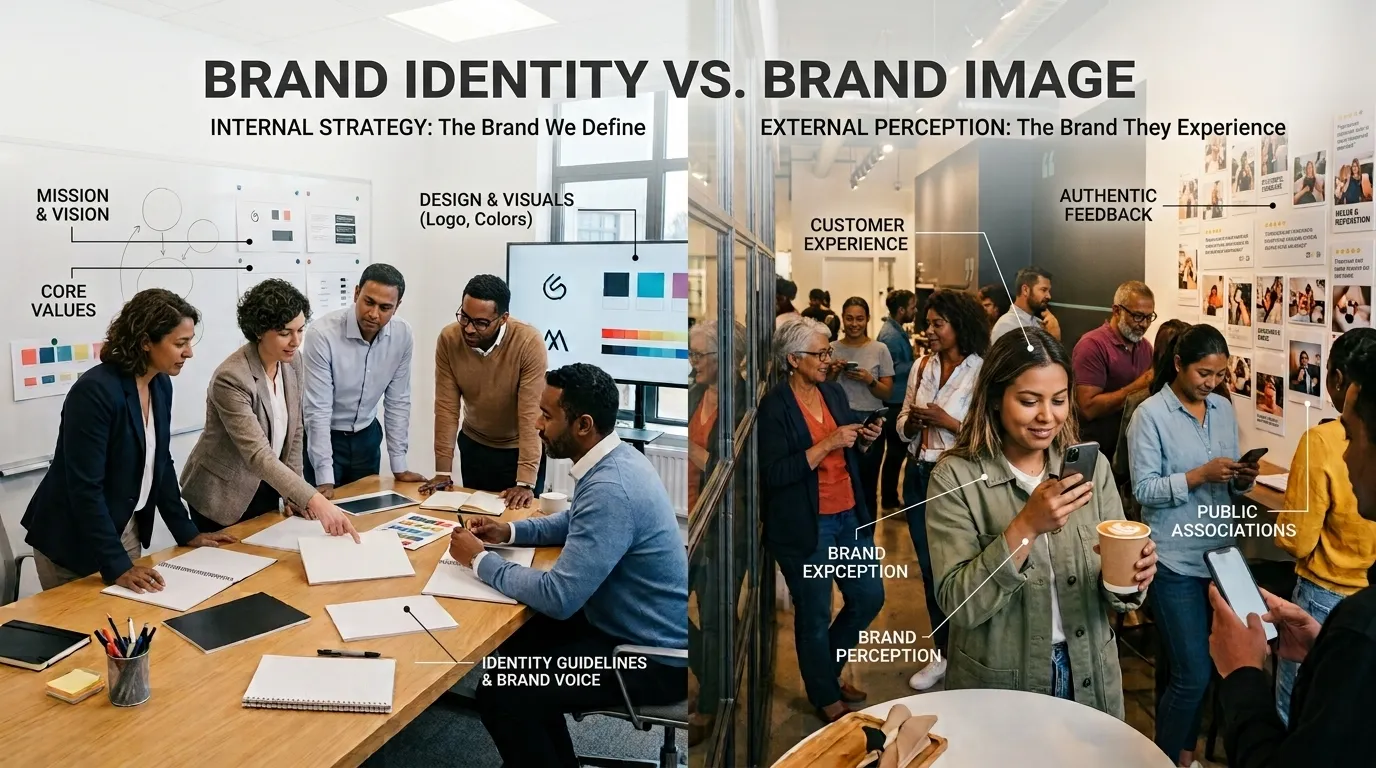
Corporate brand identity is what you send out. Brand image is what people receive. You control identity through design and messaging. Customers form the image through service, reviews and word of mouth. Brand personality, meanwhile, is the human-like trait set that lives inside your identity.
That brings us to corporate brand identity vs brand personality. Identity is the whole system. Personality is one part of it, such as "caring," "bold" or "playful." If you say you are caring but sound robotic, people will not believe you.
The American Marketing Association describes a brand as a name, term, design, symbol or other feature that separates one seller from another. That supports the identity side. However, the image side is about perception.
For example, a bank may design a warm, friendly identity. Yet if lines are long and service is slow, the image turns cold. Therefore, the gap between the two tells you where to fix things.
How do you build a corporate brand identity?
To build a corporate brand identity, follow clear steps: research, define your purpose, design the visuals, write the voice, document the rules and then roll it out. Review it each year. This order is the core of the corporate brand identity design process.
Follow this simple corporate brand identity strategy:
Research: Study customers and competitors.
Define: Write your mission, values and promise.
Design: Create the logo, colors and fonts.
Write: Set your tone and sample messages.
Document: Put everything in one guide.
Launch and train: Share it with every team.
Good corporate brand identity development never really ends. Corporate brand identity management is the daily work that follows: approving new designs, training staff and fixing off-brand material.
Let me give local corporate brand identity examples. Grameenphone began operating in 1997 and built wide recognition through steady color and clear messaging. Likewise, bKash officially launched on July 21, 2011. According to a GSMA case study, it reached 2.2 million registered customers within 17 months, and 98% of mobile users had access to the service. Today, Bonik Barta reports that bKash had 82 million verified customers at the end of last year, with 47 million active in the previous three months. Repetition builds memory.
If you run a startup, start lean. Corporate brand identity for startups needs one logo, two colors and one font. Corporate brand identity for small businesses works the same way. It does not need a big budget. It needs discipline.
Here is how I would run this for a small café, as a sample plan:
Week 1: Write the purpose in two lines and list three words that describe the café's voice.
Week 2: Draft one logo and test it on a signboard, a cup and a social post.
Week 3: Drop any color that looks weak in those tests.
Week 4: Save codes and rules in a one-page guide, then share it with staff.
Here is a short corporate brand identity checklist:
Purpose written in two lines
Logo, colors and fonts chosen
One-page guide shared with the team
Same look on social media, signs and packaging
These corporate brand identity best practices keep things steady. Also, watch corporate brand identity trends, but do not chase them. Research suggests that simpler logos, flexible color systems and clear social values are growing in popularity. Interbrand's 2024 report also warns about short-term thinking. By its model, over-focus on short-term performance marketing has cost top brands $3.5 trillion in cumulative brand value since 2000. That is a modeled estimate, so treat it with care. Adopt a trend only if it fits your purpose.
Protect your work too. Bangladesh's Department of Patents, Designs and Trademarks handles trademark registration under the Trademarks Act 2009. According to The Daily Star, protection lasts 7 years and can be renewed in 10-year terms. When I compared several legal guides, they disagreed on whether the 7 years count from the application date or the registration date. Therefore, confirm this with the DPDT or a lawyer. One guide estimates processing at 12 to 24 months, so apply early. The World Intellectual Property Organization offers global guidance on marks, and BSCIC supports small firms.
Avoid these common corporate brand identity mistakes:
Changing colors and fonts too often
Copying a competitor's look
Skipping a written guide
Ignoring customer feedback
Finally, run a corporate brand identity audit every year. Collect your logos, posters, posts and packs. Lay them side by side on one table or screen. Then ask a colleague who does not work in marketing to sort them by company. If they sort your own materials into two or three different "companies," you have work to do.
Conclusion: your next step with corporate brand identity
Corporate brand identity is your company's face, voice and promise in one package. It builds trust, saves money and sets you apart from competitors. Research suggests that consistency matters most, so start simple and stay steady. Businesses can also seek guidance from CyberCraft Bangladesh to develop a consistent brand identity.
Your next steps are easy. First, write your purpose in two lines. Second, pick your logo, colors and font. Third, create a one-page brand guide. Finally, audit your marketing materials every six months. In most cases, even these small steps can help strengthen your corporate brand identity.
FAQs about Corporate Brand Identity
What is corporate brand identity in simple words?
It is the way a company shows itself to the world. That includes the logo, colors, fonts, tone and values. When these parts match, people recognize your business quickly and feel more comfortable buying from you.
Why is corporate brand identity important for startups?
Startups have little history, so identity builds early trust. A clear look and voice make a new company seem reliable. It also saves time, because your team can follow one guide instead of guessing each time.
How much does it cost to build a corporate brand identity?
Costs vary widely. A freelancer may charge a modest fee for a logo and palette, while agencies charge far more for full systems. In most cases, small businesses can start with basics and expand once revenue grows.
How often should I update my corporate brand identity?
Review it once a year, but change it rarely. Small refreshes, such as a cleaner logo or new photos, are usually enough. Major redesigns confuse customers unless your business model or audience has changed.
Can I register my brand identity in Bangladesh?
Yes. You can apply to register your logo and name as a trademark with the Department of Patents, Designs and Trademarks. Registration lasts 7 years before renewal. Consider speaking with an intellectual property lawyer first.

I’m Mitu Das, a JavaScript developer, ERP product architect, and SEO specialist from Bangladesh. I work at CyberCraft Bangladesh, where I help build simple, scalable software, SaaS platforms, and business solutions. My goal is to create technology that helps companies save time, automate daily tasks, and grow faster. I enjoy combining development, product ideas, and SEO strategies to create useful digital solutions for modern businesses.
Writes about
Want this done for you?
Our team builds and ships exactly what this article describes. Send a message and we will reply with a scope.