
Brand Identity for SaaS and Tech Startups: The Complete Guide


Let me ask you something. When a stranger lands on your website, how many seconds do they give you before they decide if you're legit?
Not long. A few seconds, maybe less.
That's the whole game. Your product might be brilliant. Your code might be clean. But if your brand identity looks thrown together, people won't stick around to find out. I've watched this happen over and over with tech founders. Great tech, forgettable brand, slow growth.
Brand identity for SaaS and tech startups is the full system of visual and verbal signals, logo, color, typography, voice, and messaging, that shapes how buyers and investors judge your credibility in the first few seconds. A solid version typically costs $5,000 to $25,000 and takes four to eight weeks to build properly.
In this guide, I'll walk you through what brand identity actually means for a SaaS or tech company, why it matters more now than ever, and how to build one without wasting your budget. I'll also cover cost, process, and how to pick a startup branding agency if you decide to hire one. No fluff. Just what you need.
What you'll learn in this guide:
- What brand identity actually includes, beyond a logo
- Why it matters more now, especially with AI search changing how buyers find you
- A step-by-step process to build one, whether in-house or with help
- How brand identity shifts across B2B SaaS, fintech, health tech, deeptech, industrial, and consumer startups
- Real 2026 pricing, so you walk into any agency conversation informed
- How to know when it's time to rebrand, and how to choose the right partner
What Is Brand Identity for SaaS and Tech Startups? (It's a Trust System)
Most founders think brand identity is a logo. It's not. A logo is one piece of a much bigger system.
A corporate brand identity is a trust system. It's every visual and verbal signal that tells a stranger, in seconds, whether you're credible. Your colors, your typography, your website, your tone of voice, your product screenshots, even your email signature. All of it adds up to one impression: can I trust this company with my money, my data, or my time?
Think about it from your buyer's side. They're comparing you to five other tools. They don't have time to read your whole pitch deck. They're scanning. Your visual identity does the talking before your sales team even gets on a call.
The strongest corporate brand identity isn't just about looking polished. It's about creating consistency across every customer touchpoint so people recognize your business, remember it, and feel confident choosing you over the competition.
So when I say "brand identity," I mean the full system:
- Visual identity: logo, colors, type, imagery, icons, motion
- Verbal identity: your voice, tone, tagline, and messaging
- Brand strategy: the positioning that ties it all together
- Guidelines: The rulebook that keeps everything consistent as you grow
Skip the strategy and go straight to design, and you get a pretty brand that says nothing. I've seen this cost founders a fundraise. Investors notice when a brand feels shallow.
Why Startups Can't Skip This Anymore
A few years back, founders could get away with a plain logo and a template website. Not anymore. Here's why.
The market is louder: Every category is crowded. AI tools alone launch by the dozen every week. If your brand looks like everyone else's, you're invisible, even with a better product.
Buyers judge trust visually first: For B2B SaaS especially, buyers are handing over sensitive data or mission-critical workflows. A weak, inconsistent brand quietly tells them you might be weak and inconsistent everywhere else too.
AI search changed how people find you: This is the part most founders miss. People aren't just Googling anymore. They're asking AI assistants questions like "what's the best fintech onboarding tool." For your brand to show up in those answers, your positioning and messaging need to be clear enough for a language model to summarize accurately. That's answer engine optimization (AEO) and generative engine optimization (GEO) in a nutshell. A confused brand gets skipped, both by humans and by AI.
Rebranding later costs more than doing it right the first time: I'll get into rebranding cost later in this article, but the short version: fixing a broken identity always costs more than building a solid one from day one.
Brand Identity vs. Brand Strategy vs. Logo: Clearing the Confusion
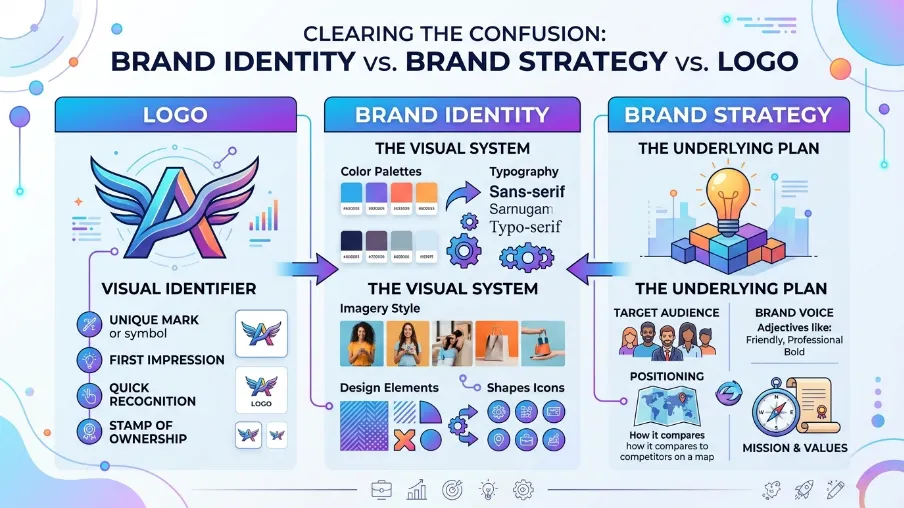
I get asked this a lot, so let's settle it here.
- A logo is a single mark. That's it.
- Visual identity design is the full system built around that mark: colors, fonts, icons, imagery style, and layout rules.
- Brand strategy is the thinking behind all of it. Who are you for? What do you stand for? Why should someone pick you over the other ten tabs they have open?
- Brand identity is strategy plus visual identity, working together.
A logo without strategy is a nice shirt with nobody inside it. It looks fine on a slide, but it doesn't move anyone to act.
How to Build a Strong Brand Identity for Your Startup, Step by Step
Here's the process I'd walk any tech or SaaS founder through, whether you hire help or do it in-house.
Step 1: Start With Creative Strategy, Not Design
Before anyone opens a design tool, answer these questions honestly:
- Who exactly is your buyer? Not "everyone," but a specific person with a specific job and a specific headache.
- What do you do better or differently than the next five tools in your category?
- What's the one word you want to own in your buyer's head?
This is creative strategy for tech brands in practice. It's not a fancy deck. It's clarity you can explain in one sentence.
Step 2: Design a Visual Identity That Fits Your Category
Once strategy is set, move to design. This includes:
- Startup logo design: simple, distinct, and legible at 16 pixels (your favicon matters more than you think)
- Color palette: pick colors that stand apart from your closest competitors, not the same blue every SaaS tool uses
- Typography: one or two typefaces, used consistently everywhere
- Iconography and imagery style: especially important for tech branding, since you're often explaining invisible things like data, automation, or infrastructure
- Illustration and motion design: short animations and custom illustrations help make abstract tech feel human, especially for AI products where trust and warmth matter
Here's a trend worth knowing: in 2026, generic AI-polished visuals are getting a backlash. Buyers can spot a templated brand from a mile away.
The brands standing out are the ones investing in thoughtful logo and visual identity design that embraces texture, imperfection, and a distinct point of view. Instead of chasing flawless aesthetics, they're creating brands that feel authentic, memorable, and unmistakably human.
Don't be afraid to look a little less "perfect" and a little more human.
Step 3: Build a Brand Guide
A brand guide, also called brand guidelines, documents the rules. Logo spacing, color codes, tone of voice examples, what not to do.
Here's the problem with most brand guides: they're a 40-page PDF that sits in a shared drive and nobody opens. Your team stops following it within a month.
This is where an AI-powered brand book is genuinely useful. Instead of a static PDF, your team (or a freelancer, or a new hire) can ask a chat assistant trained on your guidelines: "What's our secondary color for dark backgrounds?" and get the answer instantly. It keeps your brand consistent without anyone digging through a document. For a startup shipping fast, this alone can save your brand from falling apart within six months.
Step 4: Extend It to Your Website and Product
Your brand identity isn't done until it shows up everywhere your buyer looks. That means:
- Your website reflects the same colors, type, and voice
- Your product UI doesn't clash with your marketing site
- Your pitch deck, email signature, and social templates all match
A brand and a website should be built together, or at least by people talking to each other. I've seen too many startups build a polished brand identity, then hand it to a separate web team who ignores half of it.
Brand Identity by Industry: What Changes and What Doesn't
Not every tech startup needs the same approach. Here's how brand identity shifts by sector.
Brand identity for B2B SaaS startups needs to prioritize clarity and credibility over flash. Your buyer is often a committee, not one person. Your brand needs to work in a boardroom slide just as well as on your homepage.
Brand identity for fintech startups carries extra weight around trust. Money is emotional. Your visuals need to say "secure and serious" without feeling cold or old-fashioned.
Brand identity for health tech startups has to balance warmth with authority. People are trusting you with health decisions. Overly playful branding can undercut credibility, but overly clinical branding can feel distant.
Brand identity for deeptech startups often means explaining something genuinely hard to picture, like hardware, chips, or novel science. Custom illustration and diagrams do a lot of heavy lifting here, since stock photography rarely fits.
Brand identity for industrial startups needs to bridge old-world trust signals (reliability, durability) with a modern, tech-forward look, especially if you're selling software into a traditionally low-tech industry.
Brand identity for consumer startups can take more risks with personality, humor, and bold color. Consumer buyers decide fast and emotionally, so distinctiveness matters even more than in B2B.
The common thread: your brand identity should match how your specific buyer makes decisions.
Rebranding for Startups: When It's Time and How to Approach It
How do you know if you need a rebrand instead of a fresh brand from scratch?
Ask yourself:
- Does your current brand look more than four or five years old?
- Has your product changed direction since you built the current brand?
- Do your website, deck, and product all look like they came from different companies?
- Are investors or customers commenting that your visuals don't match your traction?
If you nodded at two or more of these, it's time to talk to a startup rebranding agency.
Rebranding is trickier than starting fresh. You have to protect what's already working. Loyal customers recognize your current colors or your tagline. Change everything overnight and you risk confusing the people who already trust you. A good rebranding process keeps the load-bearing pieces and rebuilds the rest around your new positioning.
Brand Identity Cost: What Startups Actually Pay in 2026
I'll be straight with you here, because most agencies won't give you real numbers.
Brand identity cost depends heavily on scope, and the range is wide:
| Scope | Typical Cost | Best For |
| Logo only | $1,500 to $5,000 | Pre-seed startups testing an idea |
| Core brand identity package (logo, color, type, guidelines) | $5,000 to $20,000 | Early to growth-stage startups |
| Full brand system (strategy, messaging, AI-powered brand book) | $12,000 to $30,000+ | Series A startups prepping to scale |
| Full identity + website build | $30,000 to $75,000+ | Startups launching or fundraising |
| Enterprise-level rebrand | $75,000 to $150,000+ | Rarely needed pre-Series B |
Tech branding pricing also depends on who does the work. A freelancer keeps costs low but may not offer strategy depth. A generalist agency might overcharge for account management layers you don't need. A boutique studio focused specifically on AI and SaaS startups tends to sit in the middle, with strategic thinking and faster turnaround since they've done this dozens of times.
My honest advice: don't chase the cheapest option, and don't assume the most expensive agency is the best fit. Ask what you're actually paying for. A designer makes things look good. A strategist figures out what to say and why. You need both.
Pricing and Process for Startups: What a Good Engagement Looks Like
A solid brand identity project usually runs four to eight weeks and follows this rhythm:
- Discovery (week 1-2): Interviews, competitor research, audience mapping
- Strategy (week 2-3): Positioning, brand personality, messaging pillars
- Visual design (week 3-5): Logo concepts, color, type, imagery direction
- Guidelines and rollout (week 5-8): Brand guide, AI-powered brand book, asset handoff, website alignment
If an agency promises a full brand identity in three days, be cautious. Good strategy takes thinking time. Rushed work usually shows.
How to Choose a SaaS Branding Agency for Startups
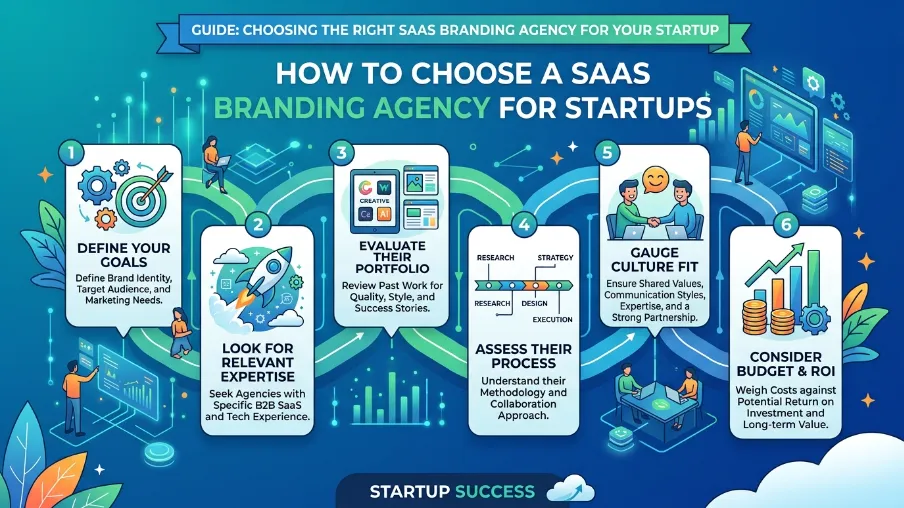
When you're evaluating a startup branding agency, here's what actually matters:
- Do they specialize in tech and SaaS? A generalist agency that brands restaurants and law firms won't understand your category's conventions.
- Do they lead with strategy or just show you mood boards? If the first call jumps straight to colors, that's a red flag.
- Who actually does the work? Ask if senior strategists are hands-on or just pitching the deal before junior staff take over.
- Do they offer a modern brand guide? An AI-powered brand book that your team can actually use beats a static PDF nobody reads.
- Can they show startup-specific results? Ask for examples of brand identity projects for companies at your stage, not just polished enterprise case studies.
A note on the numbers above: these ranges reflect 2026 market rates gathered across freelancer platforms, boutique studios, and full-service agencies serving SaaS and AI startups. Actual pricing always shifts with scope, timeline, and who's doing the work, so use these as a planning baseline, not a fixed quote.
Final Thoughts
Here's the truth. Your product might change six times before you find product-market fit. Your brand is what stays constant while everything else shifts. It’s the thing people remember, trust, and come back to, and it speaks directly to the importance of brand identity.
Don’t treat brand identity as a checkbox before your launch. Treat it as infrastructure, the same way you'd treat your codebase or your data security. Build it with real strategy, keep it consistent, and update it before it starts working against you.
If you're ready to build a brand identity that actually earns trust, whether that's your first identity or a rebrand, start with strategy, invest in a visual system that fits your category, and don't skip the guidelines. Your future customers, and your future investors, will notice the difference in the first few seconds.
Frequently Asked Questions About Brand Identity for SaaS and Tech Startups
What is brand identity for a SaaS or tech startup?
Brand identity is the full set of visual and verbal signals, your logo, colors, typography, voice, and messaging, that shape how customers and investors perceive your company. For SaaS and tech startups, it's what builds trust fast in a crowded, skeptical market.
How much does brand identity cost for a startup?
Most startups spend between $5,000 and $25,000 for a complete brand identity system, including strategy, visual design, and guidelines. Logo-only projects can run from $1,500 to $5,000, while full brand programs with a website can exceed $30,000.
When should a startup rebrand?
Rebrand when your current identity looks outdated, no longer matches your product direction, or creates inconsistency across your website, product, and marketing. A good rule: if your brand hasn't been touched in four or five years, it's worth a review.
Do I need a brand strategy before visual design?
Yes. Skipping strategy leads to a brand that looks nice but says nothing distinct. Strategy defines your positioning, so every design choice has a reason behind it.
What's an AI-powered brand book?
It's an interactive version of your brand guidelines that your team can ask questions of directly, instead of digging through a static PDF. It keeps your brand consistent as your company ships fast and grows.

I’m Mitu Das, a JavaScript developer, ERP product architect, and SEO specialist from Bangladesh. I work at CyberCraft Bangladesh, where I help build simple, scalable software, SaaS platforms, and business solutions. My goal is to create technology that helps companies save time, automate daily tasks, and grow faster. I enjoy combining development, product ideas, and SEO strategies to create useful digital solutions for modern businesses.
Writes about
Want this done for you?
Our team builds and ships exactly what this article describes. Send a message and we will reply with a scope.

.webp&w=3840&q=75)