Shopify vs WooCommerce Comparison: Which Ecommerce Platform Actually Wins in 2026

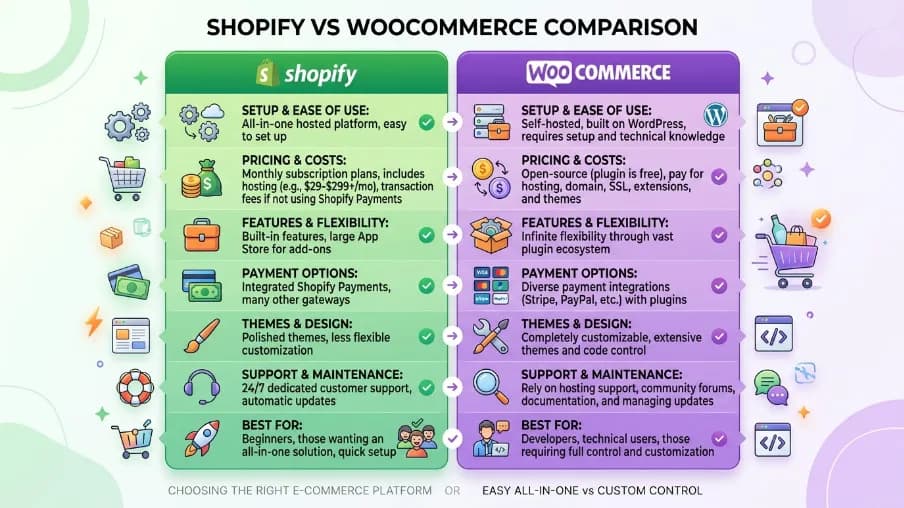
So you want to sell online. Good. But now you're stuck at the first fork in the road: Shopify or WooCommerce?
I get why this question keeps you up at night. Pick wrong, and you could spend months migrating your store later. Pick right, and you save time, money, and a lot of stress.
I've spent years helping store owners weigh this exact decision, and I've built and maintained stores on both platforms myself. Some owners want simplicity. Some want full control over every line of code. Both platforms promise the same thing: help you sell more. But they get there in very different ways, and the wrong choice can cost you real money later.
This shopify vs woocommerce comparison walks you through pricing, features, SEO, security, and scalability, using current 2026 numbers instead of outdated blog stats. No fluff. Just what you need to make a confident, informed decision for your business.
Key Takeaways
- Shopify is a hosted, all-in-one platform. Best if you want speed, built-in hosting, and no technical maintenance.
- WooCommerce is a free WordPress plugin. Best if you want full ownership, custom code access, and don't mind managing your own hosting.
- Cost: Shopify starts around $39/month all-in. A realistic WooCommerce store costs $1,800–$15,000+ per year once hosting, plugins, and themes are counted.
- SEO: Shopify covers technical SEO basics out of the box. WooCommerce, paired with Yoast, often wins for content-heavy SEO strategies.
- Security: Shopify manages security for you. WooCommerce puts that responsibility on your shoulders.
- Bottom line: There is no single "best" platform. There's only the best fit for your budget, skills, and growth plan.
Which Is Better, Shopify or WooCommerce
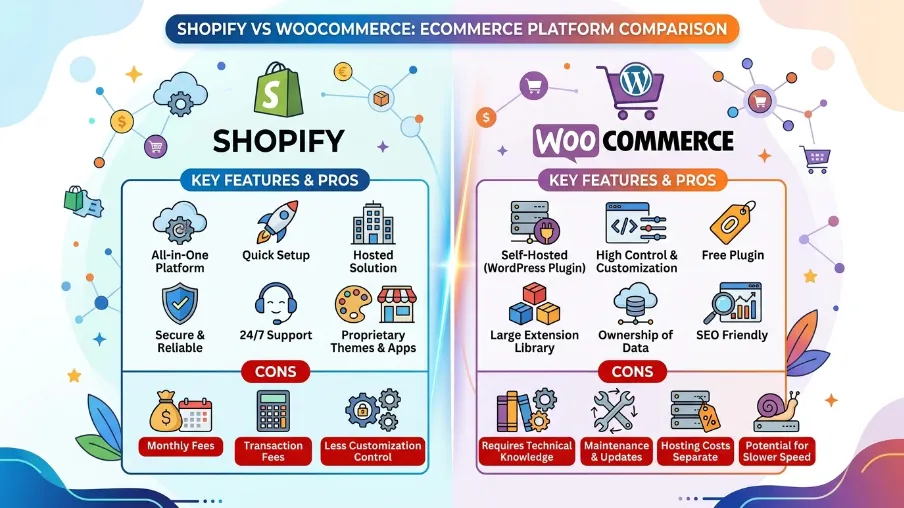
Here's the short version, if you're in a hurry.
Shopify is better if you want a fast setup, built-in hosting, and zero technical headaches. It's a hosted SaaS platform, so everything just works out of the box.
WooCommerce is better if you already run WordPress, want full control over your code, and don't mind managing your own hosting. It's a free, open-source plugin, so you pay for flexibility with your time instead of a monthly fee.
There's no universal winner in the shopify vs woocommerce debate. The right platform depends on your budget, your tech comfort, and how big you plan to grow. Let's dig into the details.
How I Compared These Platforms
Before we go further, here's how I approached this shopify vs woocommerce comparison, so you know it's grounded in more than opinion.
I looked at four things that actually affect your bottom line: real published pricing (not promotional teaser rates), built-in versus bolted-on features, documented security practices, and how each platform behaves once a store scales past its first year. I cross-checked current 2026 pricing directly against Shopify's and WooCommerce's own documentation, plus independent cost-breakdown research from ecommerce agencies that build on both platforms daily. Where a claim involves a specific number, I've sourced it rather than estimated it.
That's the standard I'd want from any guide before I trusted it with my own store's future.
What Is Shopify? A Hosted SaaS Platform Explained
Shopify is an all-in-one, hosted ecommerce platform. You sign up, pick a theme, add products, and you're live. Shopify handles the servers, security patches, and uptime for you.
Think of it like renting a fully furnished apartment. You don't own the building. But you also don't fix the plumbing.
Shopify includes secure commerce hosting with every plan, so you never need to buy or manage separate hosting. That single fact explains most of Shopify's appeal. There's nothing extra to configure.
Shopify is also certified Level 1 PCI DSS compliant, and stores built on it are PCI compliant by default. That matters if payment security keeps you up at night, and it should.
What Is WooCommerce? An Open-Source WordPress Plugin
WooCommerce is a free plugin you install on a WordPress website. It turns your blog or business site into a full online store.
WooCommerce powers millions of active ecommerce sites worldwide and holds one of the largest market shares of any ecommerce platform. That's not a niche tool. That's the backbone of a huge slice of the internet's stores, including well-known brands that could afford any platform they wanted.
The catch? You own everything, which also means you manage everything: hosting, security, updates, backups. It's your house now, and you're the landlord.
This is the core woocommerce open source wordpress plugin trade-off: total freedom in exchange for total responsibility.
Shopify vs WooCommerce: At-a-Glance Comparison Table
| Factor | Shopify | WooCommerce |
| Platform type | Hosted SaaS | Self-hosted, open source |
| Starting cost | ~$39/month | Free plugin; $1,800–$15,000+/year to run |
| Hosting | Included | You buy separately |
| Ease of setup | Very easy, no code | Moderate, needs WordPress skills |
| Built-in SEO | Strong basics out of the box | Needs Yoast or similar plugin |
| Security | Managed by Shopify, PCI compliant by default | Managed by you or your host |
| Scalability | Scales via plan upgrades | Scales via hosting and architecture |
| Best for | Beginners, small business, dropshipping | WordPress users, content-driven stores |
| Ownership of code | Limited | Full |
Shopify vs WooCommerce Pricing Comparison (2026)
Let's talk money, because this is where most people get surprised.
Shopify Pricing Breakdown
Shopify's core plans in 2026 look like this:
- Basic: around $39/month, best for new stores
- Grow: around $105/month, for growing teams
- Advanced: around $399/month, for scaling brands
- Plus: starting around $2,300–$2,500/month, for enterprise merchants
These prices include hosting, SSL, and uptime. No separate server bills, no surprise renewal invoices from a hosting company.
One thing worth flagging: every paid Shopify plan in 2026 now includes access to AI-powered shopping channels, like ChatGPT and Google's AI-driven search tools, a feature that used to be locked behind the top-tier plan. That's a real shift for anyone thinking about shopify vs woocommerce seo and long-term discoverability.
WooCommerce Real Cost Breakdown
WooCommerce is free. The plugin itself costs nothing. But your store isn't free to run.
A production-ready WooCommerce store typically costs between $1,800 and $15,000 or more per year once you add hosting, plugins, themes, and payment processing.
Here's where that money actually goes:
- Hosting: roughly $10–$250 per month, depending on traffic
- Premium theme: usually a one-time fee of $60–$200
- Essential plugins: subscriptions, bookings, SEO tools, security add-ons
- Developer help: only if you need custom features or fix plugin conflicts
Essential extensions for subscriptions, bookings, and automation typically add $500–$2,500 per year on top of hosting and your theme.
So which is actually cheaper? For a small, simple store, WooCommerce often wins on sticker price. For a growing store that wants predictable costs and zero maintenance headaches, Shopify usually pulls ahead once you count developer time. This is the real shopify vs woocommerce cost comparison story: sticker price versus total cost of ownership.
WooCommerce vs Shopify Features Comparison
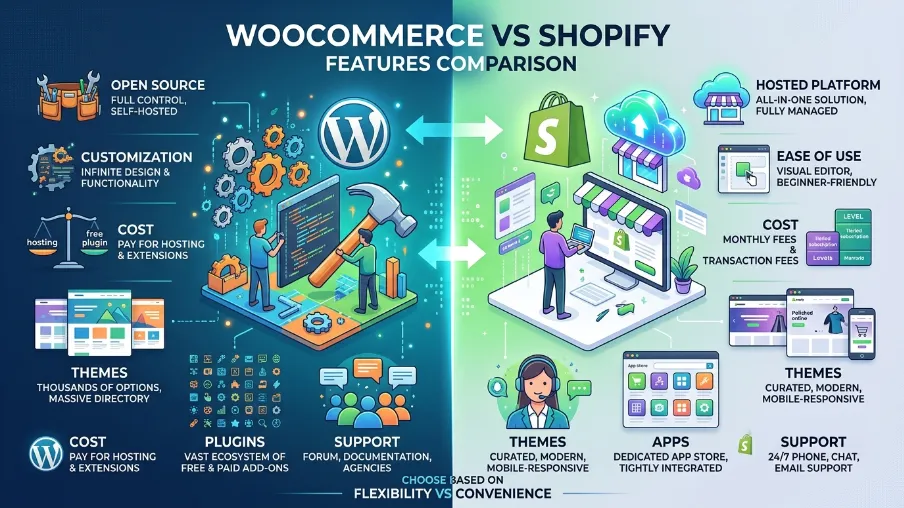
Both platforms let you sell products, manage inventory, and accept payments. But the day-to-day experience is different.
Ease of Use
Shopify wins here, plainly. You don't need to touch code. Drag, drop, publish.
WooCommerce has a steeper curve. You'll need basic WordPress comfort at minimum. If plugins conflict, and they sometimes do, you might need a developer to sort it out.
Design and Themes
Shopify has a curated theme store. Everything is tested to work together, so you're less likely to break your site with a bad update.
WooCommerce gives you access to thousands of WordPress themes. More choice, but also more risk of picking one that clashes with your plugins.
Apps and Integrations
This is a close call. Shopify has a massive app store built specifically for ecommerce tasks. WooCommerce taps into the entire WordPress plugin ecosystem, which is even bigger overall, but less specialized for selling.
For shopify vs woocommerce integrations, ask yourself: do you want tools built just for selling, or tools that also handle blogging, membership sites, and custom content types? WooCommerce flexes wider. Shopify goes deeper on commerce-specific tools.
Shopify vs WooCommerce SEO: Which Ranks Better
This one matters more than most people realize, especially heading further into 2026 as AI search grows.
Shopify has solid built-in SEO basics: clean URLs, auto-generated sitemaps, and fast-loading themes by default. You don't need a plugin to get the fundamentals right. That's the real appeal behind shopify built-in seo features.
WooCommerce needs a little more help. Most store owners pair it with an SEO plugin. This is exactly why woocommerce yoast seo is such a common search term. Yoast, or a comparable tool, fills the gap Shopify already covers natively.
Here's my honest, experience-based take: WooCommerce can outrank Shopify for content-heavy SEO strategies, because WordPress is simply a stronger blogging and content engine. I've seen WooCommerce stores with strong blog content out-rank better-funded Shopify competitors purely on content depth. But Shopify gives you a cleaner technical foundation with far less setup work. If your growth plan leans on content marketing, WooCommerce has an edge. If you want SEO basics handled automatically, Shopify wins.
Shopify vs WooCommerce Security Comparison
Security is not a place to cut corners. Ever.
Shopify handles security for you. Updates, patches, PCI compliance, and DDoS protection are baked into your subscription. You don't have to think about it, which is exactly the point.
WooCommerce puts security in your hands. You choose your host, your SSL certificate, and your security plugins. Past vulnerabilities in popular WooCommerce payment extensions have shown how a single unpatched plugin can expose admin access to attackers. That's not meant to scare you off the platform. It's a reminder that self-managed platforms need active, ongoing maintenance, not a "set it and forget it" mindset.
For shopify vs woocommerce security, Shopify is the safer default for non-technical owners. WooCommerce can be just as secure, but only if you, or a developer you trust, stay on top of updates consistently.
Shopify vs WooCommerce Scalability
Can your platform grow with you? That's the real question behind shopify vs woocommerce scalability.
Shopify scales through its plan tiers. As your revenue grows, you move from Basic to Advanced to Plus. Each tier unlocks more automation, better reporting, and a higher performance ceiling, all without you touching a single server.
WooCommerce scales too, but you're doing the heavy lifting. Bigger stores need better hosting, caching, and database tuning as traffic climbs. Plenty of large brands run successfully on WooCommerce. It just takes more engineering work to get there and to keep it stable under heavy load.
If you want scale without managing servers, Shopify is the simpler path. If you want scale with total control over your architecture, WooCommerce can absolutely deliver it.
Which Is Better for Small Business and Dropshipping
For shopify vs woocommerce for small business, I usually point new owners toward Shopify. You get a working store in a day, not a week. Support is built in. There's no server to babysit while you're also trying to run your business.
For shopify vs woocommerce for dropshipping specifically, Shopify's app ecosystem has more dedicated dropshipping tools ready to plug in on day one. Less setup, faster launch, fewer moving parts to troubleshoot.
That said, if you already run a WordPress site with an existing audience, and you just want to add a small shop, WooCommerce lets you do that without starting over on a brand-new platform.
How to Start an Online Store: A Simple Ecommerce Website Development Process
Whichever platform you pick, the ecommerce website development process follows a similar path:
- Pick your platform based on budget and technical comfort
- Choose a domain name that matches your brand
- Select a theme and customize your layout
- Add your products with clear photos and honest descriptions
- Set up payments through Shopify Payments, Stripe, or PayPal
- Configure shipping rates and delivery zones
- Test everything before you go live, especially checkout
- Launch and market your store across search and social channels
If coding isn't your thing, working with a team offering affordable ecommerce website development can save you weeks of trial and error. It's often cheaper than fixing mistakes later, once real customers are already relying on your checkout working correctly.
Best Ecommerce Platform 2026: My Honest Take

There's no single best ecommerce platform 2026 for everyone. I know that's not the exciting answer you wanted. But it's the honest one, and any guide that tells you otherwise is oversimplifying your decision.
Choose Shopify if you value speed, simplicity, and predictable monthly costs.
Choose WooCommerce if you value control, already use WordPress, and want to keep upfront costs low.
Your ecommerce platform decision 2026 should match your team's actual skills and bandwidth, not just a platform's popularity or marketing budget.
Final Thoughts
Here's what I want you to walk away with: this isn't really shopify vs woocommerce as rivals fighting for the same customer. It's shopify vs woocommerce as two different philosophies. One hands you a finished store. The other hands you the tools to build one yourself.
Think about your budget, your comfort with tech, and how fast you genuinely want to launch. That's really what this decision comes down to, more than any single feature on a comparison chart.
If you're still unsure, start small. Test a free trial on Shopify. Or spin up a WooCommerce install on a cheap host. See which one feels right in your hands before you commit real money or migrate an existing business.
Ready to build your store? Whichever platform you choose, get your product pages, checkout flow, and mobile experience right from day one. That's what actually turns visitors into paying customers, no matter which platform is running underneath.
Frequently Asked Questions About Shopify vs Woocommerce Comparison
Which is better, Shopify or WooCommerce?
Shopify is better for beginners who want a hands-off, hosted experience with support built in. WooCommerce is better for those who want full control, already use WordPress, and are comfortable managing their own hosting. Neither is universally "better." It depends on your goals, budget, and technical comfort.
Is WooCommerce really free?
The core plugin itself is completely free. But you'll still pay for hosting, a domain, a theme, and usually a few premium plugins. Realistic yearly costs typically fall between $200 and $3,000 for most small to mid-sized stores, and higher for complex, high-traffic operations.
Is Shopify worth the monthly fee?
For most store owners, yes. You get hosting, security, PCI compliance, and support bundled into one predictable subscription. You avoid the ongoing technical maintenance that WooCommerce requires, which often has a hidden cost in time or developer fees.
Can I switch from WooCommerce to Shopify later, or vice versa?
Yes, migration between the two is possible in both directions. It takes planning around product data, customer records, order history, and SEO redirects to protect your rankings, but it's a well-established process that agencies handle regularly.
Which platform is better for SEO in 2026?
Shopify handles basic technical SEO automatically, which is great if you don't want to manage plugins. WooCommerce, paired with a tool like Yoast, can outperform Shopify for content-heavy SEO strategies because WordPress is fundamentally a stronger blogging and publishing platform.
Which is cheaper long-term, Shopify or WooCommerce?
It depends on your scale. Small, simple stores often cost less on WooCommerce because there's no mandatory subscription. But once you factor in hosting upgrades, premium plugins, and developer time for maintenance, many growing stores find Shopify's predictable pricing evens out or beats WooCommerce's total cost of ownership.

I’m Mitu Das, a JavaScript developer, ERP product architect, and SEO specialist from Bangladesh. I work at CyberCraft Bangladesh, where I help build simple, scalable software, SaaS platforms, and business solutions. My goal is to create technology that helps companies save time, automate daily tasks, and grow faster. I enjoy combining development, product ideas, and SEO strategies to create useful digital solutions for modern businesses.
Writes about
Want this done for you?
Our team builds and ships exactly what this article describes. Send a message and we will reply with a scope.