How to Run Paid Media Campaigns for Digital Marketing ROI

I'll be straight with you. I've watched businesses pour thousands of dollars into paid ads - Google, Meta, TikTok - and walk away with almost nothing to show for it. No leads. No sales. Just a shrinking budget and a growing frustration.
And here's the part that hurts: it's usually not the platform's fault.
Research shows that 65% of businesses are not getting a positive ROI from digital marketing. Over 40% of digital ad spend gets wasted on poor targeting, bad tracking, and campaigns that were never built to convert in the first place.
So if you're running paid media and not seeing results - you're not alone. But I want to help you change that.
In this guide, I'll walk you through exactly how to build a paid media campaign that actually delivers digital marketing ROI. No fluff. No jargon. Just the real steps that work in 2025 and beyond.
Why Most Paid Media Campaigns Fail Before They Even Launch
Let me ask you something. Why did you start running ads?
If your answer is "because my competitor is doing it" or "because someone told me I should" - that's already a red flag.
Most campaigns fail not because the ads are bad. They fail because the strategy behind them is broken from the start.
Here's what I see most often:
- No clear goal. "Get more customers" is not a goal. "Get 50 leads at under $20 cost per lead in 30 days" - that's a goal.
- Targeting everyone. If you try to reach everyone, you reach no one. Overbroad targeting pulls in users outside your ideal customer profile, which kills conversion rates.
- Treating paid media as isolated. This is a big one. When you run ads without connecting them to your CRM, email flows, or retargeting - the algorithm operates in the dark. It wastes your budget on people who will never buy.
The brands winning with paid media right now are not necessarily spending more. They’re spending smarter.
They combine targeting precision with strong creative, proper tracking, and a connected marketing ecosystem that drives measurable digital growth.
From audience strategy to conversion optimization, every piece works together to turn ad spend into real business results.
Let’s build that for you, step by step.
Step 1: Set a Real Goal (And Calculate Your Target ROI Before You Spend)
Before you touch the ads manager, open a spreadsheet.
Ask yourself:
- What is my average order value or deal size?
- What is my current conversion rate from lead to sale?
- How much can I afford to spend to acquire one customer?
This gives you your target Cost Per Acquisition (CPA). Everything else flows from here.
For example: if your product sells for $200, and your profit margin is 50%, you can afford to spend up to $100 to acquire a customer and still break even. But your goal should be a 2:1 or 3:1 return on ad spend (ROAS) - meaning every $1 you spend brings back $2 or $3.
Here's a benchmark I want you to remember: paid search delivers an average 200% return - that's $2 back for every $1 spent. That's your floor. Anything below that, and you need to diagnose the problem.
Do this math first. Because without it, you have no way to know if your campaign is actually working.
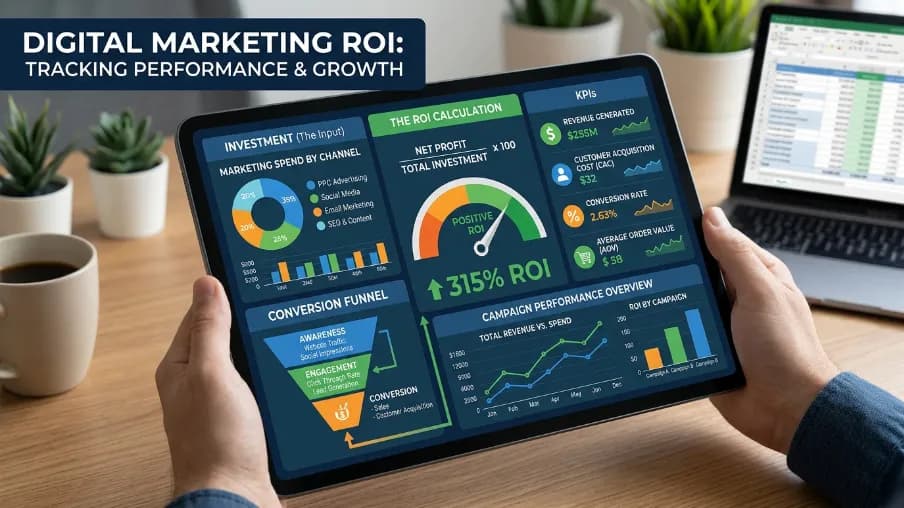
Featured Snippet Answer: To calculate digital marketing ROI, use the formula: (Revenue from Campaign – Campaign Cost) ÷ Campaign Cost × 100. A 200% ROI means you earned $2 for every $1 spent on ads.
Step 2: Know Your Audience Better Than They Know Themselves
This is where most businesses completely skip the work - and pay for it later.
Targeting the wrong audience is the #1 hidden killer of paid media ROI. You can have the best ad in the world. If it shows up in front of the wrong person, it does nothing.
Here's how I approach audience research:
Build a real Ideal Customer Profile (ICP). Not a vague "25-45 year old interested in health." Go deeper. What specific problem are they trying to solve right now? What words do they use when they search for a solution? What have they tried before that didn't work?
Use intent signals, not just demographics. Behavioral targeting - what someone has searched, clicked, or engaged with - is far more powerful than targeting by age or gender alone. Demographic and behavioral layers can conflict with each other and create wasted spend if you're not careful.
Watch for audience overlap. If you run multiple campaigns targeting similar audiences, they compete against each other. You're essentially bidding against yourself. Use audience exclusions to prevent this.
And here's something most guides won't tell you: lookalike audiences decay over time. As source data ages, platforms expand targeting too aggressively. What once delivered high-intent buyers gradually becomes a volume play. Refresh your source audiences every 60–90 days.
Step 3: Build Creative That Converts - Not Just Creative That Looks Nice
I see this all the time. A business spends $3,000 on beautiful ad creative. Professional photos. Perfect colors. Elegant copy.
And it bombs.
Why? Because pretty doesn't sell. Relevance sells.
Your ad needs to do three things in under two seconds:
- Stop the scroll
- Speak directly to a pain point your audience feels right now
- Tell them exactly what to do next
Short-form video is currently the highest-performing format. In 2025, 21% of marketers say short-form video delivers the highest ROI of any media format. Video ad spending is also projected to pass $236 billion in 2026 - that's where attention is going.
But format alone isn't the answer. Here's what matters more:
- Lead with the problem, not the product. Don't open with your brand name. Open with a situation your customer recognizes. "Still paying for leads that never convert?" hits differently than "We're a full-service agency."
- Match message to intent. Someone searching "best CRM for small business" is in evaluation mode. Someone browsing Instagram is in discovery mode. These two people need very different ads.
- Test multiple variations. Don't run one ad and wait. Run three to five variations per audience segment. Kill the losers fast. Scale the winners.
One more thing: campaigns that evolve weekly drive 2.4x higher ROI than static ones. Set a weekly cadence to review and refresh your creative. This alone can transform a struggling campaign.
Step 4: Fix Your Landing Page (Because Clicks Mean Nothing Without Conversions)
Here's a painful truth: you can have perfect targeting and great creative, and still lose money - if your landing page is broken.
A landing page that loads in over 3 seconds can dramatically increase bounce rates. A headline that doesn't match your ad copy kills trust instantly. A cluttered layout that buries the call-to-action wastes every click you paid for.
I call this the "campaign-to-conversion gap." It's the most overlooked problem in digital marketing ROI. The ad works. The landing page doesn't. And because most people only look at ad metrics, they blame the ad.
Here's what a high-converting landing page needs:
- Message match. If your ad says "Get 50 leads in 30 days," your landing page headline should say something similar. Not something different. Continuity builds trust.
- One clear action. Remove navigation menus. Remove secondary CTAs. One page, one goal.
- Speed. Use tools like Google PageSpeed Insights. Aim for under 2 seconds on mobile.
- Social proof above the fold. A testimonial or stat near the top of the page dramatically improves conversion rates.
- Scroll tracking. Use tools like Microsoft Clarity or Hotjar to see where people drop off. Fix the drop-off point first.
When you connect your landing page data to your ad data, your optimization becomes surgical. You stop guessing and start knowing.
Step 5: Track Everything - But Track the Right Things
Here's where most small businesses completely fall apart.
Studies estimate that marketers waste approximately 21% of their budgets on ineffective channels - largely because poor attribution models don't actually measure whether ads cause results. They just connect exposure to sales and call it a day.
If you rely only on platform-reported data (Google Ads telling you how great Google Ads is, Meta telling you how great Meta is), you'll get a distorted picture. Every platform takes full credit for conversions that were influenced by other channels.
What you should actually track:
- Cost Per Acquisition (CPA): How much you spend to get one customer.
- Return on Ad Spend (ROAS): Revenue generated per dollar spent on ads.
- Conversion Rate (CVR): What percentage of clicks turn into leads or sales.
- Customer Lifetime Value (LTV): This is the one most campaigns ignore. A customer worth $2,000 over two years justifies a much higher acquisition cost than a customer worth $200 once.
Set up GA4 properly. Connect it to your ads accounts. Track micro-conversions (form views, time on page, video plays) alongside macro-conversions (purchases, sign-ups). Use the Explorations tool in GA4 to analyze your funnel step by step.
Use multi-touch attribution. The average buyer touches your brand 10–20 times before converting. Last-click attribution gives all the credit to the final touchpoint and completely ignores everything that built trust before that. Multi-touch models give you a more honest picture of what's actually working.
Step 6: Manage Your Budget Like a CFO, Not a Gambler
One of the biggest market gaps I see in paid media content is this: nobody talks about budget discipline in a practical, honest way.
Most guides say "start small and scale." That's fine advice, but it skips the mechanics.
Here's how I actually think about budget:
Fund what's working. Stop what isn't. Fast. Don't give a failing campaign three months to prove itself. Review weekly. If a campaign hasn't hit your target CPA after spending 2–3x your target CPA in budget - pause it, diagnose it, fix it.
Pace weekly, not monthly. Many campaigns run out of budget mid-month and go dark - which means you pay for brand awareness for half a month and then disappear. Use pacing alerts and daily budget controls to prevent this.
Separate prospecting from retargeting budgets. These serve different purposes and need different creative, different goals, and different performance benchmarks. Mixing them gives you misleading data.
Don't ignore seasonality. Adjust your budget and messaging to match demand patterns - by day, hour, and even location. A campaign running at full budget on Sunday night may be less efficient than one paused until Monday morning, depending on your industry.
The brands getting the best digital marketing ROI in 2025 are treating every ad dollar as a CFO would treat an investment - with expected returns, performance criteria, and clear exit conditions.
The Market Gap Nobody Talks About: First-Party Data and the "Data Blackout" Problem

I want to spend a moment on something that most paid media guides completely skip.
We are living through a fundamental shift in how advertising works. Third-party cookies are disappearing. Privacy regulations are tightening. Platform data is becoming less reliable.
And here's the uncomfortable truth: if you're not building a first-party data strategy right now, your paid media ROI will decline over the next 12–24 months - regardless of how well you do everything else.
First-party data is the information you collect directly from your customers - email addresses, purchase history, on-site behavior, CRM records. When you feed this data back into your ad platforms (through tools like Meta's Conversion API or Google's Enhanced Conversions), you're teaching the algorithm who your real customers are.
Without this, the algorithm operates in the dark. It burns your budget on unqualified audiences because it doesn't know who actually bought from you.
Here's the practical fix:
- Connect your CRM to your ad platforms. Send offline conversion data back to Google and Meta so the AI learns from your actual sales, not just clicks.
- Build your email list aggressively. It's your owned audience - no platform can take it away.
- Use Customer Match campaigns. Upload your customer list to Google or Meta and find more people who look like your best buyers.
This is where the next wave of paid media winners will be built. Not on bigger budgets, but on better data.
ROI Doesn't Happen by Accident
Getting real digital marketing ROI from paid media is not about finding a magic ad format or a secret targeting trick. It's about building a system, one where your goal, your audience, your creative, your landing page, your tracking, and your data all work together.
Most businesses get one or two pieces right. The ones that win get all six working together.
If you take nothing else from this guide, take this: stop running campaigns in isolation. Connect your ads to your CRM. Build your first-party data foundation now, before the industry forces you to. And review your campaigns weekly, not monthly.
The businesses winning with paid media in 2025 are not the biggest spenders. They're the most disciplined, most data-connected, and most willing to kill what isn't working and double down on what is.
That’s the foundation of creative digital marketing combining strategy, data, creativity, and continuous optimization into one connected growth engine.
Now you have the roadmap. The next step is yours.
FAQs About Digital Marketing ROI
Q: What is a good ROI for a paid media campaign?
A good benchmark is a 2:1 return on ad spend - meaning you earn $2 for every $1 spent. For paid search, the industry average is around 200% ROI. However, what's "good" depends on your profit margins and customer lifetime value. A business with high LTV can accept a lower short-term ROAS and still win.
Q: How long does it take to see ROI from paid media?
Paid search and paid social can generate results within days of launching. But optimizing for consistent, profitable ROI typically takes 60–90 days - enough time to gather data, test creative, refine targeting, and improve your landing page. Don't judge a campaign in week one.
Q: Why are my ads getting clicks but no conversions?
This usually means one of three things: your landing page isn't aligned with your ad message, your offer isn't compelling enough to act on right now, or you're attracting the wrong type of traffic. Check your landing page load speed, headline match, and audience targeting first.
Q: Should I run ads on Google or Meta (Facebook/Instagram)?
It depends on where your customers are in the buying journey. Google Search captures high-intent buyers who are actively searching for a solution. Meta is better for building awareness with a cold audience or retargeting warm ones. Most businesses benefit from using both - but start with one, prove ROI, then expand.
Q: How much should I spend on paid media to start?
Start with enough budget to generate meaningful data - typically $1,000–$3,000/month for a small campaign. Spend less, and the algorithm doesn't have enough conversions to optimize. The goal isn't to spend more - it's to find your profitable cost per acquisition, then scale from there.

I’m Mitu Das, a JavaScript developer, ERP product architect, and SEO specialist from Bangladesh. I work at CyberCraft Bangladesh, where I help build simple, scalable software, SaaS platforms, and business solutions. My goal is to create technology that helps companies save time, automate daily tasks, and grow faster. I enjoy combining development, product ideas, and SEO strategies to create useful digital solutions for modern businesses.
Writes about
Want this done for you?
Our team builds and ships exactly what this article describes. Send a message and we will reply with a scope.