Custom ERP vs Off-the-Shelf Software: Which One Actually Wins

When I first started advising companies on ERP systems, I believed the debate around Custom ERP vs Off-the-Shelf Software was simple: off-the-shelf solutions were affordable, while custom ERP systems offered flexibility. But after years of seeing real implementation failures, hidden costs, and scaling challenges, I realized the decision is far more complex. The right ERP choice depends on your business model, growth plans, workflows, and long-term ROI, not just the upfront price. In this article, I will break down the real cost differences, when each option makes sense, and the emerging “middle path” that is helping modern businesses balance flexibility, speed, and affordability without making expensive mistakes.
What Is ERP Software and Why Does This Decision Matter So Much
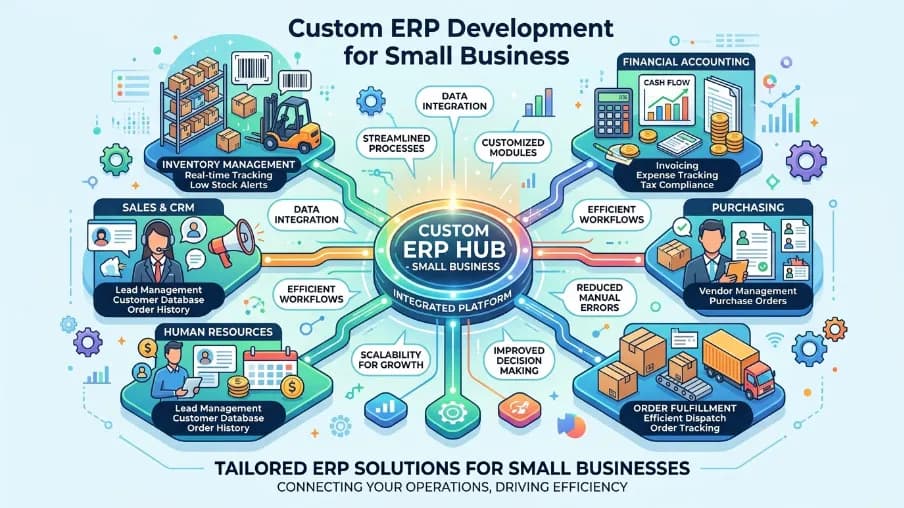
ERP stands for Enterprise Resource Planning. It is software that connects all your core business functions, including finance, HR, supply chain, inventory, and sales, into one unified system.
Think of it as your business’s central nervous system.
Now here is why the custom vs off-the-shelf ERP decision is so critical: getting it wrong is expensive. Not just in money, but in time, team morale, and competitive position.
According to Panorama Consulting’s 2024 ERP Report, the median ERP implementation cost sits at $450,000, with a median timeline of 15.5 months. And here is the scary part: 47% of ERP implementations exceed their planned budget, most commonly due to unplanned technology needs and underestimated organizational complexity.
That is not a small mistake. That is a business-changing mistake.
According to research from HG Insights, the global ERP market has grown by 8% since 2022, and companies are expected to spend $147.7 billion on ERP software in 2025. So yes, this decision matters enormously.
Bottom line: choose the wrong ERP path and you lose money, time, and competitive ground. Choose the right one and you create a foundation for long-term efficiency, scalability, and digital growth, building a system that evolves naturally with your business instead of holding it back.
Understanding Your Two Main Options
Before I compare them, let me make sure we are talking about the same things.
What Is Off-the-Shelf ERP Software
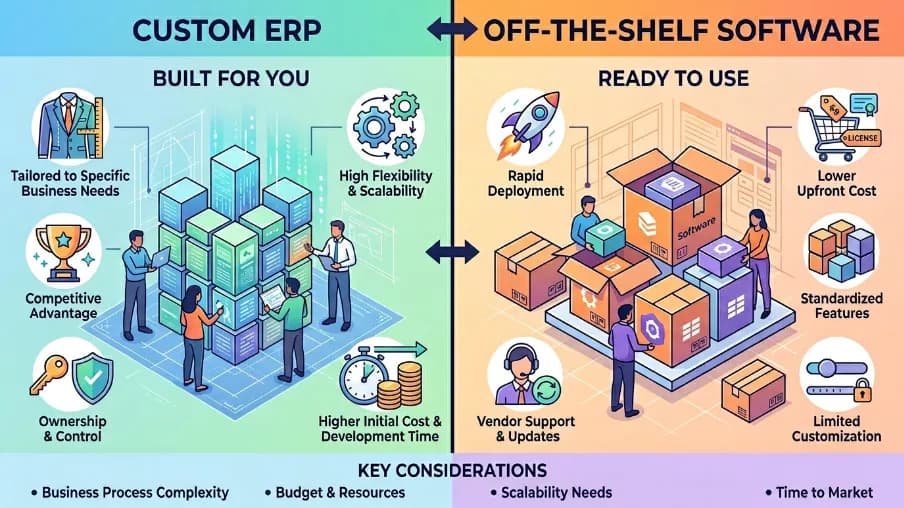
Off-the-shelf ERP, also called "packaged" or "out-of-the-box" ERP, is pre-built software designed for a broad range of businesses. Think SAP, Oracle, Microsoft Dynamics 365, NetSuite, or Odoo.
You buy a license, install it or access it via the cloud, configure it within the limits the vendor allows, and then use it.
Popular off-the-shelf ERP options include:
- SAP Business One (strong for mid-size companies)
- NetSuite (popular for cloud-first businesses)
- Microsoft Dynamics 365 (tightly integrated with Microsoft tools)
- Odoo (well-known open-source option)
What Is Custom ERP Software
Custom ERP is software built specifically for your business. A development team, either in-house or outsourced, designs and builds it around your exact workflows, your specific industry needs, and your unique processes.
Nothing is pre-made. Everything is designed for you.
This distinction sounds simple. But the financial and operational implications of that difference are enormous. That is what the rest of this article unpacks.
The Cost Truth: What Nobody Tells You Upfront
This is the section most comparison articles get completely wrong. They compare sticker prices. That is like comparing two cars by only looking at the price tag while ignoring fuel costs, insurance, and maintenance for five years and the same mistake happens in Custom ERP vs Off-the-Shelf Software comparisons.
Off-the-Shelf ERP: The Real Numbers
Yes, off-the-shelf software looks cheaper at first glance.
Yes, custom solutions demand a higher upfront investment of $100,000 to $400,000 compared to $1,000 to $100,000 for packaged alternatives. Some cloud ERP tools start as low as $150 per user per month.
But here is where it gets painful.
Imagine you have 500 users on a $150 per month per user plan. That is $75,000 a month. That is $900,000 a year. Over five years, you are paying $4.5 million just for the right to log in. And that is before a single hidden cost appears.
The subscription fee is just the start. Companies waste 15 to 20 hours weekly on workarounds, data exports, and manual band-aids. For a 10-person team at $50 per hour, that is $52,000 down the drain every year.
Hidden costs of off-the-shelf ERP that most businesses miss:
- Integrations: Connecting one platform like Salesforce to your ERP can cost $30,000 to $100,000. Custom fields or workflows add another $25,000.
- Training: Training runs $1,500 per employee for enterprise software, plus 2 to 3 weeks of slow output while teams learn the system.
- Vendor lock-in: Getting out of Salesforce or SAP costs 2 to 3 times your annual subscription.
- Annual price increases: Vendors usually raise prices 5 to 10% annually.
One manufacturing client thought they had a "$2,000 per month" solution. Their total real cost was $12,000 monthly after adding up all the extras.
Off-the-shelf only looks cheap until you price it out honestly.
Custom ERP: The Real Numbers
Custom development carries a higher upfront investment, typically $100,000 to $400,000 depending on complexity. For fintech or highly specialized industries, costs for custom ERP development can reach $300,000 and above.
But here is what changes after year one.
No licensing fees. No per-user charges. No integration taxes. No vendor raising prices on you every January.
After the development phase, costs drop dramatically. You are paying for maintenance and hosting, which is usually 15 to 20% of the original build cost annually.
If you can build a custom ERP system for $1.5 million and it saves you $900,000 per year compared to a 500-user SaaS option, the system pays for itself in less than two years. After that, you are saving nearly a million dollars a year.
This is why many enterprises invest in custom ERP development despite the higher initial cost. Custom solutions generally achieve ROI within 2 to 3 years through significant efficiency gains and the elimination of never-ending subscription costs.
Where Off-the-Shelf ERP Wins: Be Honest With Yourself
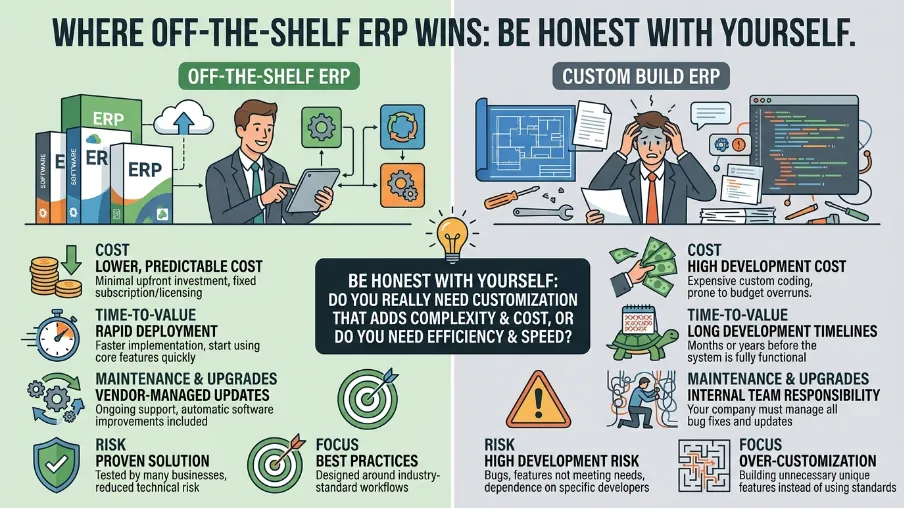
I am not here to push you toward custom software. If off-the-shelf is genuinely right for your situation, I will tell you that clearly.
Here are the honest situations where packaged ERP is the smarter choice:
You are an early-stage startup: You do not have established processes yet. Use off-the-shelf to discover what your workflows actually are. Build custom later when you know what you truly need.
Your processes follow industry standards: If you run a traditional retail business with typical inventory, sales, and finance needs, there is no reason to reinvent the wheel.
You need to go live fast: SMBs typically lack the time and resources to spend 18 to 24 months implementing an ERP system. Some cloud off-the-shelf solutions go live within weeks. Custom development takes 6 to 12 months minimum.
Your team is small: Fewer than 50 users? The per-seat licensing cost is manageable, and the long-term savings from custom likely will not justify the upfront investment yet.
Your industry has strong pre-built options: Healthcare, hospitality, and basic retail all have solid packaged solutions purpose-built for their workflows.
The problem is that most businesses that think they fit this profile actually do not. That is where they run into serious trouble 18 months into implementation.
Where Custom ERP Wins: Most Growing Businesses Land Here
Here is what the data keeps revealing.
Businesses have discovered that approximately 85 to 90% of features in off-the-shelf products go completely unused. You are essentially paying for functionality that delivers no value.
And the features you actually need? Half the time, they are not there at all.
Custom ERP is the right move when:
Your workflow is your competitive advantage: If how you operate is what separates you from competitors, you cannot afford to reshape your processes to fit generic software. The software must fit you.
You are in a niche industry: Inventory optimization, arguably the most critical function of any manufacturing ERP system, was the least likely benefit to actually be realized among surveyed companies using packaged solutions. Manufacturing, specialized logistics, and healthcare technology often cannot be adequately served by off-the-shelf tools.
You are scaling fast: Off-the-shelf systems are designed for average businesses at average scale. Fast-growing companies constantly hit ceilings. Custom systems are architected to grow with you.
You need deep integrations: If your business relies on specialized machinery, proprietary data streams, or multiple legacy systems, custom integration is typically the only way to make it work properly.
You have 100 or more users long-term: At that scale, the per-seat licensing math becomes painful fast. Custom development becomes not just preferable, but financially obvious.
Market Gap Nobody Is Talking About in 2026
Here is the part of the conversation that is missing from almost every ERP article I have read. And this is exactly where I see businesses lose the most money by making the wrong assumption.
The choice between "fully custom" and "fully off-the-shelf" is no longer the only choice available to you.
There is a third path. And it is reshaping the ERP market right now.
In 2026, 70% of new business applications are being built using low-code or no-code technologies, with the market projected to hit $187 billion by 2030. Gartner's 2024 report indicates 65% of developments are now done through low-code platforms.
What does this mean for you practically?
It means you can now get custom-fit ERP at near off-the-shelf speed and cost.
Authorized business users can configure updates themselves through visual interfaces. This shift means businesses are discovering they can have a custom fit without custom coding's traditional pain.
This is the market gap that decision-makers in 2026 need to understand:
You do not have to choose between expensive custom development and bloated packaged software.
No-code and low-code platforms give you the flexibility of custom with the deployment speed of off-the-shelf. They simplify ERP integration, accelerate business process automation, and make it easier to build tailored software solutions that fit the way your business actually operates.
For SMEs especially, this middle path often delivers the strongest ROI of all three options. If you are wondering whether custom ERP is worth the investment, the answer depends on more than the upfront price. You also need to consider ERP total cost of ownership, future ERP scalability, and how much flexibility you will have as your business grows. Low-code platforms also help reduce the risk of ERP vendor lock-in by allowing many changes to be made through configuration instead of custom code.
The same shift is changing how businesses answer questions like which ERP software is best for my industry, how much does a custom ERP system cost, and can off-the-shelf ERP be customized later. Today, those are no longer either-or decisions. Modern low-code platforms give businesses a practical middle ground, combining the speed of packaged software with the adaptability of custom development.
If you are comparing SaaS ERP vs custom-built ERP, this third option deserves serious consideration. It delivers many of the benefits of ERP software, makes legacy system replacement less disruptive, and gives you the flexibility to keep improving your ERP as your business evolves instead of outgrowing it.
If you are a small to mid-size business that has been sitting on the fence because custom felt too expensive and off-the-shelf felt too rigid, this third path is your answer. Most articles do not even mention it. That omission costs businesses real money.
How to Make the Decision: A 5-Step Framework You Can Use Today
Stop guessing. Use this framework before you commit to any spending.
Step 1: Map Your Core Workflows
Write down your 10 most important business processes. Be specific and detailed. Now ask honestly: "Can an off-the-shelf ERP system handle this without major modifications?" If the answer is "no" for more than 3 or 4 of those processes, lean strongly toward a custom solution.
Understanding the difference between custom and off-the-shelf ERP starts with evaluating how well each option fits your business operations. While there are many off-the-shelf ERP software examples available for finance, inventory, HR, and general operations, these systems often follow standardized workflows that may not match every organization’s unique requirements.
Step 2: Calculate Your 5-Year Total Cost of Ownership
For off-the-shelf ERP software: Add licensing fees, implementation costs, integration costs, training expenses, customization requirements, estimated workaround hours per week, and projected annual price increases.
For custom ERP software: Add development costs, implementation expenses, data migration, and annual maintenance at 15 to 20% of the original build cost.
Compare both totals at year 1, year 3, and year 5. A proper ERP implementation cost comparison will help you understand the true long-term investment instead of focusing only on the initial price.
Step 3: Project Your User Growth
How many users do you expect in 3 years? In 5 years? The per-seat pricing model of many ready-made systems can change significantly as your company grows. A solution that looks affordable at 30 users may become extremely expensive at 300.
For growing organizations, choosing scalable ERP solutions for enterprises can help avoid future limitations by supporting more users, expanding operations, and changing business requirements without creating unnecessary complexity.
Step 4: Identify Your Competitive Differentiators
Ask yourself honestly: "Is the way I run operations what makes me better than my competitors?" If the answer is yes, protect those processes. Do not force your business to adapt to generic software that was not designed for your industry.
This is where the benefits of custom ERP over ready-made ERP become clear. A tailored system can support unique workflows, improve efficiency, and give businesses greater control over their operations.
For industries with complex processes, such as manufacturing, custom ERP software for manufacturing can provide specialized features that standard systems often cannot deliver. This is an important factor when deciding when to choose custom ERP software for your organization.
Step 5: Evaluate the Low-Code Middle Path First
Before committing to either extreme, evaluate low-code and no-code platforms. You may find the ideal balance of speed, cost, and customization sitting right in the middle.
Many businesses move directly toward either a fully standard system or a completely custom build without considering flexible alternatives. A careful review of off-the-shelf ERP limitations and customization needs can help you choose the right approach without overspending.
Real-World Scenarios That Illustrate the Point
Manufacturers who chose off-the-shelf and paid dearly:
A mid-size manufacturer implemented a well-known packaged ERP with an initial budget of $450,000. The real manufacturing ERP implementation cost typically runs 3 to 4 times the initial budget when you factor in hidden expenses like customization, integration with existing machines and data systems, and unexpected organizational requirements. Their final cost landed between $1.35 million and $1.8 million. Despite investing in enterprise resource planning software, the inventory optimization capabilities they specifically purchased it for never delivered the expected results. It became a clear example of the challenges businesses face when choosing between custom ERP vs off-the-shelf ERP solutions without fully evaluating long-term needs.
The fintech that built custom and pulled ahead:
A fintech company needed specialized functionality that simply did not exist in any packaged ERP solution. They invested in custom ERP development with a higher upfront cost, but within two years, the system was creating competitive advantages that their off-the-shelf competitors could not replicate. A 15% productivity improvement is common, with full ROI typically achieved within 2 to 3 years. By year three, the difference was undeniable. Their experience highlighted the long-term value of custom ERP solutions when businesses require flexibility, scalability, and unique capabilities that standard platforms cannot provide.
The SME that found the middle path and won fast:
A growing e-commerce business could not justify the investment required for full custom ERP development. Instead, they used a low-code platform to build a tailored order management and inventory system. They went live in 8 weeks, paid a fraction of traditional custom development costs, and ended up with a system that matched their workflow instead of forcing the business to adapt. For companies searching for the best ERP for small businesses or deciding which ERP is better for growing businesses, a flexible approach can provide the right balance between customization, speed, and affordability.
So Which One Actually Wins
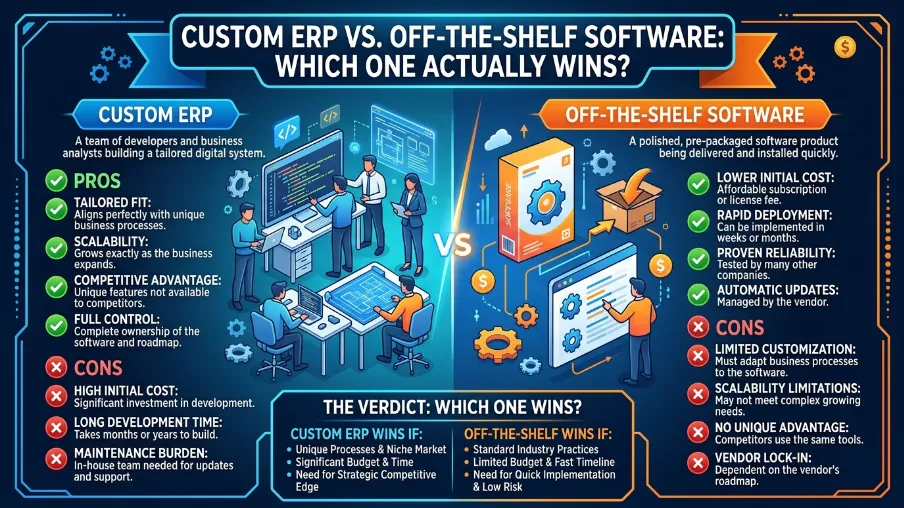
Here is my honest answer after everything I have walked you through.
There is no universal winner in the ERP vs custom development decision.
The business that wins is the one that makes this decision based on their specific reality: their workflows, their scale, their 5-year user projections, and their competitive differentiators. Not based on vendor marketing. Not based on what competitors seem to be doing. And definitely not based on sticker price alone.
If your processes are standard and your team is small, an off-the-shelf ERP is probably the right starting point. Off-the-shelf ERP software and off-the-shelf ERP solutions can provide reliable functionality, faster deployment, and lower initial investment for businesses that do not require deep customization.
If your processes are your competitive edge, you are scaling rapidly, or you have 100 or more users in your 3-year plan, Custom ERP software development will likely deliver stronger long-term value and outperform off-the-shelf options on a 5-year ROI basis. A tailored ERP system allows businesses to build around their unique workflows, operational requirements, and future growth plans.
If you fall somewhere in the middle, and honestly most businesses do, explore the low-code and no-code middle path before committing to either extreme. It is the option many decision-makers have not fully evaluated yet, and it is where a significant portion of smart ERP decisions are moving.
The global ERP market has grown 8% since 2022, and companies are expected to spend $147.7 billion in 2025. A significant amount of that investment will be spent poorly by businesses that commit without fully analyzing their operational needs, scalability, and long-term goals.
Do not be one of them.
Frequently Asked Questions: Custom ERP vs Off-the-Shelf Software
Q: Is custom ERP always more expensive than off-the-shelf?
No, not in the long run. Custom ERP carries a higher upfront cost of $100,000 to $400,000 compared to initial off-the-shelf licensing. But when you factor in annual subscription fees, hidden integration costs, customization charges, and weekly workaround losses, many businesses find custom ERP is cheaper over a 5-year total cost of ownership comparison.
Q: How long does custom ERP take to build?
Typically 6 to 12 months for a full custom ERP system. Simpler, well-scoped systems can be completed in 3 to 6 months. Low-code custom solutions can sometimes be deployed in as little as 8 to 12 weeks.
Q: Can I switch from off-the-shelf to custom ERP later?
Yes, but the migration is painful and expensive. Extracting your data from locked systems like SAP or Salesforce typically costs 2 to 3 times your annual subscription fee. The best time to plan your long-term ERP strategy is before you lock yourself in, not after two years of operation.
Q: What is the single biggest mistake businesses make when choosing ERP?
Comparing only the upfront price. The decision should always be grounded in Total Cost of Ownership across 5 years, not just what you pay on day one. The day-one price is often the least relevant number in the entire decision.
Q: Is off-the-shelf ERP a good fit for small businesses?
Yes, for early-stage businesses with standard processes and fewer than 50 users, off-the-shelf is often the right starting point. However, as your team grows and your processes become more specialized, you should revisit this decision every 2 to 3 years. What fits you at 20 employees rarely fits you at 200.

I’m Mitu Das, a JavaScript developer, ERP product architect, and SEO specialist from Bangladesh. I work at CyberCraft Bangladesh, where I help build simple, scalable software, SaaS platforms, and business solutions. My goal is to create technology that helps companies save time, automate daily tasks, and grow faster. I enjoy combining development, product ideas, and SEO strategies to create useful digital solutions for modern businesses.
Writes about
Want this done for you?
Our team builds and ships exactly what this article describes. Send a message and we will reply with a scope.