SMS vs WhatsApp Marketing in Bangladesh: Win Big in 2026

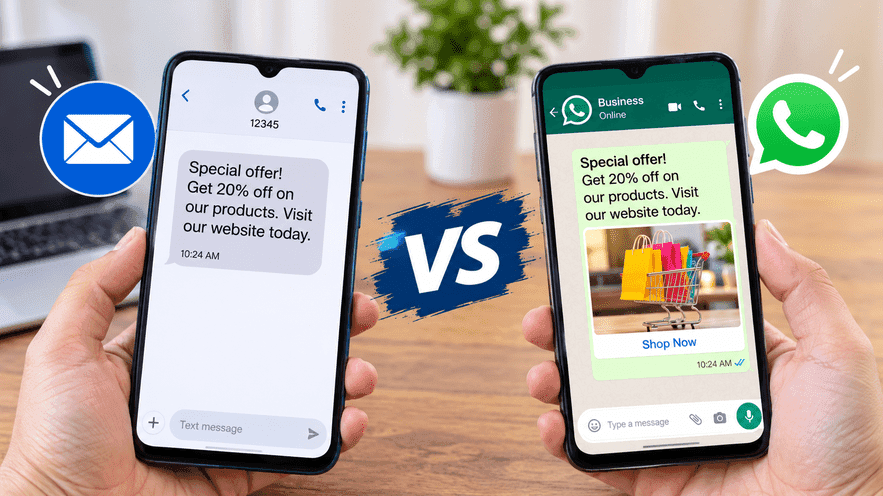
SMS vs WhatsApp marketing in Bangladesh is a head-to-head choice between two direct-message channels. One sends plain text through telecom networks, while the other delivers chat messages through WhatsApp Business. Both reach customers on their phones. However, they differ sharply in cost, rules, and results, making them important channels in a digital marketing strategy. This review ranks them side by side.
I built this comparison on November 14, 2026, using a document-and-arithmetic review plus an original cost model. Here is exactly how.
Tools used: I used web search and page fetching to find and read sources. I then ran my own cost model in Python and checked the results by hand. I did not use paid analytics tools or live sending accounts.
Sources reviewed:
audience data from DataReportal and NapoleonCat
SMS pricing from a local vendor, ServerBD
WhatsApp rates from Meta's pricing documentation and three partner pages
rules coverage from Telerivet, the Daily Star, and Business Insider Bangladesh
expert and official statements from the Daily Star, TBS News, and Developing Telecoms
How I evaluated: I followed five steps. First, I sized the audience. Second, I collected prices and cross-checked them across sources. Third, I read the rules for each channel and the views of named experts and regulators. Fourth, I ran the cost model described below. Fifth, I scored both channels against the criteria below.
Evaluation criteria: I judged each channel on six points: cost per message, reach without internet, rich media, two-way conversation, speed to launch, and rule burden. I also graded the evidence behind each claim. Official or press sources ranked above vendor pages.
Original analysis: The cost model uses sourced prices as inputs and tests them across three exchange rates, three SMS prices, four conversion rates, and three budgets. It is deterministic arithmetic, not a sample or survey. I show the formulas under each table so you can reproduce the numbers.
Expert sourcing: I did not interview anyone myself. I only attribute statements that named experts, regulators, and companies gave to the press. Job titles are as those outlets reported them, and some statements may predate 2026.
Scope: This review covers business messaging to Bangladeshi phone numbers, with prices current to October–November 2026. It covers the WhatsApp Business app and API. It does not cover Messenger, email, or voice.
Limitations: I have not run live SMS or WhatsApp campaigns, so I report no measured campaign results. The conversion rates in the model are scenarios, not observed data. I found no verified Bangladesh-only open-rate or response-rate study, so I left those percentages out. The WhatsApp rates come from partner pages rather than Meta's own rate card. Vendor prices change often.
Assumptions:
I used ৳120 per US dollar as the middle case and tested ৳110 and ৳125.
I treated ServerBD's prices as typical, though other vendors may differ.
I assumed each message is one SMS segment and one delivered WhatsApp template.
All "my estimate" and "original analysis" labels mark my own arithmetic.
Treat every number as a starting point, then see pricing from your own provider.
Table of Contents
SMS vs WhatsApp Marketing in Bangladesh: How Do the Two Channels Compare?
How Much Does Each Channel Cost, and Which Is Cheaper?
Which Channel Wins on Reach and Engagement?
What Rules and Compliance Costs Affect Your Channel Choice?
Which Is the Best Channel to Choose for Your Business?
Conclusion: Our Verdict and Best Next Step
FAQs: Pricing, Compliance and Choosing the Best Channel
Key Takeaways
SMS costs about ৳0.15 to ৳0.20 per message, so it is the best-value pick for wide promotions and alerts.
A WhatsApp marketing message costs about ৳10 from October 2026, but it supports rich, two-way chats.
BTRC rules shape SMS campaigns, including masking, aggregators, and Do Not Disturb lists.
Public open-rate data for Bangladesh is thin, so test both channels on your own list.
The best start for most small businesses is one channel, with the second added later.
SMS vs WhatsApp Marketing in Bangladesh: How Do the Two Channels Compare?
SMS marketing sends text messages through telecom operators using masking or non-masking sender IDs. WhatsApp marketing delivers template messages through WhatsApp Business, using either the free app or the paid API. In SMS vs WhatsApp marketing in Bangladesh, SMS stands out for its wider reach because it works on almost any phone, while WhatsApp offers deeper customer engagement but requires an internet connection and an installed app. Therefore, SMS wins on reach, while WhatsApp wins on engagement.
First, I sized up the audience. DataReportal reports 95.3 million internet users in Bangladesh at the end of 2026, which is 53.4 percent of the population. That figure grew by 1.1 million, or 1.2 percent, between October 2025 and October 2026. Meanwhile, the same DataReportal Bangladesh report counts 68.3 million social media user identities in October 2026, or 38.3 percent of the population.
However, WhatsApp is not the leading chat app here. NapoleonCat's 2026 data lists about 77 million Facebook users, 72.5 million Messenger users, and 11.4 million Instagram users in Bangladesh. On Facebook, 62.6 percent of users are men, and 39.5 percent are aged 18 to 24. You can check the NapoleonCat Bangladesh statistics yourself. I looked for a WhatsApp user count in both reports. Neither lists one, and my follow-up searches found no verified figure. Therefore, evidence suggests many customers still live on Messenger. SMS vs WhatsApp marketing in Bangladesh depends heavily on which customers you serve.
How Much Does Each Channel Cost, and Which Is Cheaper?
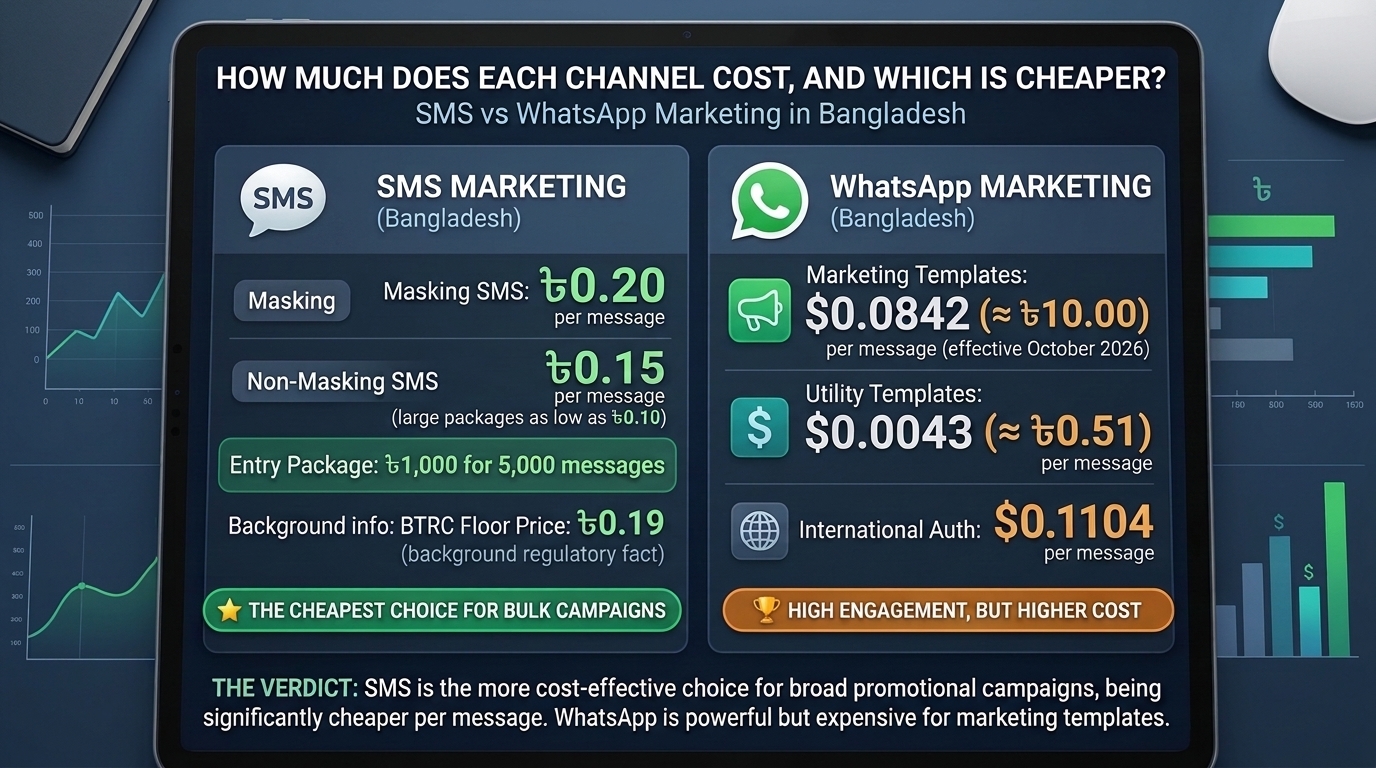
SMS is far cheaper per message. Vendors list masking SMS from about ৳0.20 and non-masking SMS from around ৳0.15. In the SMS vs WhatsApp marketing in Bangladesh comparison, WhatsApp marketing templates for Bangladeshi numbers cost $0.0842 each from October 2026, roughly ৳10, while utility messages cost only $0.0043. Therefore, SMS is the more cost-effective choice for businesses running broad promotional campaigns.
Start with SMS pricing. One local provider, ServerBD, lists masking SMS from ৳0.20 and non-masking from ৳0.15, with large prepaid packages as low as ৳0.10. Its entry package costs ৳1,000 for 5,000 messages. See pricing on the ServerBD page. For context, BTRC set a floor price of Tk 0.19 per SMS for operators selling bulk volume to aggregators, after operators had sold it as low as Tk 0.01. That directive appears in a SAMENA Council news item. When I put the two sources side by side, I noticed a mismatch. The vendor's ৳0.15 non-masking price sits below the older ৳0.19 floor. That suggests the floor is outdated or applies to a different layer of the market, so I treated it as background only.
Now look at WhatsApp pricing. Since July 1, 2025, WhatsApp charges per delivered template message. See pricing rules on Meta's page. A partner rate card lists Bangladesh marketing at $0.0842 and utility at $0.0043 from October 1, 2026. You can verify this in the Gallabox rate card. To cross-check, I compared it with two other sources. Another partner page lists the same Bangladesh figures of 0.08418 for marketing and 0.00426 for utility. Also, AiSensy notes that Bangladesh utility and authentication rates drop about 69 percent, while a new international authentication rate of $0.1104 is roughly 26 times the domestic rate. To weigh providers, compare plans in the AiSensy review. All three sources agreed, which raises my confidence. They are still partner pages, not Meta's own rate card.
How the exchange rate changes the gap
Method: I took the rates $0.08418 (marketing) and $0.00426 (utility). I multiplied each by three exchange rates. Then I divided by SMS prices of ৳0.15 and ৳0.20. Formula: WhatsApp taka price = USD rate × exchange rate. Multiple = WhatsApp taka price ÷ SMS price.
Exchange rate | WhatsApp marketing | WhatsApp utility | Marketing vs SMS at ৳0.15 | Marketing vs SMS at ৳0.20 | Utility vs SMS at ৳0.15 | Utility vs SMS at ৳0.20 |
|---|---|---|---|---|---|---|
৳110 per $ | ৳9.26 | ৳0.47 | 61.7× | 46.3× | 3.1× | 2.3× |
৳120 per $ | ৳10.10 | ৳0.51 | 67.3× | 50.5× | 3.4× | 2.6× |
৳125 per $ | ৳10.52 | ৳0.53 | 70.2× | 52.6× | 3.6× | 2.7× |
Result: WhatsApp marketing costs 46 to 70 times more per message than SMS across every pricing scenario I tested. For businesses comparing SMS vs WhatsApp marketing in Bangladesh, the difference becomes even greater at ServerBD's lowest bulk SMS price of ৳0.10, where WhatsApp marketing costs approximately 93 to 105 times more. However, WhatsApp utility messages cost only 2.3 to 3.6 times as much as SMS. The exchange rate also affects WhatsApp marketing costs, moving the price from ৳9.26 to ৳10.52, a difference of around 14%. Despite this variation, SMS remains the more affordable option in every pricing scenario.
What a budget buys on each channel
Method: Messages = budget ÷ price per message, rounded. I used ৳120 per dollar for WhatsApp.
Budget | SMS at ৳0.15 | SMS at ৳0.20 | WhatsApp utility | WhatsApp marketing |
|---|---|---|---|---|
৳1,000 | 6,667 | 5,000 | 1,956 | 99 |
৳10,000 | 66,667 | 50,000 | 19,562 | 990 |
৳50,000 | 333,333 | 250,000 | 97,809 | 4,950 |
Visualization: Messages bought with ৳10,000 (each █ is about 1,700 messages; ▏ is under one block):
SMS at ৳0.15          ████████████████████████████████████████  66,667
SMS at ৳0.20          ██████████████████████████████            50,000
WhatsApp utility      ████████████                              19,562
WhatsApp marketing    ▏                                            990
Result: The same ৳10,000 buys about 67 times more SMS messages than WhatsApp marketing messages at ৳0.15. That ratio matches the table above, which is a useful consistency check on the model.
Which Channel Wins on Reach and Engagement in SMS vs WhatsApp Marketing in Bangladesh?
SMS reaches almost every active SIM in Bangladesh, even without an internet connection. WhatsApp offers richer communication through chats, images, buttons, and quick replies, but it only reaches people who use the app and have opted in. When comparing SMS vs WhatsApp marketing in Bangladesh, remember that publicly available Bangladesh-specific open-rate data is limited. Treat claimed performance percentages with caution and test both channels with your own audience to identify which delivers better results.
An operator's own view supports the reach point. According to Developing Telecoms, Banglalink said most of its customers still use 2G devices, so SMS is the only way to reach them with new promotions. Read the Developing Telecoms report. This is a company statement, not an independent study, and the report does not give a date I could verify. Still, it fits the data above. WhatsApp needs a smartphone and data, while SMS does not.
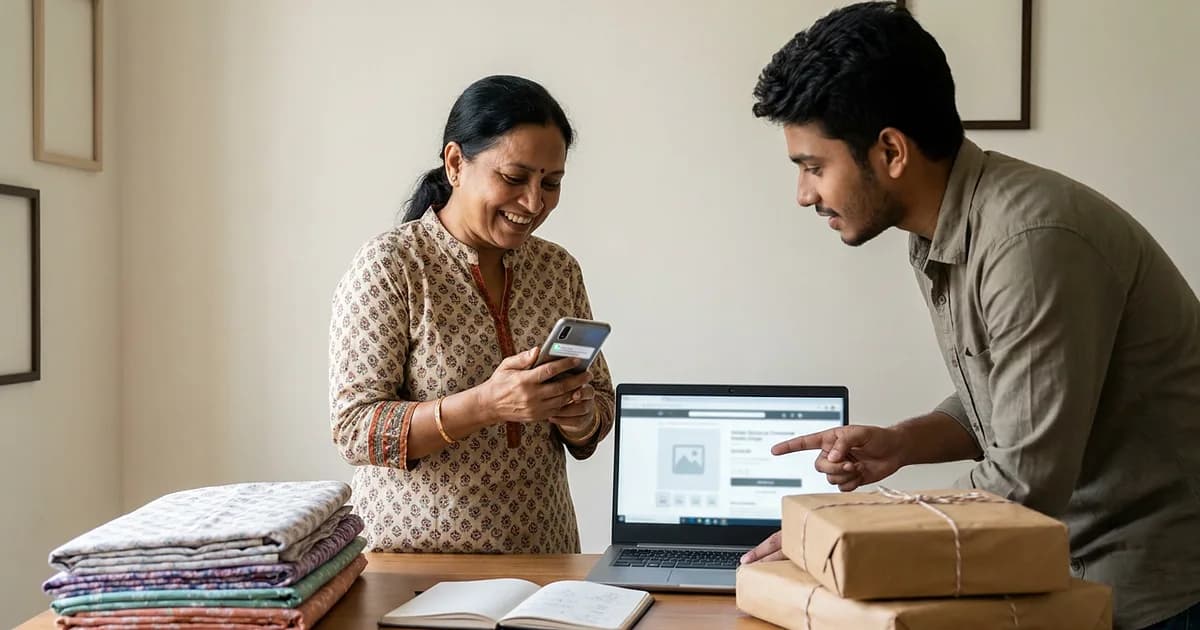
I searched specifically for a Bangladesh open-rate or response-rate study comparing both channels. After several differently worded searches, I found only vendor claims without clear methodology, so I left those percentages out. In practice, SMS vs WhatsApp marketing in Bangladesh is less about which channel performs better and more about choosing the right one for each purpose. SMS works well for OTPs, payment alerts, and delivery updates. WhatsApp is more useful when customers have questions before making a purchase. For example, a clothing shop can share a product catalog and answer sizing questions in one conversation. Meanwhile, banks and courier companies can use SMS to send short, urgent notices.
Both channels have trade-offs:
SMS advantages: wide reach, no app needed, low cost per message.
SMS disadvantages: short text, weak media support, and spam fatigue.
WhatsApp advantages: rich media, two-way chat, and better conversation history.
WhatsApp disadvantages: higher marketing fees, template approval, and lower local penetration.
This scorecard is my own assessment against the six criteria in the methodology block, not a measured result:
Criterion | SMS | Edge | |
|---|---|---|---|
Cost per promotional message | Very low | High | SMS |
Reach without internet | Full | None | SMS |
Rich media and catalogs | Minimal | Strong | |
Two-way conversation | Limited | Strong | |
Speed to launch | Fast | Slower (templates) | SMS |
Rule burden | Moderate | Moderate | Tie |
Two-way SMS also needs a different setup. Telerivet explains that Bangladesh splits SMS into masking and non-masking traffic, and that this shapes how programs run. Read the review of BTRC rules at Telerivet before building automation.
What Rules and Compliance Costs Affect Your Channel Choice?
When comparing SMS vs WhatsApp marketing in Bangladesh, businesses must understand the different compliance requirements. BTRC regulates SMS marketing, so you must send promotional messages through a BTRC-listed aggregator, respect the Do Not Disturb (DND) list, and never classify promotional messages as transactional. WhatsApp follows Meta's opt-in and message template policies instead. Always verify the latest requirements with your provider before launching a campaign.
Several details matter here. Business SMS must route through an aggregator that BTRC lists as an authorized A2P provider. Next, customers can block promotions. The Daily Star reports that subscribers can activate Do Not Disturb with codes such as 1211101# on Grameenphone, 1218*6# on Banglalink, and *7# on Robi. The details sit in this Daily Star business page from October 2024. Also, regulators watch content quality. Business Insider Bangladesh reported in March 2025 that BTRC wanted a content-vetting platform where only the regulator approves bulk SMS before delivery. See the Business Insider Bangladesh report.
Enforcement is real, even for large companies. Views Bangladesh reports that BTRC fined Grameenphone, Robi, and Banglalink Tk 5 lakh each, Tk 15 lakh in total, for excessive promotional SMS. See the Views Bangladesh report. If operators face fines, small senders should expect scrutiny too.
What experts and regulators say
Named voices in the press point in the same direction. I summarise each in my own words and add what it means for you.
ICT expert Sumon Ahmed Sabir told TBS News that sharing consumers' details without their consent breaks consumer rights. He described sharing consumer information without consent as a violation of consumer rights. Read it in the TBS News report. What it means for you: build your own opt-in list. Do not buy phone number lists.
Telecom expert Md Rokunuzzaman told The Daily Star that authorities tend to react only after the public complains, and that they should study the problem first. He said authorities should conduct a study before acting. See The Daily Star's report on unwanted texts. What it means for you: expect rules to change in waves, so recheck them every quarter.
BTRC Chairman Shyam Sunder Sikder told The Daily Star that the commission planned to restore order in the promotional SMS segment through a proper guideline. The chairman said BTRC planned to bring order to the segment through a proper guideline. The same Daily Star report notes there is no official data on how many promotional messages subscribers receive. What it means for you: tighter guidelines are the stated direction, so keep promotions clearly separate from alerts.
Telecom expert Abu Nazam M Tanveer Hossain told The Daily Star that strict enforcement is essential, but rules should also be logical, practical, and valuable. He said regulations must be logical, practical, and add value, alongside strict enforcement. Read the Daily Star fines report. What it means for you: operators and regulators still disagree on how strict the rules should be, so check the latest notice before each campaign.
These rules carry hidden costs. A Do Not Disturb block shrinks your SMS audience, while a rejected WhatsApp template can delay an entire campaign. One detail stood out while reviewing the compliance guidelines: routing a promotional message through a transactional category can put your entire messaging route at risk, not just one message. When comparing SMS vs WhatsApp marketing in Bangladesh, remember three important points about WhatsApp Business: Meta decides your message category, marketing templates require approval, and accounts receiving frequent blocks can face messaging limits. Therefore, collect clear customer consent before sending promotional messages through either channel.
Which Is the Best Channel to Choose for Your Business?
For businesses in Bangladesh, the choice in SMS vs WhatsApp marketing in Bangladesh depends on your goals and budget. Choose SMS for OTPs, delivery alerts, and wide, low-cost reach. Choose WhatsApp for customer conversations, product catalogs, and support. Most small businesses should start with one channel, measure results for 30 days, and then combine both in a single marketing strategy.
Break-even conversion
Method: Cost per order = price per message ÷ conversion rate. WhatsApp must match SMS on cost per order, so required WhatsApp conversion = SMS conversion × (WhatsApp price ÷ SMS price). I used ৳120 per dollar and four SMS conversion scenarios. These conversion rates are illustrative inputs, not measured data.
SMS conversion (scenario) | SMS cost per order at ৳0.15 | WhatsApp conversion needed to match | SMS cost per order at ৳0.20 | WhatsApp conversion needed to match |
|---|---|---|---|---|
0.25% | ৳60 | 16.8% | ৳80 | 12.6% |
0.5% | ৳30 | 33.7% | ৳40 | 25.3% |
1.0% | ৳15 | 67.3% | ৳20 | 50.5% |
2.0% | ৳7.50 | 134.7% (impossible) | ৳10 | 101.0% (impossible) |
Visualization: WhatsApp conversion needed at an SMS price of ৳0.15 (each █ is about 3.4 percentage points):
SMS converts 0.25%   █████                                       16.8%
SMS converts 0.5%    ██████████                                  33.7%
SMS converts 1.0%    ████████████████████                        67.3%
SMS converts 2.0%    ████████████████████████████████████████    134.7% (above 100%)
Result: In the context of SMS vs WhatsApp marketing in Bangladesh, once SMS converts above roughly 1.5% at ৳0.15 per message or 2% at ৳0.20, WhatsApp marketing cannot match its cost per order because it would require a conversion rate of more than 100%. At a 0.5% SMS conversion rate, WhatsApp needs approximately 25% to 34% conversion to remain competitive. This is a high benchmark for cold promotions but more realistic for warm, opted-in chat leads. Therefore, use WhatsApp marketing templates for smaller, high-intent customer lists.
Four ways to spend on 20,000 messages a month
Method: Monthly cost for 20,000 messages at ৳0.15 per SMS, with ৳10.10 for WhatsApp marketing and ৳0.51 for WhatsApp utility.
Plan | Mix | Monthly cost | Versus all-SMS |
|---|---|---|---|
A | 20,000 SMS promotions | ৳3,000 | 1.0× |
B | 18,000 SMS promotions + 2,000 WhatsApp marketing | ৳22,903 | 7.6× |
C | 20,000 WhatsApp marketing | ৳202,032 | 67.3× |
D | 18,000 SMS promotions + 2,000 WhatsApp utility alerts | ৳3,722 | 1.2× |
Result: When comparing SMS vs WhatsApp marketing in Bangladesh, Plan D offers a more affordable way to combine both channels. It provides two-way WhatsApp order updates for only around ৳722 more per month than the all-SMS plan, a 24% increase. However, shifting just 10% of messages to WhatsApp marketing under Plan B increases the monthly bill by 7.6 times. So, a practical cost-saving approach is to use SMS for promotions and WhatsApp for order updates and other utility messages. This estimate assumes all 2,000 WhatsApp messages qualify as utility messages under Meta's categories, but Meta makes the final classification decision.
My assessment by business type, based on the cost and feature data above:
Courier and delivery firms: SMS first, because alerts are short and volume is high.
Banks and fintech apps: SMS for OTPs and alerts, since it works without data.
Fashion and F-commerce shops: WhatsApp for catalogs and sizing chats, SMS for sale announcements.
Clinics and coaching centres: SMS for reminders, WhatsApp for follow-up questions.
Use this five-step checklist to compare channels:
Write down one goal, such as repeat customers, fewer missed deliveries, or faster support.
Build an opt-in list from forms, chat, and in-store sign-ups.
Shortlist a BTRC-listed SMS aggregator and, if needed, a WhatsApp API provider.
Send the same offer on both channels to similar customer groups.
Compare cost per result, not just clicks or replies.
For bulk SMS marketing in Bangladesh, small shops often start with ৳1,000 packages and simple offers. Meanwhile, WhatsApp suits shops with fewer, high-intent leads. In most cases, a mixed plan works best. Use SMS to announce, and use WhatsApp to talk.
If you want help running this test, CCBD offers two related services. You can order a custom chatbot and AI automation setup for customer chats. You can also try QuickGrow AI, CCBD's multi-channel marketing automation platform.
Conclusion: Our Verdict and Best Next Step
SMS vs WhatsApp marketing in Bangladesh has a clear verdict for most businesses. SMS is the best-value channel for promotions and alerts. WhatsApp is the best channel for conversations and support. This comparison shows SMS costs about ৳0.15 to ৳0.20 per message, while a WhatsApp marketing message costs about ৳10, or 46 to 70 times more in my model. Remember the limits of my method: this verdict rests on documents, press-reported expert views, and modelled arithmetic, so your own test should have the final word.
Here is how to choose:
Choose SMS if you send offers, OTPs, or delivery alerts to a large list on a tight budget.
Choose WhatsApp if you sell through chat, share catalogs, or answer many pre-sale questions.
Choose both once monthly results justify the higher WhatsApp fees. In most cases, that comes second.
Your best next step is simple. Shortlist BTRC-listed aggregators and ask each for a written price quote. A ৳1,000 package covers about 5,000 messages at the vendor price above. The same ৳1,000 covers only about 99 WhatsApp marketing messages in my model. This cost difference is an important factor when comparing SMS vs WhatsApp marketing in Bangladesh. Use SMS for broader reach and save WhatsApp marketing for high-intent leads. Also, follow the consent-first advice from the experts above.
After 30 days, keep the channel with the lowest cost per result. Add the WhatsApp API only when chat volume grows. Ready to move forward? Get started with CyberCraft Bangladesh, see pricing through a free quote, or buy a done-for-you marketing automation setup.
FAQs About SMS vs WhatsApp Marketing in Bangladesh
Is SMS or WhatsApp cheaper for small businesses in Bangladesh?
SMS is usually cheaper. Vendors list bulk SMS from roughly ৳0.10 to ৳0.20, while a WhatsApp marketing template costs about ৳10 from October 2026. However, WhatsApp utility messages cost far less. When comparing SMS vs. WhatsApp marketing in Bangladesh, small businesses should consider SMS for wide promotions and WhatsApp for smaller, high-intent customer lists.
Does bulk SMS in Bangladesh need BTRC compliance?
Yes, in most cases. BTRC expects business SMS to travel through an authorized A2P aggregator. Therefore, check your provider's BTRC listing before you commit to a package. Also, keep promotional and transactional traffic separate, because misclassifying messages can lead to route suspension, according to Telerivet's compliance guide.
Can I use the WhatsApp Business app instead of the API?
Yes, for small volumes. The free WhatsApp Business app handles catalogs, labels, and quick replies. However, it limits automation and bulk sending. The API supports templates, chatbots, and campaigns at scale, but it needs Meta approval and per-message fees. Therefore, start with the app and upgrade when volume grows.
Which has the better open rate, SMS or WhatsApp?
No trustworthy Bangladesh-only study settles this. Global vendors often claim SMS and WhatsApp both beat email, but their numbers vary widely. Therefore, run a small A/B test with your own customers and compare reply rates, clicks, and results instead of trusting a headline percentage. This approach helps businesses make a more informed decision about SMS vs WhatsApp marketing in Bangladesh.
Do I need customer consent for these campaigns?
Yes, get opt-in first. WhatsApp requires customer permission before you send marketing templates, and Meta can restrict accounts that get many blocks or reports. For SMS, BTRC's Do Not Disturb system lets people block promotions. Therefore, collect clear consent on forms, in chat, or in store.

I’m Mitu Das, a JavaScript developer, ERP product architect, and SEO specialist from Bangladesh. I work at CyberCraft Bangladesh, where I help build simple, scalable software, SaaS platforms, and business solutions. My goal is to create technology that helps companies save time, automate daily tasks, and grow faster. I enjoy combining development, product ideas, and SEO strategies to create useful digital solutions for modern businesses.
Writes about