
AI Chatbot vs Live Chat Support: Which One Actually Wins in 2026

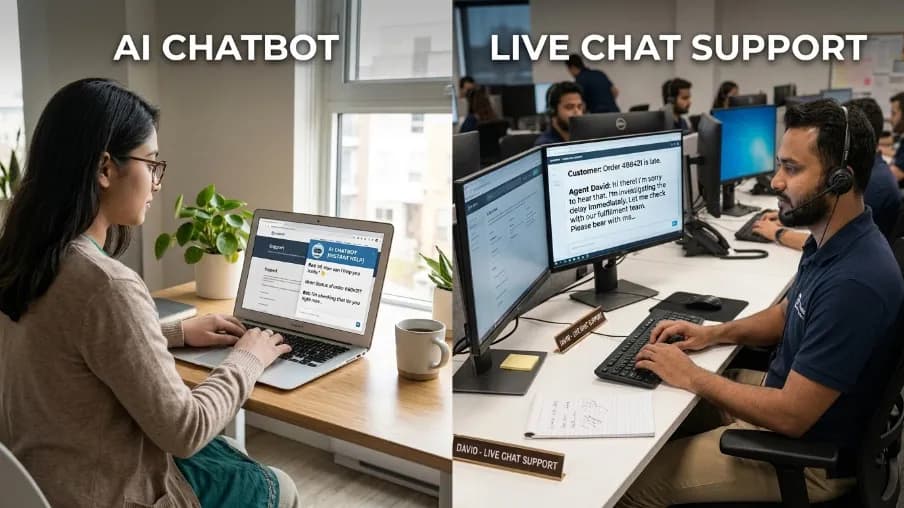
Quick answer: AI chatbot vs live chat support refers to the choice between automated, instant customer responses and human-led conversations. Most businesses do best with a hybrid setup: use an AI chatbot vs live chat support decision framework where the bot handles repetitive questions and a human takes anything complex or high-stakes. The full comparison, costs, and decision framework are below.
By Mitu Das, specializing in SEO and content strategy, for CyberCraft Bangladesh. Published: July 26, 2026
Jump to: What Is an AI Chatbot? · What Is Live Chat? · Side-by-Side Comparison · Pros & Cons · Hybrid Model · How to Choose · FAQ
Key Takeaways
AI chatbots win on speed, cost, and availability: They cost roughly $0.50–$0.70 per conversation, versus $6–$15 for a human-handled one. They also run 24/7.
Live chat wins on trust and complex issues: Live chat satisfaction sits around 85%, according to Statista and Zendesk data. Only phone support scores higher.
Adoption is accelerating fast: AI-agent adoption in customer service rose from 39% in 2025 to 66% in 2026, according to Salesforce's State of Service report.
Hybrid setups outperform either alone: Pairing AI with a smooth handoff to a human pushes satisfaction to 92%. AI-only interactions land around 80%.
The right choice depends on your ticket mix: If most of your volume is repetitive, lean chatbot-first. If it's high-stakes or emotional, lean human-first. That's the core logic behind every AI chatbot vs live chat support decision.
The Verdict: AI Chatbot vs Live Chat Support
For most growing businesses, the AI Chatbot vs Live Chat Support question isn't an either/or decision. Use a chatbot for repetitive, low-stakes questions like order status and pricing. Send anything complex, emotional, or high-value to a live agent. Pure chatbot-only works if your support volume is small and low-stakes. Pure live-chat-only works too, but only if your volume is low and every interaction needs a personal touch. Most businesses land somewhere in between. That's where a hybrid model wins.
Let me guess why you're here. You're staring at your customer support setup. Tickets are piling up. Your team is tired. Someone on your team just said, "Maybe we need a chatbot." Someone else said, "No, customers hate bots. We need more live agents."
That's when the AI Chatbot vs Live Chat Support debate usually begins. Choosing the right option isn't always as simple as it seems.
I've heard this exact debate more times than I can count. Here's the honest answer: you don't have to pick a side.
In this guide, I'll walk you through what AI chatbots do well and where live chat does better. Then I'll show you how the smartest businesses in 2026 are blending both. I'll also cover how AI automation can reduce manual work well beyond the chat window. By the end, you'll know which setup fits your business, your budget, and your customers.
Let's get into it.
What Is an AI Chatbot?
Quick answer: An AI chatbot is software that uses artificial intelligence and natural language processing to talk with website visitors, answer questions from a knowledge base, and handle simple tasks like order tracking. It runs 24/7 and costs roughly $0.50–$0.70 per conversation, versus $6–$15 for a human agent.
How AI Chatbots Work?
An AI chatbot is software that uses artificial intelligence to talk with website visitors. It relies on natural language processing to understand what people mean. Unlike older rule-based bots, AI chatbots understand what a user actually wants. They answer questions from a knowledge base. They can also handle tasks like tracking orders, scheduling appointments, or guiding customers through a service.
Modern AI chatbots provide support 24/7. As a result, this cuts down the need for human agents to handle repetitive questions.
What They Do Well?
Here's what AI chatbots genuinely do well:
They never sleep. A chatbot answers at 3 AM the same way it does at 3 PM.
They answer instantly. No hold music. No "please wait, an agent will be with you shortly."
They cost less per conversation. Industry data puts AI chatbot interactions at roughly $0.50 to $0.70 each. Human-handled interactions run $6 to $15.
They scale without hiring. One chatbot can handle thousands of chats at once. Your support team can't.
For example, IBM research suggests AI chatbots can handle up to 80% of routine tasks and customer inquiries. That frees human agents to focus on harder problems. That's not a small number. It's most of your support volume, handled without a single human typing a reply.
Where They Fall Short?
However, chatbots aren't magic. They struggle with nuance, emotion, and anything outside their training data. Ask a bot a question it wasn't built for, and you'll get stuck in a loop. It just keeps saying, "I'm sorry, I didn't understand that." This is one half of the equation. It's also the half most businesses reach for first.
What Is Live Chat Support?
Quick answer: Live chat support is a real-time text channel that connects website visitors with a human agent. It resolves complex, emotional, or high-value questions better than a bot, with an average satisfaction rating around 85–88%, but it costs $6–$15 per conversation and needs staffed coverage.
How Live Chat Work?
Live chat support is a real-time channel. It lets website visitors talk with a support agent through text. It helps businesses answer questions, resolve issues, and guide customers while they browse. Unlike email, live chat gives you immediate two-way communication. That makes it useful for fast help and for capturing leads.
Why It Still Matters
Here's why live chat still matters, even in an AI-first world:
People trust humans with complicated problems: A billing dispute or a refund appeal needs empathy, not a script.
Live chat converts better: Visitors who chat with a live agent are far more likely to buy. A real person can answer follow-up questions naturally. That builds trust in the moment.
Customers still prefer it, for now: Research shows a large share of people still say they prefer human support, especially for anything personal or high-stakes. The American Customer Satisfaction Index puts live chat's average rating at 88%, the highest of any digital support channel.
The Trade-Off
That said, the catch is cost. Live chat needs trained agents, shift coverage, and management. Agents can also only handle one or two conversations at a time. They can't scale the way a bot can. That's the other half of the equation. It's the side most businesses assume they still need.
AI Chatbot vs Live Chat Support: Real Comparison
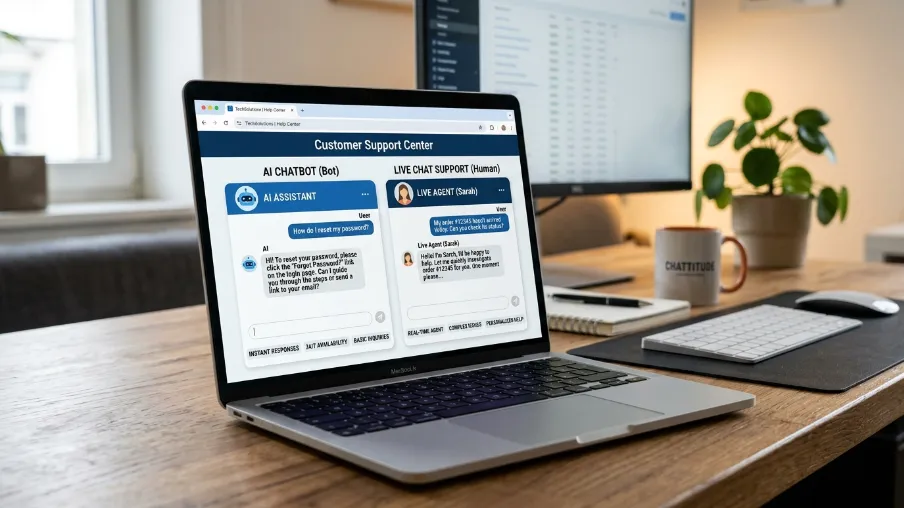
Let's put AI Chatbot vs Live Chat Support side by side. This is what most people are actually trying to figure out when choosing the right customer support solution for their business.
Speed and Availability: Which Wins for Your Business
Chatbots answer in seconds, 24/7, every day of the year. Live chat depends on staffing. It's great during business hours, but slower at night or during a rush. If speed matters most for simple questions, chatbots win here without much argument.
Cost Comparison: AI Chatbot vs Live Chat Pricing
This one isn't close. AI chatbots are dramatically cheaper per conversation than human agents. In fact, that gap only grows as your support volume grows. If you're a small business on a tight budget, chatbot support is the more sustainable starting point.
Accuracy on Complex Issues: Where Live Chat Still Wins
Here's where live chat pulls ahead. Complicated, multi-part, or emotionally charged issues still need a human. For instance, bots can misread intent, or give a technically correct but unhelpful answer. For anything involving money, trust, or frustration, a live agent handles it better.
Customer Satisfaction: Which Option Do Customers Prefer?
Quick answer: Live chat satisfaction sits around 85%, second only to phone support at 91%. AI chatbots score lower alone, around 80%, but hybrid setups that hand off to a human reach 92%, higher than either channel on its own.
This is the most interesting part of the debate. The data tells a nuanced story. Live chat satisfaction sits around 85%. Only phone support scores higher, at 91%, according to Statista and Zendesk data. Meanwhile, other research shows about 80% of users who talk with AI chatbots report a positive experience. Organizations that pair AI with a smooth handoff to a human see even higher approval. Their satisfaction rate reaches 92% when AI escalates properly to a person.
The pattern is clear. Chatbots satisfy people when the question is simple. Live agents satisfy people when the question is hard. Satisfaction improves most when the routing is right. It's not about picking bot or human. Instead, it's about sending the right question to the right channel.
Conversion and Sales Impact: Which Drives More Revenue
Quick answer: Live chat drives more revenue. Chatters are roughly 2.8x more likely to convert than non-chatters and spend about 60% more per order, according to Forrester and ICMI. Chatbots support sales too, mainly by answering quick product questions before cart abandonment, but rarely close bigger deals alone.
Live chat has a strong track record here. According to Forrester and ICMI research, chatters are roughly 2.8x more likely to convert than visitors who don't chat, and they spend about 60% more per order. Chatbots support sales too, mostly by answering quick product questions before someone abandons their cart. Still, the human touch tends to close bigger deals.
AI Chatbot vs Live Chat Support: At a Glance
Factor | AI Chatbot | Live Chat | Recommended If... |
|---|---|---|---|
Speed | Instant, 24/7 | Fast during staffed hours only | You need instant answers around the clock → Chatbot |
Cost per conversation | ~$0.50–$0.70 | ~$6–$15 | Budget is tight and volume is high → Chatbot |
Best for | Repetitive, simple questions | Complex, emotional, high-value issues | Your issues are sensitive or high-stakes → Live Chat |
Scalability | Unlimited concurrent chats | Limited by agent headcount | You get sudden traffic spikes → Chatbot |
Customer trust | Lower for sensitive issues | Higher for sensitive issues | Trust is your top priority → Live Chat |
Conversion impact | Moderate (quick product Q&A) | Strong (can close bigger deals) | You sell high-ticket items → Live Chat |
Availability | Always on | Business hours, or with shift coverage | You need 24/7 coverage without hiring → Chatbot |
Use this as a quick gut-check. The more rows lean toward "Live Chat" for your business, the more you should weight your setup toward human coverage, and vice versa.
Pros and Cons : AI Chatbot vs Live Chat Support
AI Chatbot
Pros:
Instant, 24/7 responses
Roughly 10x cheaper per conversation than a human agent
Scales without hiring
Cons:
Struggles with nuance and emotion
Lower customer trust for sensitive issues
Needs a strong knowledge base to be useful at all
Live Chat
Pros:
Higher trust for complex or sensitive issues
Stronger conversion on high-value sales
Can de-escalate frustrated customers
Cons:
Limited by agent headcount and shift coverage
Costs $6–$15 per conversation, versus under $1 for a bot
Slower response outside business hours
AI Chatbot Benefits: Is It Right for Your Business?
Quick answer: An AI chatbot is right for your business if most of your support volume is repetitive, your budget is tight, or you're losing customers who message outside business hours. It's the wrong fit if your issues are mostly complex, emotional, or high-value.
If you're on the fence, here's why so many businesses are adopting chatbots right now:
Cost savings: Fewer routine tickets means a leaner support team, without dropping quality on simple questions.
Round-the-clock coverage: You stop losing customers who message you outside business hours.
Consistency: A bot never has a bad day, and it never gives two different answers to the same question.
Instant scale: A viral post or holiday sale spike won't overwhelm a bot the way it overwhelms a small team.
Data collection: Every chatbot conversation is a data point you can use to improve your FAQs, products, and website.
AI Chatbot Adoption: The Data Behind the Decision
The shift toward AI-first support isn't a maybe anymore. Here are a few numbers worth knowing:
80% of companies are either using or planning to adopt AI-powered chatbots for customer service, according to Gartner.
AI-agent adoption in customer service rose from 39% in 2025 to 66% in 2026. That's a 1.7x jump in a single year, per Salesforce's State of Service report.
68% of consumers report having used an automated customer service chatbot, according to Ipsos.
Intercom's Fin AI reportedly resolves 81% of support volume for the businesses using it, according to Intercom's own reporting.
"Agentic AI in customer service has moved from promise to proof." — Kishan Chetan, EVP & GM, Agentforce Service, Salesforce, on the State of Service: AI Agents Edition report
These numbers all point the same direction: chatbots have moved from experimental to expected. That doesn't mean live chat is obsolete, though. It means the starting point for most support decisions has shifted.
Live Chat Benefits: Why It's Still Worth the Investment
Live chat isn't old news. It's still one of the top-rated support channels out there, and for good reason:
Higher trust. People relax when they know a real person is listening.
Better for high-stakes moments. Refunds, complaints, and confusing issues get resolved faster with a human who can think on their feet.
Stronger conversions. A knowledgeable agent can turn a hesitant browser into a buyer.
Emotional intelligence. Bots can't truly de-escalate an angry customer. A trained agent can.
Flexibility. Agents can bend the rules when it makes sense, something a bot's programming usually won't allow.
AI Chatbot vs Live Chat Support: Hybrid Model
Here's the honest truth: AI Chatbot vs Live Chat Support is a bit of a false choice in 2026. The businesses winning at customer experience aren't picking one. They're combining both. This hybrid approach is the biggest shift happening in customer support right now.
A large share of businesses now run live chat and AI chatbots together to speed up replies. In fact, many industry leaders expect generative AI to handle the bulk of routine interactions within a few years, Salesforce projects AI will handle 50% of all customer service cases by 2027, up from 30% today. Meanwhile, humans stay firmly in charge of anything complex or sensitive. Customer expectations are rising too: Zendesk's 2026 CX Trends report found 74% of consumers now expect 24/7 service, and 88% expect faster responses than they did just a year ago.
Here's what a smart hybrid setup usually looks like:
Tier 1: The AI chatbot greets the visitor, answers FAQs, checks order status, and gathers basic details.
Tier 2: Smart handoff. If the bot can't resolve it, or the customer asks for a human, it passes the full history to a live agent. No repeating yourself.
Tier 3: A live agent steps in for anything emotional, high-value, or outside the bot's scope.
This setup gives you the speed and cost savings of automation. It also gives you the trust and judgment of a real person, exactly where it matters most.
An Illustrative Scenario (Hypothetical)
To make this concrete, here's a hypothetical walkthrough of how a hybrid rollout typically plays out. This is an illustrative example, not a real client case.
The problem: A mid-sized online retailer gets around 200 support tickets a day. Most are simple: order status, return policy questions, sizing. But the support team of three is drowning, and response times have slipped to several hours during peak season.
The approach: The business adds an AI chatbot to handle the top 10 most common questions, like order tracking, returns, and shipping times. It also sets a clear escalation rule. Any message with words like "refund," "damaged," or "cancel" routes straight to a human, along with the full chat transcript.
The likely result: The chatbot picks up the repetitive, low-stakes volume. The three-person team spends its time on the smaller number of tickets that actually need judgment. They're no longer typing "your order ships in 3-5 days" fifty times a day.
The lesson: The win isn't replacing the team. It's protecting their time for conversations that need a human, while the bot absorbs the repetitive load.
Beyond Chat: Getting More ROI From Your Support Stack
From Chat to Full Automation
Here's something most people miss when comparing AI Chatbot vs Live Chat Support: the conversation is just the front door. The real win comes from what happens behind it.
Good AI support doesn't stop at answering a question on your website. It reduces manual work across your whole support process, not just the chat window. Once a chatbot finishes a conversation, that data doesn't have to sit there. Instead, it can trigger the next step automatically, such as creating a support ticket, updating customer records, qualifying a lead, or sending the conversation to a human agent when needed.
Real Examples
A few examples worth knowing:
Automated email routing: No one has to manually read every inbound email and forward it to the right department anymore. AI can read the message, understand what it's about, and send it straight to billing, sales, or tech support.
Workflow automation for tickets: When a chatbot can't resolve an issue, it doesn't just dump a raw transcript on an agent's desk. Instead, it can tag the ticket, set the priority, and route it to the right team. Agents open a ticket already knowing what's going on.
Follow-ups and reminders: AI can automatically send a follow-up message, a satisfaction survey, or a status update, without anyone on your team lifting a finger.
Why This Matters?
This is where automation earns its keep, especially when comparing AI Chatbot vs Live Chat Support. It's not just about replacing a human in a chat window. It's about removing repetitive manual steps throughout your support process. That way, your team spends more time on conversations that need real judgment instead of copy-pasting, sorting, or forwarding messages by hand.
Ultimately, if your team is still manually routing emails or tagging tickets, that's usually the first place to start automating, even before you change your live chat setup. This approach helps you build a more efficient support system while keeping human agents focused where they add the most value.
How to Choose?
Answering this question for your own business comes down to three questions.
1. What kind of questions do you get most? If 70% of your tickets are repetitive, like order status, hours, pricing, or returns policy, an AI chatbot will save you real money fast.
2. What's your budget and team size? Small teams benefit most from automation, since it covers gaps without new hires. Larger teams with complex products often need both.
3. How emotional or high-value are your interactions? Selling a $10 product? A bot is probably fine. Selling a $10,000 service, or dealing with unhappy customers? You need a real human ready to step in. For context, Kayako's research found 41% of consumers rank live chat as their preferred support channel, ahead of phone (32%) and email (23%) — a signal of how much weight people put on real-time human contact for the interactions that matter most to them.
If you're still unsure, start with a chatbot for FAQs. Keep live chat as your safety net. You can always adjust the split once you see real data from your own customers.
Common Mistakes That Waste Your Support Budget
Getting this balance wrong usually shows up in a few common ways. I've seen these mistakes over and over, so let's avoid them:
Making the bot pretend to be human. Customers dislike this. Be upfront that they're chatting with AI. Honesty builds trust faster than pretending.
No easy way to reach a person. If a customer types "talk to a human" and gets stuck in a loop, you'll lose them. Always offer a clear escalation path — Zendesk's CX Trends research found 70% of customers expect anyone they interact with, bot or human, to have full context of their issue.
Using a chatbot with a thin knowledge base. A bot is only as good as the information behind it. Garbage in, garbage out.
Ignoring live chat during peak hours. If your bot escalates to a live agent who's overwhelmed, the customer waits anyway. Staff for your busiest hours.
AI Chatbot vs Live Chat Support: Method & Scope
This guide was compiled through a comparative review of publicly available industry research on AI chatbots and live chat support. Figures were cross-checked across multiple sources rather than pulled from a single publisher.
Sources used: Data points are drawn from Gartner, Salesforce's State of Service report, Statista, Zendesk, IBM, Ipsos, and Intercom's own reporting, each linked inline where cited above.
Evaluation criteria: This comparison is built around five factors that consistently show up across industry benchmarks: speed and availability, cost per conversation, accuracy on complex issues, customer satisfaction, and conversion impact.
Scope and limitations: Cost and satisfaction figures cited here are industry aggregates, not a controlled study. They will vary by industry and ticket complexity. They also depend on how well a chatbot is trained on a company's own knowledge base. The illustrative scenario earlier in this guide is a hypothetical walkthrough built from common patterns in the cited sources. It is not an audited or company-specific case.
Assumptions: This guide assumes a general small-to-midsize business context. Enterprise deployments and regulated industries like finance or healthcare may see different results. So might highly technical products.
Conclusion: Which Option Should You Choose?
Quick answer: Choose an AI chatbot for repetitive, low-stakes volume on a tight budget. Choose live chat for complex, high-value, or emotional interactions. Choose a hybrid setup, chatbot first with a smart handoff to a human, if your ticket mix includes both, which is true for most businesses.
If you've read this far, you already know where you land:
Repetitive, low-stakes volume, tight budget? Start with an AI chatbot. It pays for itself fast.
Complex, high-value, or emotionally sensitive interactions? Prioritize live chat, even if it costs more per conversation.
A mix of both? Most businesses fall here. Build the hybrid model outlined above: chatbot for Tier 1, smart handoff to a human for anything it can't resolve.
The decision doesn't have to be perfect on day one. Start with a chatbot covering your top 10 FAQs, keep live chat as the safety net for everything else, and adjust the split as real ticket data comes in.
Ready to do this? Contact CyberCraft Bangladesh to help businesses build the right AI chatbot vs live chat support hybrid system, matched to their ticket volume, customer needs, and budget.
FAQs About AI Chatbot vs Live Chat Support
What is the difference between AI Chatbot vs Live Chat Support?
AI Chatbot vs Live Chat Support compares automated AI-powered customer service with human-led support. AI chatbots answer common questions automatically, while live chat connects customers with human agents.
Is AI chatbot better than live chat support?
Neither is universally "better." AI chatbots win on speed, cost, and 24/7 availability for simple, repetitive questions. Live chat wins on trust, empathy, and handling complex or emotional issues, with satisfaction rates around 85–88%. The best comparison for most businesses usually ends with a blend of both, not a single winner.
Do customers prefer live chat or AI chatbots?
It depends on the question. For quick answers, most people are fine with a bot, especially if it resolves the issue fast. For anything complicated or personal, people still strongly prefer a human. That's exactly why a hybrid model works best.
How much does AI chatbot support cost compared to live agents?
AI chatbot interactions typically run far cheaper per conversation than human-handled ones. That's because one bot can manage unlimited conversations at once. Live agents cost more per conversation, but they add value on complex or high-stakes issues that a bot might mishandle.
Can a chatbot fully replace live chat support?
Not yet, and probably not soon. Chatbots handle routine questions well, resolving up to 80% of them according to IBM, but they still struggle with nuance, empathy, and unusual problems. Most businesses keep live chat available as a backup, even when a chatbot handles first contact.
What's the best way to combine AI chatbot and live chat?
Let the AI chatbot handle first contact and routine questions. Then set up a smooth handoff to a live agent for anything complex, emotional, or high-value. Make sure the agent can see the full chat history. That way, customers never repeat themselves.

I’m Mitu Das, a JavaScript developer, ERP product architect, and SEO specialist from Bangladesh. I work at CyberCraft Bangladesh, where I help build simple, scalable software, SaaS platforms, and business solutions. My goal is to create technology that helps companies save time, automate daily tasks, and grow faster. I enjoy combining development, product ideas, and SEO strategies to create useful digital solutions for modern businesses.
Writes about