
Power-SEO Open-Source SEO Tool Case Study: How Moved From Page 2 to Page 1


The Power-SEO open-source SEO tool is a free, modular toolkit for JavaScript and TypeScript developers who want to manage technical SEO, metadata, structured data, sitemaps, and website audits within their codebase. This review explains its features, package options, benefits, limitations, and differences from paid SEO platforms using Google Search Console data from a production website.
After adopting Power SEO on CyberCraft Bangladesh in August 2026, I observed an increase in daily impressions from 1,124 to 2,733 and an improvement in impression-weighted average Google position from 13.05 to 8.89. However, clicks per day increased only slightly across the full comparison periods, and these results do not prove that the toolkit alone caused the changes.
In this guide, I'll explain how I measured the results, which keywords gained visibility, what the toolkit offers for React and Next.js projects, and where paid SEO tools remain useful. If you're comparing free open-source SEO tools for developers, this case study will help you evaluate whether Power SEO fits your technical requirements and budget.
About the Author
Written by: Mitu Das, SEO Specialist and Web Developer. I have worked in SEO and content writing since 2024, focusing on technical SEO, JavaScript SEO, React, Next.js, metadata, structured data, and website performance. I analyze SEO tools and Google Search Console data to evaluate search visibility, technical SEO implementation, and content performance. My work combines SEO strategy and web development to explore practical solutions for JavaScript websites, including open-source SEO tools and automated website audits.
Reviewed by: Senior Content Strategist at CyberCraft Bangladesh. Our review process checks technical accuracy, search intent, SEO best practices, implementation examples, and the reliability of reported performance data.
Published: October 14, 2026
Editorial policy: This guide evaluates Power SEO's features, npm packages, framework compatibility, implementation examples, and limitations. The performance analysis uses Google Search Console data from CyberCraft Bangladesh and compares search impressions, clicks, and average position before and after adoption. Because new content and other ranking factors may have influenced the results, the article distinguishes observed changes from proven causation. Product-related claims and technical recommendations are reviewed for accuracy and practical usefulness.
Experience: My work covers technical SEO, JavaScript SEO, React, Next.js, metadata optimization, structured data, website audits, and search performance analysis. I focus on explaining how developers can integrate SEO into their codebases and evaluate open-source tools alongside paid SEO platforms. I will update this guide as Power SEO's features, relevant framework documentation, and search engine guidance change.
Key Takeaways
Free SEO toolkit: Power SEO offers 17 modular npm packages for metadata, JSON-LD schema, sitemaps, redirects, and technical SEO audits.
Improved search visibility: After adoption in August 2026, CyberCraft Bangladesh daily impressions increased from 1,124 to 2,733, while impression-weighted average Google position improved from 13.05 to 8.89.
Limited click growth: Average daily clicks increased from 3.51 to 3.61 across the comparison periods, despite stronger visibility.
Built for developers: TypeScript support and modular packages help React, Next.js, Remix, and Node.js developers integrate SEO tasks into their workflows.
Complements paid SEO platforms: Power SEO handles technical SEO tasks but does not provide its own keyword search-volume database or backlink index.
Results are not guaranteed: New content and other Google ranking factors may have contributed to the improvements. The case study shows a correlation, not proof that Power SEO alone caused the gains.
Best for technical control: Developers and agencies seeking free, code-based SEO automation may find it useful, while businesses needing extensive keyword research and backlink analysis may still need paid tools.
What is the Power-SEO open-source SEO tool?
The Power-SEO open-source SEO tool is a free, modular toolkit for JavaScript and TypeScript developers. It helps manage meta tags, JSON-LD structured data, sitemaps, redirects, content analysis, and technical SEO audits. Published as 17 independent npm packages, it lets developers install only the features they need for React, Next.js, Remix, and other JavaScript projects.
Why I Started Using a Power-SEO Open-Source SEO Tool
The CyberCraft Bangladesh website had the same technical SEO gaps I often see on JavaScript sites: inconsistent meta tags, missing structured data, incomplete sitemaps, and no repeatable way to audit pages before a release.
Paid SEO suites solve part of that problem, but they charge per seat and operate outside your codebase. I wanted tooling that sits in the repository, ships with the app, and costs nothing to install. That's why I started using the Power-SEO open-source SEO tool in August 2026.
What Does the Power-SEO Open-Source SEO Tool Include?
The Power-SEO open-source SEO tool includes 17 modular npm packages for metadata, structured data, sitemap generation, redirects, content analysis, readability, and technical audits. Its packages support different development workflows, allowing teams to integrate SEO checks into their codebase and build process without purchasing a separate toolkit subscription.
You only install what you need, and the core is zero-dependency. These are the packages I used:
@power-seo/react: SEO and breadcrumb components for React apps
@power-seo/meta: server-side metadata helpers
@power-seo/schema: JSON-LD builders for 23 schema types, with validation
@power-seo/sitemap: sitemap generation, splitting and streaming
@power-seo/audit: an audit engine with 30+ rules
@power-seo/content-analysis and @power-seo/readability: on-page scoring
Every package is available at npmjs.com/org/power-seo. For a React single-page app, my typical install is npm install @power-seo/react @power-seo/schema @power-seo/core.
How I Measured It
I kept the analysis simple. Both periods come from the same Search Console property, the same search type and the same site, so the comparison is as fair as the data allows. I didn't exclude any days, and I didn't cherry-pick queries.
To measure the impact of the Power-SEO open-source SEO tool, I compared two periods:
Before: 12 Apr to 31 Jul 2026 (111 days)
After: 1 Aug to 11 Oct 2026 (72 days)
I used impression-weighted positions, so low-traffic days don't distort the average.
Before and After: Power-SEO Open-Source SEO Tool
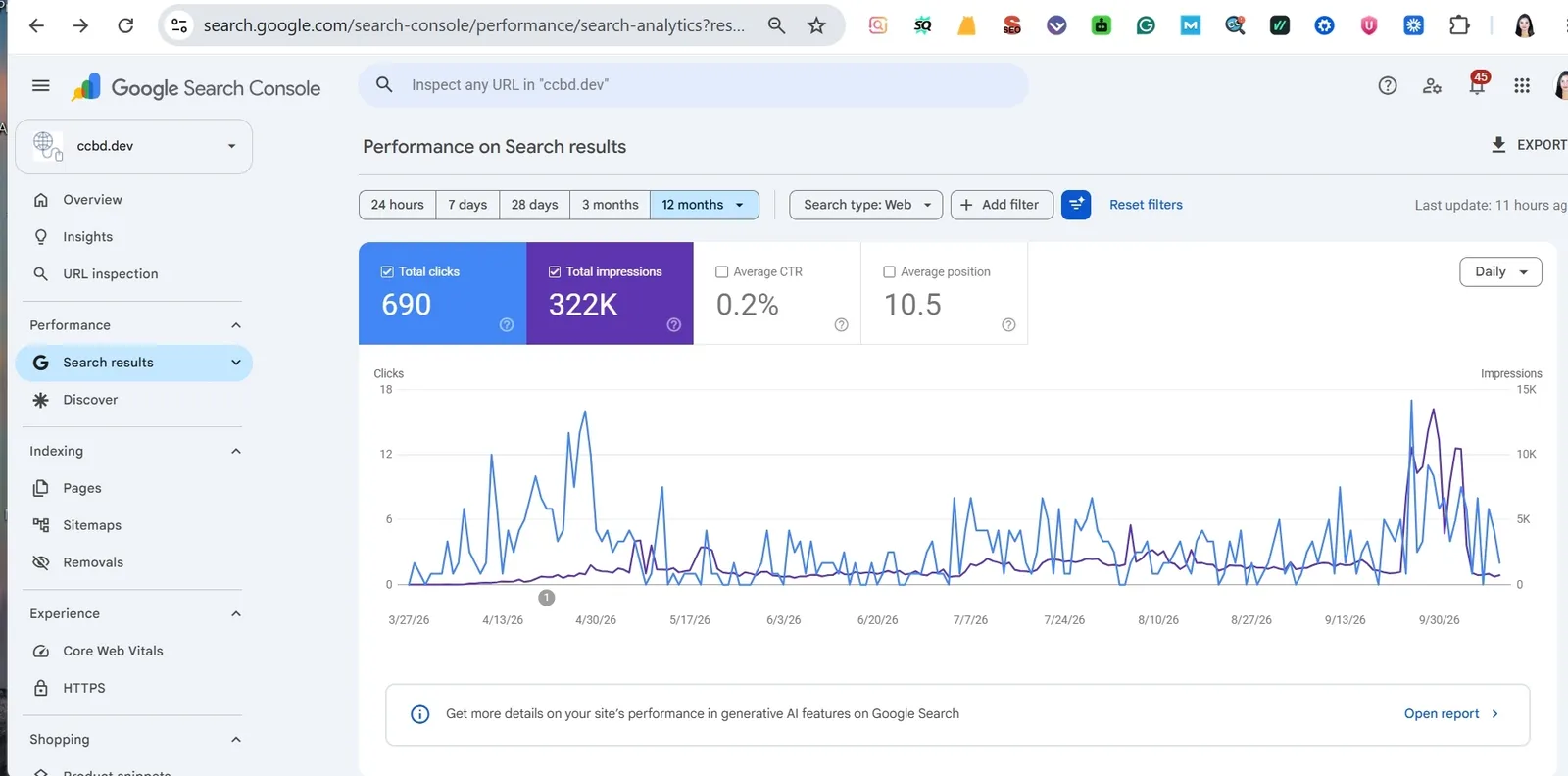
Before using Power SEO
Between April 12 and July 31, 2026, the site experienced a sharp contraction in search performance after an initial peak in late April. Daily clicks dropped from highs around 15–16 to near-zero levels through late May and June, reflecting severe search traffic instability. While impressions saw a slight baseline lift starting in mid-June, overall engagement remained suppressed until a recovery began in late July.
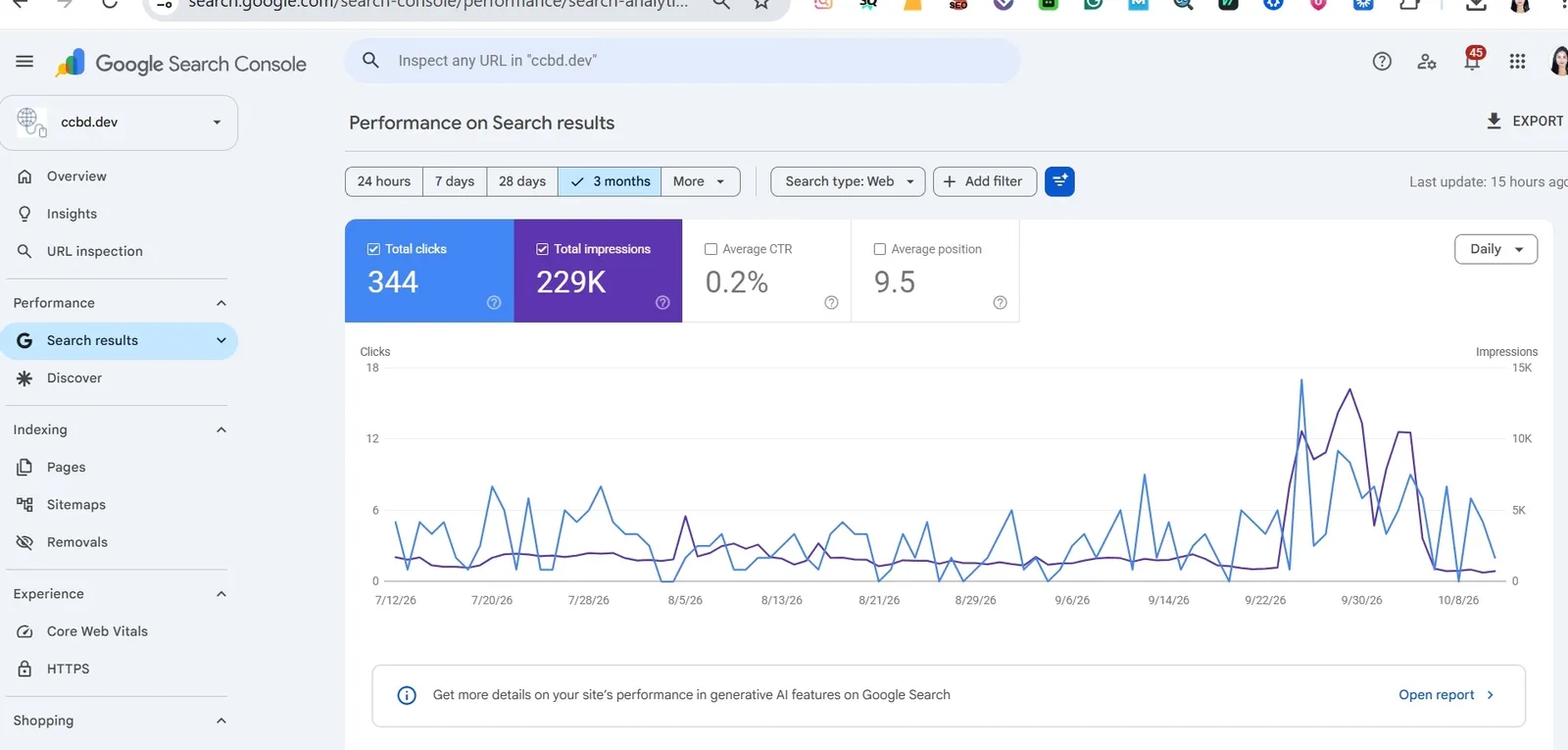
After using Power SEO
Over the past 3 months, CyberCraft Bangladesh generated 229K total impressions and 344 total clicks from Google Search, with an average CTR of 0.2% and an average position of 9.5. Both impressions and clicks saw a significant surge in late September.
Averages hide the trend, so here's the month-by-month view
Month | Avg. position | Impressions/day | Clicks/day |
|---|---|---|---|
May | 13.2 | 1,421 | 2.2 |
Jun | 13.8 | 802 | 1.7 |
Jul | 14.6 | 1,476 | 4.1 |
Aug | 12.9 | 1,738 | 2.4 |
Sep | 9.1 | 3,420 | 4.3 |
Oct (1 to 11) | 7.7 | 3,664 | 5.2 |
Did Google Rankings Improve After I Adopted Power SEO?
Yes, Google Search Console data showed improved visibility after I adopted Power SEO on ccbd.dev in August 2026. Impression-weighted average position improved from 13.05 before adoption to 8.89 afterward, while daily impressions increased from 1,124 to 2,733. However, new content and other ranking factors may also have contributed to these changes.
Visibility more than doubled: Daily impressions grew from about 1,100 to about 2,700. Over the last three weeks of the export (21 Sep to 11 Oct) I saw about 5,400 impressions per day.
Clicks followed rankings: Over those same three weeks, clicks averaged 5.95 per day against 3.51 before, roughly 70% higher.
The gain came in stages: August was a transition month, and honestly I saw little movement. The step change arrived in mid-September, when weekly impressions jumped from about 10,000 to 37,674 and then 69,156. If you adopt a Power-SEO open-source SEO tool, plan for a 6 to 8 week lag before the ranking impact shows up.
Which Keywords Drove the Growth?
Non-brand queries contributed to the website's increased search visibility. The query "seo tools" generated 72,836 impressions at an average position of 5.85, while "single page application search engine optimization" generated approximately 2,900 impressions. The queries "react seo checklist" and "react seo tools" also attracted clicks, indicating growing visibility for developer-focused SEO topics.
"seo tools": 72,836 impressions at an average position of 5.85
"single page application search engine optimization": about 2,900 impressions at position 10.4
"react seo checklist": 21 clicks at position 7.3 with 8.4% CTR
"react seo tools": 13 clicks at position 8.9 with 10.2% CTR
My strongest pages were technical guides such as best-open-source-seo-tools (135,020 impressions, position 6.6) and seo-for-single-page-applications (51,662 impressions).
Is a Power-SEO Open-Source SEO Tool Worth the Investment?
The Power-SEO open-source SEO tool is worth considering if you want free, code-based technical SEO automation. Its modular packages help developers manage metadata, schema, sitemaps, and audits within their projects. However, setup requires technical skills, and businesses needing extensive keyword research, backlink analysis, and competitor data may still need paid SEO platforms.
Licence cost: installing the packages is free, while enterprise SEO suites typically bill monthly per seat.
Developer fit: the toolkit is written in TypeScript and works inside your existing build, so there's no separate dashboard to maintain.
Modularity: you add only the schema, sitemap or audit packages you need, which keeps bundles small.
Ownership: your SEO logic stays in your repository, not in a third-party subscription.
Higher rankings for commercial keywords such as "seo tools" and "react seo tools" put your product in front of buyers who are already searching. Even at this early stage, the Power-SEO open-source SEO tool delivered traffic growth without any extra tooling spend.
Free Open Source SEO Tool Comparison: Power SEO vs Paid Platforms
Power SEO is a free open-source SEO toolkit for technical tasks performed inside a codebase, while paid SEO platforms typically provide broader keyword databases, backlink indexes, competitor research, and rank tracking. Power SEO focuses on implementation and automation, so developers can use it alongside paid platforms rather than treating it as a complete replacement.
Capability | Power-SEO open-source SEO tool | Paid SEO suite (typical) |
|---|---|---|
Price | Free to install from npm | Subscription, often per seat |
Where it runs | Inside your codebase and build | Separate web dashboard |
Metadata checks | Yes (@power-seo/meta and core validators) | Audit-style reports |
JSON-LD schema | Builders and validation (23 types) | Reports on existing markup |
Technical audit | 30+ rules (@power-seo/audit) | Crawl-based audits |
Content scoring | Yoast-style scoring and readability | Varies by plan |
Keyword volume and backlink data | Not included; Semrush and Ahrefs API clients | Built-in databases |
Open source SEO tools vs paid tools. Let me be straight with you: paid platforms win on data, because keyword volumes, backlink indexes and rank tracking come built in. Open tools win on control and cost. For many teams, free SEO tools vs premium SEO software isn't an either-or choice, and the Power-SEO open-source SEO tool ships API clients for Semrush and Ahrefs, so paid data can flow into your own scripts.
Technical depth: Among free open source technical SEO tools, the useful ones check what search engines read directly. Among open source website SEO audit tools, the audit package applies 30+ rules, which makes it free SEO software with technical SEO features you can run before every release.
Schema and metadata: If you need open source SEO tools with schema markup, the schema package builds and validates JSON-LD. The meta and core packages validate titles and descriptions, so it's one of the free SEO tools with metadata analysis built in.
Keyword and content analysis: I want to be realistic about keyword work. Among open source SEO tools for keyword analysis, Power SEO analyzes on-page content with Yoast-style scoring rather than supplying search volumes. Its content-analysis and readability packages are free SEO tools for content analysis, and the integrations package connects Semrush or Ahrefs when you need volume data.
Automation: Because everything is code, I'd put this toolkit on any shortlist of open source SEO automation tools. You can generate sitemaps at build time, run the audit before release and manage redirects in code.
Features and performance: On open source SEO software features, the Power-SEO open-source SEO tool's 17 packages cover metadata, schema, sitemaps, redirects, link analysis, images, analytics and AI prompt templates. For an open source SEO tool performance comparison, my own before-and-after data above is the evidence I can stand behind. I didn't benchmark other toolkits head to head.
Who Should Use This Free Open Source SEO Toolkit?
This free open-source SEO toolkit is best suited to JavaScript and TypeScript developers, web development agencies, and businesses with access to technical support. It helps teams automate recurring SEO tasks within their codebases without adding a toolkit subscription. Businesses that primarily need keyword discovery, backlink research, or a beginner-friendly dashboard may prefer additional SEO tools.
If you're a developer: If you search for free SEO tools for developers, the main benefit I'd point to is that SEO work lives in pull requests instead of spreadsheets. When you shortlist the best open source SEO toolkit for JavaScript, look for TypeScript types, modular installs and a zero-dependency core, which the Power-SEO open-source SEO tool provides.
If you build with React or Next.js: The react package covers open source SEO tools for React projects, and the meta package supports server rendering, so it also fits open source SEO tools for Next.js 14+. The same approach works for open source SEO tools for JavaScript websites built on Remix or plain Node.js, and it's a free SEO toolkit for modern web frameworks in general.
If you run an agency: Open source SEO tools for agencies make sense when the same checks repeat across many client sites. If your team standardizes on the Power-SEO open-source SEO tool, you can install the audit and sitemap packages once per project and keep results consistent.
If you run a small business: Free SEO tools for small businesses are usually limited by budget, not by need. Choosing free SEO tools with no subscription removes a recurring cost, though someone on your team still needs developer skills to set the packages up.
What Hasn't Improved Yet
CTR is low: I now appear for broad terms like "seo tools", where impressions are huge but CTR is only 0.06%. Sharper titles and descriptions are my next fix.
Brand search still dominates clicks: The query "cybercraft bangladesh" alone produced 134 clicks, about a fifth of the total.
The window is short: This is one site over a few months, so it shows a strong correlation, not a controlled experiment.
My Honest Caveats
Full disclosure: my company builds Power SEO and owns ccbd.dev, so I'm reporting on our own product.
We published new SEO blog content during the same period, and Google algorithm updates can also move rankings. I can't isolate exactly how much of the gain came from the toolkit.
The Search Console export covers six months, so my baseline starts in April.
How did I set up Power SEO?
To set up Power SEO, install the packages required for your framework, configure site-wide metadata, add structured data where appropriate, and generate your sitemap. You can also use content analysis and technical audit packages to identify issues before deployment. Follow the official Power SEO Quick Start guide and test the configuration before publishing.
Step 1: Install
npm install @power-seo/meta @power-seo/schema
Step 2: Add site-wide metadata (Next.js App Router)
// app/layout.tsx
import { createMetadata } from '@power-seo/meta';

export const metadata = createMetadata({
  title: {
    template: '%s | My Site',
    default: 'Welcome to My Site',
  },
  description: 'Your site description here',
  metadataBase: new URL('https://example.com'),
  openGraph: {
    type: 'website',
    url: 'https://example.com',
    siteName: 'My Site',
  },
});
Step 3: Add page metadata and Article schema
// app/blog/[slug]/page.tsx
import { createMetadata } from '@power-seo/meta';
import { article, toJsonLdString } from '@power-seo/schema';

export function generateMetadata({ params }) {
  return createMetadata({
    title: 'My Blog Post',
    description: 'A great article about SEO.',
    canonical: `https://example.com/blog/${params.slug}`,
    openGraph: {
      type: 'article',
      publishedTime: '2026-01-15T00:00:00Z',
    },
  });
}

export default function BlogPage() {
  const schema = article({
    headline: 'My Blog Post',
    datePublished: '2026-01-15',
    author: { name: 'Jane Doe' },
  });

  return (
    <>
      <script
        type="application/ld+json"
        dangerouslySetInnerHTML={{ __html: toJsonLdString(schema) }}
      />
      <article>
        <h1>My Blog Post</h1>
      </article>
    </>
  );
}
Using a React SPA instead?
npm install @power-seo/react @power-seo/schema @power-seo/core
import { SEO, Breadcrumb } from '@power-seo/react';

<SEO
  title={post.title}
  description={post.excerpt}
  canonical={`https://example.com/blog/${post.slug}`}
  openGraph={{
    type: 'article',
    images: [{ url: post.image, width: 1200, height: 630 }],
  }}
/>
<Breadcrumb
  items={[
    { name: 'Home', url: '/' },
    { name: 'Blog', url: '/blog' },
    { name: post.title },
  ]}
/>
Step 4: Score your content and add a sitemap
import { analyzeContent } from '@power-seo/content-analysis';

const result = analyzeContent({
  title: 'My Article',
  metaDescription: 'Description',
  content: '<h1>My Article</h1><p>Content...</p>',
  focusKeyphrase: 'my keyword',
});
console.log(`SEO Score: ${result.score}/${result.maxScore}`);
// app/sitemap.ts (Next.js)
import { toNextSitemap } from '@power-seo/sitemap/next';

export default async function sitemap() {
  const urls = await fetchAllUrls();
  return toNextSitemap(urls);
}
How Do You Get Started With Power SEO?
Pick the Power-SEO open-source SEO tool packages for your stack. React SPAs usually need
@power-seo/reactand@power-seo/schema.Add validated JSON-LD to your key pages and fix errors with the built-in validator.
Generate your sitemap programmatically and split it if it grows large.
Run
@power-seo/auditbefore every release to catch regressions.Track results in Search Console for at least two months.
Conclusion: Is Power SEO the Right Open-Source SEO Tool?
The Power-SEO open-source SEO tool is a practical option for JavaScript and TypeScript developers who want to manage technical SEO directly within their codebase. Its modular packages cover metadata, JSON-LD structured data, sitemap generation, redirects, content analysis, and technical audits. However, it does not replace paid SEO platforms for keyword search-volume data, backlink analysis, or competitor research.
My Google Search Console comparison for CyberCraft Bangladesh showed that daily impressions increased from 1,124 to 2,733, while impression-weighted average position improved from 13.05 to 8.89 after adoption in August 2026. Daily clicks increased only slightly across the full comparison periods. These results demonstrate improved search visibility during the period, but they do not prove that Power SEO alone caused the improvement.
The right choice depends on your SEO needs:
Choose Power SEO if you develop JavaScript websites and need free, code-based technical SEO automation.
Combine it with paid SEO platforms if you also need keyword research, backlink data, or competitor analysis.
Consider alternative solutions if you prefer a beginner-friendly dashboard or do not have access to development support.
Overall, Power SEO is best understood as a technical SEO implementation toolkit, not a complete replacement for every SEO tool. Evaluate its packages against your framework, test the output on your website, and monitor indexing, impressions, clicks, and rankings in Google Search Console to determine whether it meets your requirements.
Frequently Asked Questions
What is the Power-SEO open-source SEO tool?
The Power-SEO open-source SEO tool is a free, modular TypeScript toolkit for technical SEO. Its 17 npm packages cover meta tags, JSON-LD structured data, sitemaps, redirects, content analysis, and website audits. Developers can install individual packages to manage SEO tasks in React, Next.js, Remix, and other JavaScript projects.
Does Power SEO improve Google rankings?
Power SEO can help improve technical SEO implementation, but it cannot guarantee higher Google rankings. On ccbd.dev, average position improved from 13.05 to 8.89, while daily impressions increased by 143% after adoption. Because new content was also published during this period, the results show a correlation rather than proof that Power SEO caused the gains.
How long does Power SEO take to show results?
In my ccbd.dev case study, the clearest visibility gains appeared in mid-September, approximately six weeks after adopting Power SEO in August 2026. This timeframe is specific to my website, not a guarantee. Results depend on crawling, indexing, content quality, competition, and other Google ranking factors.
Is the Power-SEO open-source SEO tool free for commercial projects?
Yes, Power SEO packages can be installed without a purchase fee, making them an option for commercial projects. However, integration, developer time, and maintenance can create costs. Before using the toolkit commercially, review the licence in the official GitHub repository and verify any package-specific licence terms.
Which Power SEO packages do I need for a React app?
For a React single-page application, start with @power-seo/react for SEO components and @power-seo/schema for structured data. Add @power-seo/core if your setup requires it. You can also install @power-seo/sitemap for sitemap generation and @power-seo/audit for technical SEO checks before deployment.
Does Power SEO work with Next.js?
Yes, Power SEO provides packages for Next.js SEO workflows. Use @power-seo/meta to generate metadata and @power-seo/schema to create structured data. The correct implementation depends on your Next.js version and routing architecture, so follow the official documentation and verify the rendered metadata and JSON-LD before deployment.
How is Power SEO different from a meta-tag library?
A meta-tag library primarily manages page titles, descriptions, and social sharing metadata. Power SEO extends beyond metadata with separate packages for JSON-LD structured data, sitemaps, redirects, content analysis, and technical audits. This modular ecosystem helps developers manage multiple SEO implementation tasks without relying on a single-purpose metadata library.
What are the best free open source SEO tools for developers?
The best free open-source SEO tools for developers depend on their technical requirements. Look for metadata management, structured data generation, sitemap support, automated audits, and framework compatibility. Power SEO combines these capabilities in modular JavaScript packages, but developers needing keyword search volumes, competitor research, or backlink databases will need additional tools.
What are free SEO toolkit alternatives to Power SEO?
Free SEO toolkit alternatives to Power SEO include React and Next.js metadata libraries, structured data utilities, sitemap generators, and browser-based SEO audit tools. Compare these options based on features, framework compatibility, maintenance, licensing, and setup requirements. Choose individual libraries for specific tasks or a modular toolkit when you need several SEO features together.
Where can I find open source SEO tools on GitHub?
You can find the Power-SEO open-source SEO tool on GitHub, where its source code and documentation are available. To discover other open-source SEO tools, search GitHub for metadata libraries, sitemap generators, structured data utilities, and audit projects. Review licences, recent commits, issue activity, and documentation before selecting a project.
Sources and References

I’m Mitu Das, a JavaScript developer, ERP product architect, and SEO specialist from Bangladesh. I work at CyberCraft Bangladesh, where I help build simple, scalable software, SaaS platforms, and business solutions. My goal is to create technology that helps companies save time, automate daily tasks, and grow faster. I enjoy combining development, product ideas, and SEO strategies to create useful digital solutions for modern businesses.
Writes about
Want this done for you?
Our team builds and ships exactly what this article describes. Send a message and we will reply with a scope.