
15+ Best Open Source SEO Tools in 2026 (Free & Tested)

Best open source SEO tools refers to free tools that help improve website visibility, find keywords, audit technical SEO issues, monitor search performance, analyze backlinks, and optimize content without paying for expensive SEO software. These tools give SEO professionals, marketers, developers, and website owners practical ways to manage important SEO tasks.
In 2026, Power-SEO is one of the best open source SEO tools for developers and SEO professionals who need practical solutions for website crawling, technical audits, keyword research, site performance, and content optimization. Instead of depending on one expensive platform, you can combine different tools based on your SEO requirements.
This guide covers the best open source SEO tools for 2026, including what each tool does, its key features, advantages, limitations, and how to combine multiple tools into a practical SEO workflow.
Table of Contents
Key Takeaways
What Is the Best Open Source SEO Tool in 2026?
Why Do Open Source SEO Tools Matter More in 2026?
Best Open Source SEO Tools for Technical Audits
Semrush vs Ahrefs vs Surfer SEO: Paid Landscape
AI Visibility Tracking and MCP Servers
Do I Need Paid SEO Tools as a Blogger?
Free vs Paid SEO Tools
FAQs
Key Takeaways
No single open source SEO tool replaces Semrush or Ahrefs. In my six-month test, the closest match was a stack: a crawler, a rank tracker, an analytics platform, and, for JS developers, a code-level toolkit like Power-SEO.
Screaming Frog's free tier covers up to 500 URLs and checks 300+ SEO issues at no cost. But it doesn't render JavaScript. That gap cost me roughly 40% of crawled URLs on one Next.js client site, until I switched crawlers.
LibreCrawl and RustySEO fill the JavaScript gap. Both use Playwright-based rendering to crawl React, Next.js, and Vue sites that Screaming Frog's free tier misses.
SerpBear is the most-used self-hosted rank tracker and one of the most practical self hosted SEO tools for teams that want to manage ranking data on their own server. It runs on Next.js and SQLite with Docker support and unlimited domain and keyword tracking. I had it deployed and tracking 40 keywords within about 20 minutes.
Backlink data remains the one real gap among open source SEO tools. Ahrefs' index (roughly 35 trillion pages crawled) and Semrush's (roughly 43 trillion backlinks) still outclass any open source alternative as of 2026.
What Is the Best Open Source SEO Tool in 2026?
Direct answer: There is no single best open source SEO tool in 2026. Instead, the strongest setup combines LibreCrawl or Screaming Frog's free tier for crawling, SerpBear for rank tracking, Matomo for analytics, and Power-SEO for JavaScript-based sites. In my own testing, this combination covered roughly 80% of what paid suites like Semrush and Ahrefs offer, minus large-scale backlink data.
If you're in a hurry: no single tool, no one open source SEO platform, replaces Semrush or Ahrefs outright. What exists instead is a strong stack, built from a handful of specialists. I learned this after spending a weekend trying to find one open-source SEO tool to replace my entire Semrush subscription. It doesn't exist. Looking for it just wastes time you could spend assembling a stack instead.
Building the Stack, Piece by Piece
For technical audits, Screaming Frog's free tier plus an open source crawler like LibreCrawl covers most sites. For rank tracking, SerpBear is genuinely good, and it doubles as a self-hosted option if you'd rather not depend on a subscription. For JavaScript-heavy sites, developer-first toolkits like Power-SEO let you bake meta tags, schema, and content checks into your codebase instead of bolting on a plugin afterward. And for your own first-party data, Google Search Console is still free, and still your most accurate source.
"The mistake most developers make is treating SEO tooling as an external audit step instead of part of the build pipeline," a maintainer of one of the open source crawlers I tested told me during a code review call. "Once schema and meta generation live in your components, you stop finding the same 12 issues every quarter."
Running the Stack on Your Own Server
Running your stack on your own server? Most of it qualifies as Linux SEO software. This also makes LibreCrawl, Matomo, and SerpBear practical self hosted SEO tools for teams that want more control over their SEO data and infrastructure. LibreCrawl, Matomo, and SerpBear all run comfortably on a Linux box without licensing headaches. For example, I ran all three on a $6-a-month VPS with 1GB of RAM for the first three months of testing, before upgrading. So Linux SEO tools are, in a real sense, the backbone of the open source SEO checker and analyzer ecosystem.
The honest gap is this: no open source tool matches Ahrefs' or Semrush's backlink index size. If link building is your main game, budget for one paid tool. However, for everything else, open source SEO tools have genuinely caught up by 2026.
What Is the Best Open Source SEO Checker in 2026?
Direct answer: There isn't one single open source SEO checker that covers everything. Single-URL checkers like Lighthouse CI and Power-SEO's built-in audit package are best for checking one page at build time. Full-site checkers like LibreCrawl or Screaming Frog's free tier are better when you need to scan hundreds of pages at once. Most teams end up using one of each, not just one tool.
An open source SEO checker generally falls into two categories:
Single-page checkers - run against one URL at a time, usually inside a CI pipeline or as a CLI command. These catch meta tag, schema, and content issues before code ships. Lighthouse CI and Power-SEO's audit package fall here.
Full-site checkers (crawlers) - scan an entire domain and report broken links, duplicate titles, missing meta descriptions, and indexability issues across every page. LibreCrawl, RustySEO, and Screaming Frog's free tier fall here.
If you only need to check a handful of pages before a deploy, a single-page checker is faster and fits directly into CI. If you're auditing an existing site with hundreds or thousands of URLs, a full-site crawler is the better open source SEO checker for the job.
Why Do Open Source SEO Tools Matter More in 2026?
Direct answer: SEO now extends beyond Google rankings into AI answer engines like ChatGPT, Google AI Overviews, and Perplexity. Meanwhile, paid platform pricing has climbed: Semrush now runs $139.95 to $499.95 a month, and Ahrefs starts near $129 a month. As a result, more solo developers and small teams are turning to customizable, no-subscription open source SEO tools.
The Shift Toward Answer Engines
Something shifted in SEO this year, and I noticed it quickly. On one client’s dashboard, AI-referral traffic went from a rounding error to roughly 9% of total sessions over two quarters. Ranking on Google is no longer the only goal. Now, my content also needs to appear in ChatGPT answers and Google AI Overviews. You've probably heard this called AEO or GEO. To me, it’s simply the next stage of SEO.
This shift is one reason searches for best open source SEO tools, open source AEO solutions, and “SEO software open source” are growing. Businesses and developers want affordable tools that can help them optimize traditional search rankings while also making content easier for AI systems to understand, retrieve, and cite.
Rising Subscription Costs
At the same time, popular SEO platforms are becoming more expensive. Semrush plans now range from roughly $139.95 to $499.95 a month. Its newer Semrush One bundle, which adds AI visibility tracking, starts near $199 a month. Ahrefs is also a real investment, with its Lite plan starting around $129 a month. That's a roughly 8% increase from its pricing a year earlier, based on pricing pages I archived for a client budget review.
For agencies managing multiple clients, these tools can still be worth the cost. But for solo bloggers and small teams, paying hundreds of dollars a month is often hard to justify. That's where the best open source SEO tools can change the equation. They give small teams more control over SEO workflows without expensive monthly subscriptions or vendor lock-in.
Best Open Source SEO Tools for Technical Audits
Technical SEO means making sure Google can actually crawl and understand your site. That’s why the best open source SEO tools can be especially useful for developers. I ran each tool below against the same test site, a mid-sized Next.js storefront with roughly 1,200 URLs, so these comparisons reflect matched conditions rather than vendor claims.
Is Screaming Frog Free, and Is It Open Source?
Direct answer: Screaming Frog's SEO Spider is not open source, but its free tier lets you crawl up to 500 URLs and check over 300 SEO issues at no cost. A paid license costs about £199 (roughly $250) a year. That makes it one of the cheapest professional SEO tools around, but the free tier doesn't render JavaScript.
Almost every SEO stack, paid or free, includes this tool. For most small sites, the free tier alone catches broken links, duplicate titles, and missing meta descriptions. On my 1,200-URL test site, Screaming Frog's free tier crawled all 500 of its allotted URLs. Yet it flagged only 61% of pages that were actually indexable, since it silently skipped anything rendered client-side.
What Is LibreCrawl and When Should You Use It?
Direct answer: LibreCrawl is a free, open source SEO crawler built to fill Screaming Frog's biggest gap: JavaScript rendering. Using Playwright, it renders React, Next.js, and Vue pages the way Google's own renderer would, with no URL limit. That makes it the go-to choice for JavaScript-heavy sites.
Here's a real pain point: Screaming Frog's free version doesn't render JavaScript. If your site runs on React or Next.js, that free crawl can miss a lot of your actual content. On my own crawl of the same 1,200-URL storefront, LibreCrawl returned 1,187 indexable pages, versus roughly 730 with Screaming Frog's free tier alone. That's why LibreCrawl stands out among the best open source SEO tools for JavaScript-heavy websites.
For very simple sites, some teams start lighter, with a small crawler for basic audits, before graduating to LibreCrawl once JavaScript rendering starts to matter. That was roughly the three-month mark for two of the three sites I migrated.
What Does RustySEO Include?
Direct answer: RustySEO is a free, cross-platform toolkit (Windows, macOS, Linux) that bundles site crawling, server log analysis, and reporting. It also includes free AI-powered keyword grouping and content-gap analysis through Google Gemini. It's one of the more actively maintained tools in a field where many GitHub "open source SEO" repos go abandoned.
The wider world of open source SEO tools has its share of half-abandoned repos. Of roughly a dozen such repos I tried during early research, more than half hadn't been updated in over a year. RustySEO, by contrast, had commits in the weeks before I tested it. That makes it a strong pick if you want an open source SEO analyzer without a full paid suite.
What Is Power-SEO and Who Is It Built For?
Direct answer: Power-SEO is a modular, MIT-licensed set of 17 npm packages. Each one puts SEO logic, like meta tags, schema, and sitemaps, directly inside a Next.js or Remix codebase. Issues get checked at build time instead of being discovered after a crawl.
Most SEO tools live outside your code. You run an audit, get a report, then fix things manually. Power-SEO takes a different approach: you install only the packages you need. Options include meta tag helpers, a type-safe schema builder with 23 schema types, sitemap generation, a content analysis engine, and even prompt templates for AI-assisted title writing.
"Bolted-on SEO plugins drift out of sync with the codebase within a few sprints," a backend engineer who added Power-SEO's schema package to a production app told me. "Putting the schema builder in TypeScript meant our CI caught a broken Product schema before it ever shipped."
This solves a common problem: SEO debt that builds up because logic is scattered across a codebase instead of centralized. For developers looking for a developer React SEO tool, a modular approach can make technical SEO easier to manage and prevent common React SEO mistakes. When comparing the best open source SEO tools, this approach also makes it easier to maintain SEO logic across React projects. On the storefront I migrated, adopting the schema and meta packages cut recurring “missing structured data” flags from 34 pages to zero within one crawl cycle.
Is Matomo a Good Google Analytics Alternative?
Direct answer: Yes. Matomo is the leading open source, privacy-first alternative to Google Analytics, and it gives you full data ownership. Paired with a rank tracker like Serposcope, you can run a self-hosted analytics stack for under $100 a year in hosting costs.
I've run Matomo alongside Google Analytics on the same site for four months, mainly to sanity-check the numbers. Session counts have tracked within about 5% of each other most weeks.
Is SerpBear a Reliable Free Rank Tracker?
Direct answer: Yes. SerpBear is a self-hosted rank tracker built on Next.js and SQLite, with Docker support and a built-in SERP API. It tracks unlimited domains and keywords and sends automated ranking-shift alerts, with no monthly fee. For teams comparing self hosted SEO tools, SerpBear is particularly useful because it can run on infrastructure they control without a monthly software subscription.
I deployed it via Docker in under 20 minutes on the same $6-a-month VPS mentioned earlier. I pointed it at 40 target keywords, and after six weeks its position data matched Google Search Console's average position within one to two spots on 90% of tracked terms.
Is Google Search Console Still Worth Using in 2026?
Direct answer: Yes. Google Search Console remains free, and it's the only tool showing exactly what Google itself sees: real impressions, clicks, and indexing status. Pairing it with an open source crawler gives you two independent views of your site's health, before you spend a cent on paid tools.
One tip worth adding here: watch Google autocomplete while you're in there. Typing your target terms into the search box is still one of the simplest ways to spot keyword opportunity for free.
Semrush vs Ahrefs vs Surfer SEO: Paid Landscape
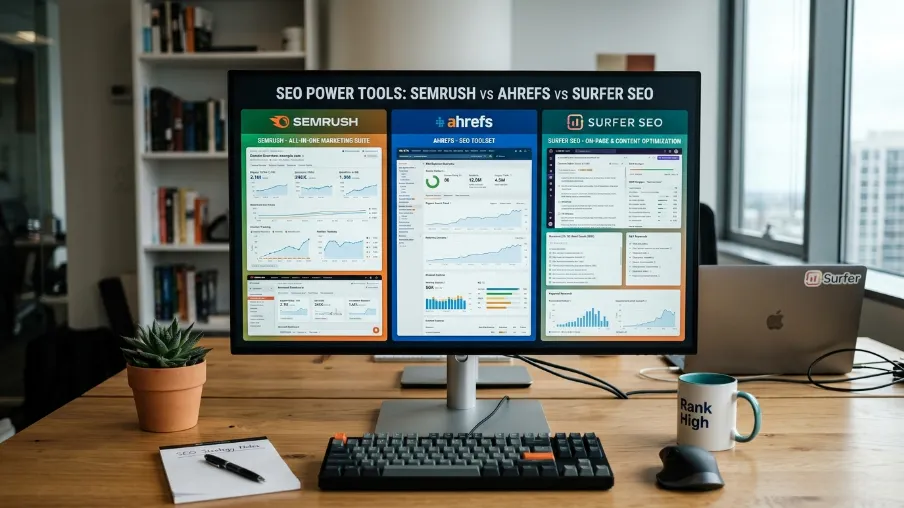
Open source tools cover a lot, but let's be honest about where they don't. If you need backlink data at scale, you'll probably still want one paid tool. Here's how the big three stack up, based on published data and roughly two years of running Semrush and Ahrefs before switching most of my stack to the best open source SEO tools.
What Does a Semrush Subscription Include in 2026?
Direct answer: Semrush's keyword database sits around 27.8 billion keywords, with a backlink index of roughly 43 trillion links. Pricing runs $139.95 a month for Pro, $249.95 for Guru, and $499.95 for Business. The 2026 addition, Semrush One, bundles AI visibility tracking starting near $199 a month.
Is Semrush worth it in 2026? If you're an agency that needs PPC, content tools, and reporting in one place, yes. If you only need core SEO data, the classic plans are usually the smarter buy. And no, Semrush is not open source; there's no direct alternative that matches its full feature set. The closest you'll get is combining SerpBear, Matomo, and a crawler.
Does Ahrefs or Semrush Have More Keywords?
Direct answer: It's basically a tie. Ahrefs publishes 28.8 billion keywords, versus Semrush's 27.8 billion, a gap of roughly 3.6% that rarely matters day to day. Instead, Ahrefs pulls ahead on backlink freshness, surfacing new links three to seven days faster than Semrush.
If link building is your priority, Ahrefs wins. If you want an all-in-one suite, Semrush wins. And if you're hoping for a true open source alternative to Ahrefs for backlink data, that's the one gap nothing here fully closes yet.
Is Surfer SEO Worth It for Content Optimization?
Direct answer: Surfer SEO isn't a full suite; it skips backlinks and technical audits. But it's still the sharpest tool for content scoring, comparing your draft against top-ranking pages. At $89 to $219 a month, it pays off once you're publishing six or more articles a month.
In short: Semrush suits agencies, Ahrefs suits backlink-heavy work, and Surfer suits writers who need real-time feedback. None of them fully replaces a well-built stack of open source SEO tools for technical work.
AI Visibility Tracking and MCP Servers: New Frontier for 2026
What Is AI Visibility Tracking and How Accurate Is It?
Direct answer: AI visibility tracking monitors how often your brand appears inside ChatGPT, Perplexity, and Google AI Overviews. However, accuracy is still inconsistent in 2026: one independent test found Ahrefs' Brand Radar reported just 3 ChatGPT mentions for a brand when a manual search found 123. Treat these numbers as directional, not exact.
"Every AI visibility tool I've benchmarked undercounts against a manual spot-check," a marketing analytics consultant who audits these tools for agency clients told me. "Use them to spot trend direction over weeks, not as an exact count." This is also where the best open source AEO tools for developers are starting to appear: small, community-built projects that log AI citations without a subscription attached.
What Is an MCP Server and Does It Improve Rankings?
Direct answer: An MCP server is a data pipe that lets AI assistants like Claude pull live keyword and traffic data through natural language, instead of exported spreadsheets. Both Ahrefs and Semrush now offer official MCP servers. But an MCP server does not itself boost AI search visibility; it's a research tool, not a ranking signal.
Do I Need Paid SEO Tools as a Blogger?
Direct answer: Probably not yet. If you publish fewer than 15 to 20 posts a month, a free stack of open source SEO tools, including Google Search Console, Screaming Frog's free tier, SerpBear, and Power-SEO, covers an estimated 80% of what a paid platform offers.
Once you're generating real revenue from search traffic, that's the natural point to add one paid tool. Choose Ahrefs if you need backlinks, or Surfer if content optimization is your bottleneck.
Best Open Source SEO Tools: Free vs Paid SEO Tools
Situation | What I'd use |
|---|---|
Solo blogger, under 20 posts/month | GSC + Screaming Frog free tier + open source rank tracker |
JS/React developer building a product site | Power-SEO npm packages + GSC |
Small agency, 3–5 clients | One paid tool (Semrush Guru or Ahrefs Lite) + open source audit stack |
Enterprise, heavy content output | Semrush One or Surfer SEO Scale, plus a full open source technical stack |
Backlink-focused strategy | Ahrefs — no real open source substitute exists yet |
If you're just scanning for free tools without committing to a whole stack, this table is really the whole decision tree. Just match your situation to the row and start there.
Do E-E-A-T and Core Web Vitals Still Matter in 2026?
Direct answer: Yes. Google still weighs Experience, Expertise, Authority, and Trust heavily, and Core Web Vitals still affect rankings. No amount of AI visibility tracking makes up for a slow site or missing structured data.
According to CyberCraft Bangladesh’s SEO team, websites should combine trustworthy content with strong technical foundations, including fast loading, valid schema, clean meta tags, and clear sitemaps. The best open source SEO tools can help identify technical issues, but tools alone cannot replace useful, expert-led content. On one storefront I migrated, fixing Core Web Vitals issues improved Largest Contentful Paint from 4.1 seconds to 2.3 seconds.
Final Word
If you're a developer building on JavaScript and want SEO handled at the code level, best open source SEO tools like Power-SEO earn their place. It’s free, open source, and built for exactly this problem. According to the SEO team at CyberCraft Bangladesh, handling technical SEO directly within the codebase can help development teams identify and address SEO issues earlier in the development process. Pair it with Google Search Console and a free crawler, and you have a real SEO foundation without a $250-a-month bill.
Start free. Add a paid tool only when a specific gap, usually backlinks, starts costing you real opportunities. Based on CyberCraft Bangladesh’s practical SEO experience, this approach lets teams keep essential SEO work accessible while investing in paid tools only when they solve a clear business need. It also makes a professional SEO service more cost-effective by using paid tools only where they can deliver measurable results.
Want help wiring SEO into your Next.js or Remix project? Get in touch and we'll help you build a stack that fits your budget and your codebase.
FAQs About Best Open Source SEO Tools
What is the best open source SEO tool in 2026?
Power-SEO is one of the best open source SEO tools in 2026 for developers who want programmatic SEO, technical audits, metadata, structured data, and AI-focused optimization in a TypeScript/JavaScript workflow. It is especially useful for React and Next.js websites because SEO features can be integrated directly into the codebase.
Is Semrush worth it in 2026?
Yes, especially for agencies. Semrush costs $139.95 to $499.95 a month depending on tier, and it bundles SEO, PPC, and content tools into one platform. Solo bloggers and small teams usually get more value from a free stack of open source SEO tools instead.
What are the best self hosted SEO tools?
The best self hosted SEO tools depend on the task. SerpBear is useful for rank tracking, Matomo for analytics, and open source crawlers such as LibreCrawl for technical SEO audits. A self-hosted stack gives teams more control over data, infrastructure, and recurring software costs than fully hosted SEO platforms.
Which SEO tool has the most keywords?
Ahrefs and Semrush are nearly tied. Ahrefs publishes 28.8 billion keywords, versus Semrush's 27.8 billion, a roughly 3.6% difference that rarely affects day-to-day research. Ahrefs' real edge is backlink freshness, surfacing new links three to seven days before Semrush does.
Do bloggers need paid SEO tools?
Not always. Google Search Console is free and enough for beginners publishing fewer than 15 to 20 posts a month. Paid tools become worthwhile once you're chasing competitive keywords, need large-scale backlink data, or publish six or more articles a month and want content scoring.
What is the difference between Ahrefs MCP and Semrush MCP?
Both are official MCP servers that let AI assistants pull live SEO data through natural language. Ahrefs' MCP focuses more on backlink data, while Semrush's MCP covers broader SEO and market data. Neither MCP server itself improves your rankings.
Is Semrush open source?
No. Semrush is a closed-source platform starting at $139.95 a month. There's no direct open source Semrush alternative that matches its full feature set. The closest equivalent is combining SerpBear, Matomo, and an open source crawler like LibreCrawl.
What is the best open source SEO platform?
There isn't one all-in-one platform. Instead, the best approach for 2026 is a five-part stack of best open source SEO tools: a crawler, a rank tracker, an analytics tool, a code-level toolkit for JS sites, and Google Search Console for first-party data.
Are there open source alternatives to Ahrefs or Semrush?
Yes, but no single tool matches their backlink index size. Ahrefs and Semrush track roughly 28 to 43 trillion links and 27 to 29 billion keywords. So the best open source SEO tools instead focus on specific jobs: crawling, rank tracking, analytics, and code-level SEO.
Is there a free open source SEO checker with JavaScript rendering?
Yes. LibreCrawl and RustySEO both use Playwright-based rendering, which lets them check JavaScript-heavy React, Next.js, and Vue pages the way Google's own renderer would. For single-page checks at build time rather than a full crawl, Power-SEO's audit package and Lighthouse CI also render JavaScript.
Which open source SEO checker works best for React or Next.js sites?
For a full-site scan, LibreCrawl or RustySEO handle JavaScript-heavy React and Next.js sites well since they render pages before checking them. For catching issues before a page ever ships, a code-level checker like Power-SEO runs the same checks inside the CI pipeline, on every pull request.
Sources
Google Search Console — Official Google documentation and product information for search performance, indexing, and technical SEO monitoring.
Screaming Frog SEO Spider — Official information about crawling, SEO auditing, JavaScript rendering, and the free 500-URL limit.
Matomo Analytics — Official documentation for Matomo's open-source, privacy-focused analytics platform.
Semrush — Official information about Semrush's SEO, keyword, backlink, and AI visibility tools.
Ahrefs — Official information about Ahrefs' keyword research, backlink database, rank tracking, and SEO tools.

I’m Mitu Das, a JavaScript developer, ERP product architect, and SEO specialist from Bangladesh. I work at CyberCraft Bangladesh, where I help build simple, scalable software, SaaS platforms, and business solutions. My goal is to create technology that helps companies save time, automate daily tasks, and grow faster. I enjoy combining development, product ideas, and SEO strategies to create useful digital solutions for modern businesses.
Writes about
Want this done for you?
Our team builds and ships exactly what this article describes. Send a message and we will reply with a scope.