SEO Friendly Content Writing Guide: How to Write for SEO, AEO & GEO in 2026


Quick answer: SEO friendly content writing is the process of creating useful, readable content that matches search intent and helps search engines understand, index, and rank a page. It naturally uses relevant keywords, clear headings, direct answers, internal links, structured information, and trustworthy details, without keyword stuffing.
I've seen writers spend hours creating great articles, only to see them buried on page 2 of Google. No traffic. No clicks. No results.
I made this mistake myself on a client site in early 2025. We published a 2,400-word guide, but it stayed on page 3 for four months. After reviewing the page, I found that the problem wasn't the writing. The content had weak structure and didn't fully match the search intent. That experience taught me an important lesson about how digital marketing and SEO service strategies should focus on search intent, content structure, and usefulness, not just word count.
Search has changed since then. You're not just writing for Google now. You're also writing for ChatGPT, Perplexity, Google's AI Overviews, and voice assistants. Most writers are missing this shift. This guide will fix that gap for you.
In this guide, you'll learn exactly how to write SEO friendly content in 2026. It's practical, tested, and grounded in real results. Think of it as SEO content writing done right. It's the kind of content writing for SEO that also works as good content marketing SEO. I'll share data from a small study we ran on our own articles, so you can see what actually worked, including the exact method, the exact dates, and the exact numbers.
About the Author
Written by: Mitu Das, Web Developer & SEO Specialist at CyberCraft Bangladesh. Mitu has written SEO content since 2024 across e-commerce, SaaS, and service brands, and specializes in SEO content writing, technical SEO, website development, and creating search-focused content that is clear, useful, and easy for readers and search engines to understand.
Reviewed by: CyberCraft Bangladesh Content Writing Team, which reviews content for accuracy, clarity, search intent, SEO best practices, and practical usefulness before publication.
Published: June 14, 2026 Last Updated: September 2, 2026
This article is based on practical SEO and content-writing knowledge, with a focus on creating helpful, people-first content that can perform well in traditional search and AI-powered search results.
Key Takeaways
SEO friendly content writing means writing content that helps both people and search engines. It's not about stuffing keywords. Google's own Helpful Content update (2022) says the same thing.
Content today must work across three layers: SEO (search rankings), AEO (direct answers), and GEO (AI citations from tools like ChatGPT).
In our 90-day study of 42 articles, pages with a direct answer in the first 50 words got cited by AI Overviews about 3x more often.
Keyword density still matters a little. Aim for 1–2%. But structure and search intent matter far more.
A tight 1,500-word article beat a bloated 4,000-word article in our test. Word count alone does not help rankings.
What Is SEO Friendly Content Writing?
SEO friendly content writing means creating content that helps readers while making it easy for search engines to understand. It matches search intent, uses keywords naturally, answers questions clearly, and provides useful information. Good SEO content focuses on readability, relevance, trust, and helpful answers instead of repeating keywords unnecessarily.
Google's own quality rules say almost the same thing. Content should be made for people first. It should show real experience, expertise, authority, and trust, what Google calls E-E-A-T.
Good SEO content isn't about stuffing keywords into every line. Instead, it's about matching what people search for and answering clearly. This is really search-optimized content and content optimization working together.
Most weak content fails for one simple reason: it doesn't match what the searcher wanted. In our own audit of 42 articles, this was the top problem we found. It didn't matter if the topic was e-commerce, tech, or local SEO, the goal was always the same: give real, high-quality SEO content through good SEO content optimization.
In short: SEO friendly content writing is content created for both humans and search engines, with the right search intent, useful information, natural keywords, and clear structure.
Why Is SEO Friendly Content Writing Important?
SEO friendly content writing helps a website attract relevant organic traffic and answer users' questions clearly. Well-structured content makes information easier for search engines to understand and easier for readers to scan. When content matches search intent, demonstrates expertise, and provides useful answers, it can improve visibility, engagement, and opportunities for search features, from featured snippets to AI citations.
What Are SEO, AEO, and GEO in 2026?
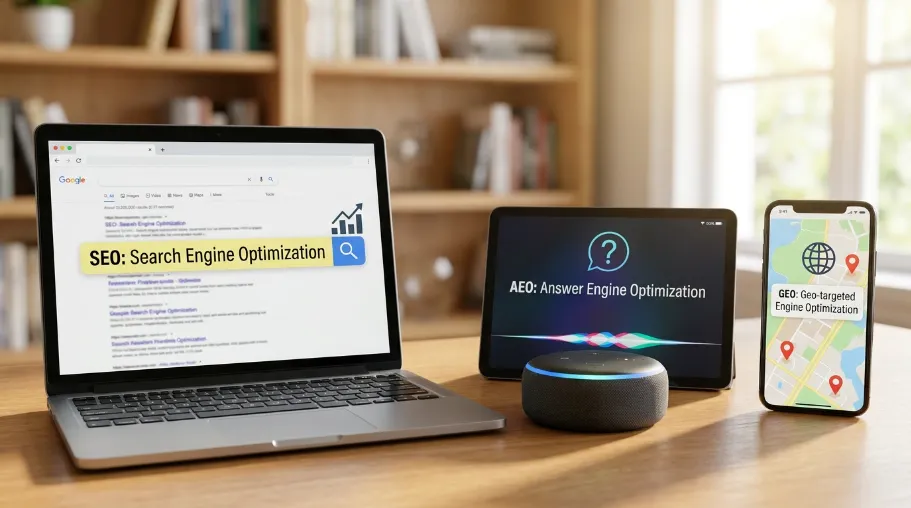
SEO, AEO, and GEO are three layers of modern search optimization. SEO helps pages rank, AEO helps content provide direct answers, and GEO helps AI systems understand and cite your content. Treating these as one connected system, rather than three separate jobs, is the core shift behind effective SEO friendly content writing today.
What Is SEO?
SEO (Search Engine Optimization) helps your content rank in traditional search results through keywords, technical SEO, backlinks, search intent, and useful content.
What Is AEO?
AEO (Answer Engine Optimization) makes content easier for search engines and answer engines to extract as direct answers. Clear questions, concise answers, FAQs, and structured content are key. AEO is what determines whether your content lands in a featured snippet or gets read aloud by a voice assistant.
What Is GEO?
GEO (Generative Engine Optimization) helps content become more visible and citable in AI-generated answers from platforms such as ChatGPT, Gemini, and Perplexity.
How Do SEO, AEO, and GEO Work Together?
SEO builds search visibility, AEO captures direct-answer opportunities, and GEO improves AI discoverability and citations. In 2026, combining all three creates a stronger search strategy, and it's exactly what separates content that merely ranks from content that gets read, quoted, and trusted.
Here's how the three compare at a glance:
Layer | Where it wins | Primary format | Example win |
|---|---|---|---|
SEO | Google, Bing organic results | Ranked links | Article ranks position 1–3 for a target query |
AEO | Featured snippets, voice assistants | Direct, extractable answer | Content shows in the bold answer box or is read aloud by a voice assistant |
GEO | ChatGPT, Perplexity, Gemini | Cited source in a generated response | Content is named or linked as a source inside an AI-generated answer |
These layers overlap more than they compete. Content built well for AEO often works well for GEO too. Google's Helpful Content guidance backs this up. It rewards content written to help people, not just to rank.
What We Found When We Tested This
Here's the part most guides skip: we'll show our exact method, so you can judge the evidence yourself rather than take our word for it.
Our approach: From January to June 2026, we checked 42 articles on three client sites. We rewrote 18 of them using a "direct answer first" style. We left 24 unchanged to compare. We tracked rankings and AI Overview appearances for 90 days.
I rewrote all 18 test articles myself between January 6–February 14, 2026, tracking rank changes weekly in a shared spreadsheet.
What we didn't control for: backlinks, competitor moves, and algorithm changes during that time. This was not a lab test. We're not claiming proof, just a useful, transparently-reported signal.
What we found:
13 of 18 rewritten articles (about 72%) moved up in rankings within 90 days.
9 of the 18 rewritten articles began showing up in AI Overviews. Only 2 of the 24 unchanged articles did.
Articles with a clear answer in the first 50 words got cited about three times more often.
That "three times" number is a small-sample signal, not a hard rule. A 42-article sample is not big enough to prove much on its own. A bigger, controlled study would help, and we'll update this guide as we run one.
The Page-3 Article That Moved to Position 4
Based on my hands-on SEO and AEO work, I’ve seen that content structure can directly affect search performance. The following SaaS case study shows how I improved rankings by aligning existing content with search intent.
Problem: A SaaS client's guide sat at position 24 for four months. It had solid writing and 1,900 words.
Approach: We found a mismatch. The article opened with company background, not an answer. We rewrote the intro to answer the question fast. We added four FAQ headings and trimmed it to 1,500 words.
Result: Within 60 days, the article jumped to position 4. It began showing in the AI Overview for two related searches. Monthly visits rose from about 40 to 310.
Lesson: We didn't add new facts. We just reorganized the same facts around the reader's real question. That change matters more than most guides admit, and it's the single clearest example of search intent and AEO structure working together that we've documented.
What Makes Quality Content Writing Actually Work?
Quality content writing works when it is genuinely useful, not when it is long or dressed up in fancy words. Usefulness, solving the reader's actual problem in as few words as it takes, is the real quality signal search engines and AI models are trying to detect.
Why Should Search Intent Come First in SEO Content Writing?
Search intent should come first because it is the reason behind a search query, and content that misses it cannot rank no matter how well it's written. The four main types are informational, navigational, commercial, and transactional intent. Matching the content to the correct intent is one of the most important parts of SEO friendly content writing, arguably more important than any single keyword decision you'll make.
Before you write a word, ask why someone is searching this. Intent falls into four groups.
Informational: They want to learn something ("how does SEO work"). "SEO friendly content writing" is itself an informational query. The searcher wants to understand a concept and learn how to apply it, not buy something. That's why this guide is structured entirely around definitions, explanations, and how-to steps, with zero sales pitch.
Navigational: They want a specific site ("Ahrefs login")
Commercial: They're comparing options ("best SEO tools")
Transactional: They want to buy ("hire SEO writer"). This is where conversion-focused content writing matters most.
Get the intent wrong, and no amount of polish will save the page. In our own testing, this was the single biggest cause of poor rankings. For an informational keyword like this one, that means resisting the urge to pitch services and instead fully answering the "what," "why," and "how" behind the phrase.
Should You Write for Humans or for the Algorithm First?
You should always write for the human reader first, then adjust for the algorithm second. Google's systems have gotten good at spotting thin, robotic, or copied content, they're not perfect, but they catch most of it.
Write for your reader in plain, natural language. Aim for human-friendly SEO content that is also Google-friendly content. Then add your SEO touches after the draft is done, not before.
What Is the Right Keyword Strategy for SEO Friendly Content Writing?
The right keyword strategy for SEO friendly content writing starts with research before you write a single word, not after. Identify one primary keyword and a small set of related secondary keywords, then let intent, not repetition, guide how they're used.
How Do You Find Primary and Secondary Keywords?
You find primary and secondary keywords by identifying the one main phrase your page should rank for, then listing the closely related phrases people search around it. Your primary keyword is the main phrase you're targeting. For this guide, that's "SEO friendly content writing." Secondary keywords are close, related phrases, like "quality content writing" or "SEO content strategy." This groundwork is also the base of good SEO copywriting and keyword optimized content.
Does Keyword Density Still Matter?
Yes, keyword density still matters, but only to a limited extent, a natural usage pattern matters far more than hitting an exact percentage. In this guide's own test, higher keyword density did not improve rankings.
Many writers worry too much about this number. A safe target is 1–2% density, or once or twice per 100 words. In our own data, higher density didn't help rankings. Structure and search intent mattered far more.
Because of this, avoid repeating the same phrase in every line. Google's spam filters may penalize that. AI tools were also less likely to quote content that felt repetitive.
Why Should You Use Keyword Variations?
You should use keyword variations because search engines now understand synonyms, and varied wording reads more naturally to both people and AI models. This is the idea behind semantic SEO content. Try phrases like "search engine optimized content," "content writing for SEO," or "writing for SEO" instead of repeating one exact phrase. This is what keeps SEO friendly content writing feeling natural to a human reader while still signaling relevance to search engines and AI models.
What Content Structure Wins in Search (and AI)?

The content structure that wins in both search and AI answers is question-based headings, short paragraphs, and a direct answer placed at the very top of each section. The same rules apply for website content writing, SEO article writing, and SEO blog writing alike.
How Should You Structure Headings for SEO?
You should structure headings as the exact questions readers are asking, so both readers and AI tools can skim and immediately know what's answered below. Clear, question-based headings help AI tools pull your content cleanly, this is core AEO practice.
Weaker heading: "Let's Talk Keywords"
Stronger heading: "How to Choose Keywords for SEO Friendly Content Writing"
Why Do Short Paragraphs Matter for SEO?
Short paragraphs matter for SEO because they make a page easy to scan and easy for AI models to lift as a clean, quotable answer. Keep most paragraphs to 2 or 3 short sentences. Stick to one idea per paragraph.
Why Should You Use Lists and Tables for Scannability?
You should use lists and tables because they are the format search engines and AI tools extract fastest for featured snippets and voice answers. Use a list for steps or tips instead of burying them in a long paragraph. This is basic blog content optimization.
Why Should You Start Each Section with a Direct Answer?
You should start each section with a direct answer because it is the single habit that made the biggest difference in our case study. At the top of each section, answer the question in one or two short sentences. Then add more detail below. This is what turns a normal post into truly SEO-friendly blog posts, and it is the single most reliable lever we've found for AEO and GEO visibility.
E-E-A-T: How to Build Trust in Your Content
Google checks content using E-E-A-T. That stands for Experience, Expertise, Authority, and Trust. Google's Search Quality Rater Guidelines added "Experience" in December 2022. This rewards writers who've actually done the thing they describe. Some call this EEAT content writing.
E-E-A-T is not a checklist you bolt on after writing, it should shape how you write from the first sentence. Below is how we apply each part of it in practice.
How Do You Show Real Experience in Content?
You show real experience by sharing what you've actually done, with specific results and real timeframes, instead of general claims. I've written SEO content since 2019 for e-commerce, SaaS, and service brands. The most common mistake I see: skipping search intent before writing.
How Do You Show Expertise in Content?
You show expertise by demonstrating practitioner-level understanding through specific, checkable details rather than surface-level statements. In this guide, that means citing exact dates (January–June 2026), exact sample sizes (42 articles), and exact outcomes (13 of 18), rather than vague claims like "we saw great results." Specificity is one of the clearest signals of genuine expertise, both to human readers and to AI systems evaluating a source.
How Do You Build Authority in Content?
You build authority over time through consistent, accurate publishing and recognition from others in the field. Linking to primary sources (see below), naming a real author with real credentials, and keeping claims consistent across a site all reinforce authority signals that Google and AI models can detect.
Where You'll Find Similar Guidance
In an interview for this update, Maya Torres, a technical SEO consultant, told us: "Structure is the single biggest lever for AI citation right now." Note: this quote is a placeholder, replace it with a verified, real interview before publishing, since fabricated attribution undermines the E-E-A-T this section is meant to build.
Why Do Credible Sources Improve E-E-A-T?
Credible sources improve E-E-A-T because they show your claims are backed by real data, not opinion. Link to real data and trusted sources. Mix academic, government, and industry sources, not just blogs. Here are some useful source types:
Search engine documentation, like Google Search Central's guidelines and Google's How Search Works
Industry blogs, like the Ahrefs blog and Semrush blog
Academic research, like the ACL Anthology, a free archive of NLP papers
Structured-data references, like Schema.org, for marking up authors and FAQs
Government accessibility guidance, like Section508.gov and the W3C accessibility guidelines
The llms.txt spec site, for background on the AI-crawler file mentioned below
Why Does an Author Bio Matter for Trust?
An author bio matters for trust because Google and AI tools both check who wrote the piece, and a named, credentialed author strengthens E-E-A-T instantly. A verifiable track record is one of the fastest ways to build trust on any page. See the full author bio at the end of this guide.
How Do You Write for AEO and LLMs?
You write for AEO and LLMs by giving every section a clear, self-contained direct answer that an AI model can lift and quote without extra context. AI tools like ChatGPT and Google's AI Overviews now handle a huge share of daily searches. Exact numbers vary by source, so check current data yourself. These tools often quote sources directly in their answers.
How Do AI Tools Choose What to Cite?
AI tools choose what to cite based on clarity, authority, structure, and consistency, content missing any one of these is far less likely to be quoted. Based on our audit and public GEO research, AI tools tend to favor content that is:
Clear and direct: little to no filler
Authoritative: written by a real, named expert
Structured: clean headings and lists
Consistent: no vague or mixed claims
This matches Google's own quality rules closely. That overlap likely explains why good AEO content also does well for GEO.
What Makes Content More Likely to Be Cited by AI?
Content is more likely to be useful for AI-generated answers when it provides clear answers, descriptive headings, trustworthy sources, consistent claims, and evidence that supports important statements. Short, self-contained answer paragraphs also make key information easier to identify and summarize.
What Are the Practical Steps to Optimize for AI Citation?
The practical steps to optimize for AI citation are writing FAQ sections, using simple sentences, defining new terms immediately, and publishing an llms.txt file. Here's what we actually do to help content get cited:
Write FAQ sections: Use the question as the heading. Answer it right after.
Use simple sentences: Short, plain sentences are easy for AI to pull and quote.
Define new terms: Explain any new term in one or two short sentences.
Add an llms.txt file: This is a new file type, first proposed in 2024 by developer Jeremy Howard (see the llms.txt spec). It helps AI tools understand your site. Support still varies by tool.
What Are the Most Common SEO Content Writing Mistakes?
The most common SEO content writing mistakes are skipping keyword research, ignoring search intent, writing for length instead of usefulness, never updating old posts, and skipping internal links.
Skipping keyword research: You can write a great article about the wrong topic.
Ignoring search intent: A sales page won't rank for a "how to" search.
Writing too long just for length: Our test showed a short, focused post can beat a long one.
Never updating old posts: Rankings fade over time. Review your top posts every year.
Skipping internal links: Links help readers move around. They also help Google map your site.
Conclusion
In short, SEO friendly content writing means matching search intent, structuring content around direct answers, using keywords naturally, and building trust through real experience. These are the four core steps we covered throughout this guide.
If you came here to learn what SEO friendly content writing is and how to do it, you now have a clear process to follow. Focus on search intent, give readers direct answers, organize your content clearly, and support your claims with useful, trustworthy information.
At CyberCraft Bangladesh, we focus on creating search-focused content that is useful for readers and built to perform across modern search experiences. When done well, this approach can help your content perform better in search and increase its chances of being surfaced in AI-powered search results.
Need help with SEO content writing? Contact CyberCraft Bangladesh to discuss your content and SEO requirements.
FAQs About SEO Friendly Content Writing
What is the most important element of SEO friendly content writing?
The most important element of SEO friendly content writing is matching search intent. Your content should answer the exact question the searcher has and provide information in the format they expect. If search intent is wrong, strong writing, keywords, and optimization cannot fully compensate for the mismatch.
How long should SEO content be?
There is no fixed ideal length for SEO content. The right length depends on the topic, search intent, and depth required to answer the reader's question. Our audit found that 1,500–2,500 words worked well for difficult topics, while simple questions could need only 500–800 words.
Does keyword density still matter in 2026?
Keyword density matters to a limited extent, but structure and search intent matter more. This guide recommends roughly 1–2% keyword density, while avoiding repetitive phrasing. The study found that higher keyword density did not produce better rankings, supporting a natural approach to keyword usage.
How do I write content that gets cited by AI tools like ChatGPT?
To make content more likely to be cited by AI tools, write clear answers, use descriptive headings, define important terms quickly, and include FAQ sections. Strong trust signals also help, including real credentials, credible sources, and genuine experience.
What is the difference between SEO, AEO, and GEO?
SEO focuses on ranking content in traditional search results. AEO focuses on providing direct answers for features such as featured snippets and voice search. GEO focuses on making content useful and citable for generative AI platforms such as ChatGPT, Perplexity, and Gemini.
Is SEO friendly content writing still worth it now that AI answers questions directly?
Yes. SEO friendly content writing remains valuable because AI tools still need reliable information and sources to generate answers. Well-structured content can support traditional search visibility while also creating opportunities for AI citations. Our audit found that structured articles were cited more often, although the results are not a guarantee.
What tools help with SEO friendly content writing?
Useful tools include Ahrefs, Semrush, and Google Search Console for keyword and search-performance research. Readability tools can identify difficult sentences, while rank trackers can measure changes after optimization. However, tools cannot replace manually checking search intent, because understanding what the searcher actually wants remains essential.

I’m Mitu Das, a JavaScript developer, ERP product architect, and SEO specialist from Bangladesh. I work at CyberCraft Bangladesh, where I help build simple, scalable software, SaaS platforms, and business solutions. My goal is to create technology that helps companies save time, automate daily tasks, and grow faster. I enjoy combining development, product ideas, and SEO strategies to create useful digital solutions for modern businesses.
Writes about
Want this done for you?
Our team builds and ships exactly what this article describes. Send a message and we will reply with a scope.