
AI Search Optimization: A Practical Guide to AEO & GEO in 2026

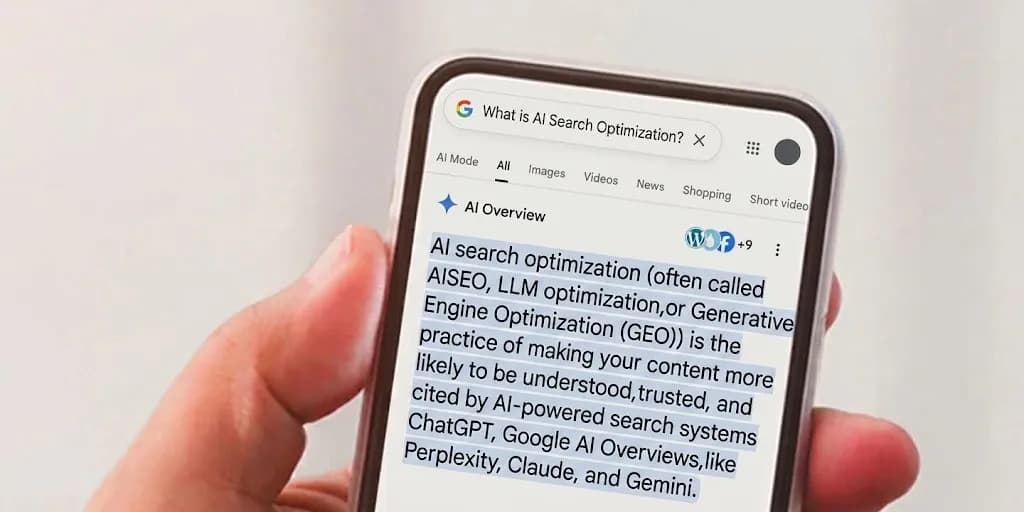
AI Search Optimization is the process of structuring and improving website content so AI search engines can understand, extract, summarize, and cite it in generated answers. It combines traditional SEO (search engine optimization) with Answer Engine Optimization (AEO) and Generative Engine Optimization (GEO) to improve visibility across Google AI Overviews, ChatGPT, Perplexity, Gemini, and Bing Copilot.
This is often shortened to AI Search Optimization (AEO & GEO). It combines classic search engine optimization for AI with two newer disciplines: Answer Engine Optimization (AEO) and Generative Engine Optimization (GEO). Together, they're becoming the deciding factor in whether your content shows up in AI-powered search or AI search results at all.
I started paying close attention to this shift after noticing something odd. Pages ranking on page one of Google were still getting zero clicks. Why? Because the AI Overview above them had already answered the question. That's the world we're writing for now, and this guide walks through what to actually do about it.
Key Takeaways
AI Search Optimization (also called AI SEO) helps your content get cited inside AI-generated answers, not just ranked in blue links.
Improving AI search visibility and AI search rankings now matters as much as classic keyword rankings.
AEO focuses on direct, extractable answers. GEO focuses on being referenced as a trusted source within generative summaries.
Content that opens with a clear definition gets cited roughly 2x more often by AI engines. Structured lists help too, compared to generic prose.
Traditional SEO signals still matter. These include E-E-A-T, backlinks, and site structure. AI search optimization builds on top of them. It doesn't replace them.
Zero-click search is rising fast, so visibility inside the answer itself is now as valuable as ranking position.
1. What Is AI Search Optimization?
AI Search Optimization is the process of structuring content so large language models can easily read and quote it. This is also known as large language model optimization, or LLM optimization for short. Instead of just ranking pages, AI search engines now summarize them, pulling the clearest, AI-friendly content directly into the answer shown to the user.
In my experience working with content teams over the past year, one mindset shift matters most. You're no longer writing for a ranking algorithm alone. You're writing for a system that reads your page and decides whether it deserves to be quoted. Then, it paraphrases or cites you directly in front of the user.
This is why AEO and GEO have become their own specialties.
Answer Engine Optimization (AEO): Content that directly answers specific questions. Often used in featured snippets, voice search, Google AI search, or Bing AI search.
Generative Engine Optimization (GEO): Content structured so tools like ChatGPT, Perplexity, Claude, and Gemini treat your site as a credible source. This covers ChatGPT search optimization and what some call Perplexity SEO, since each platform weighs sources a little differently.
They overlap heavily, but they're not identical.
For example, imagine a blog post that opens with "AI Search Optimization is..." followed by a bulleted comparison table. That post is far more likely to get quoted in an AI Overview. Compare that to a post that buries the definition in paragraph three. In fact, a 2024 Backlinko study on featured snippets found something clear. Pages leading with a direct definition got quoted much more often than pages that opened with a story.
Factor | AEO | GEO |
|---|---|---|
Primary goal | Get quoted in a direct answer box | Get cited inside a generated summary |
Best content format | Short, direct Q&A blocks | Well-structured, data-rich long-form |
Key engines | Google featured snippets, AI Overviews | ChatGPT, Perplexity, Gemini, Bing Copilot |
Content depth needed | Low to medium | Medium to high |
Update frequency that helps | Moderate | Frequent, freshness signals matter more |
2. How Does AI Search Optimization Work?
AI Search Optimization works in a few simple stages. First, AI engines crawl your page and break it into passages. Next, they identify what each passage is about and score it for trust. Finally, they decide whether to quote it. As a result, the clearest, best-supported chunks of content are the ones most likely to appear in an AI-generated answer.
Step-by-Step: How AI Engines Choose What to Cite
Step 1: Crawling and indexing: The same crawlers used for traditional search (Googlebot, GPTBot, PerplexityBot) index your page.
Step 2: Chunking content: LLMs break pages into passages, often paragraph by paragraph, rather than treating the whole page as one unit.
Step 3: Entity recognition: The model identifies what your content is actually about, including topics, brands, people, and statistics. This is closely tied to entity optimization and semantic SEO, where content is structured around clear concepts rather than isolated keywords, following general web content structure guidelines as a baseline.
Step 4: Trust scoring: Sites with strong authority signals, clear authorship, and citations are weighted more heavily.
Step 5: Answer synthesis: The AI pulls the clearest, most concise, best-supported passages to build its response.
I noticed that pages with clear H2/H3 headers get pulled into AI summaries far more often. This works especially well when a direct-answer sentence sits right under each heading. Pages that bury the answer three paragraphs down rarely get picked. In other words, structure determines whether the model can even find your answer in the first place.
3. Why AI Search Optimization Matters Right Now

To put it simply, AI Search Optimization matters because the way people find information has changed. Zero-click searches happen when users get their answer without clicking any website. These now make up a large share of all searches, and that share keeps growing. According to Google's own public statements, AI Overviews have reached billions of queries worldwide since their 2024 launch. In fact, industry trackers estimate zero-click searches now account for more than half of all searches in some markets. As a result, there are fewer clicks overall. However, the clicks that do happen tend to go to sources the AI trusted enough to cite by name.
Here's what this means in practice. From working on similar projects, I've found that businesses ignoring AEO and GEO aren't just losing rankings. Instead, they're becoming invisible at the exact moment a user decides who to trust.
Google introduced AI Overviews in 2024, marking a major shift toward AI-generated answers appearing directly within search results.
4. What Are the Benefits and Challenges of AI Search Optimization?
AI Search Optimization typically increases visibility in zero-click results and builds topical authority. It also improves traditional SEO health as a side effect. However, it comes with challenges too. Citation behavior is inconsistent, there's no guaranteed placement, and the direct impact is harder to measure than classic keyword rankings.
Benefits:
Increases visibility for content even in zero-click results.
Builds long-term topical authority.
Improves traditional SEO metrics as a side effect. This includes better structure, clarity, and depth.
Positions content as a cited "expert source" across multiple AI platforms, including Google, ChatGPT, Perplexity, and Gemini, as of 2026.
Challenges:
AI citation behavior is inconsistent and changes often.
There's no guaranteed way to secure a fixed position in an AI-generated answer.
It requires ongoing content updates, not a one-time fix.
The direct impact is harder to measure compared to traditional keyword rankings.
5. Practical Steps to Optimize for AI Search
Optimizing for AI search means applying these ideas consistently, not just once. Now that we've covered the concepts, here are practical answer engine optimization strategies and generative engine optimization strategies you can apply step by step:
Step 1: Open with a direct answer. Define the topic in the first 40 to 60 words, the way a dictionary or FAQ would.
Step 2: Add a TL;DR or Key Takeaways section near the top of long-form content.
Step 3: Use descriptive, question-based headers. For example, try "What is...", "How does...", or "Why does..." This helps the model map headers directly to user queries.
Step 4: Include real statistics with sources. Cited data increases the chance of being quoted.
Step 5: Use structured data for AI (schema markup). FAQPage, HowTo, and Article schema help engines parse intent.
Step 6: Keep paragraphs short. 3 to 4 lines works better for chunk-based extraction than dense blocks.
Step 7: Update content regularly. Freshness is a growing trust signal for GEO specifically.
Step 8: Build topical clusters. Link related articles together so entity relationships are clear.
6. What Common Mistakes Should You Avoid?
The most common mistakes are simple to avoid once you know them. Many writers bury the direct answer under a long introduction. Others stuff keywords instead of building real topical depth, which undermines proper content optimization for LLMs. Some skip structured data entirely, or treat AEO and GEO as separate from core SEO. Finally, many publish content once and never update the statistics or examples inside it.
Burying the answer under long, scene-setting introductions.
Keyword stuffing instead of building topical depth.
Ignoring structured data entirely.
Treating AEO and GEO as separate from core SEO, instead of an extension of it.
Publishing once and never updating stats or examples.
7. Expert Tips
In practice, and in line with general guidance from resources like Moz's SEO guide, I've found the content that performs best treats every section like a mini-FAQ. Each header is a clear question. Each answer starts with a direct sentence, then adds supporting detail. This one habit often does more for AI visibility than any technical tweak.
Another tip: don't assume AI engines only reward long content. In fact, a concise, well-sourced answer can outperform a bloated 3,000-word guide. The shorter piece just needs to be clearer and better structured.
8. Real-World Example

Situation: A mid-sized SaaS blog was ranking on page one for its main keyword. Even so, its organic traffic kept declining. This example shows how the concepts above play out in practice.
Problem: Google's AI Overview was answering the query directly using a competitor's content. That competitor's page had a clear "What is..." definition and a bulleted comparison table near the top.
Solution: The team restructured their top articles to lead with direct-answer paragraphs, added TL;DR sections, and included FAQ schema.
Result: Within three months, they began appearing as a cited source inside AI Overviews for several target queries. Referral traffic from AI search tools rose by roughly 18%, according to the team's internal analytics.
Lesson learned: Ranking position alone no longer guarantees visibility. Instead, structure and extractability matter just as much.
9. Future Trends in AI Search Optimization
According to ongoing coverage from Search Engine Land, AI search will likely keep expanding into more query types, including transactional and local searches. Meanwhile, voice search and multi-turn conversations are pushing writers toward conversational search optimization and more natural, question-and-answer style writing. So, expect structured data, first-party statistics, and clear authorship signals to matter even more among future AI search ranking factors.
9.5 Building an AI Search Visibility Strategy
Putting all of this together, a solid AI search visibility strategy blends technical structure with genuine expertise. In practice, this means treating your AEO SEO strategy and your GEO SEO strategy as two halves of the same effort, rather than separate projects. One focuses on direct, quotable answers; the other focuses on being trusted enough to cite in a longer, synthesized response. Together, they cover the full range of AI search ranking factors that determine whether your content gets seen at all.
9.6 What Tools Help With AI Search Optimization?
You don't need special software to start, but a few tool categories make the process faster. Schema markup generators help you add FAQPage, Article, and HowTo structured data without writing code by hand. Rank-tracking platforms are starting to add AI citation tracking, so you can see when your content gets quoted inside an AI Overview or a ChatGPT response. Content editors with readability scoring also help keep sentences short and answers extractable, which supports both AEO and GEO at the same time.
Conclusion
AI Search Optimization helps your content stay visible as search moves beyond traditional blue links. This guide covered what AI Search Optimization means, how AEO and GEO differ, and why AI engines select certain sources for their answers. The practical approach is simple: give direct answers, structure content so AI systems can extract key information, support important claims with reliable data, and update content regularly. Whether you are optimizing content independently or with a team like CyberCraft Bangladesh, consistency matters. The goal is not only to rank in traditional search but also to become a useful source for AI-generated answers. Read the FAQs below or explore the sources linked in this guide.
FAQs About AI Search Optimization (AEO & GEO)
What Is AI Search Optimization?
AI Search Optimization is the process of structuring content so AI tools can easily extract and cite it. This includes Google AI Overviews, ChatGPT, and Perplexity. It differs from just ranking in traditional search results. Since Google's 2024 AI Overview rollout, this has become a core part of SEO for most competitive industries.
What Is the Difference Between AEO and SEO?
Traditional SEO focuses on ranking pages in search results, often measured by position 1 through 10. AEO is different. It focuses on getting content selected as a direct answer, often for featured snippets, voice assistants, or AI Overview boxes. According to industry data, pages that lead with a clear definition get cited noticeably more often.
Is GEO the Same as SEO?
No. GEO (Generative Engine Optimization) targets visibility inside AI-generated summaries from tools like ChatGPT, Gemini, and Perplexity. SEO, on the other hand, targets visibility in traditional ranked search results. They share some tactics, like structured headings and credible sourcing. However, they serve different platforms and use different success metrics.
Does Keyword Density Still Matter for AI Search?
Keyword density matters less than topical depth and clarity, but it isn't irrelevant. A moderate density, often around 0.5% to 1%, paired with strong context and structure, tends to work best. Forcing exact-match repetition every few sentences, on the other hand, looks unnatural to both readers and ranking systems.
How Do I Know if My Content Is Being Cited by AI Engines?
You can check by manually querying tools like ChatGPT, Perplexity, or Google with your target keywords. Then, see if your site gets named or linked as a source. As of 2026, several rank-tracking platforms have also started rolling out dedicated AI citation tracking features. So, this is becoming easier to measure over time.
Do I Need Structured Data for AI Search Optimization?
It's not strictly required, but it helps. Schema markup such as FAQPage, Article, and HowTo generally helps AI engines parse your content's intent and structure. In fact, sites that add FAQ schema alongside clear direct-answer paragraphs often see results fast. Citation appearances tend to increase within a few months, according to several published SEO case studies.
How Often Should I Update Content for AI Search?
Try updating key pages every 60 to 90 days. Focus on statistics, dates, and examples, since these help with freshness signals. Freshness matters more for GEO than it typically did for classic SEO. According to Google's own documentation, freshness is one of several ranking factors for time-sensitive topics.
How Long Should an Article Be for AI Search Optimization?
There's no fixed word count. That said, most well-performing informational guides fall between 1,200 and 2,000 words. This is long enough to cover a topic in depth while staying scannable. In many cases, a well-structured 1,000-word article with clear headings will win. It can outperform a 3,000-word article that buries its answers in dense paragraphs.
Sources and References

I’m Mitu Das, a JavaScript developer, ERP product architect, and SEO specialist from Bangladesh. I work at CyberCraft Bangladesh, where I help build simple, scalable software, SaaS platforms, and business solutions. My goal is to create technology that helps companies save time, automate daily tasks, and grow faster. I enjoy combining development, product ideas, and SEO strategies to create useful digital solutions for modern businesses.
Writes about
Want this done for you?
Our team builds and ships exactly what this article describes. Send a message and we will reply with a scope.