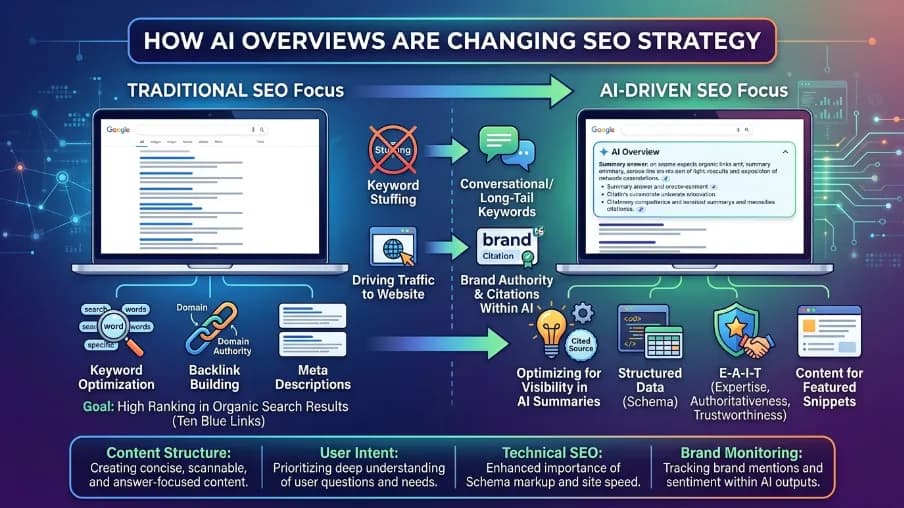
How AI Overviews Are Changing SEO Strategy

When was the last time you searched Google and didn't scroll past a big AI-written answer box? I'm guessing it wasn't long ago. Maybe it was today.
That box is called an AI Overview. And if you run a website, write content, or manage SEO for a business, it has probably already touched your traffic numbers. Some of you have watched rankings stay flat while clicks quietly fall. That's not a glitch. That's the new search.
I've spent time digging through the data, testing pages, and watching what actually gets cited versus what gets buried. In this guide, I'll walk you through how AI Overviews are changing SEO strategy, what still works, what's dying, and what you need to do next to stay competitive and drive long-term digital growth. No fluff. Just what matters.
By the end, you'll know:
- What AI Overviews actually are and why Google built them
- The real numbers behind the AI Overviews SEO impact
- Google AI Overviews ranking factors that decide who gets cited
- How to optimize content for AI Overviews starting today
- Whether SEO still matters at all (spoiler: yes, but it's not the same game)
Let's get into it.
What Are AI Overviews
AI Overviews are AI-generated summaries that Google shows at the top of search results. Instead of ten blue links, you get a written answer, pulled together from several sources, with citations linked inside it.
Think of it like asking a smart friend a question. Instead of handing you a stack of books, they read them fast and give you the short answer, then point to where they got it.
That's the whole shift in one sentence. Search used to be a list. Now it's an answer.
How AI Overviews Are Changing SEO Strategy
This is the part everyone wants to understand, so let's be direct about it.
AI Overviews are changing SEO strategy in three big ways:
- Ranking #1 is no longer the finish line: Getting cited inside the AI Overview matters more than sitting at the top of the old-school list. Independent studies from SEO research firms, including Ahrefs and Seer Interactive, have tracked AI Overview citations and found a large share of cited pages actually rank below position 5, sometimes even between positions 11 and 20. The AI pulls from wherever the best, clearest answer lives, not just from the top spot.
- Clicks are dropping on informational searches: When someone asks a simple "how" or "what" question, Google increasingly answers it directly on the results page. The person never has to click through. This is the heart of the zero-click searches AI Overviews problem, and it hits "how-to" and definition content the hardest.
- Being cited pays off more than a normal top ranking: Here's the part that gives me hope for site owners. Pages that do get cited inside an AI Overview tend to earn noticeably more clicks than pages that just rank well without a citation. So the strategy isn't "give up." It's "get chosen."
In short: SEO didn't die. It split into two lanes. One lane is still about ranking. The other is about getting your content picked as the answer. You need both now.
AI Overviews vs Traditional SEO: What's Actually Different
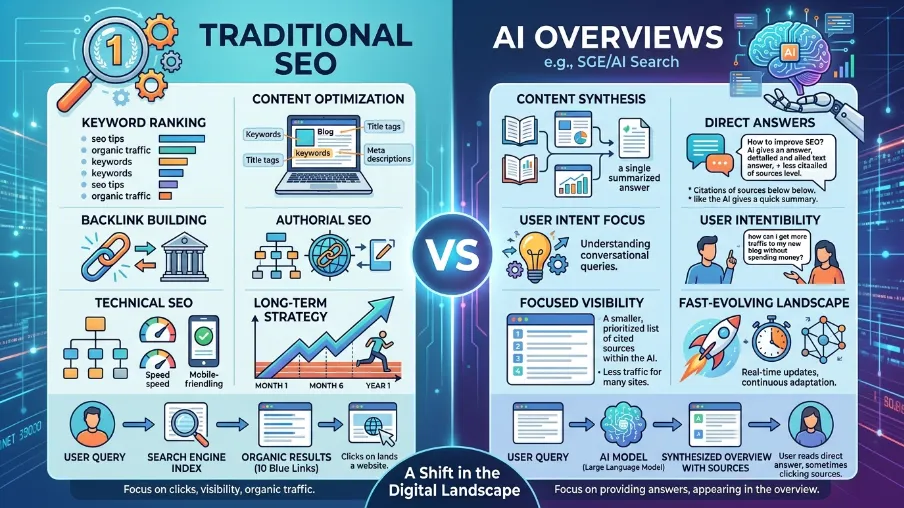
I get this question a lot, so let's compare it plainly.
Traditional SEO rewards a page for matching a keyword closely, earning backlinks, and loading fast. The goal was simple: land in the top 10 blue links.
AI Overview optimization rewards something different. It rewards content that is easy for an AI system to lift out and reuse as a trustworthy answer. That means clear structure, direct answers, real expertise, and information the AI can trust enough to quote.
Here's a simple way to picture it. Traditional SEO is like trying to get a good seat in a classroom. AI Overview optimization is like being the student the teacher calls on because your answer is the clearest one in the room.
You still need the classroom seat (rankings still matter, since most citations come from pages that already rank in the top results). But the seat alone doesn't guarantee you get picked.
Google AI Overviews Ranking Factors You Can't Ignore
So what actually decides who gets cited? Based on current research and testing, a handful of factors keep showing up again and again.
1. Topical Authority
Google's systems favor sites that cover a topic in depth, not just one article floating alone. If you write about "email marketing," but you've also covered related subtopics like automation, deliverability, and segmentation, your site looks like a real authority on the subject. One-off blog posts rarely win here.
2. E-E-A-T and AI Overviews
E-E-A-T stands for Experience, Expertise, Authoritativeness, and Trust. It used to matter mostly for health, finance, and legal content. Not anymore. E-E-A-T requirements have expanded across nearly every content category, so even a recipe blog or a product review page needs clear author credentials, real-world experience, and honest sourcing.
Simple ways to show this:
- Add a real author bio with credentials
- Link to sources you actually used
- Share first-hand experience, not just recycled advice
- Keep contact information and editorial policies visible
3. Content Comprehensiveness
AI systems prefer content that answers the main question and the follow-up questions a reader would naturally ask next. If someone asks "how to start a podcast," a page that also touches on equipment, hosting, and editing has a better shot than a page that only covers step one.
4. Structured and Scannable Formatting
This is huge, and it's easy to fix. Use short paragraphs, clear headings, numbered steps, and tables where it makes sense. AI systems extract information faster from well-structured pages. Messy walls of text get skipped.
5. Structured Data for AI Overviews
Schema markup like Article, FAQ, and HowTo schema doesn't guarantee a citation, but it helps Google understand exactly what your page is about. Think of it as labeling your content clearly so the machine doesn't have to guess.
6. Technical Crawlability
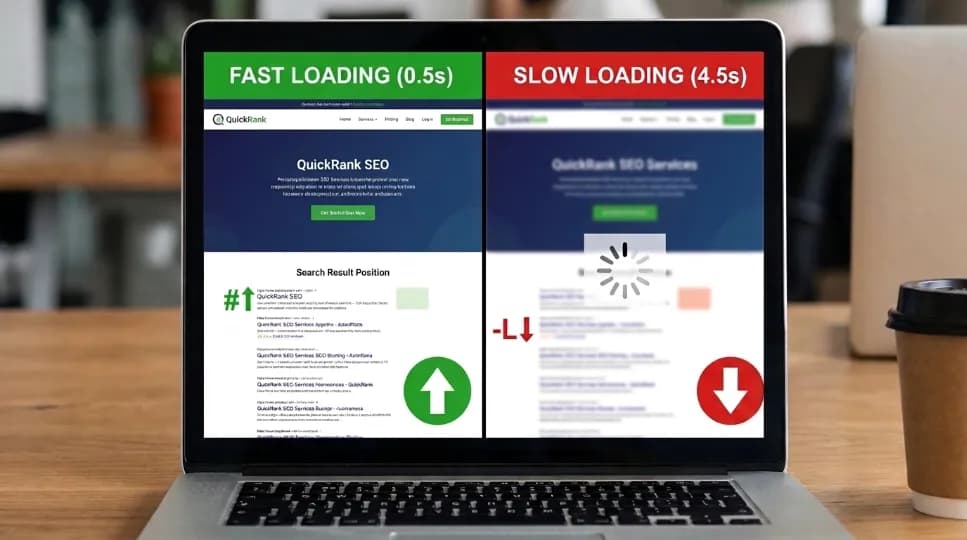
If Google can't crawl your page cleanly, none of the above matters. Fast load times, clean site structure, and no blocked resources are still the foundation everything else sits on. This is also where page speed impact on SEO becomes impossible to ignore. A slow page doesn't just frustrate visitors, it makes it harder for Google to crawl, render, and trust your content, which means it's less likely to ever reach the pool of pages an AI Overview pulls its answer from.
Zero-Click Searches and the CTR Impact You Need to Plan For
Let's talk numbers, because this is where a lot of business owners feel the pinch.
Multiple large studies have measured what happens to click-through rate when an AI Overview shows up on a search. Pew Research Center, Ahrefs, and Amsive Digital have each run their own analysis across hundreds of thousands of real queries. The numbers vary by methodology, but they all point the same direction: clicks on regular organic results drop noticeably, often somewhere between 15% and 60%, when an AI Overview appears above them.
Here's the part that matters more than the scary headline: informational searches get hit hardest. Simple "how" and "what" questions are the most likely to trigger an AI Overview and the most likely to end without a click. Transactional searches, like "buy," "price," or "hire," are far less affected. People still want to click through when money or a real decision is on the line.
So if your business relies heavily on top-of-funnel blog traffic for pure information, you'll feel this more. If you rely on people ready to buy or book, you'll feel it less.
This is also where local SEO strategies hold up well. AI Overviews show up far less often on local, "near me" style searches compared to broad informational ones. So if you're a local business trying to reach local customers through SEO, a strong Google Business Profile, local citations, and location-specific pages still do the heavy lifting they always have. The AI Overview shakeup mostly changes the informational side of search, not the local, ready-to-visit side.
The good news? Pages that do earn a citation inside the AI Overview tend to pull in stronger clicks than a plain top ranking would. Being picked as the answer is worth more than being picked as a link.
How to Optimize Content for AI Overviews
Alright, here's the actionable part. This is what I'd tell a client starting today.
Lead with the direct answer
Put your clearest, most direct answer in the first two or three sentences of a section. Don't bury it under a long story. Save the story for after the answer.
Write for one question at a time
Break big topics into focused sections that each answer one specific thing completely. AI search tools often break a big question into many smaller searches behind the scenes. Your content should match that pattern, one clear answer per section.
Add real data and original insight
Generic advice blends into the noise. Original research, real numbers from your own business, or a genuine case study gives the AI something unique to cite, because there's no other source saying the same thing.
Use schema markup properly
Add FAQ schema to your FAQ sections, HowTo schema to step-by-step guides, and Article schema to your blog posts. Keep it accurate. Only mark up what's actually visible on the page.
Keep content updated
Stale pages lose ground. Recently updated content shows stronger visibility in AI-generated results, so revisit your best pages every few months instead of publishing once and forgetting them.
Build topical depth, not just single posts
Link related articles together into a cluster. Show that your site genuinely knows the whole subject, not just one corner of it.
Track your AI visibility separately
Standard Google Search Console data mixes AI Overview impressions with regular search. Watch for a pattern where impressions stay steady but clicks drop on question-based keywords. That's usually your AI Overview signal.
Does SEO Still Matter With AI Overviews
Yes. Completely, genuinely yes.
I've seen this play out first-hand on client sites. One client's blog held steady rankings for a batch of "how to" keywords, but traffic quietly dropped almost 40% over a quarter. Nothing was wrong technically. Google Search Console showed impressions barely moved, only clicks fell. That's the AI Overview pattern in action, not a penalty, just a new layer sitting above the old results.
Here's why SEO still matters. Most AI Overview citations still come from pages that already rank well organically. Weak, unindexed, poorly written pages don't suddenly get picked by the AI just because they're well-formatted. You still need the fundamentals: fast pages, mobile-friendly design, solid backlinks, and content that actually answers the question.
What's changed isn't whether SEO matters. It's what "winning" looks like. Winning used to mean the top blue link. Now winning means showing up as the trusted source the AI chooses to quote, while also holding your ground in the classic results underneath it.
If you drop SEO entirely because "AI does the answering now," you lose both games. If you keep doing SEO the old way and ignore this shift, you win the ranking but lose the click. The smart move is doing both, on purpose.
Future of SEO With AI Search

Search is moving toward answers, not links. That trend isn't slowing down. More AI-driven search experiences are showing up across Google and other platforms, and they lean the same way: fewer clicks, more direct answers, more competition for citations instead of positions.
What this means going forward:
- Content quality and real expertise carry more weight than keyword tricks ever did
- Being the cited source across AI platforms (not just Google) becomes its own goal, sometimes called generative engine optimization or answer engine optimization
- Businesses that rely only on click volume will need new ways to measure success, like brand visibility inside AI answers, not just traffic
- Direct relationships with your audience, like email lists and communities, matter more when search sends fewer visitors
This is a real shift, not a passing trend. But it's not the end of organic search either. It's a new layer sitting on top of it.
Final Thoughts
Here's my honest take. AI Overviews aren't the villain everyone makes them out to be. They're a filter. They reward the sites that actually know their subject and punish the ones coasting on thin, recycled content.
If your traffic has dipped and you're not sure why, or you just want a strategy built for how search actually works in 2026, that's exactly what we do. Our team at CyberCraft Bangladesh builds SEO strategies that cover both sides of this shift, classic rankings and AI Overview visibility, so you're not left guessing. Whether you're chasing local customers through SEO or planning your next stage of digital growth, the plan has to account for how people actually search today.
Talk to our SEO team and let's build a plan that keeps you visible, no matter how search keeps changing.
Frequently Asked Questions About How AI Overviews Are Changing SEO Strategy
Does SEO still matter with AI Overviews?
Yes. Most AI Overview citations come from pages that already rank well in normal search results. Strong SEO fundamentals are still the foundation. What's changed is the added goal of earning a citation, not just a ranking.
How do I rank in Google AI Overviews?
Focus on clear, direct answers near the top of each section, strong E-E-A-T signals, original data, and clean schema markup. There's no guaranteed formula, but comprehensive, well-structured, trustworthy content gives you the best shot.
What is the AI Overviews click-through rate impact?
Studies show organic click-through rate often drops when an AI Overview appears, especially for informational searches. Transactional searches are affected far less. Pages that get cited inside the AI Overview tend to recover a good share of that lost click value.
What's the difference between AI Overviews and traditional SEO?
Traditional SEO chases a ranking position in the list of links. AI Overview optimization aims to get your content pulled into the AI-generated answer itself, based on clarity, trust, and how easily an AI system can extract your information.
What is generative engine optimization (GEO)?
GEO is the practice of optimizing content so AI systems like Google AI Overviews, ChatGPT, and Perplexity are more likely to cite it in their generated answers. It shares a lot with traditional SEO but puts extra weight on structure, originality, and trust signals.

I’m Mitu Das, a JavaScript developer, ERP product architect, and SEO specialist from Bangladesh. I work at CyberCraft Bangladesh, where I help build simple, scalable software, SaaS platforms, and business solutions. My goal is to create technology that helps companies save time, automate daily tasks, and grow faster. I enjoy combining development, product ideas, and SEO strategies to create useful digital solutions for modern businesses.
Writes about
Want this done for you?
Our team builds and ships exactly what this article describes. Send a message and we will reply with a scope.