Custom Ecommerce Development vs SaaS Platforms: Which One Actually Grows Your Business

Picking an e-commerce platform feels like a small decision. It isn't. I've watched brands pick Shopify in a weekend, then spend two years fighting its limits. I've also watched others sink $200,000 into a custom build they didn't need yet. Both mistakes come from the same place: nobody explained the real trade-offs before the invoice showed up.
This guide fixes that. We build both SaaS storefronts and fully custom ecommerce platforms for clients every year, so this comparison comes from work we've shipped, not just research. I'll walk you through custom ecommerce vs SaaS e-commerce in plain words. You'll see real costs, real limits, and a clear way to decide which path fits your business and support long-term digital growth. No jargon. No sales pitch. Just the facts you need before you sign a contract.
By the end, you'll know exactly which questions to ask, whether that's Shopify vs custom ecommerce development, BigCommerce vs custom built ecommerce, or open source vs SaaS.
What's the Real Difference Between Custom Ecommerce and SaaS Platforms
Let's start simple.
A SaaS ecommerce platform is rented software. Think Shopify, BigCommerce, or Wix. You pay monthly. The vendor hosts your store, handles security patches, and gives you a set of templates and apps to work with. You build fast, but inside their walls.
Custom ecommerce development means your store is built specifically for you. A development team writes the code, designs the architecture, and connects the exact tools your business needs. You own the code. You control every rule. But you also own every bug, every server, and every upgrade.
Neither one is "better" in general. Each one is better for a specific business, at a specific stage. That's the whole point of this article.
SaaS Ecommerce Pricing: What You Actually Pay in 2026
SaaS platforms sell themselves on low starting prices. That part is true. But the sticker price is only the entry fee.
Take Shopify as the clearest example. In 2026, plans run from a Basic tier around $39 a month up to Advanced near $399 a month. Shopify Plus starts at roughly $2,300 per month on a three-year contract. Once your store crosses a revenue threshold, Plus shifts to a variable fee based on a percentage of total sales instead of a flat rate.
This pricing reality is one of the biggest reasons the debate around custom ecommerce development vs SaaS platforms has become more important for growing brands.
That's just the subscription. Add on top:
- Transaction fees if you skip the platform's own payment processor
- Apps for reviews, subscriptions, loyalty, and search, often $50 to $500 a month combined
- Premium themes and custom design work
Expansion stores for extra markets, which can cost hundreds of dollars per month per additional store beyond what's included
Third-party app fees that often add another 20% to 40% on top of your base platform cost once you factor in tools like email marketing and reviews
This is the hidden cost of SaaS ecommerce nobody mentions in the sales demo. Your $39-a-month plan can quietly become a $2,000-a-month operation once apps, themes, and fees stack up, making custom ecommerce development vs SaaS platforms a cost comparison worth evaluating beyond the advertised monthly price.
Custom Ecommerce Development Cost: The Real Numbers
Custom development costs more upfront. There's no way around that. But the range is wider than most agencies admit, because it depends entirely on scope.
Here's a realistic breakdown for 2026:
- Small custom store: $15,000 to $25,000, for a clean, conversion-ready build with a few hundred products. This tier is usually the sweet spot if you're searching for affordable e-commerce website development that still avoids template limits.
- Mid-size custom or headless build: $60,000 to $250,000, for advanced integrations, custom checkout, and multi-region support
- Enterprise custom platform: $150,000 to over $1 million, for large catalogs, ERP integration, and heavy traffic
If you're weighing headless commerce architecture specifically, expect it to add twenty to a hundred thousand dollars on top of a standard build, since you're paying for a separate frontend layer plus the API work that connects it to your backend.
That sounds steep next to a $39 SaaS plan. But here's the number that actually matters: total cost of ownership, not sticker price.
Total Cost of Ownership: SaaS vs Custom Over Time
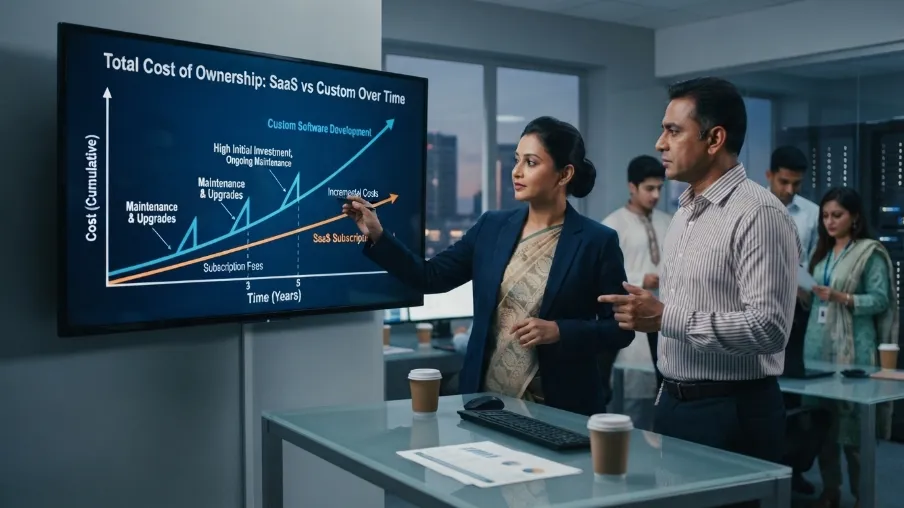
This is where most comparisons fall short. They compare month one, not year three.
A SaaS platform's monthly fee looks small. But add up three to five years of subscriptions, transaction fees, app costs, and the developer you'll eventually hire anyway to work around platform limits. That number climbs fast, especially at scale.
A custom platform's upfront cost looks big. But once it's built, your ongoing costs are mostly hosting and maintenance, not rent to a platform vendor. You're not paying a growing revenue-share fee just because your business succeeded.
Here's a simple way to think about it: SaaS front-loads convenience and back-loads cost. Custom front-loads cost and back-loads control. Neither is wrong. It depends on how long you plan to run this store, and how fast you expect to grow.
One real detail worth knowing: enterprise brands moving to open-source or custom-built stacks have reported initial costs coming in nearly 39% lower than staying on a top-tier SaaS plan, once licensing and app-stack spending are counted properly. That's not true for every business, but it shows why the "SaaS is always cheaper" assumption doesn't hold at scale.
Scalability: Where Custom Ecommerce Platforms Pull Ahead
Scalability isn't just about traffic spikes on Black Friday. It's about whether your platform can grow in the direction your business actually needs to go.
SaaS platforms scale well for standard retail. They struggle with:
- Multi-vendor marketplaces: If your core business model is a multi-vendor marketplace where third-party sellers manage their own inventory and fulfillment, most SaaS platforms aren't built for that. You can patch it together with apps, but it's a workaround, not a real fit.
- Complex B2B logic: Basic B2B features now ship on lower SaaS tiers, but advanced needs like unlimited catalogs, complex approval chains, and punchout integrations with ERP systems often require a self-hosted or custom solution.
- Full data ownership: Some businesses, especially regulated ones, need to own every line of code and control exactly where their data lives. That's something a rented platform can't fully offer.
Custom ecommerce platforms don't have these ceilings. You build the exact logic your business needs. There's no waiting for a vendor's roadmap to catch up to your growth.
Ecommerce Platform Customization Limitations You Should Know
Every SaaS platform has walls. You just don't see them until you hit one.
Common limits I see brands run into:
- Checkout customization locked behind the most expensive tier
- API rate limits that throttle your ERP or PIM sync once you scale
- Design restricted to what the theme engine allows
- Feature requests stuck in a backlog you don't control
None of this means SaaS is bad. It means SaaS optimizes for speed and simplicity, not infinite flexibility. If your business model is standard retail, this rarely matters. If your business model is unusual, it matters a lot.
Headless Custom Ecommerce Development vs Saas Platforms: A Middle Path
Here's something a lot of comparisons miss: it's not always custom-from-scratch versus fully-templated SaaS. There's a middle option.
Headless commerce keeps a platform's backend (inventory, orders, payments) but replaces the frontend with a custom-built storefront. You get commerce infrastructure you don't have to build yourself, plus the design freedom and speed of a custom frontend.
The performance case for this is strong. One well-documented migration to a headless setup saw a 136.7% increase in ecommerce conversion rate and 74.8% more add-to-carts after moving to a headless architecture. Another brand reported a 132% jump in mobile sessions and a 12% conversion rate increase after a headless commerce revamp.
Headless isn't free, though. A real production headless storefront typically starts around $10,000 to $15,000 for a small build, and enterprise headless projects can run well past $150,000. It's a strong middle ground for brands that have outgrown template limits but don't need a fully custom backend yet.
Open Source Ecommerce vs SaaS: What Changes
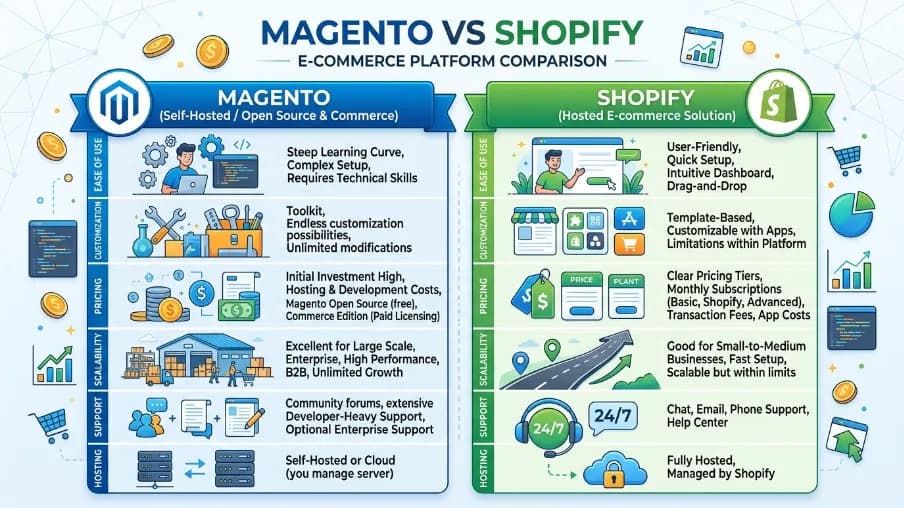
Open source platforms (Magento, now Adobe Commerce, WooCommerce, and newer options like Medusa) sit between SaaS and full custom.
You don't pay licensing fees for the core software. But you do pay for hosting, developers, security patches, and every plugin you add. Even a professionally implemented open-source Magento build typically costs $15,000 to $50,000 once hosting, development, and extensions are factored in.
The trade-off: you get more control than SaaS, less turnkey convenience, and you're responsible for your own security and updates. This suits businesses with in-house technical capacity, or an agency partner who handles it for you.
Platform Face-Offs: Shopify, BigCommerce, Magento, and WooCommerce vs Custom
Quick, honest comparisons:
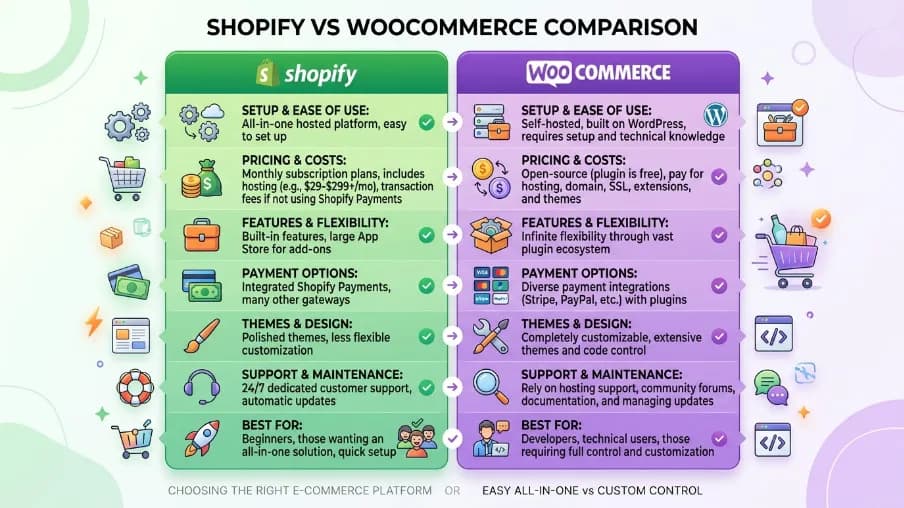
Shopify vs custom ecommerce development: Shopify wins on speed to launch and app ecosystem. Custom wins on unlimited flexibility and no revenue-share fees at scale. Shopify Plus is genuinely strong for mid-size brands that need B2B and checkout customization without building it themselves.
BigCommerce vs custom built ecommerce: BigCommerce packs more native features into its core plans, which can reduce app dependency. Custom still wins if your business model doesn't match standard retail patterns, like complex marketplaces or unusual pricing logic.
Magento (Adobe Commerce) vs custom build: Magento offers deep customization out of the box, which is why many "custom" projects are actually built on top of it rather than from a blank slate. It shines for large catalogs and B2B but comes with real hosting and maintenance overhead.
WooCommerce vs SaaS platforms: WooCommerce is the most affordable entry into open source, especially if you already run WordPress. It's a solid choice for small to mid-size stores, but it needs more hands-on maintenance than any SaaS plan.
The Ecommerce Website Development Process: What to Expect
Whichever path you pick, the e-commerce website development process follows a similar shape. Knowing these steps helps you spot a rushed proposal before you sign it.
- Discovery and requirements: Your business model, catalog size, integrations, and budget get mapped out before any code is written.
- Platform or architecture decision: This is where the custom ecommerce vs SaaS ecommerce call actually gets made, based on your discovery findings, not a vendor's preference.
- Design and UX: Wireframes and visual design come next, usually 15% to 25% of total project cost on a custom build.
- Development and integrations: The storefront, checkout, and any ERP, CRM, or payment integrations get built and connected.
- QA and testing: Security, payment flows, and mobile performance get tested before launch, not after.
- Launch and post-launch support: A good e-commerce website development process doesn't end at go-live. Ongoing maintenance, monitoring, and updates keep the store secure and fast.
A SaaS build can compress this timeline to a few weeks. A custom build usually runs three to eighteen months, depending on scope. Either way, skipping steps to save time almost always costs more later in rework.
Which E-Commerce Platform Is Right for Your Business

Here's the honest framework I use with clients.
Choose SaaS (Shopify, BigCommerce) if:
- You're launching in weeks, not months
- Your business model is standard B2C retail
- You have a small or no in-house dev team
- You're under roughly $1M to $5M in annual revenue
- You want the most affordable e-commerce website development route to get live fast
Choose headless commerce if:
- You've outgrown template design limits
- Site speed and conversion rate are hurting revenue
- You have $5M+ in revenue and a mid-size dev budget
- You want platform stability with frontend freedom
Choose fully custom ecommerce if:
- Your business model doesn't fit standard retail (marketplace, complex B2B, unique logic)
- You need full data ownership for compliance reasons
- You're planning multi-year, high-growth scale
- Rented software fees would eventually cost more than owning your stack
This is exactly the kind of assessment our team walks through with every client before recommending a build. If you want a second opinion on where your business actually sits, that's a conversation worth having before you commit budget either way.
Bottom Line
There's no universal winner in the custom ecommerce development vs SaaS platforms debate. SaaS platforms are excellent for speed and simplicity. Custom ecommerce development is excellent for control and long-term ownership. The right choice depends on your revenue, your growth plans, and how much your business model deviates from standard retail.
If you're still unsure which path fits, that's normal. Most founders are. The smartest next step isn't picking a platform today. It's getting a clear, honest assessment of your specific business first.
Ready to figure out what actually fits your business? Talk to our ecommerce development team for a straight answer, not a sales pitch. We'll look at your numbers, your growth plans, and your technical needs, then tell you honestly whether SaaS, headless, or custom is the right call.
FAQs About Custom Ecommerce Development vs SaaS Platforms
Is custom ecommerce development worth it?
Yes, if your revenue and complexity justify it. For a growing brand with unique business logic, multi-vendor needs, or high transaction volume, custom development often pays for itself within one to two years by removing recurring platform fees and revenue-share costs.
What is the cost of building an ecommerce website from scratch?
In 2026, a small custom store starts around $15,000. Mid-size builds with integrations run $60,000 to $250,000. Enterprise platforms can exceed $500,000 depending on scale and compliance needs.
Why choose custom ecommerce over SaaS?
Mainly for control. Custom development removes platform ceilings on customization, avoids revenue-share fees at scale, and gives you full ownership of your code and data.
What are the disadvantages of SaaS ecommerce platforms?
Recurring fees that grow with revenue, limited backend access, dependency on the vendor's roadmap, and customization walls once your business needs get specific.
When should you build custom ecommerce instead of using SaaS?
When your business model doesn't fit standard templates, when you've hit real customization or API limits on SaaS, or when your projected long-term platform costs exceed what a custom build would cost to own outright.
What's the most affordable e-commerce website development option for a small business?
For most small businesses, a SaaS platform or a small-scope custom build (roughly $15,000 to $25,000) is the most affordable e-commerce website development path. It gets you a professional, conversion-ready store without enterprise-level integration costs.
What does the e-commerce website development process actually look like?
It runs through discovery, platform or architecture decisions, design, development and integrations, QA, and launch, followed by ongoing support. A SaaS store can move through this in weeks. A custom build usually takes three to eighteen months depending on scope.

I’m Mitu Das, a JavaScript developer, ERP product architect, and SEO specialist from Bangladesh. I work at CyberCraft Bangladesh, where I help build simple, scalable software, SaaS platforms, and business solutions. My goal is to create technology that helps companies save time, automate daily tasks, and grow faster. I enjoy combining development, product ideas, and SEO strategies to create useful digital solutions for modern businesses.
Writes about
Want this done for you?
Our team builds and ships exactly what this article describes. Send a message and we will reply with a scope.