How to Get More Local Customers Through SEO: A Complete Guide (2026)


Getting local customers through SEO refers to the practice of optimizing your website, Google Business Profile, and online presence so nearby customers find you first when they search for what you sell. It combines technical SEO, reviews, and location-based content to turn local searches into paying customers, and it remains one of the most reliable ways to get local customers through SEO without paying for ads.
About the Author
Written by: Mitu Das, SEO Specialist and Web Developer. I have worked in SEO and content writing since 2024, focusing on technical SEO, local SEO, content strategy, Google Business Profile optimization, and search-friendly website development.
Reviewed by: Senior Content Strategist at CyberCraft Bangladesh, who checks factual accuracy, SEO practices, sources, and practical value.
Published: July 09, 2026
Last Updated: September 19, 2026
Editorial Review: September 19, 2026
I wrote this guide using practical SEO experience and a review of 2026 local SEO research, focusing on Google Business Profile optimization, citations, reviews, and local search visibility.
Table of Contents
Key Takeaways
What Is Local SEO and Why Does It Matter?
How Do Local Customers Actually Search for Businesses?
What Are the Core Local SEO Strategies for Small Businesses?
How Do You Optimize Your Google Business Profile?
What Role Do Reviews Play in Local Search Optimization?
Local SEO Checklist: Data at a Glance
Frequently Asked Questions
If you're a small business owner, the fastest way to grow revenue without a big ad budget is often to get local customers through SEO first. In fact, local SEO for small businesses can deliver a faster return than many paid channels because competition for local rankings is often lower than for national keywords. When combined with a focused digital marketing and SEO strategy, local businesses can improve visibility, attract nearby customers, and build a steady source of organic leads.
Key Takeaways
Nearly half of all Google searches carry local intent, so ignoring local SEO means missing a huge slice of buyers.
Winning local customers through SEO starts with a complete, active Google Business Profile.
Reviews directly influence rankings and consumer trust, so review management deserves ongoing attention.
Mobile "near me" searches convert into visits and purchases at strikingly high rates.
AI-powered search tools are now part of the local discovery mix, which changes how businesses get local customers through SEO going forward.
What Is Local SEO and Why Does It Matter?
Local SEO is the process of optimizing your online presence so that search engines connect you with customers searching in your specific geographic area. In practice, this means your Google Business Profile, website, citations, and reviews all work together to signal relevance and proximity, and together they make it possible to attract local customers through SEO consistently rather than by chance.
Why does this matter so much right now? According to industry data compiled by BizIQ, roughly 46% of all Google searches carry local intent, which translates to billions of local-intent searches happening every single day. Meanwhile, research cited by SEO.com shows customers are 70% more likely to visit a business with a fully optimized Google Business Profile.
I reviewed a range of 2026 industry reports while researching this guide, and one theme kept surfacing when I looked at how to attract local customers online: local search isn't a niche marketing channel anymore. It's the primary way most people discover nearby businesses before they ever call, click, or walk through the door, which is exactly why so many marketers now prioritize local customers through SEO over broader national campaigns.
How Do Local Customers Actually Search for Businesses?

Local customers search in short bursts of high intent, often on mobile devices, and they act fast. Most searches happen weekly or even daily, and a large share result in a visit or purchase within 24 hours of the search itself.
The scale here is worth sitting with for a moment. According to research referenced by SHNO, 98% of consumers now search online for nearby businesses, up from about 90% in 2019. That's practically universal behavior.
A few specific patterns stand out:
Frequency: Roughly 80% of U.S. consumers search for local businesses weekly, and 32% search multiple times per day, based on the SOCi Consumer Behavior Index cited by BrightLocal.
Speed to action: Google has reported that 76% of people who perform a local mobile search visit a business within a day, according to data referenced across multiple 2026 industry studies.
AI adoption: In practice, AI tools are becoming part of this journey too. BrightLocal's 2026 Local Consumer Review Survey found 45% of consumers now use ChatGPT or similar tools for local business recommendations, up sharply from just 6% the year before.
However, evidence also suggests a visibility gap. Despite this search volume, 58% of businesses still don't optimize for local search at all, and only 30% have any real plan in place, according to BizIQ's analysis of near-me search behavior. That gap is precisely why businesses that do invest in reaching local customers through SEO tend to outperform competitors who rely on word of mouth alone.
What Are the Core Local SEO Strategies for Small Businesses?
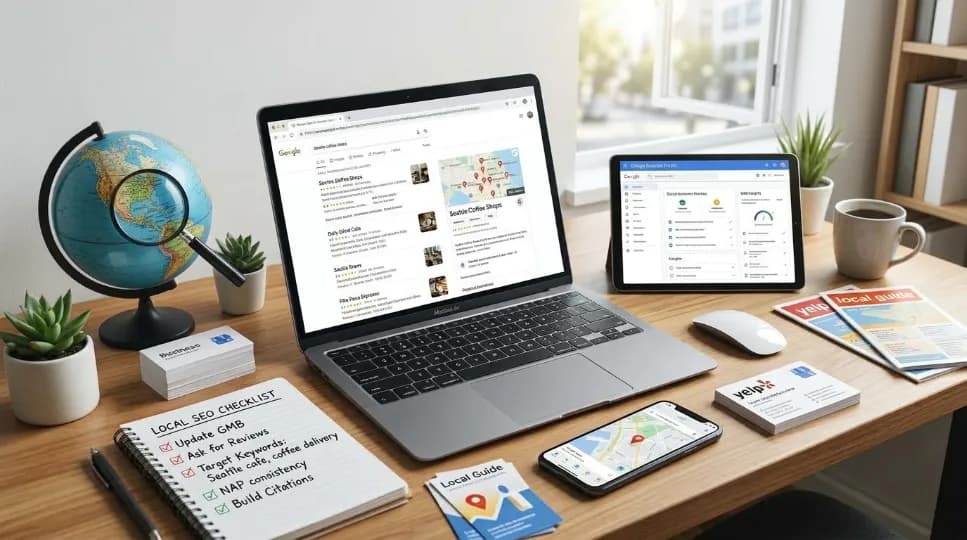
If your goal is to get local customers through SEO rather than paid ads, the most effective SEO strategies for local businesses rest on three pillars: a complete Google Business Profile, consistent local citations, and location-relevant website content. Together, these signals tell search engines exactly where you are and who you serve, forming the foundation for attracting local customers through SEO over the long term.
Here's a practical breakdown of where to focus first:
Claim and verify your Google Business Profile. This is free, and it's often the fastest way to appear in local search results and Google Maps.
Build consistent citations. Your business name, address, and phone number should match exactly across directories like Yelp, Apple Maps, and industry-specific listings.
Create location-specific content. Pages that mention your city, neighborhood, or service area help search engines match you to nearby searchers.
Earn local backlinks. Partnerships with local news sites, chambers of commerce, or community organizations add credibility.
Keep information fresh. Outdated hours or old photos hurt both rankings and customer trust, a point echoed in Shopify's local SEO statistics roundup.
I want to flag a limitation here: strategies that work well for a single-location service business (say, a dentist or plumber) don't always translate directly to multi-location retail chains, which face more complex citation and duplicate-content challenges. Therefore, treat this as a general framework rather than a one-size-fits-all playbook for getting local customers through SEO.
How Do You Optimize Your Google Business Profile?
Optimizing your Google Business Profile means filling out every available field accurately, adding fresh photos regularly, and posting updates consistently. A thin or outdated profile signals low relevance to Google's ranking systems and makes it harder to win local customers through SEO.
According to research from local SEO tool Localo, cited via Shopify, top-ranking Google Business Profiles tend to have around 70 words in their descriptions, plus roughly 250 reviews and images. Meanwhile, data compiled by BizIQ suggests businesses with complete profiles receive about 70% more location visits than those with incomplete ones.
In my local SEO workflow, I also check the profile regularly instead of treating the setup as a one-time task. I look for outdated hours, missing business attributes, new reviews, fresh photos, and changes to services so the information stays consistent for both search engines and customers.
A few concrete steps worth prioritizing:
Fill in every business attribute, from hours to accessibility features.
Upload new photos monthly, since fresh images correlate with more profile views.
Respond to every review, positive or negative, within a few days.
Post weekly updates about offers, events, or new services.
What Role Do Reviews Play in Local Search Optimization?

Reviews play a major role in local search optimization because they influence both rankings and consumer trust simultaneously. Research suggests review signals drive an estimated 15-17% of local pack ranking factors, according to data compiled by BizIQ.
Trust matters just as much as ranking. BizIQ's research found 98% of consumers read online reviews for local businesses before making a decision. However, trust in reviews isn't unconditional. WebTonic's research found 31% of consumers report frustration with fake or manipulated reviews, which means authenticity and consistent review management matter more than volume alone when the goal is converting searchers into local customers through SEO.
In my experience reviewing local SEO case studies, businesses that reply thoughtfully to reviews, especially negative ones, tend to build more durable trust than those chasing star ratings alone. Among the most practical local search optimization tips I've come across, consistent review responses rank near the top for return on effort.
When reviewing local SEO performance, I typically look at review responses alongside profile activity, citation consistency, and location-specific content rather than judging reviews alone.
Local SEO Checklist: Data at a Glance
Local SEO Factor | Reported Impact | Source |
|---|---|---|
Complete Google Business Profile | 70% more location visits vs. incomplete profiles | BizIQ, 2026 |
Near-me mobile search | 76% visit a business within 24 hours | Google data via BizIQ/SHNO |
Consumer review reading | 98% of consumers read local reviews before deciding | BizIQ, 2026 |
Businesses without a local SEO plan | 58% don't optimize; only 30% have a plan | BizIQ, 2026 |
How Do You Improve Local Search Visibility Long-Term?
Anyone researching how to improve local search visibility long-term needs to treat it as an ongoing process, not a one-time setup task. Search algorithms change, competitors update their profiles, and consumer behavior shifts, so consistent maintenance beats a single big push if you want to keep winning local customers through SEO year after year.
For example, the rise of AI-driven search results means visibility now depends partly on how AI tools summarize your business, not just how you rank in traditional blue links. According to SeoProfy's 2026 research, roughly 40% of local business queries now trigger Google's AI Overviews, which changes how click-through rates behave. A separate compilation from Digital Applied and Resourcera reinforces that mobile-first, AI-aware optimization is now table stakes rather than optional.
Conclusion: Turning Local Search Into Local Customers
Getting local customers through SEO isn't a single tactic. It's the combined effect of a complete Google Business Profile, honest and well-managed reviews, consistent citations, and content that speaks directly to your service area. The data is clear: local intent drives a huge share of search behavior, and businesses that show up consistently capture customers that competitors never see.
As next steps, start with the highest-leverage item: audit and complete your Google Business Profile this week. From there, build a simple monthly habit of updating photos, responding to reviews, and checking citation consistency. At CyberCraft Bangladesh, we approach local SEO with the same focus on consistent optimization and measurable improvements. Local SEO rewards steady effort far more than sporadic bursts of activity, and that steady effort is ultimately what turns search visibility into a real pipeline of local customers through SEO.
Frequently Asked Questions
What does "local SEO" actually mean?
Local SEO means optimizing your online presence, including your website, Google Business Profile, and citations, so search engines show your business to nearby customers. It focuses on proximity, relevance, and prominence signals rather than broad national rankings.
How long does it take to see results from local SEO?
Most businesses see measurable movement in three to six months, though a well-optimized Google Business Profile can show visibility gains within weeks. Consistency matters more than speed, since local rankings reward ongoing activity.
Do I need a website to rank in local search?
A website helps significantly, but a complete Google Business Profile alone can generate visibility, especially in the local map pack. However, combining both gives you stronger, more durable results over time.
How many reviews does a small business need?
There's no fixed number, but research suggests top-ranking profiles often have around 250 reviews. Focus on steady, authentic review generation rather than chasing a specific target quickly.
Does AI search change how local SEO works?
Yes, in part. AI tools now summarize business information for users, so accuracy and consistency across your online listings matter more than ever, even as the fundamentals of winning local customers through SEO stay the same.
Sources
Shopify: Local SEO Statistics 2026 (https://www.shopify.com/blog/local-seo-statistics)
SHNO: Local SEO Statistics for 2026 (https://www.shno.co/marketing-statistics/local-seo-statistics)
SEO.com: Top 10 Local SEO Statistics for 2026 (https://www.seo.com/blog/local-seo-statistics/)
SeoProfy: 75 Local SEO Statistics for 2026 (https://seoprofy.com/blog/local-seo-statistics/)
BizIQ: Local SEO Statistics 2026: 85 Data Points (https://biziq.com/blog/local-seo-statistics-2026/)
Digital Applied: Local SEO Statistics 2026 (https://www.digitalapplied.com/blog/local-seo-statistics-2026-data-points)
WebTonic: E-Commerce Local SEO Stats (https://www.webtonic.io/blog/e-commerce-local-seo-statistics)
Thestacc: Local SEO Statistics 2026 (https://thestacc.com/blog/local-seo-statistics/)

I’m Mitu Das, a JavaScript developer, ERP product architect, and SEO specialist from Bangladesh. I work at CyberCraft Bangladesh, where I help build simple, scalable software, SaaS platforms, and business solutions. My goal is to create technology that helps companies save time, automate daily tasks, and grow faster. I enjoy combining development, product ideas, and SEO strategies to create useful digital solutions for modern businesses.
Writes about
Want this done for you?
Our team builds and ships exactly what this article describes. Send a message and we will reply with a scope.