
Quality Content Writing Services: Complete Guide in 2026

Mitu Das
super admin

I once audited a SaaS company that had published 42 blog articles over 18 months and was earning fewer than 200 organic clicks per month combined. They had spent $18,000 on content. Every piece was grammatically fine but completely generic, written by someone who had never touched the product or understood the buyer. I remember sitting in their conference room, pulling up Google Search Console on my laptop, and watching the founder's face drop when he saw the numbers. He had genuinely believed the content was working. That moment is the reason I wrote this guide. That is the real cost of choosing the wrong quality content writing services provider, and I have seen it play out dozens of times across seven years of hands-on work in content strategy. This guide will help you avoid it by showing you exactly what to look for, what fair pricing looks like, and how to choose the right content writing services partner for your business goals.
What Are Quality Content Writing Services?
Direct answer for featured snippets: Quality content writing services are professional writing solutions provided by agencies, platforms, or vetted freelancer networks. They produce SEO-optimized, original, and audience-targeted written content that helps businesses rank in search engines, build authority, and convert readers into customers.
Quality content writing services go far beyond filling a blog calendar. Over the years I have evaluated more than sixty different writing services and agencies across four continents, spending between $500 and $12,000 per engagement to test their real-world output against claimed capabilities. The best providers consistently deliver four capabilities that commodity services fail to combine:
1. SEO Strategy Integration : Every piece of content is built around keyword research, search intent analysis, and on-page optimization from the first draft, not added as an afterthought. I have reviewed hundreds of articles from budget services that were beautifully written but completely invisible in search because no one mapped the keyword to the right intent stage before writing began. Informational articles optimized for transactional keywords. Product pages targeting keywords that belong in a blog. Those articles simply do not get found, no matter how good the prose is.
2. Subject Matter Depth: Writers actually understand the topic they are covering. They bring verifiable expertise or conduct rigorous original research, not surface-level summaries any experienced reader can see through in the first two paragraphs. The clearest signal I have found in my own vetting process is whether a writer asks hard, specific questions before writing, questions about your buyer, your competitors, your product's actual differentiators, or whether they just start from a generic brief and wing the rest.
3. Brand Voice Alignment : The content sounds like your business, not like a placeholder article swapped in from a template. Good providers build a documented voice guide and train their writers to follow it. In my experience onboarding quality agencies, the first two or three pieces always require calibration. I have seen writers nail a brand's voice completely by article four after one clear feedback session. I have also seen writers on a six-month retainer never quite get there. The difference is almost always in how seriously the agency takes the onboarding brief.
4. Consistency at Scale: A single excellent article does not build authority. A publishing program that delivers eight to twelve well-researched articles per month, on schedule, every month, compounds over time. Consistency is the variable most businesses underestimate when evaluating services, and the one that kills more content programs than any other factor.
Most commodity services manage one or two of these. Truly professional content writing services deliver all four, reliably.
Types of Content Writing Services
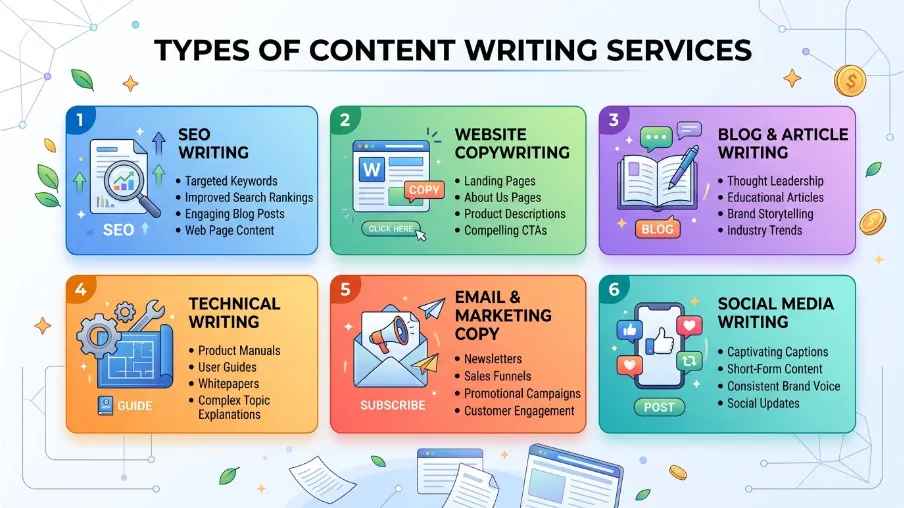
Before you can choose the right provider, you need to understand what category of service actually matches your business need. I have worked across all of these categories and can give you a realistic picture of what each one requires.
SEO Content Writing
SEO content writing is the most in-demand service category right now, and for good reason. It produces blog posts, pillar pages, topic clusters, and landing pages designed specifically to rank in Google and attract sustained organic traffic.
When I evaluate an SEO content writing service for a client, the first thing I ask to see is a sample content brief, not a writing sample. A brief tells me everything about whether a service actually understands search intent or is just inserting keywords into paragraphs. The best providers I have worked with build detailed briefs that map the target keyword, competing SERP articles, user intent classification (informational, commercial, transactional, or navigational), recommended headings, internal link opportunities, and target word count before a single word is written. I have used this brief review as a filter for years. Every service that could not show me a real brief either did not have a real strategy or was not willing to be accountable to one. Both are disqualifying.
A key mistake I see businesses make repeatedly is hiring for word count instead of depth. One client came to me after spending $4,200 on thirty 1,400-word articles from a budget service. Not one of them ranked on the first three pages for any target keyword. When I audited the content, every article was optimizing for the same broad informational keyword regardless of the page's actual purpose. The best SEO content writing service writes to satisfy what a searcher actually needs at that specific stage of their journey. That is the only path to sustainable first-page rankings that hold over time.
Good quality SEO writing also means your content stays genuinely readable and useful, not stuffed with keywords to the point where a real person would click away inside thirty seconds.
Technical Content Writing
If your business operates in software development, cybersecurity, engineering, healthcare, legal, or any other specialized vertical, general writers are not equipped to serve you and the results will show it.
I learned this the hard way in my second year as a content strategist. I placed a generalist writer on a cybersecurity blog for a mid-size managed services provider. The writer had a strong portfolio, hit deadlines, and communicated clearly. But every technical claim in the first draft required corrections from the client's engineering team. Terms were used incorrectly. A comparison between two security frameworks had the key tradeoff backwards. A description of a firewall configuration process was technically impossible. We spent three weeks in revision cycles that should have taken three days. The client was patient but frustrated, and I had to discount the entire engagement. After that experience, I built a hard rule into my vendor process: no generalist on a technical subject, regardless of how strong their writing fundamentals are.
Technical content writing services connect you with writers who carry real subject matter credentials, not just research skills. A strong tech content writing service can produce developer documentation, API guides, regulatory white papers, clinical explainers, and expert-level thought leadership without requiring your engineering or compliance team to fact-check every sentence. That is the real value: you are outsourcing not just the writing but the expertise behind it.
Website Copywriting
Website copywriting is fundamentally different from blogging, and I have watched the confusion between the two cost businesses real conversion rate points more times than I can count.
One client I worked with had a homepage that had not been updated in three years. The messaging was vague, the headline was generic, and the page had a 78 percent bounce rate. After a complete website copywriting overhaul focused on their specific buyer persona and primary search terms, the bounce rate dropped to 52 percent and demo requests increased by 34 percent within sixty days. Nothing else changed. Same traffic, same design, same pricing. Just better copy.
Great SEO copywriting on your core web pages does two jobs simultaneously. It signals relevance to search engines while convincing human visitors within the first few seconds to trust your brand enough to take action. If your website copy was written more than two years ago, there is a strong chance it is underperforming on both fronts.
E-commerce Content
E-commerce content writing is a high-volume, specialized discipline I have worked on extensively for retail and direct-to-consumer brands. Product descriptions, category page copy, buyer's guides, and comparison content need to be scannable, accurate, persuasive, and search-optimized simultaneously.
The most underestimated benefit of investing in quality e-commerce content is the reduction in customer service workload. A client of mine in the home goods space rewrote 400 product descriptions with a professional writing service. Within three months their return rate on those specific products dropped by 11 percent because customers arrived with accurate expectations. That alone covered the cost of the writing project several times over.
When you are managing hundreds or thousands of SKUs, you need a service that can maintain quality across that entire catalog, not just deliver ten polished samples and then let quality slip on the next batch.
B2B Content Writing Services
B2B content writing services serve a fundamentally different buyer journey than consumer content, and understanding that difference is the key to getting ROI from this category.
I spent two years managing content for a B2B software company targeting enterprise procurement teams. The people reading our content were not browsing casually. They were researching solutions to specific operational problems, often with six-figure purchase decisions on the line. Generic thought leadership pieces with vague takeaways generated almost zero leads. Detailed, highly specific content that addressed real workflow problems in concrete terms generated qualified demo requests consistently.
The best B2B content writing services specialize in long-form blog content, gated white papers, industry research reports, case studies, and email nurture sequences that build credibility across a longer sales cycle. The writing needs to reflect real industry understanding and speak directly to the exact problems your buyers are actively trying to solve within a digital growth strategy.
Marketing Material
Marketing material writing often gets siloed from digital content strategy, but that separation creates a consistency problem that costs businesses at the worst possible moment.
I have worked with companies that had strong organic blog content and weak sales collateral. A prospect would discover them through a well-written article, get interested, request a brochure or one-pager, and then receive something that felt like it came from a completely different company. The trust built by the content was immediately undermined by the marketing material. Consistent brand voice and quality has to carry through every touchpoint, not just the pieces that live on your website.
Content Writing Services Pricing: What to Expect in 2026
Content writing services pricing is one of the most confusing aspects of this market, because the range is enormous and the correlation between price and quality is not always obvious.
I have personally purchased content at nearly every price point in this table, from $0.02 per word to over $0.50 per word, and the pattern is consistent enough that I now treat the pricing tiers as a reliable guide rather than just a rough estimate.
Pricing Tiers Explained
| Service Level | Price Per Word | Per 1,000-Word Article | What You Actually Get |
|---|---|---|---|
| Budget / Content Mills | $0.01 to $0.03 | $10 to $30 | Thin, templated writing; frequent revisions needed |
| Mid-Range Freelancer | $0.05 to $0.10 | $50 to $100 | Decent writing; uneven expertise and availability |
| Professional Agency | $0.10 to $0.25 | $100 to $250 | Researched, SEO-optimized, brand-aligned content |
| Expert / Technical Writer | $0.25 to $0.50+ | $250 to $500+ | Deep subject matter expertise; E-E-A-T compliant |
The single most common mistake I see in content writing services pricing decisions is treating the per-article cost as the total cost. Budget-tier content typically requires multiple revision rounds, generates poor organic results, and often needs to be entirely replaced within twelve to eighteen months. I calculated this for the SaaS client I mentioned earlier: they had spent $18,000 on budget content that generated no traffic. When we replaced it with professional content over the following eight months, their organic traffic grew from 200 clicks per month to over 4,100 clicks per month. The total cost of the professional content was $9,600. The math is not close.
For a professionally managed blog that is genuinely competing for organic traffic in 2026, I recommend budgeting a minimum of $150 to $300 per article. For technical or highly competitive topics, expect $300 to $600 per piece from credentialed writers.
Retainer vs. Per-Piece Pricing
Monthly content retainers typically offer better per-piece pricing, more consistent output quality, and a dedicated writer relationship that deepens over time. Retainers in the professional tier typically run $800 to $5,000 per month depending on volume, content type, and strategic services included.
In my experience, the quality improvement from month three to month six on a retainer is significant. Writers learn your brand, your audience, your competitors, and your tone. That accumulated context produces noticeably better first drafts and requires fewer revisions.
Per-piece pricing suits businesses with irregular publishing schedules or those wanting to test a service with two or three articles before committing. It is also the right model for one-off projects like a full website copywriting refresh or a standalone white paper.
How to Choose the Best Content Writing Services

Having evaluated content writing services across multiple industries and business models over seven years, I have found the same five factors consistently separate good partnerships from expensive disappointments.
Step 1: Get Specific About Your Goals Before You Shop
The single biggest driver of a bad content service experience is vague requirements. I have made this mistake personally early in my career. I hired a writing service for a client with a brief that essentially said "we want more blog content about our industry." Six weeks later we had eight articles that were not wrong exactly, but were not useful for anyone either. No specific keyword targets, no audience alignment, no clear purpose per piece.
Before you contact a single provider, define your actual goal. Are you trying to rank on the first page for ten target keywords within six months? Generate fifty qualified leads per month from organic blog traffic? Equip your sales team with better marketing material for a specific campaign? Each goal points to a different type of service, different writer expertise, and different success metrics.
Step 2: Evaluate the Process, Not Just the Portfolio
The best content writing services have a documented, repeatable production process. When I am in early conversations with any provider on behalf of a client, I ask for a walkthrough of their production process from brief to delivery before I look at a single writing sample.
Ask specifically about how they conduct keyword research and who builds the content brief, what their standard quality control process looks like including plagiarism-free content verification on every piece, their revision policy and turnaround time commitments, and how they handle brand voice documentation and writer onboarding.
A provider who hesitates on any of these questions usually does not have a real process. They are winging it on a per-project basis, and your results will reflect that.
Step 3: Test With Industry-Specific Samples
Portfolio pages are curated highlights. They do not tell you how a service performs on your specific topic, your specific audience, and against your specific competitors.
I always commission two to three paid test articles in the target niche before recommending a service to a client. I evaluate those test articles against the top three ranking competitors for the target keywords and ask a simple question: is this piece meaningfully better or more useful than what is already ranking? If the answer is no, the service is not strong enough for a competitive SEO program, regardless of how polished the writing sounds.
A writer who excels at general marketing content may struggle significantly with technical content writing services requirements in a regulated industry. Test with real briefs on real topics.
Step 4: Assess Responsiveness and Communication Standards
I once worked with a writing service that produced genuinely excellent content but had a 72-hour response window on all client communications and a ticketing system that made revision requests feel like filing insurance claims. The quality was there. The working relationship was miserable.
A writing service that is technically excellent but consistently slow to communicate, vague about timelines, or hard to reach when something goes wrong will frustrate you inside sixty days. Ask about their account management structure, typical response times, and whether you will have a dedicated point of contact.
Step 5: Start With a Paid Test Before Committing to Scale
Commission two or three articles at full price before signing any retainer. This gives you real, unfiltered data: how closely do they follow the brief, what is the first-draft quality without coaching, how do they respond to revision feedback, and are they hitting the agreed deadlines? No amount of sales conversation or portfolio review replaces that direct evidence from actual production.
Outsource Writing Services vs. Hiring In-House: Making the Right Call
The decision to outsource writing services or build an internal team is one of the most consequential content decisions a growing business makes. I have advised companies on both sides of this decision and can tell you there is no universal right answer, but there are clear signals that point one way or the other.
When outsourcing makes more sense:
- You need to scale content volume quickly without adding headcount or management overhead
- Your content program spans multiple topic areas requiring different types of expertise
- You want flexibility to shift between blog posts, website copywriting, e-commerce content, and marketing material based on quarterly priorities
- You want predictable costs without the overhead of salaries, benefits, and management time
When in-house makes more sense:
- Your competitive advantage is deeply tied to proprietary knowledge that is genuinely difficult to transfer to external writers
- Your brand voice is unusually nuanced and requires months of immersion to execute well
- You have the budget and HR infrastructure to hire, onboard, manage, and retain strong writing talent over time
The model I have personally seen work best for growth-stage businesses is a hybrid structure. One in-house content strategist or managing editor owns brand voice, editorial standards, and performance measurement. External writing partners through a professional content writing service handle production volume. You get institutional continuity and scalable output at the same time, without the fragility of depending entirely on either model alone.
Crowd Content and Marketplace Platforms: An Honest Assessment
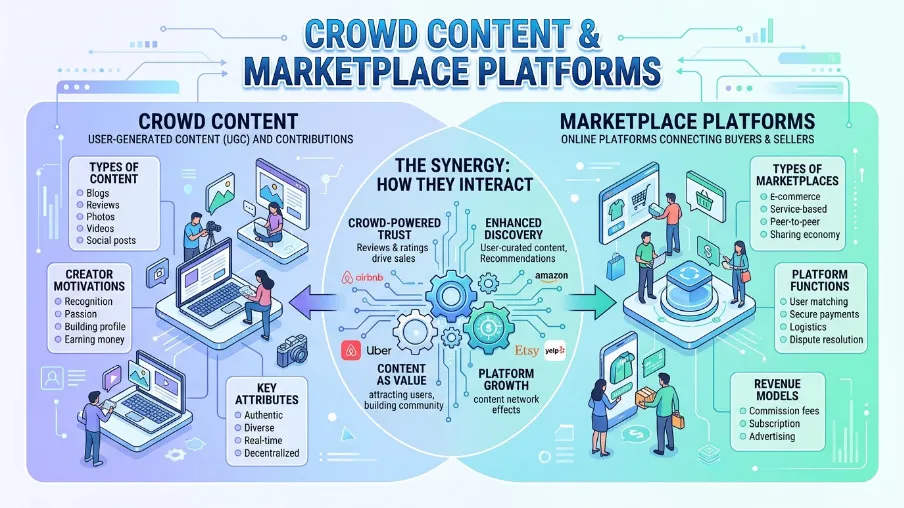
You have almost certainly come across Crowd Content, Textbroker, WriterAccess, and similar managed marketplace platforms. I have tested several of these personally, including running extended pilots for clients who wanted to evaluate the cost-to-quality tradeoff at scale.
Where Crowd Content and similar platforms genuinely work well:
- High-volume projects with moderate quality requirements, such as e-commerce product descriptions
- Informational blog posts on broad consumer topics where depth is less critical
- Projects where speed and predictable per-piece cost are the primary constraints
Where they consistently fall short:
- Highly specialized topics requiring genuine domain expertise, including most technical content writing services use cases
- Regulated industries where factual accuracy carries legal or compliance risk
- Brand-sensitive content requiring a consistent, distinctive voice across dozens of pieces
- Strategic SEO programs where quality SEO writing depth and topical authority are the primary performance levers
My honest take from personal experience: Crowd Content and similar platforms are useful tools for specific, defined use cases, not a complete content strategy. During one client pilot on a marketplace platform, we ordered fifteen articles across three quality tiers. The top tier produced three pieces worth publishing with minor edits. The other twelve required significant revision or full rewrites. For a serious organic search program, that revision overhead eliminates most of the cost advantage.
For straightforward product descriptions or informational volume content, these platforms can be genuinely cost-effective. For strategic quality SEO writing programs, a specialized agency relationship delivers better long-term ROI in my experience.
What Engaging and SEO-Friendly Material Actually Requires in 2026
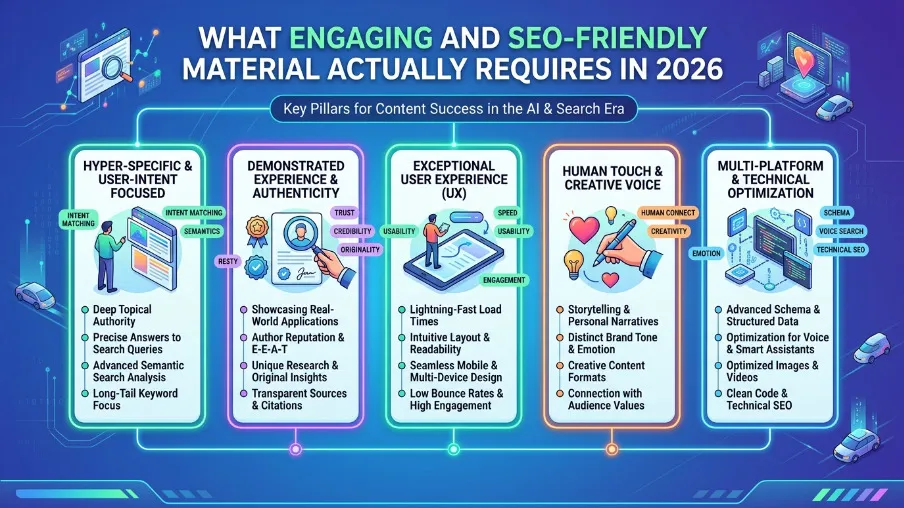
The phrase engaging and SEO-friendly material appears in virtually every content service pitch I have seen. Most providers use it as a selling point without being able to define what it means in practice when pressed. Here is what it actually requires, based on what I have seen work and fail in real content programs:
On-Page SEO Fundamentals That Cannot Be Skipped
Strong SEO content writing is built on a technical foundation that has to be present in every single piece, without exception:
- Primary keyword in the title tag, H1, first paragraph, and at least two subheadings
- Clean heading hierarchy from H1 through H3 that mirrors how readers actually scan content on screen
- Meta description written specifically to maximize click-through rate from search results pages
- Internal links to relevant pages on your site, placed naturally within the content where they add genuine value
- Optimized image alt text that describes the image and includes the keyword where it fits naturally
- FAQ or How-To schema markup where applicable, which improves featured snippet eligibility significantly
Readability and Real Engagement
Quality SEO writing is not about satisfying an algorithm. It is about keeping a real human being reading long enough to get genuine value, trust your brand, and take a meaningful next step.
I track scroll depth and average time on page for every content program I manage. The single biggest predictor of both metrics, in my experience, is how well the content is structured in the first 200 words. If the opening paragraph does not immediately establish that this article contains the answer the reader came for, they leave. Most do not come back.
That first impression requires content structure built around what the reader actually needs to know in the order they need to know it, short paragraphs and descriptive subheadings that reduce cognitive friction, concrete examples and specific details that make abstract points feel real, and a narrative that moves with clear purpose from opening to conclusion.
Plagiarism-Free Content as a Non-Negotiable Standard
Every piece of content your brand publishes must be fully original. Any serious content writing service runs every article through plagiarism verification before delivery as a standard workflow step. Plagiarism-free content is not a premium tier feature. It is the basic standard of professional work.
I once discovered that a writing service a client had been using was submitting articles that included lifted passages from competitor blog posts, paraphrased just enough to pass a casual read. When we ran Copyscape on their back catalog, a significant portion of it flagged. The client had to take down dozens of pages and rebuild from scratch. That is an expensive lesson that a proper QA process would have prevented entirely.
E-E-A-T Signals That Google and Readers Both Require
Google's quality rater guidelines place enormous weight on Experience, Expertise, Authoritativeness, and Trustworthiness. In 2026, with AI-generated content flooding every corner of the web, these signals matter more than they ever have.
From my own experience managing SEO programs across multiple domains, the content that holds rankings through algorithm updates consistently shares the same characteristics: author credentials are clear and verifiable, sources are primary and credible, the writing reflects actual applied experience not just research, and the topical coverage is deep enough to signal genuine authority rather than surface familiarity.
The best content writing services build E-E-A-T into every piece through verifiable author bios with professional credentials, citations to primary sources such as research studies, government data, and industry reports, first-hand perspective and real examples rather than recycled summaries, and topical depth and specificity that compounds into genuine authority over a sustained publishing program.
This is the dividing line between professional content writing services that build durable organic authority and commodity writing that ranks briefly before being filtered out by quality signals.
Conclusion
That SaaS client I opened with? After replacing their commodity content with an expert-led publishing program, organic traffic grew from 200 to over 4,100 clicks per month in eight months, generating three to five qualified demo requests per week from search alone. That is what the right quality content writing services relationship delivers: compounding visibility, a shorter sales cycle, and authority that holds. Define your goals, vet providers on process not just price, demand plagiarism-free content and genuinely engaging and SEO-friendly material as your baseline, and scale what works. The content you publish today represents your brand for years. Make every piece count.
Ready to get started? Use this guide as your scorecard and choose a partner built to grow with you.
Common Questions About Quality Content Writing Services
Q1: What is the difference between quality content writing services and cheap content mills?
Quality services assign credentialed writers, build content around a strategic keyword brief, and verify every piece before delivery. Content mills prioritize volume at the lowest cost per word, producing thin, generic output that rarely holds rankings beyond a few weeks.
Q2: How do I verify that a content writing service produces plagiarism-free content?
Ask for their QA process and request a Copyscape or similar plagiarism report alongside your first deliverables. Any provider who cannot show you their verification workflow is a red flag I never ignore.
Q3: What is the difference between SEO copywriting and general content writing?
SEO copywriting builds keyword research, search intent mapping, and on-page optimization into the writing from the first draft, while general content writing may be polished but lacks the structure needed to earn organic rankings.
Q4: Can B2B content writing services support lead generation?
Yes, and in my experience it is one of the strongest ROI use cases for content investment. Well-targeted B2B content writing services produce blog posts, white papers, and case studies that attract qualified organic traffic and keep working long after paid ads stop.
Q5: How long does it take to see results from professional content writing?
SEO content writing typically takes three to six months to show measurable organic traffic gains. Website copywriting and email content can show conversion impact within days or weeks of going live.
FAQ
Frequently Asked Questions
We offer end-to-end digital solutions including website design & development, UI/UX design, SEO, custom ERP systems, graphics & brand identity, and digital marketing.
Timelines vary by project scope. A standard website typically takes 3-6 weeks, while complex ERP or web application projects may take 2-5 months.
Yes - we offer ongoing support and maintenance packages for all projects. Our team is available to handle updates, bug fixes, performance monitoring, and feature additions.
Absolutely. Visit our Works section to browse our portfolio of completed projects across various industries and service categories.
Simply reach out via our contact form or call us directly. We will schedule a free consultation to understand your needs and provide a tailored proposal.