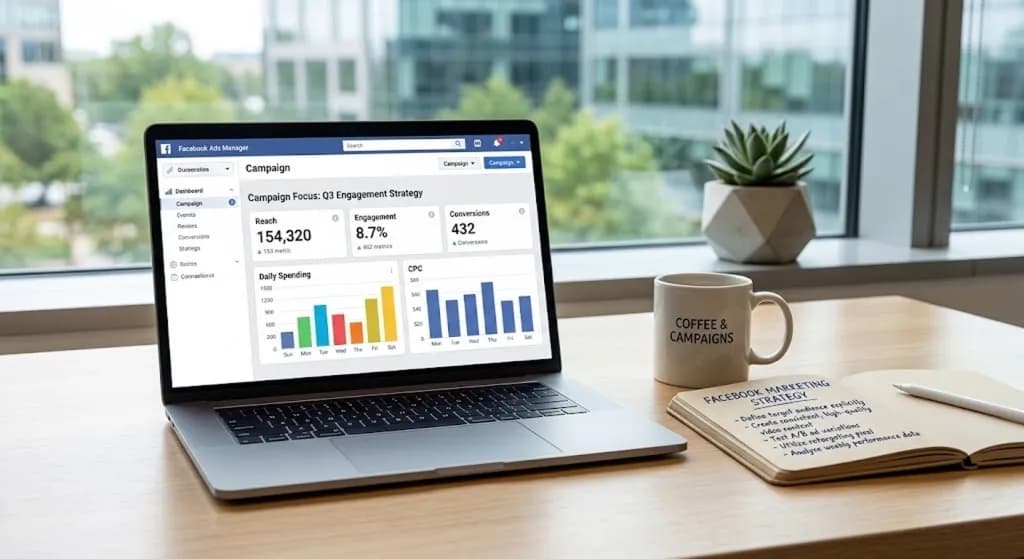
Facebook Ad Campaign Management: Complete Guide to Ads That Actually Work (2026)

Let me guess. You launched a Facebook ad. You waited. Then you watched your budget disappear with almost nothing to show for it.
I've been there. And honestly, so has almost every marketer who ever touched Meta Ads Manager.
Here's the hard truth. The problem usually isn't your product, your price, or even your creative. Most Facebook ads fail because of poor campaign management. That's the invisible stuff underneath that most guides skip over.
In this article, I'm going to walk you through everything I know about Facebook ad campaign management. From building a proper structure, to budgeting smart, to reading your data like a pro. By the end, you'll know exactly what to fix, what to test, and what to stop doing right now to achieve sustainable digital growth. Let's get into it.
What Is Facebook Ad Campaign Management
Facebook ad campaign management is the ongoing process of planning, launching, monitoring, and optimizing your paid ads on Meta's platform.
It's not a one-time setup. It's a system.
Think of it like running a small engine. You can build it perfectly, but if you never check the oil or adjust the timing, it burns out.
Good campaign management means you are always:
- Watching what the data tells you
- Testing new ideas with discipline
- Scaling what works and cutting what doesn't
- Giving Meta's algorithm what it needs to learn and improve
And in 2026, with Meta's AI getting smarter every quarter, the role of a campaign manager has shifted. You are no longer just pushing buttons. You are setting strategy and letting the machine do the heavy lifting. As long as you build the right foundation.
Start With the Right Campaign Structure
This is the part most people skip. And it costs them everything.
Campaign structure is the invisible architecture that determines whether Meta's algorithm can actually do its job. You can have the most compelling video ad and a perfectly defined audience, but if your campaigns are structured incorrectly, Meta's algorithm never gets the chance to work its magic.
So how do you structure a campaign correctly?
Use the Three-Level Framework
Meta campaigns work on three levels: Campaign, Ad Set, and Ad.
- Campaign level: You set your objective here. Do you want sales, leads, traffic, or awareness? Pick one. Don't mix.
- Ad set level: This is where you define your audience, placement, budget, and schedule.
- Ad level: This is your actual creative. The image, video, copy, and call to action.
Each level has a job. Don't ask one level to do another's work.
Keep It Simple: Two to Four Campaigns Maximum
Consolidation beats fragmentation almost every time in Facebook advertising. The sweet spot for most advertisers is running 2 to 4 campaigns maximum. One for cold prospecting, one for retargeting, and potentially one for specific testing initiatives.
Running too many campaigns at once splits your data and confuses the algorithm. Meta needs roughly 50 conversion events per week per campaign to exit the "learning phase." If you spread 20 conversions across five campaigns, none of them learn fast enough.
Separate Prospecting From Retargeting
Use different campaigns for different audience stages. Cold audiences need bold, eye-catching creative. Warm audiences (people who visited your site, watched your videos, or engaged with your posts) respond better to testimonials, case studies, or discounts. Hot audiences (past buyers) should see upsells, bundles, or loyalty offers.
This sounds simple. But most beginners shove everyone into one campaign and wonder why results are inconsistent.
How to Choose the Right Campaign Objective
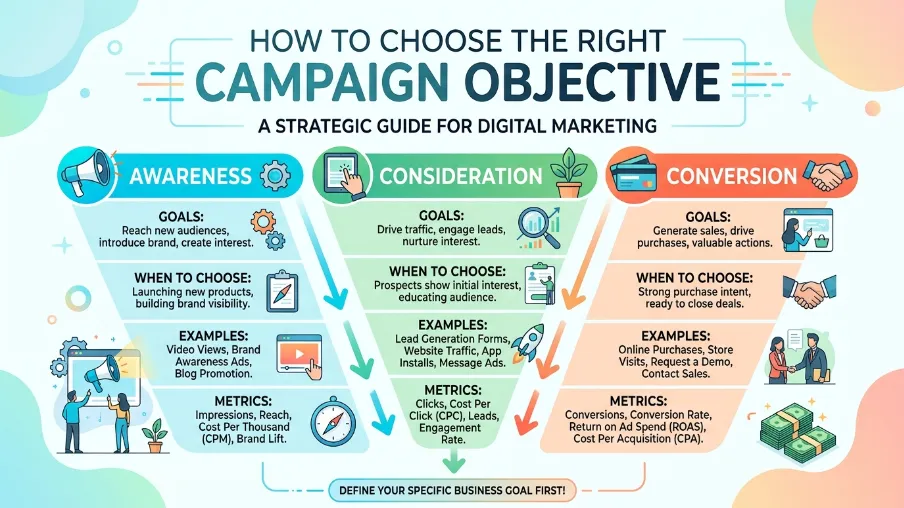
This one decision shapes everything that follows.
Defining clear objectives is the first step of any successful campaign. Choices include brand recognition, traffic, lead generation, and sales or conversions. Choosing the wrong objective leads to unfocused spending and poor results.
Here's a quick guide:
- Awareness: You're new and just want people to know you exist.
- Traffic: You want people on your website (but not necessarily buying yet).
- Leads: You're collecting emails or phone numbers.
- Sales: You want people to buy. This is the one most e-commerce brands should start with.
In 2026, Sales and Leads remain top performers for ROI-focused marketers.
One big mistake I see all the time. People run Traffic campaigns and then wonder why no one is buying. The Traffic objective tells Facebook to send clickers, not buyers. Be intentional.
Audience Targeting: Broad Beats Narrow in 2026
This surprised me when I first learned it, but the data is clear. Research shows that broad targeting generates 113% more ROAS than highly specific audience selections. In modern digital marketing, Meta's algorithm has access to thousands of data points about user behavior. When you constrain the algorithm with detailed interests, you're essentially telling it to ignore potentially higher-performing users who don't fit your narrow criteria.
Your audience size should be at least 2 million people for prospecting campaigns.
Let that sink in. The old approach of ultra-specific interest stacking is no longer the advantage it once was. In today's digital marketing landscape, broad targeting often gives the algorithm the flexibility it needs to find the right customers more efficiently, leading to better performance and stronger returns.
Use Advantage+ Audiences First
The new Andromeda algorithm means your creative is your targeting. Advantage+ is no longer optional. It's the default. When you let Meta's AI decide who sees your ads based on your creative, you often get better results than manually building audiences.
Start with Advantage+ defaults. Let it run 3 to 7 days or until you hit 50 conversions before touching anything.
Build Retargeting Audiences That Actually Convert
Retargeting campaigns deliver a median ROAS of 3.61 compared to just 2.11 for prospecting campaigns. That's a 71% improvement for targeting people who already know your brand. Yet most advertisers spend 80% of their budget trying to find new customers instead of converting the warm traffic they already have.
Your retargeting audiences should include:
- Website visitors from the last 30 to 60 days
- Video viewers (people who watched 50%+ of your content)
- Instagram and Facebook page engagers
- Email list uploads (Custom Audiences)
These people already know you. They just need a nudge.
Budget Management: Science Behind Smart Spending
Budget mistakes are the fastest way to waste money on Facebook. Let me show you what works.
Use Campaign Budget Optimization (CBO)
Campaign Budget Optimization, now called Advantage+ Campaign Budget, is Facebook's automated budgeting system that allocates a single campaign budget across multiple ad sets. Instead of manually splitting budgets, you set one total budget and Facebook dynamically distributes it to the ad sets that perform best in real time.
This saves you hours of manual work. The algorithm is often better at moving money around than we are.
But CBO has rules. Stick to 3 to 5 ad sets for best results. If your budget is too tight, you'll stall performance. Making frequent edits resets the learning phase and delays results.
How Much Should You Spend to Start
Start with a practical test budget, such as $100 per day for 30 days. Very low budgets, like $5 per day, won't produce enough data to optimize.
For smaller businesses, even $30 to $50 per day can work, but only if you keep the campaign structure lean and focused.
Scale Slowly: Don't Double Overnight
Increasing budgets too quickly resets the learning phase and makes your costs spike. Instead of doubling budgets overnight, increase slowly so Facebook can adjust without hurting performance.
The standard rule is to increase budget by 20% every 2 to 3 days when performance is strong. Not 50%. Not 200%. Slow and steady keeps the algorithm stable.
Ad Creative: Your Best Targeting Tool
Here's something that changed how I think about Facebook ads forever.
In 2026, your creative IS your targeting. The algorithm looks at your ad and finds the right people for it. If your creative is weak, no audience setting in the world will save you.
Test More Variations Than You Think You Need
You need volume. Not 3 variations. Not 5. You need 10 to 20 genuinely different creative concepts per campaign. Different hooks, formats, and visual styles give Meta's algorithm enough to work with.
I know that sounds like a lot. But the brands winning right now aren't running one polished ad. They're running 15 different angles and letting the algorithm pick the winner.
Prioritize Short-Form Video
Short-form video content (Reels) is the highest-performing ad format on Meta in 2026 for awareness and consideration campaigns.
Vertical video. 15 to 30 seconds. Hook in the first 3 seconds. That's the formula. Don't overthink it.
Watch for Ad Fatigue
When an ad frequency metric creeps above 3.5 for a cold audience, that's a clear sign of ad fatigue. Performance often drops after a few weeks, so refresh headlines, visuals, or formats regularly to keep engagement high.
Set a reminder. If you haven't refreshed creatives in 3 weeks and performance is slipping, that's your signal.
Tracking and Metrics: Know What to Measure
Running ads without proper tracking is like driving with your eyes closed.
Set Up Both the Pixel and Conversions API
Using both tracking methods, the Meta Pixel and the Conversions API, ensures a complete picture of your performance so you can make smarter decisions and keep your Facebook ad campaigns profitable.
The old Pixel alone misses data, especially after iOS privacy changes. The Conversions API fills those gaps by sending data directly from your server.
Focus on the Metrics That Matter
Here are the key numbers to track:
- ROAS (Return on Ad Spend): The most important metric. The average Facebook ads ROAS across industries is 2.19:1. Top performers often achieve two to three times these results.
- CTR (Click-Through Rate): Tells you if your creative is compelling. Aim for 1%+.
- CPC (Cost Per Click): Facebook ads average a cost-per-click of $1.92 across industries.
- CPA (Cost Per Acquisition): How much you pay for each conversion.
- Frequency: How many times the same person sees your ad. Above 3.5 is the danger zone.
Know When to Scale and When to Pause
If your campaign is hitting your goals or providing a positive ROAS for several days in a row, consider scaling. If your ads aren't meeting expectations or you're going through budget too quickly, pause. But don't pause for more than one day, as the learning process of the algorithm will restart.
Patience is a strategy. The first 7 to 14 days are usually messy. That's the algorithm learning. Don't pull the plug too early.
Common Facebook Ad Campaign Management Mistakes to Avoid
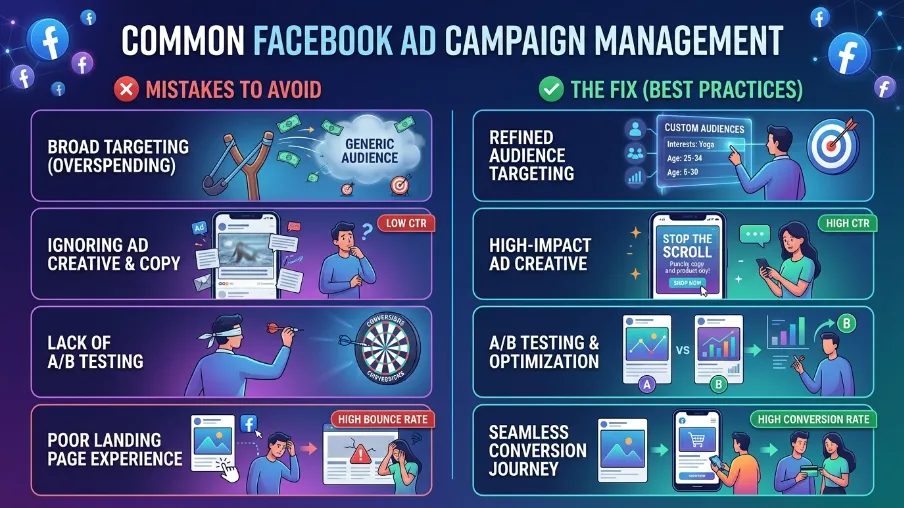
Let me save you from the errors I see kill campaigns every week.
1. Using the Boost Post button instead of Ads Manager: Using only the Promote Post button limits access to advanced targeting, bidding strategies, and optimization tools. This prevents strategic control necessary for achieving high ROI.
2. No clear campaign objective: If you don't know what you want, Facebook doesn't know who to show your ad to. Always start with a defined goal.
3. Too many ad sets, too little budget: Spreading $50/day across 10 ad sets means no single ad set gets enough data. Consolidate.
4. Changing things too fast: Every time you edit a running campaign, the learning phase resets. Make changes with intention, not anxiety.
5. Expecting instant results: Expecting immediate results from Facebook ads can lead to frustration and impulsive decisions. Building a successful ad campaign takes time and sustained effort.
Manage Your Campaigns Like a System, Not a Gamble
If there's one thing I want you to take away from this guide, it's this: Facebook ad campaign management is not about luck. It's about building the right system.
Structure your campaigns clearly. Choose your objective wisely. Give the algorithm enough budget to learn. Test more creatives than you think you need. And above all, be patient.
The brands winning on Meta right now aren't smarter than you. They're just more systematic. They treat every campaign as a test and every data point as feedback.
You can do the same. In fact, many of the most common digital marketing mistakes come from rushing campaigns, ignoring data, or constantly changing strategies before the algorithm has time to learn. Build a system, trust the process, and let the data guide your decisions.
FAQs About Facebook Ad Campaign Management
What is Facebook ad campaign management?
Facebook ad campaign management is the process of creating, organizing, monitoring, and optimizing paid ad campaigns on Meta's platform (Facebook and Instagram). It includes setting objectives, defining audiences, managing budgets, testing creatives, and analyzing performance to improve results over time.
How much budget do I need to start Facebook ads?
You need at least $30 to $50 per day to generate enough data for the algorithm to optimize. Starting too small (under $10/day) means the algorithm can't learn fast enough and your costs stay high. For serious results, a $100/day testing budget for 30 days is a strong starting point.
How long does it take for Facebook ads to work?
Most campaigns need 7 to 14 days before you see consistent results. This is the "learning phase" where Facebook tests different audiences and placements. Don't judge a new campaign in its first 3 days.
What is a good ROAS for Facebook ads?
The industry average is around 2.19:1. For e-commerce, aim for 3:1 as a minimum. Top performers hit 4 to 6:1. What matters most is whether your ROAS is above your break-even point, which depends on your profit margins.
Should I use broad targeting or interest targeting?
In 2026, broad targeting with Meta's AI tools (like Advantage+) generally outperforms narrow interest targeting. The algorithm has far more data than any interest stack you can build manually. Start broad, let the machine optimize, and layer in constraints only if needed.

I’m Mitu Das, a JavaScript developer, ERP product architect, and SEO specialist from Bangladesh. I work at CyberCraft Bangladesh, where I help build simple, scalable software, SaaS platforms, and business solutions. My goal is to create technology that helps companies save time, automate daily tasks, and grow faster. I enjoy combining development, product ideas, and SEO strategies to create useful digital solutions for modern businesses.
Writes about
Want this done for you?
Our team builds and ships exactly what this article describes. Send a message and we will reply with a scope.