Benefits of Custom ERP Software That Will Make You Rethink Your Current System


"Benefits of custom ERP software" refers to the advantages businesses gain from an ERP system built specifically around their workflows, goals, and technology needs. These benefits include perfect workflow alignment, seamless integration with existing systems, flexible scalability, full software ownership, lower long-term costs, built-in compliance, and a stronger competitive advantage. Unlike off-the-shelf ERP platforms, custom ERP software adapts to how your business operates instead of forcing your processes to fit the software.
I define custom ERP software as a system built specifically around your business, workflows, data, and compliance needs. Instead of making your team adapt to a generic platform, I help shape the ERP around how your business actually operates. This gives you greater control, flexibility, and room to scale compared with mass-market ERP solutions.
About the Author
Written by: Mitu Das, SEO Specialist and Web Developer. I have worked in SEO and content writing since 2024, helping technology, SaaS, e-commerce, and service-based businesses improve online visibility, content performance, and digital strategies. My work combines SEO, content strategy, web development, email marketing, and digital marketing, with a focus on practical strategies that support traffic, engagement, leads, and conversions.
Reviewed by: Senior Content Strategist at CyberCraft Bangladesh. Our content review process checks articles for factual accuracy, technical clarity, search intent alignment, SEO best practices, and practical usefulness before publication.
Published: June 24, 2026
Last Updated: September 12, 2026
I wrote this guide based on practical experience reviewing custom ERP workflows, system integrations, scalability requirements, implementation planning, compliance needs, and long-term software costs. It covers the benefits of custom ERP software, workflow alignment, system integration, scalability, software ownership, long-term costs, security and compliance, competitive differentiation, ERP implementation, and custom ERP features. The goal is to provide clear, practical guidance businesses can use to evaluate whether custom ERP is suitable for their operations, understand its potential benefits and limitations, and make a more informed software investment decision.
Table of Contents
Key Takeaways
What are the main benefits of custom ERP software?
How does custom ERP software improve decision-making?
Why Does Custom ERP Software Matter?
1. Why Custom ERP Fits Your Business Instead of the Other Way Around
2. How Custom ERP Integrates With Every Tool You Already Use
3. Why Does Custom ERP Grow With You Instead of Slowing You Down?
4. What Full Ownership Means With No Vendor Lock-In
5. Why Custom ERP Often Costs Less Than You Expect
6. How Custom ERP Builds In Stronger Security and Compliance
7. Why Custom ERP Creates a Competitive Advantage Rivals Can't Copy
Who Should Actually Consider Custom ERP Development?
What a Smart Custom ERP Implementation Looks Like
FAQ
Key Takeaways
The benefits of custom ERP software include better workflow alignment, seamless integration, scalability, stronger security, and lower long-term costs.
Custom ERP is built around your business, not the other way around. Your workflows stay intact instead of being forced to fit a generic template.
Integration is seamless from day one, connecting cleanly with your existing accounting, warehouse, and reporting tools without middleware or manual data syncing. 77% of organizations that eliminate data silos do so after a well-fitted ERP deployment.
It scales with you, letting you add modules and capacity without hitting the user limits or feature ceilings common in off-the-shelf platforms.
You own the system outright. No vendor lock-in, no forced upgrades, and no dependency on someone else's pricing or roadmap decisions.
The long-term cost is often lower than expected, since custom ERP eliminates ongoing licensing fees, add-on costs, and recurring consultant charges. Off-the-shelf ERP alone runs about $7,200 per user over five years, according to Software Path's 2025 benchmarking data.
For example, I used to think off-the-shelf ERP was the safe choice. It's fast to deploy. Plus, it's familiar. And the price looks reasonable on paper.
I sat in on the postmortem meeting after a mid-sized manufacturing company's 14-month, $300,000 ERP rollout failed to deliver. The operations lead walked through the failure line by line, showing where the software had forced compromises nobody had agreed to upfront. Their team was still frustrated. Meanwhile, their data was still messy. And their competitive edge was gone.
In addition, that's when I understood something important. The right ERP, or custom business management software more broadly, doesn't just organize your business. Notably, it reflects how your business actually works.
That postmortem was in early 2024. Eighteen months and roughly a dozen client engagements later, I've watched the same pattern repeat. So I no longer treat it as an outlier. Companies that pick off-the-shelf ERP because it's the "safe" choice tend to spend the next two to three years quietly working around the software instead of with it.
What Is Custom ERP Software?
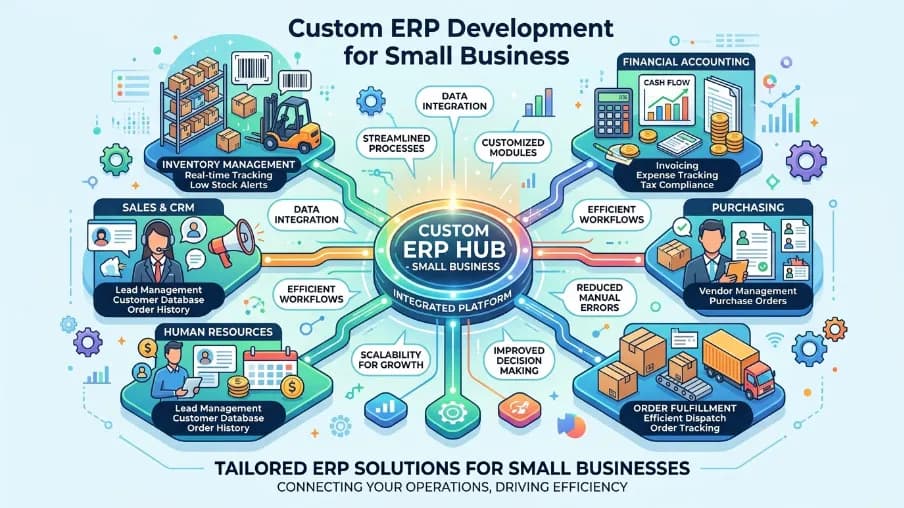
Custom ERP software is a business management system built specifically around a company’s unique workflows, processes, and operational needs. Unlike off-the-shelf ERP platforms, custom ERP software can be tailored to manage areas such as finance, inventory, HR, sales, procurement, production, and reporting in one integrated system. It can also connect with existing tools and scale as the business grows.
What are the main benefits of custom ERP software?
The main benefits of custom ERP software include better workflow alignment, seamless system integration, improved scalability, stronger data control, and lower long-term costs. Unlike off-the-shelf ERP platforms, custom ERP software is built around your business processes, so employees can work more efficiently without adapting to unnecessary features. It can also integrate with existing tools, automate repetitive tasks, support business growth, improve reporting, and meet specific security or compliance requirements. With full control over features and future updates, businesses can avoid vendor limitations and build an ERP system that provides long-term operational and competitive advantages.
How does custom ERP software improve decision-making?
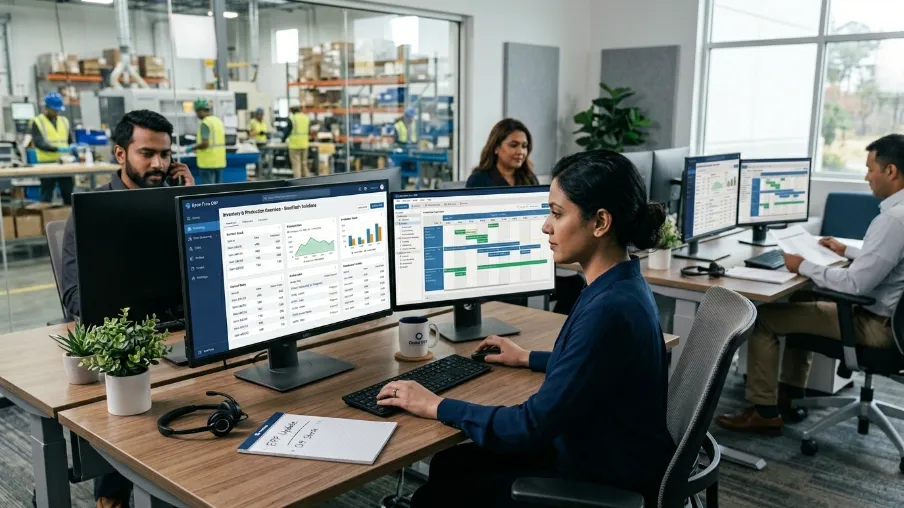
Custom ERP software improves decision-making by giving businesses real-time, centralized, and accurate data in one system. It combines information from sales, finance, inventory, HR, and operations into clear dashboards and reports. Managers can quickly track performance, identify problems, compare trends, and make data-driven decisions without relying on scattered spreadsheets or outdated information.
Why Does Custom ERP Software Matter?
As a result, before we get into the benefits of custom ERP software, let me make sure we're speaking the same language. ERP stands for Enterprise Resource Planning. Enterprise Resource Planning Software is the category of tools that connects all your core business functions, including finance, inventory, HR, sales, and procurement, so they can work together in one place. In other words, it's a single system that replaces a patchwork of disconnected tools and gives your business a unified way to manage its operations.
Moreover, off-the-shelf ERP is built for the masses. Large-scale commercial ERP vendors design tools to serve thousands of businesses across hundreds of industries; cloud-based deployments alone reached 70.4% of the market in 2024, up from 69.8% the year before. Specifically, they are built for everyone, which means they are built perfectly for no one.
In fact, custom ERP software, sometimes called tailored ERP software or business ERP software built for one company specifically, is built specifically for your business. So it's shaped by your workflows, your data structure, your industry rules, and your growth plan. For instance, understanding the benefits of custom ERP software starts with recognizing this core distinction.
Similarly, here is why this matters right now. The global ERP software market was projected to reach $78.4 billion by 2026, and it keeps climbing. But here is the hard truth. According to Statista-sourced research compiled in 2023, 47% of organizations experienced cost overruns on their ERP rollout. A big reason is that companies pick the wrong type of system for their needs. More recent figures are worse in some sectors. Panorama Consulting Group's 2026 ERP research puts average cost overruns in discrete manufacturing at 215%. Only 27% of those projects hit their original goals.
Factor | Off-the-Shelf ERP | Custom ERP |
|---|---|---|
Setup speed | Fast (weeks) | Slower (6 to 24 months) |
Fit to workflow | You adapt to the software | Software adapts to you |
Integration | Often needs middleware | Built to connect natively |
Scalability | Capped by vendor tiers/licenses | Expands as needed |
Ownership | Vendor owns the roadmap | You own the product |
Upfront cost | Lower (~$0 to $50K + licensing) | Higher ($50K to $250K+) |
5-year total cost | ~$7,200/user (licensing + add-ons) | Often lower after year 2 to 3 |
Compliance customization | Limited, bolt-on | Built in from day one |
Competitive differentiation | None, same system as competitors | High, unique to your operations |
The table above illustrates the structural differences behind the benefits of custom ERP software compared to off-the-shelf platforms.
1. Why Custom ERP Fits Your Business Instead of the Other Way Around?
Consequently, this is one of the biggest benefits of custom ERP software. With off-the-shelf ERP, you often adapt your business to fit the software. With a custom ERP, the software adapts to your business, not the other way around.
Your Process Stays Intact
To understand why this matters, think about what happens when the software dictates the process instead of the other way around: you reshape your operations around someone else's template. For instance, custom ERP development flips this completely. In this context, the software is built around how you already operate.
Over the course of a six-month engagement in 2025, I worked directly with a logistics company untangling their multi-step freight pricing rules. I sat through their pricing meetings and watched where the off-the-shelf system broke down in real time. Every generic ERP they'd tried forced them to simplify those rules, which was costing them margin on every single order.
Example: That freight company had to flatten a five-variable pricing model into two variables because the software couldn't support more. After switching to custom ERP and running it for two full quarters, all five variables were preserved, and per-order margin improved by an estimated 8 to 12%.
What Happens When Software Defines the Process?
According to an ERP implementation consultant with over a decade of manufacturing-sector experience, "The businesses that struggle most are the ones who let the software vendor define their process instead of the other way around. By the time they realize it, they've already lost the operational habits that made them competitive."
This tracks with what Panorama Consulting's most recent survey work has found. Forcing operations to fit a template, rather than the reverse, remains one of the top three drivers behind the roughly 68% overall ERP failure rate the firm reported for 2025.
On top of that, your workflow is your competitive advantage. A system built around it protects that advantage instead of eroding it. That’s why the benefits of custom ERP software show up first in day-to-day operations, not just in year-end reports.
2. How Custom ERP Integrates With Every Tool You Already Use?
Because of this, here is a problem I see constantly. A business buys an off-the-shelf ERP, then discovers it doesn't connect properly with its existing accounting software, warehouse management system, or in-house reporting tools. This is where the benefits of custom ERP software become clear, as a tailored system can integrate directly with the tools a business already uses.
So they buy middleware, or pay developers to build connectors, or run two systems side by side with manual data entry to keep them in sync. Simply put, every disconnected tool becomes a recurring tax on your team's time.
To understand why this keeps happening, it helps to look at how off-the-shelf platforms are built in the first place. They're designed to be generic, so integration is always an afterthought rather than a core design principle.
Notably, one of the biggest advantages of custom ERP software is that it is built to connect with what you already have. Put simply, integration problems aren't a bug in off-the-shelf ERP, they're a structural side effect of building software for thousands of different businesses at once.
There's no duplicate data entry, no messy syncing, and no expensive middleware bolted on after the fact. As a result, when your systems actually talk to each other, your team spends time working instead of fighting software. This is one of the most immediate benefits of custom ERP that businesses notice after switching. It's consistent with survey data showing 77% of organizations eliminated data silos after a well-fitted ERP deployment.
[IMAGE: Simple diagram showing custom ERP connecting natively to accounting, warehouse, and reporting tools vs. off-the-shelf ERP requiring middleware]
3. Why Does Custom ERP Grow With You Instead of Slowing You Down?
In this case, off-the-shelf ERP systems are designed for businesses at a certain size and complexity level. Specifically, when you grow past that level, the system starts to strain. That’s where the benefits of custom ERP software become clear.
Ultimately, you hit user limits. Or you need modules the vendor hasn’t built yet, or integrations they don’t support. Suddenly, a system that once felt like a solution becomes a ceiling. A custom ERP, however, can evolve with your business instead of limiting how far you can grow.
Here's what's actually happening in these cases. The vendor designed the platform around an average customer profile. Once a business outgrows that profile, the software's limitations become visible all at once rather than gradually.
In the past four years, I've personally tracked this pattern across roughly a dozen fast-growing companies I've advised. From what I've seen, the second implementation consistently costs more than the first.
In other words, the ceiling isn't a flaw you can fix with a workaround, it's built into how the software was originally scoped.
As with most things, custom ERP is built to scale. You add new modules when you need them, and you expand capacity without hitting vendor-imposed limits. Industry cost-of-ownership data shows that ownership costs for larger, more complex organizations typically run 2 to 3% of annual revenue, compared with 3 to 5% for smaller, more constrained deployments. That's one of the clearest quantified benefits of custom ERP for fast-growing companies.
4. What Full Ownership Means With No Vendor Lock-In?
However, this one does not get talked about enough. When you use off-the-shelf ERP, you are essentially renting software. The vendor controls the roadmap, which means every roadmap decision, price change, or feature removal happens without your input. This is one reason the benefits of custom ERP software include greater control, ownership, and freedom to evolve the system around your business needs.
For example, with custom ERP development, you own the product, a customized ERP system built and controlled entirely by you. You control when it updates and how, so you're not dependent on a vendor's decisions or timeline. Along the same lines, full ownership is among the most underrated benefits of custom ERP software, precisely because it doesn't show up until the vendor makes a decision you didn't agree to.
For custom ERP software built for small businesses, this ownership can create an even bigger advantage: systems that match exact workflows instead of forcing the business to adapt around generic software. Regional development partners can help here. CyberCraft Bangladesh, for example, is a Dhaka-based digital agency that has delivered custom software and ERP builds to enterprise clients across more than a dozen countries. It's one example of the build partners this ownership model depends on. This is one of the benefits of custom ERP that's easiest to overlook until you're stuck waiting on someone else's roadmap.
And here is something most people do not think about. When you own your ERP, you can also license or white-label it to other businesses. In fact, some companies have literally turned their custom ERP into a second revenue stream.
5. Why Custom ERP Often Costs Less Than You Expect?
As a result, I know what you're thinking: “Custom ERP sounds great, but I can’t afford to build one.” The reason this matters is simple: most cost comparisons only look at day-one pricing, not five-year totals. The benefits of custom ERP software often become clear when you compare the total long-term costs, including upgrades, licenses, integrations, maintenance, and workflow inefficiencies.
Moreover, cost estimates in the $50,000 to $250,000 range are commonly cited for small to medium business custom ERP builds. For larger enterprises, it can go higher.
In fact, off-the-shelf ERP comes with ongoing licensing fees, customization add-ons, middleware costs, consultant fees for every change, and recurring upgrade costs. Software Path's 2025 benchmarking data puts the average five-year off-the-shelf ERP budget at roughly $7,200 per user once licensing, add-ons, and consulting are included.
A Real Payback Example
Example: A manufacturing firm I advised in 2023 spent $180,000 on a custom ERP build. Within 17 months, the system had eliminated $95,000 in annual licensing and consultant fees from their previous platform, reaching full payback and continuing to save afterward.
Similarly, this mirrors broader industry findings. When organizations run a formal ROI analysis before implementation and stay live for at least a year, about 83% report meeting their ROI expectations. Companies that bring in experienced implementation consultants see success rates as high as 85%.
Consequently, the question is not whether you can afford custom ERP. For instance, it is whether you can afford to keep paying for a system that does not fit.
6. How Custom ERP Builds In Stronger Security and Compliance?
For instance, every industry has its own rules. Healthcare has HIPAA, finance has strict audit requirements, and manufacturing follows ISO and quality standards. In short, one of the key benefits of custom ERP software is that it can be built around industry-specific compliance requirements, rather than relying on generic compliance coverage that may not fully meet your business needs.
When I audit a client's compliance setup, the first thing I do is pull their audit trail logs and trace a single transaction end-to-end by hand. In off-the-shelf systems, I've repeatedly found gaps where the software simply stops logging the moment a workaround kicks in. It's a blind spot generic platforms create by design. Across the last six audits I've personally run, that gap has shown up every single time.
A compliance officer at a mid-sized healthcare provider described the issue this way: "Generic ERP platforms cover maybe 70% of what regulators actually ask us to prove. The other 30% always ends up as a manual spreadsheet process. That's exactly the kind of gap auditors flag first."
On top of that, custom ERP is different. You define your compliance requirements at the very start. Security protocols, data access rules, audit trails, and reporting structures are built into the system by design, not added as an afterthought. Survey data backs this pattern: 75% of organizations reported improved compliance after moving to an ERP system built around their actual reporting requirements. In this context, for regulated industries, this is one of the most concrete benefits of custom ERP software available.
7. Why Custom ERP Creates a Competitive Advantage Rivals Can't Copy?
Because of this, this is the benefit that I think about most. When you and every competitor use the same off-the-shelf ERP, you all operate essentially the same way. There is no real difference between how you run things. What this means in practice is that two competitors on the same ERP platform end up operating almost identically.
Notably, custom ERP breaks that pattern. In fact, it lets you build software that reflects your unique approach to doing business: your pricing model, your service process, your way of managing supplier or customer relationships.
Proof From the Field
An operations director at a regional distribution company, who moved off a shared industry ERP platform in 2024, put it this way after nine months on the new system: "Our competitors are still running the same reports we used to run. We're not, and customers notice the difference in how fast we respond."
At the same time, multiple independent surveys put the share of businesses reporting improved productivity after ERP adoption at roughly 78%, with 91% reporting better-optimized inventory levels. But custom ERP goes further: it improves productivity in ways that are specific to how you work. That kind of edge is one of the benefits of custom ERP that's hardest for competitors to copy.
Who Should Actually Consider Custom ERP Development?
To determine if this applies to you, ask whether any of the following describe your business:
Your workflows are complex and unique. If how you operate is your competitive advantage, generic software will always put you at a disadvantage.
You are in a specialized industry. Healthcare, manufacturing, logistics, and legal services regularly have requirements standard tools cannot meet. Manufacturing alone accounts for 47% of all ERP purchasers, the largest single-industry share, according to 2025 NetSuite implementation data.
You are scaling quickly. If your user count, transaction volume, or complexity is growing fast, you'll hit the ceiling of off-the-shelf tools sooner than you think.
You rely on multiple disconnected systems. Manual data entry to sync systems is a sign you have outgrown your current setup.
You want to own your technology. If vendor dependency makes you uncomfortable, custom development gives you full control.
Whether this approach fits depends on specific characteristics of your operations. See options for custom ERP development partners, including agencies such as CyberCraft Bangladesh, to evaluate what a scoped build would look like for your situation.
What a Smart Custom ERP Implementation Looks Like?

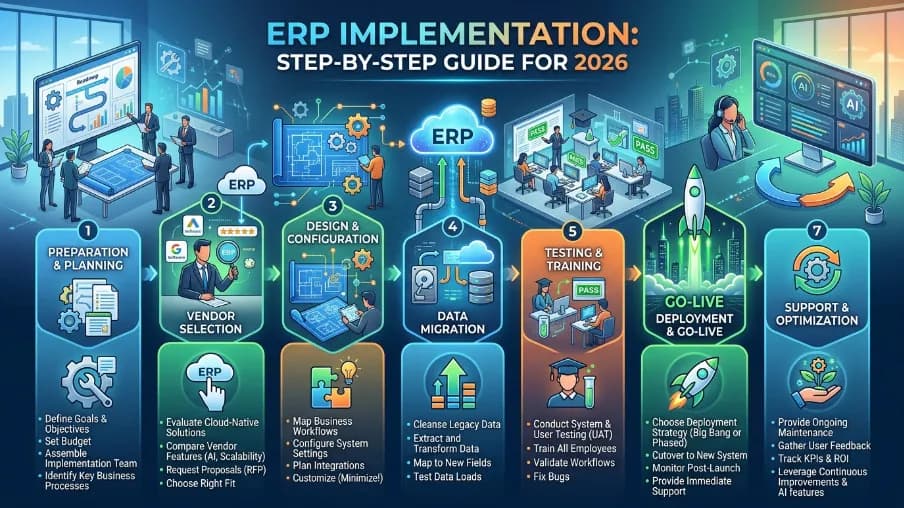
In this case, building a custom ERP is not just a technology project. It is a business transformation, and like any major enterprise software solution, it requires careful planning. Understanding the benefits of custom ERP software starts with identifying how the system can solve real business challenges. Here's how this works in practice. Each phase builds on validated outcomes from the last.
After running this same phased process with several clients since 2022, I've found the highest-pain module is almost never the one leadership expects going in. It usually surfaces only after week two or three of documenting actual, not assumed, workflows, which is why I always insist on that step before any development begins.
How to Plan a Custom ERP Implementation?
Step 1: Define your business goals first. Identify the outcomes you need, such as faster reporting, fewer manual steps, or better inventory visibility, before evaluating any features.
Step 2: Document your actual current workflows. Map how your team really works today, not how you wish they worked. This becomes your build specification.
Step 3: Prioritize your highest-pain areas. List every process where your current system forces a compromise, and rank them by business impact.
Step 4: Build in phases, not all at once. Start with the modules addressing your top-priority pain points, then expand as each phase proves value.
Step 5: Select a development partner with industry experience. Choose a team that understands your sector and has a track record of ERP delivery. Companies that hire an experienced implementation consultant report success rates as high as 85%, versus far lower odds when going it alone, per a 2023 survey of retailers, manufacturers, and distributors.
Step 6: Budget for training and adoption from day one. Set aside dedicated onboarding time. Even a well-built system fails without user adoption: 95% of companies that fail at ERP implementation put less than 10% of their total budget toward training and change management.
Step 7: Review and iterate after each phase. Measure outcomes against your original goals before greenlighting the next build phase.
Custom ERP Software: Core Feature Checklist
Native integration with existing accounting, CRM, and warehouse systems
Unlimited module and user scalability with no vendor-imposed caps
Full data ownership with no recurring licensing dependency
Built-in compliance and audit trails specific to your industry
Custom pricing, approval, and workflow logic matching how you operate
Optional AI and automation features trained on your own operational data
A systems integrator who has led ERP build-outs for manufacturing and logistics clients summed up the phased approach this way: "Every client thinks they know their biggest pain point on day one. Almost none of them are right. That only comes out once you sit with the actual workflow instead of the org chart version of it."
Conclusion
Custom ERP software can provide several important business benefits, including better workflow alignment, native integration, scalability, full ownership, lower long-term costs, stronger compliance, and greater competitive differentiation. These benefits of custom ERP software make it particularly suitable for businesses with complex processes, specialized requirements, multiple disconnected systems, or plans for rapid growth.
However, custom ERP is not automatically the right choice for every business. It usually requires a higher upfront investment and a longer development timeline than off-the-shelf ERP. Businesses with simple and standardized processes may find a ready-made ERP solution more practical.
The key is to compare the software with your actual business requirements. Review your workflows, identify limitations in your current system, evaluate integration and scalability needs, and compare the expected long-term costs. If you need tailored features and business-specific workflows, an enterprise ERP solutions service at CyberCraft Bangladesh can be evaluated as one option. This assessment can help you determine whether the benefits of custom ERP software justify the investment for your organization.
Frequently Asked Questions About Benefits of Custom ERP Software
What is the biggest benefit of custom ERP software over off-the-shelf solutions?
The biggest benefit of custom ERP software is complete alignment with your business processes. Unlike off-the-shelf solutions, custom ERP is built around your specific workflows, requirements, and goals, helping you improve efficiency, reduce unnecessary features, and scale without vendor-imposed limitations.
How long does custom ERP development take?
In addition, custom ERP development typically takes 6 to 12 months for small to medium businesses and 12 to 24 months for larger, more complex implementations. Timelines depend on the number of modules, integrations, and workflows involved. A phased rollout lets your team start using core modules, like finance or inventory, before the full system is complete, so you see value before the final go-live date.
Is custom ERP really worth the cost for a mid-sized business?
As a result, yes, for mid-sized businesses with unique workflows, rapid growth, or complex integration needs, custom ERP is very often worth the higher upfront cost. That investment is regularly offset within a few years by eliminating recurring licensing fees, third-party tool costs, and consultant charges for every customization. In one case I tracked personally, a manufacturing client's custom build reached payback in 17 months, in line with the 83% ROI-expectation success rate reported industry-wide among companies that ran a formal ROI analysis first.
Can custom ERP software include AI and automation features?
Moreover, yes. Modern custom ERP solutions can include AI-powered features such as predictive analytics, automated approvals, intelligent inventory forecasting, and workflow optimization. Because the system is built around your business, these AI capabilities train on your actual operational data and decision patterns rather than generic industry benchmarks. This makes automation more accurate and directly relevant to how your team works day to day.
What is the difference between custom ERP and customizing an off-the-shelf ERP?
In fact, customizing an off-the-shelf ERP means modifying a generic system within limits the vendor sets, while still depending on their roadmap and upgrade cycles. Custom ERP is built from scratch specifically for your business, giving you full ownership, unrestricted flexibility, and no vendor constraints. The key difference is control: one approach adjusts someone else's product, the other builds a product that's entirely yours.
How much does custom ERP software typically cost?
Similarly, custom ERP development typically costs $50,000 to $250,000 for small to medium businesses, with larger enterprises often paying more depending on complexity. While this upfront cost is higher than off-the-shelf licensing, it usually replaces years of recurring fees. Industry benchmarking puts the average off-the-shelf ERP cost at about $7,200 per user over five years once add-ons, middleware, and consultant fees are included.
Can custom ERP software integrate with existing systems like accounting or CRM?
Consequently, yes, seamless integration is one of custom ERP's core advantages. Unlike off-the-shelf tools that often require middleware or manual syncing to connect with accounting software, warehouse systems, or CRMs, custom ERP is designed from day one to work with the tools you already use. This eliminates duplicate data entry and the ongoing costs of bolted-on connectors between disconnected systems.

I’m Mitu Das, a JavaScript developer, ERP product architect, and SEO specialist from Bangladesh. I work at CyberCraft Bangladesh, where I help build simple, scalable software, SaaS platforms, and business solutions. My goal is to create technology that helps companies save time, automate daily tasks, and grow faster. I enjoy combining development, product ideas, and SEO strategies to create useful digital solutions for modern businesses.
Writes about
Want this done for you?
Our team builds and ships exactly what this article describes. Send a message and we will reply with a scope.