Facebook Marketing Tips: A Practical Guide to Growing Your Business in 2026

Looking for Facebook marketing tips that actually work in 2026? Here's the short answer. Combine consistent, value-first content with targeted ads. Pay close attention to what the algorithm rewards right now. In 2026, that means video, Reels, and genuine engagement over passive likes. That single shift in focus is what separates pages that grow from pages that stall.
I've spent years running digital marketing campaigns for small businesses and local brands. Facebook marketing tips that sounded great two years ago don't always hold up today. The platform has changed. The algorithm has changed. And the audience's patience for obvious sales pitches has changed too. This guide walks through what's actually working, why it works, and how to apply it to your business.
A quick note on where this advice comes from. It's based on hands-on campaign work across small-business and local-brand accounts. It's also cross-checked against Meta's own published advertising guidance and current industry data (see the Sources section). Where something is a general pattern rather than a guarantee, we say so. Results vary by industry, audience, and budget.
Facebook still matters. It has more than 3 billion monthly active users worldwide. That's one of the largest audiences any business can reach on a single platform. Getting your strategy right, or wrong, has a big impact on your bottom line.
Quick Answer: The most effective Facebook marketing tips for 2026 are: (1) prioritize short-form video and Reels for organic reach, (2) post consistently 3–5 times a week with a content mix, not just promotions, (3) reply to comments quickly to boost engagement signals, (4) use Custom and Lookalike Audiences for ads instead of broad interest targeting, and (5) test small ad budgets before scaling. Combining organic content with paid ads generally outperforms either approach alone.
Key Takeaways: Facebook Marketing Tips at a Glance
Facebook marketing works best as a mix of organic content (posts, Reels, Groups) and paid ads (targeted campaigns).
In 2026, the algorithm favors video and Reels over static images, and comments over likes.
Consistency (3–5 posts/week) matters more than posting volume.
Small, tested ad budgets typically outperform large untested campaigns.
Facebook remains one of the largest social platforms globally, with over 3 billion monthly active users, making it a viable channel for most business types.
What Is Facebook Marketing?
Facebook marketing is the use of Facebook's Pages, Groups, ads, and content tools to build brand awareness, connect with an audience, and generate leads or sales. It has two main pillars: organic marketing (free content like posts, Reels, Stories, and community engagement) and paid marketing (Facebook Ads that target specific audiences by interest, behavior, and demographics). Most successful strategies combine both. Organic content builds trust and community over time, while paid ads scale reach and drive conversions faster, so businesses that use only one tend to underperform those that use both together.
In practice, that means treating your Page like an ongoing conversation rather than a billboard. A steady mix of organic posts keeps your audience engaged between purchases, while targeted ads reach the people who haven't found you organically yet.
How Does Facebook Marketing Work?
In short: Facebook marketing works by matching your content or ads to people likely to care about them, then using engagement signals like comments, watch time, and shares to decide how far that content spreads. The algorithm ranks posts based on how often people engage with them, how recently they were posted, whether viewers watch videos to completion, and whether the content keeps people on Facebook rather than sending them elsewhere. Pages that post and forget tend to plateau, while pages that treat Facebook like a two-way conversation grow steadily, even on a small ad budget.
The algorithm decides what shows up in someone's feed based on a few key signals:
How often people engage with your content (comments weigh more than likes)
How recently you've posted
Whether people watch your videos to completion
Whether your content keeps people on Facebook or sends them elsewhere
Pages that treat Facebook like a broadcast channel, post and forget, plateau fast. Pages that treat it like a conversation, replying to comments and asking questions, keep earning distribution long after the post goes live.
Why Does Facebook Marketing Still Matter in 2026?
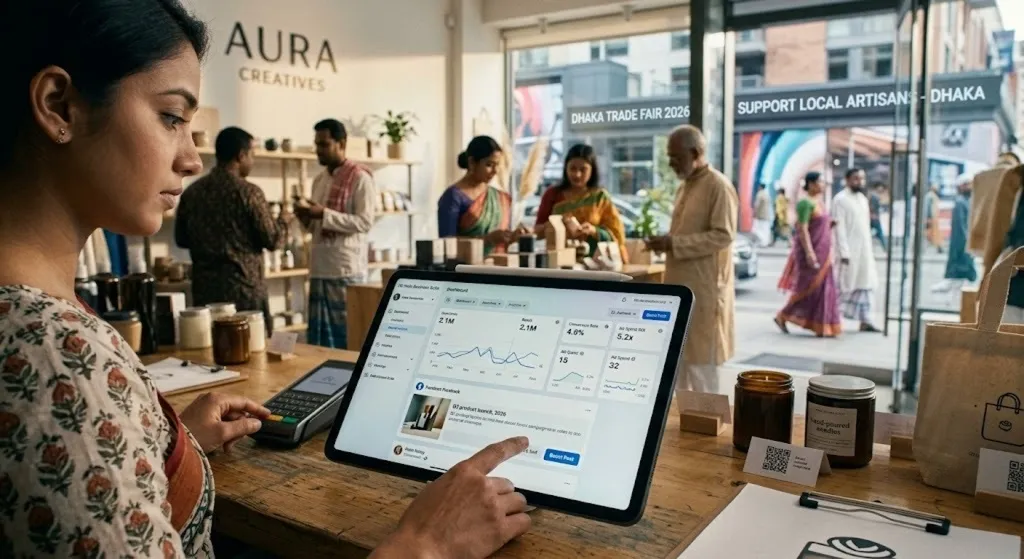
Yes, Facebook marketing is still worth it in 2026. It has the largest active user base of any social platform, more than 3 billion monthly active users worldwide, and it typically offers a lower cost-per-lead than newer platforms for local and small businesses. Some assume Facebook skews toward older users, but more than 200 million businesses still actively use its Pages, Groups, and Marketplace tools, and there's currently less advertiser competition there than on TikTok or Instagram, which keeps costs down for businesses willing to show up consistently.
That said, it's not a magic channel. It works best as part of a broader creative digital marketing plan, not as a standalone strategy.
Facebook Marketing Tips for Beginners: Where to Start
If you're new to Facebook marketing, don't try to do everything at once. These beginner-friendly Facebook marketing tips will get you moving in the right order.
Optimize your Page: complete profile, clear business description, contact details, and a recognizable profile photo/cover image.
Define your audience: age range, location, interests. Vague targeting wastes ad spend.
Plan a simple content calendar: 3–4 posts per week is often enough to stay visible.
Mix content types: Reels, photos, polls, and short-form video, not just promotional posts.
Set one small ad budget: test messaging before scaling spend.
This order matters. Some businesses jump straight to paid ads before their Page even looks credible. The ads underperform because visitors land on an inactive-looking Page and bounce.
Practical Steps: Building a Facebook Marketing Plan That Works
Step 1: Set a Clear Goal
Brand awareness, lead generation, and direct sales each need different content and ad formats. Trying to do all three with one campaign usually dilutes results.
Step 2: Know Your Audience Deeply
Facebook's targeting tools let you narrow by location, age, interests, and behavior. Layer in a Custom Audience, people who've visited your site or engaged with your Page, for stronger results than cold targeting alone.
Step 3: Prioritize Video and Reels
Short-form video consistently gets more organic reach than static images right now. That's largely because Facebook is pushing Reels to compete with TikTok and Instagram. A 15–30 second video showing your product, process, or team tends to outperform a plain product photo.
Step 4: Post at the Right Times, But Test It
General best-practice windows, like late morning and early evening on weekdays, are a reasonable starting point. But your audience's active hours may differ. Check your Page's Insights data after a few weeks and adjust.
Step 5: Engage, Don't Just Post
Reply to comments within a few hours when you can. Early engagement signals tell the algorithm a post is worth showing to more people.
Step 6: Run Small, Focused Ad Tests
Instead of one big campaign, run 2–3 small ad variations with different images or headlines. Let the data tell you which one performs before you scale budget.
Facebook Advertising Tips That Actually Move the Needle
The core Facebook advertising tip: target warm audiences (Custom/Lookalike) instead of cold interest targeting. Test multiple creatives at once. Refresh ads before frequency climbs past 5, and stay within Meta's ad review guidelines as you scale.
Tip | Why It Works | Common Mistake to Avoid |
|---|---|---|
Use Custom & Lookalike Audiences | Targets people similar to your best existing customers | Relying only on broad interest targeting |
Test multiple creatives | Different visuals resonate with different segments | Running one ad for weeks unchanged |
Optimize for the right objective | Aligns delivery with your actual goal (leads vs. awareness) | Choosing "engagement" when you need "conversions" |
Use clear, simple CTAs | Reduces friction, improves click-through | Vague or multiple CTAs in one ad |
Monitor frequency | High frequency (5+) often signals ad fatigue | Ignoring frequency until performance drops |
Ad fatigue happens faster than people expect. An ad that performs well in week one can quietly decline by week three. That's simply because the same audience has seen it too many times. Refreshing creative regularly isn't optional. It's maintenance.
Facebook Content Marketing Strategies That Build Engagement
The content types that generally build the most engagement are behind-the-scenes video, user-generated content, quick educational tips, polls, and Facebook Live, in that rough order.
Behind-the-scenes content performs well because it feels authentic rather than promotional.
User-generated content (customer photos, reviews, tags) builds trust faster than brand-created content alone.
Educational posts, quick tips related to your industry, tend to get saved and shared more than pure promotions.
Polls and questions in Groups or on your Page boost comments, which the algorithm rewards.
Facebook Live sessions, even short ones, often get priority visibility compared to pre-recorded video.
Pages that post purely promotional content ("Buy now! 20% off!") tend to see engagement flatten within a few weeks. Pages that lead with useful or entertaining content, and mention products more subtly, build steadier long-term growth.
Facebook Marketing Tips: Facebook marketing mistakes to avoid
Posting inconsistently: Sporadic posting confuses the algorithm and your audience.
Ignoring comments and messages: Slow response times hurt both engagement signals and customer trust.
Overusing hard sales language: Constant discount-only posts often reduce organic reach over time.
Not tracking Insights: Without checking what's working, you're guessing, not strategizing.
Setting ad budgets too high before testing: Small test budgets typically reveal what works before you scale spend.
Ignoring video: Static-image-only strategies generally underperform compared to Reels and short video in 2026's feed environment.
A Real-World Example
Situation: A local bakery client posted only product photos with prices, 2–3 times a week. Engagement was almost nonexistent.
Problem: Reach had stalled. The Page felt like a digital menu, not a community.
Solution: We shifted the content mix. That meant short Reels of the baking process, a weekly "ask us anything" post, and customer photo reposts. Product posts dropped to about 30% of total content.
Result: Within about six weeks, comment engagement rose noticeably. Organic reach on Reels outperformed static posts by a wide margin.
Lesson learned: People engage with people and process, not just products. Facebook's algorithm tends to reward that shift with more visibility.
Facebook Marketing Trends Heading Into the Rest of 2026
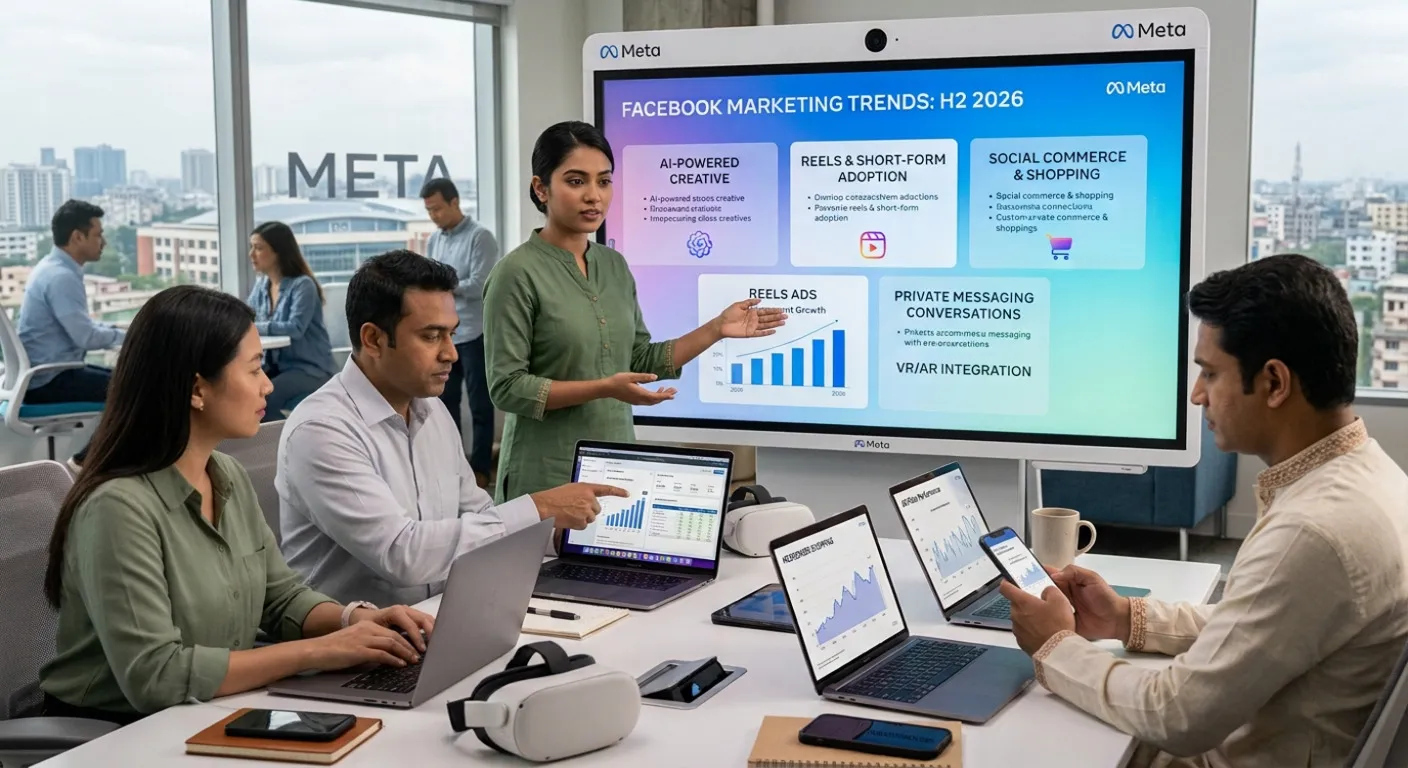
Reels remain the primary organic growth lever, especially among younger users who watch video content daily.
Community and Groups continue gaining importance, as many users now favor interest-based Groups over public Feed browsing.
AI-assisted ad creative tools inside Meta Ads Manager are becoming standard for generating and testing variations quickly.
Mobile-first design is essential, since the vast majority of Facebook users now access the platform only through mobile devices.
These trends may shift again later in the year. It's worth revisiting your strategy quarterly rather than setting it once and forgetting it.
Limitations and Honest Caveats
No guide can promise specific results. It's worth being upfront about that. A few honest caveats:
Results vary by industry: A local restaurant and a B2B software company will see very different engagement and ad performance patterns, even using the same tactics.
The algorithm changes without notice: What's ranking well in mid-2026 (Reels, comment-heavy posts) may shift again. Treat this guide as a snapshot, not a permanent rulebook.
Ad costs fluctuate. Cost-per-click and cost-per-lead depend heavily on your industry, season, and competition. The tips here explain how to test efficiently, not a guaranteed price.
Organic reach has structural limits: Even with excellent content, organic reach for business Pages is generally a small fraction of total followers. Paid promotion is often necessary to reach beyond your existing audience.
This guide reflects publicly available data and hands-on campaign experience, not proprietary Meta data. For platform-specific policy questions, Meta's own Business Help Center is the authoritative source.
Facebook Marketing Tips: Quick Recap
If you take nothing else from this guide, here are the Facebook marketing tips worth acting on first:
Post video and Reels consistently. They're currently favored by the algorithm over static images.
Prioritize comments over likes. Ask questions and reply quickly; engagement signals drive reach.
Layer Custom and Lookalike Audiences into your ad targeting instead of relying on broad interests.
Test small ad budgets first. Scale only what's already proven to work.
Balance promotional posts with value-first content. Don't let your Page read as one long sales pitch.
These five tips form the foundation everything else in this guide builds on.
Conclusion
These Facebook marketing tips point back to one idea: show up consistently and treat your audience like people, not a sales funnel. Mix organic content with small, tested ad spend, watch your Insights data, and double down on what works. No big budget needed, just a Page, a content calendar, and one small ad test.
Want help applying this? Get a free quote from CyberCraft Bangladesh or browse our digital marketing services.
FAQs About Facebook Marketing Tips
1. What are the best Facebook marketing tips for small businesses?
Facebook marketing tips: Focus on a complete Page profile, consistent posting (3–4 times weekly), a mix of video and image content, and small, tested ad budgets before scaling. Engagement and consistency matter more than posting volume.
2. How do I increase Facebook page engagement?
Post content that invites comments, like questions and polls. Respond quickly to interactions. Prioritize Reels and short video, which generally get more organic reach than static posts right now.
3. How much should I spend on Facebook ads as a beginner?
There's no universal number. Many businesses start with a small daily test budget, often a few dollars a day per ad variation, before scaling what performs.
4. Are Facebook ads still effective in 2026?
Yes, generally. Facebook's large active user base and detailed targeting tools keep ads cost-effective, particularly for local and niche audiences. Results still vary by industry and competition.
5. How often should I post on Facebook for a business page?
Most guidance suggests 3–5 times per week. That's enough to stay visible without overwhelming your audience or your own content pipeline.
6. What is the biggest Facebook marketing mistake to avoid?
Being overly promotional. Pages that post only sales content tend to see reach and engagement decline over time. Pages that balance promotion with value-driven content hold up better.
7. Do Facebook Reels really help business growth?
In many cases, yes. Short-form video is currently prioritized in Facebook's algorithm. It often gets wider organic reach than photo-only posts.
8. Is organic or paid Facebook marketing better?
Neither works best alone. Organic content builds trust and community over time. Paid ads accelerate reach and conversions. Combining both is generally the most effective approach.
Sources and References
Meta Business Help Center: official guidance on Facebook advertising policies and best practices
Meta Ad Review Policy Guidelines: how ad review and enforcement works
Backlinko (Semrush), Facebook User & Growth Statistics to Know in 2026
SocialPilot, Latest Facebook Statistics Marketers Should Know in 2026

I’m Mitu Das, a JavaScript developer, ERP product architect, and SEO specialist from Bangladesh. I work at CyberCraft Bangladesh, where I help build simple, scalable software, SaaS platforms, and business solutions. My goal is to create technology that helps companies save time, automate daily tasks, and grow faster. I enjoy combining development, product ideas, and SEO strategies to create useful digital solutions for modern businesses.
Writes about