AI-Powered Content Marketing: The Complete Guide for Modern Marketing Teams


Quick answer: AI-powered content marketing is the use of AI tools for research, drafting, editing, optimization, and distribution, combined with human strategy and fact-checking, to produce content faster and at greater scale than manual writing alone. It is not "letting AI publish on its own"; the strongest AI content marketing strategy still puts a human editor in charge of facts, tone, and the final call before anything goes live.
This guide explains what AI-powered content marketing is, how it works step by step, what tools it involves, where it genuinely helps, where it falls short, and how to build an AI content strategy for your own team. It also covers common mistakes, realistic costs, and how long results typically take.
Content demand keeps rising while budgets and staff often don't, and that gap is exactly what AI-powered content marketing is built to close. Teams that use AI content generation tools for research and first drafts consistently move faster than teams doing that work by hand, and the gap between the two keeps growing as adoption spreads.
Table of Contents
How This Guide Was Made
Key Takeaways
What Is AI-Powered Content Marketing?
Why It Matters Now
Benefits and Challenges
A Simple Example
Practical Steps
Common Mistakes
Expert Tips
Future Trends
FAQ
Key Takeaways
AI content marketing mixes AI speed with human skill. This makes content faster and bigger in scale.
It works best for research, outlines, drafts, and data checks. It's not meant to publish final copy on its own.
Good teams follow one clear path: write a brief, make a draft, edit by hand, polish it, then publish.
The biggest risk is skipping edits. That's where trust gets lost, not the AI itself.
Treat your AI plan as one full system. Don't just buy one tool and stop there.
What Is AI-Powered Content Marketing?
AI-Powered Content Marketing means using AI tools at every step. This covers ideas. This covers drafts. This covers edits. This covers SEO checks. This covers sharing too. It's not just manual writing anymore. It's a full plan, not one single tool. Here's an example. A team might use one tool for keyword research. They use another tool for first drafts. A data tool tracks what works. A human editor ties it all together. That person checks facts. That person fixes the tone. That person makes the final call.
This is not the same as "let AI write your blog." Most good plans use AI for the hard, slow work. That means research. That means first drafts. That means data checks. Humans still handle strategy. Humans still check facts. Humans still guard the brand voice. Humans still make the final call. That split matters more than most guides admit. OpenAI released GPT-4 in March 2023. Google rolled out its Helpful Content system in August 2022. Both events changed how fast AI content gets made. Both events changed how closely that content gets checked once it's live.
How AI Tools Fit a Real Workflow
Here's what a typical AI-assisted workflow looks like:
Keyword research: AI tools group keywords fast. AI tools spot content gaps fast too.
Outlining: AI builds a working outline. It's based on what readers want to know.
Drafting: A first draft comes from the tool. Then, a human writer edits it closely.
Improving (often called "optimizing"): AI checks reading ease. AI checks keyword use. AI checks page structure. In other words, it makes a draft easier to read.
Sharing: Automation tools turn one post into social posts. They turn it into emails. They turn it into short scripts too.
Here's what I've learned. Teams that skip step 3, real human editing, tend to fail. A draft is just a start point. One thing I learned early: a draft can look clean and still be wrong. So, "sounds good" is not the same as "is true."
Why AI-Powered Content Marketing Matters Now
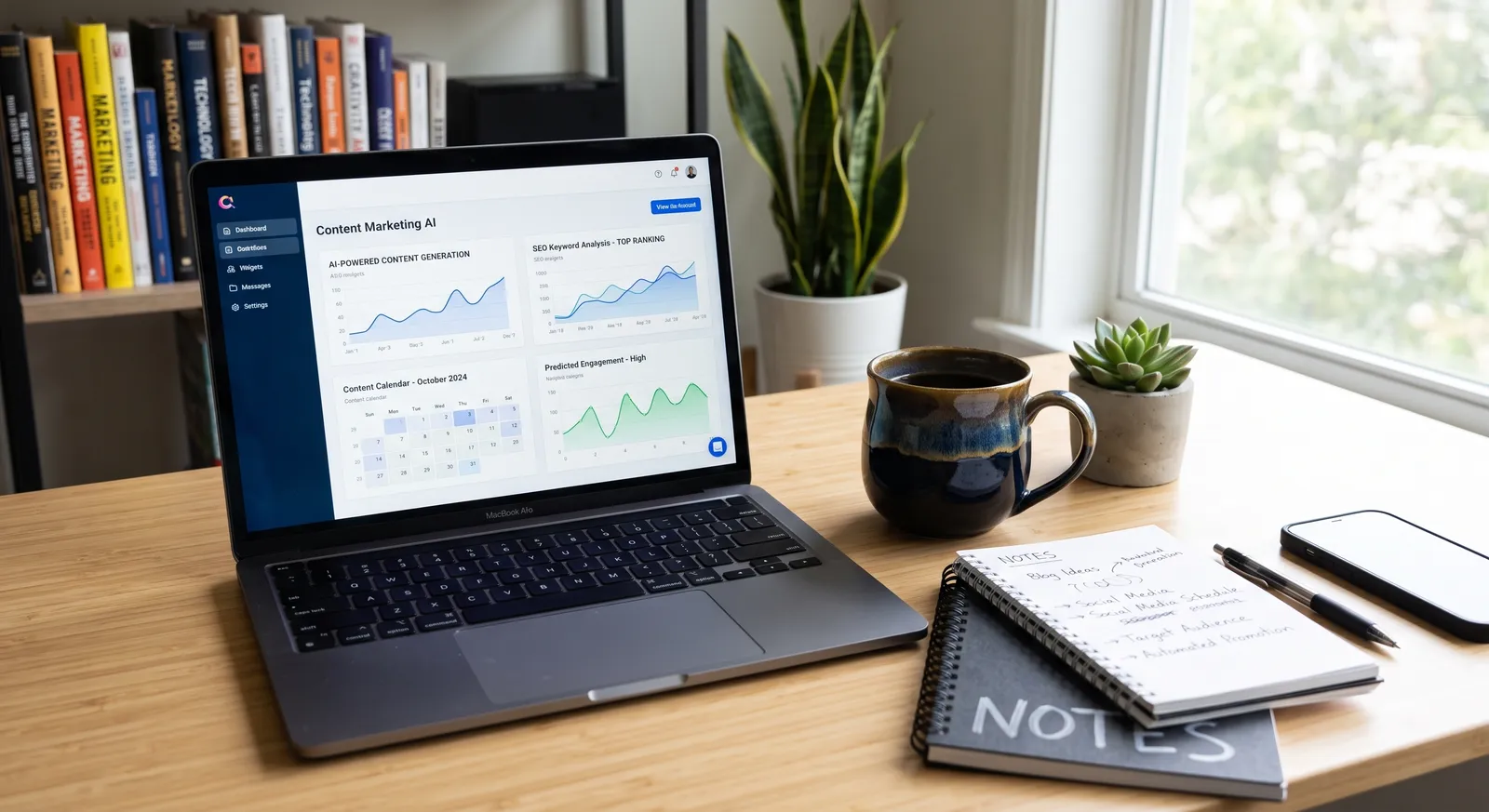
Content demand has not slowed down. But budgets and staff often have. That gap is why AI content marketing is now a must-try for busy teams. Business writers, like those at Harvard Business Review, have covered this shift too.
Here are a few reasons it matters:
Less burnout: Teams keep a steady content plan. Staff don't need to work long hours.
Faster research: A full day of research can shrink to just an hour.
Better targeting: AI helps write for different reader groups. Teams don't need whole new campaigns each time.
Better choices: AI data tools spot patterns fast. These patterns are easy to miss by hand.
I want to be honest here too. None of this replaces real strategy. AI can write fast. But it can't tell you why your reader cares about a topic. That's still a human job.
Benefits and Challenges of AI Content
What Are the Benefits?
The main wins are speed, scale, and steady quality. Teams can research, draft, and reuse content much faster by hand. They can do this without hiring more staff. As a result, writers get more time for strategy and fresh ideas.
Benefit | What It Looks Like |
|---|---|
Speed | First drafts made in minutes, not hours |
Scale | One team runs a much bigger content plan |
Consistency | Tone stays steady across many pages |
Insight | Easy to see which topics and titles work |
Reuse | One post becomes posts, an email, and a script |
What Are the Challenges?
The biggest issues are flat writing, wrong facts, and voice drift. AI can write text that sounds sure but is wrong. It can be dull. It can be off-brand. This happens without clear prompts. This happens without a sharp editor. Left alone, these small issues pile up over time.
Flat writing: Drafts often read plain without strong prompts and real edits.
Wrong facts: AI can state wrong facts with full confidence. So, checking facts is a must.
Voice drift: Without clear rules, tone can shift from page to page.
Too much trust in AI: Teams that skip review lose reader trust over time.
Thin content: Readers and search engines both notice copycat pages.
Here's what I've seen. Weak teams treat AI as a stand-in for writers. Strong teams treat AI as a tool for writers. The results look very different. I've checked content built the weak way. The pattern repeats every time. Output starts strong. Then, it fades fast. Readers spot the sameness. Trust drops. Researchers at the Nielsen Norman Group have long linked that drop to plain, low-effort content.
AI-Powered Content Marketing: A Simple Example
Here's a common story I've seen play out in real teams.
The problem: A small team of two needs four posts a month. They only have time for two.
What was hard: Research and drafts ate up most of the writing time. So, the schedule kept slipping.
What they did: The team used AI for early research and outlines. Then, they used their saved time on edits and fact-checks. Say research time drops from four hours to one hour per post. That's a 75% cut on that one task. That saved time goes right back into editing.
What happened: The team got back to four posts a month. They did this without new hires. Why? Because the real slow spot, research time, got fixed first.
What they learned: AI did not remove the need for a sharp editor. It just freed up that editor's time. That time went toward real, careful judgment calls.
Practical Steps for an AI Content Plan
Here's a simple process I use with teams. It won't fit every team the same way. Still, this order works well for most:
Check your process: Find out where time really goes: research, drafts, edits, or sharing.
Fix real slow spots not everything at once. Start with your slowest step.
Build one brief template: Use the same style each time: same tone, same audience, same goal.
Set one hard rule: No draft goes live until a real person checks it.
Track clear numbers, like traffic and sign-ups. Don't just track how much you publish.
Check results each month: Tools and search rules shift often. Don't "set and forget" your plan.
Common Mistakes With AI Content
Here are the mistakes I keep seeing across teams that are new to AI content marketing:
Skipping edits: This is the biggest mistake. It's usually why AI content falls flat.
Skipping fact checks: AI can state stats that sound real but aren't true. Always check first.
Stuffing keywords: Some AI drafts over-use keywords. This feels odd to real readers.
No clear voice: If your content just repeats what's already out there, readers have no reason to stay.
Using every tool the same way: Research tools, writing tools, and data tools solve different problems. The wrong tool wastes time.
Tips for Better AI Content
Feed your tool real samples of your best posts. This helps new drafts match your voice.
Use AI for research and outlines. But write your intro and closing yourself. That's where voice matters most.
Mix AI drafts with real reader questions. Pull them from support chats or forums. This keeps content grounded in real needs.
Check your content each month. Use data tools to flag weak pages. Fix old pages instead of always starting fresh.
Check real keyword data with tools like Ahrefs or Semrush. Study proven tips from sites like Backlinko. This way, your AI drafts rest on solid ground, not guesswork.
Future Trends in AI Content

Here are a few trends worth watching:
Answer Engine Optimization (AEO) is growing fast. ChatGPT launched in November 2022. Chat-based search tools have grown fast since then. More readers now get answers straight from AI. They skip the click to a page. This changes how content must be built to get quoted at all.
More combined tools. Expect fewer single-task AI tools. Expect more platforms that do research, drafts, and sharing all in one place.
More value on real work. As more content uses AI, real data and real first-hand experience will matter even more for trust. Groups like Stanford's Institute for Human-Centered AI track this shift closely.
Frequently Asked Questions About AI-Powered Content Marketing
What Is AI-Powered Content Marketing in Simple Terms?
It means using AI tools to help with research, drafts, edits, and sharing. Humans still handle strategy and quality checks. It's a full workflow, not just one tool. Most teams use AI for the slow parts, like first drafts. Then, a real editor checks facts and tone before it goes live.
Does Google Penalize AI-Generated Content?
No, not by default. Google's own guidance, updated in 2023, says using AI to write content is not against its rules. But Google does flag content made just to game rankings. This is true for human writing too. Google's Search Quality Rater Guidelines added the "Experience" part of E-E-A-T back in December 2022. That's the part AI-only content tends to miss most. In short, quality matters more than which tool made the draft.
What Are the Best Tools for Beginners?
The best first tool depends on your slowest step. There's no single "best" pick for everyone. Research tools help teams stuck on planning. Writing tools help teams stuck on drafting speed. Data tools help teams unsure what's working. Start with whatever step wastes the most time.
Can AI Fully Replace Content Writers?
In most cases, no. AI speeds up research and drafts. But real writers still handle voice, facts, and trust. In my experience, the best setup treats AI as a helper for a skilled writer. It should not replace that writer.
How Much Does This Cost?
Cost swings a lot based on the tools you pick. Some tools are free. Some cost a lot, with built-in data tools too. Many teams start with one cheap tool to fix one slow spot. Then, they add more tools as they grow.
Is AI Content Good for SEO?
It can be, if the draft gets edited, checked, and made truly useful. AI speeds up the work. But rankings still depend on real value. They depend on matching what readers search for. Thin or copy-paste AI drafts still rank poorly over time.
How Long Until I See Results?
Most teams see faster output within a few weeks. Research and drafting speed up right away. But SEO and traffic gains take longer, often three to six months. Search engines need time to find and rank new pages. Don't expect fast traffic wins from AI alone.
What Skills Does My Team Need?
Your team needs strong editing and fact-check skills. That matters more than deep AI knowledge. The key skill is knowing your reader well. That way, you can spot when a draft misses the mark. Prompt-writing helps some. But it matters far less than a sharp human check before anything goes live.
Actionable Takeaways
Remember these key points about AI-powered content marketing:
Use AI to speed up research and drafts. Don't skip the final human edit.
Fix one slow spot at a time. Don't add five tools at once.
Never publish an AI-made stat or claim. Check it against a real source first.
Track real results, like traffic and sign-ups. Don't just count how much you publish.
Next Steps
Want to go deeper? Read more on how to compare AI writing tools for your slowest step. Or, learn how to build a content plan that stays steady each month. Want to see which AI tools fit your budget? That's a good next stop after this guide.
Further Reading and References
For more on AI-powered content marketing, these are solid places to read:
Content Marketing Institute: https://contentmarketinginstitute.com
HubSpot Marketing Blog: https://blog.hubspot.com/marketing
Google Search Central Documentation: https://developers.google.com/search
Search Engine Journal: https://www.searchenginejournal.com
Search Engine Land: https://searchengineland.com
Final Thoughts
AI-powered content marketing is not about replacing people. It's about cutting out boring, repetitive work. This frees up time for strategy and the small touches that build trust. At CyberCraft Bangladesh, AI can be part of a broader content workflow where technology supports efficiency without replacing human judgment. The best teams treat AI as one part of a bigger system. They don't use it as a shortcut around real work.
Here's the direct answer this guide opened with: AI-powered content marketing works best when AI handles speed and scale, while people handle judgment and voice. So, if you're just starting out, start small. Fix one slow spot. Check your results. Then, grow from there.

I’m Mitu Das, a JavaScript developer, ERP product architect, and SEO specialist from Bangladesh. I work at CyberCraft Bangladesh, where I help build simple, scalable software, SaaS platforms, and business solutions. My goal is to create technology that helps companies save time, automate daily tasks, and grow faster. I enjoy combining development, product ideas, and SEO strategies to create useful digital solutions for modern businesses.
Writes about
Want this done for you?
Our team builds and ships exactly what this article describes. Send a message and we will reply with a scope.