
Review Writing vs Testimonial Writing: Real Difference

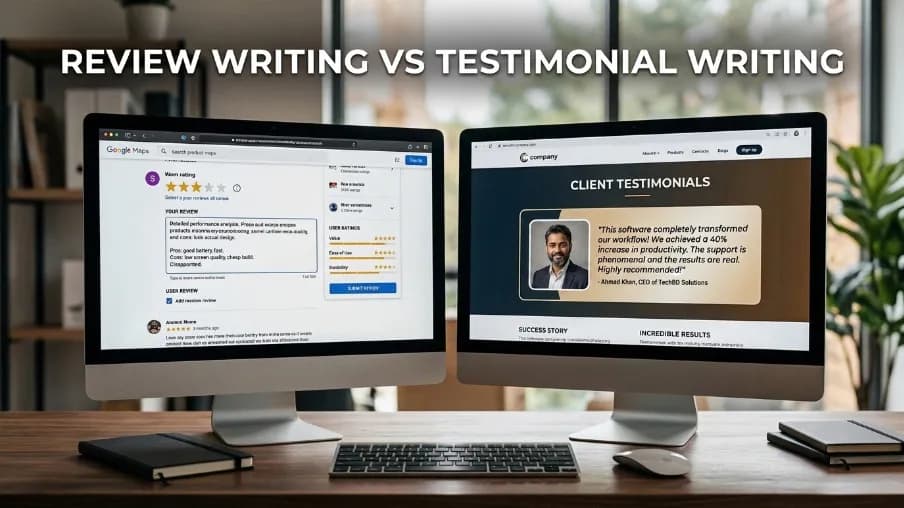
Review Writing vs Testimonial Writing is a comparison of two kinds of customer content. A review is an open, honest opinion that can be good or bad. A testimonial is a positive statement that a business asks for and shares. Both build trust, but they work in different ways.
I reviewed the FTC's public guidance and several BrightLocal surveys to write this guide. However, I did not run my own tests. Treat the numbers as research-based, not final. Why does this topic matter? In digital marketing and SEO, customer words do real work. Reviews and testimonials shape what people see, trust, and click. Therefore, knowing which one to use, and when, can save you time and money.
Key Takeaways
A review is an honest opinion. A testimonial is a selected success story.
Reviews usually live on public sites. Testimonials live on a brand's own pages.
Specific details make both formats more believable.
Fake or hidden-bias content can break FTC rules.
Most businesses do best when they use both formats honestly.
Table of Contents
What Is Review Writing vs Testimonial Writing?
How Does Review Writing vs Testimonial Writing Differ in Practice?
How Do You Write a Review?
How Do You Write a Testimonial?
What Are the Benefits of Each?
What Do the Rules Say About Authentic Review Writing?
Final Takeaways and Next Steps
FAQs
What Is Review Writing vs Testimonial Writing?
Review writing means sharing an honest opinion about a product or service, whether it is good or bad. Testimonial writing means crafting or collecting a positive customer story that a business uses in its marketing. Therefore, the main difference in review writing vs testimonial writing is control. Reviewers speak freely, while testimonials are chosen, edited with permission, and shared by the brand.
Here is the review writing vs testimonial writing meaning in short. A review answers, “Was this worth it?” A testimonial answers, “How did this help me?” For example, a customer review might say a blender crushed ice well but cracked its lid in six weeks. A business testimonial might say a baker reduced missed orders from 12 a month to 2.
Customer feedback is a wider idea. It includes surveys, support chats, and complaints. A testimonial is simply feedback that a business selects and publishes with permission.
How Do Review Writing vs Testimonial Writing Differ in Practice?
In practice, review writing vs testimonial writing differs mainly in where the content appears and who controls it. Reviews live on third-party sites like Google or Amazon, where anyone can post them. They can include both praise and complaints. Testimonials usually appear on a brand’s website or brochure and highlight positive experiences, often with a customer’s name, photo, and specific result.
Feature | Review | Testimonial |
|---|---|---|
Where it appears | Public platforms | Brand-owned pages |
Tone | Mixed, honest | Positive, focused |
Who controls it | The reviewer | The business (with permission) |
Typical length | 50–150 words | 2–4 sentences |
Main goal | Help buyers decide | Prove results |
This split matters in digital marketing and SEO planning. Reviews usually grow on outside platforms, so you earn them over time. Testimonials sit on pages you control, so you can place them where buyers need proof. For example, a testimonial fits a landing page, while a review fits a product listing.
How Do You Write a Review?

To write a review, state what you bought, how you used it, and what happened. Then share pros, cons, and a clear rating. Keep your tone honest and specific. Add details like dates, prices, and results. Finally, tell readers who should buy it and who should skip it.
Here are my review writing tips, in order:
Name the product or service and say how long you used it.
Describe one real moment of use.
List two pros and one con.
Add a rating and a short verdict.
Disclose any free product or payment.
Good customer review writing feels like advice from a friend. For example: "I used this planner for 30 days. The weekly layout saved me time, but the paper bled through with gel pens. Four stars."
How Do You Write a Testimonial?

To write a testimonial, start with the customer's problem. Next, describe the change they saw, using real numbers when possible. Then add their name, role, and permission to publish. Keep it short, around two to four sentences. Finally, read it aloud so it sounds like a real person, not an ad.
Here are my testimonial writing tips:
Ask open questions, such as "What changed after you started?"
Keep the customer's own words whenever you can.
Use one clear result, not five vague claims.
Get written approval before you publish.
Service testimonial writing works best with a before-and-after story. For instance: "Before, I spent six hours a week on invoices. Now it takes one." Each example here is an illustration, not a real quote.
What Are the Benefits of Each?
Review writing builds broad trust because readers see honest, mixed opinions. Testimonial writing builds focused trust because it tells one clear success story. Reviews help search visibility and product choice. Testimonials help sales pages convert. Therefore, most businesses benefit from using both, as long as each one is genuine.
The data shows why reviews matter. BrightLocal's first survey in 2010 polled 2,012 consumers across the US and UK. Reading reviews was more common in the US, at 71%, than in the UK, at 61%. By 2014, 88% of respondents had read reviews to judge a local business's quality, from 2,104 completed surveys. In 2015, only 8% said they never read reviews, down from 29% in 2011.
Habits keep changing. According to BrightLocal's 2018 survey, 86% of consumers read reviews for local businesses, and the typical reader checks about 10 before trusting a company. The 2019 edition found that 82% read reviews, and 97% of those readers also read the business's responses. Meanwhile, the 2020 report showed 87% reading reviews, and 72% of US consumers having written one for a local business.
Trust is the key point. A Search Engine Land summary of the 2015 survey says 80% trust online reviews as much as personal recommendations. These surveys are self-reported, so evidence suggests a trend, not an exact number for today.
Year | Measured fact | Source |
|---|---|---|
2010 | 71% of US and 61% of UK consumers read reviews | BrightLocal |
2011 | 29% of consumers never read reviews | BrightLocal (via Search Engine Land) |
2014 | 88% read reviews to judge quality | BrightLocal (via Search Engine Land) |
2015 | 92% read reviews; 8% do not | |
2018 | 86% read reviews; about 10 read on average | BrightLocal |
2019 | 82% read reviews; 97% read replies | BrightLocal |
2020 | 87% read reviews; 72% have written one | Small Business Trends (on BrightLocal) |
Reading depth matters too. In 2015, 40% of consumers formed an opinion after reading just one to three reviews, and 73% needed fewer than six. In 2014, 85% felt satisfied after reading up to 10 reviews. Therefore, a short, specific review often does more work than a long, vague one. In 2020, 20% of consumers expected a reply to their review within one day. In practice, that makes a fast, polite response part of good review writing.
How do these fit into digital marketing and SEO? In most cases, fresh reviews give search engines new, relevant words about your business. Meanwhile, testimonials help visitors act once they land on your page. Research suggests both can support trust, though results vary by industry. Use reviews to get found, and use testimonials to close the deal.
What Do the Rules Say About Authentic Review Writing?
In the United States, the FTC bans fake reviews and testimonials. Businesses cannot buy them, invent them, or hide insider ties. Knowing violators face civil penalties of up to $51,744 per violation. Therefore, authentic review writing and honest testimonial writing are not just good ethics. They are also legal safety.
Here is the timeline I verified. The FTC started the process on November 8, 2022 with an advance notice. According to Perkins Coie, the June 2023 proposal drew 100 public comments, the rule took effect on October 21, 2024, and penalties reach $51,744 per violation. On August 14, 2024, the FTC announced its final rule. According to the FTC's announcement, the rule bans fake reviews, including AI-generated ones, and allows civil penalties against knowing violators. Fenwick adds that the Commission approved it 5-0. The rule amends 16 CFR Part 465.
How do you spot fake content? Wilson Sonsini says a sudden flood of reviews, unnatural language, or the wrong business name can signal fakes. I am not a lawyer, so check with legal counsel before you set review policies.
This applies to every digital marketing and SEO plan. Fake or hidden-bias content can cost you more than it earns. Authentic content protects your brand, your rankings, and your reader's trust.
Review Writing vs Testimonial Writing: Final Takeaways and Next Steps
So, what is the answer? Review Writing vs Testimonial Writing comes down to control and purpose. Reviews are open opinions that help people choose. Testimonials are approved stories that show results. In my experience reading these sources, honesty and detail separate strong examples from weak ones.
Here are your next steps:
Pick one product or service you know well.
Write a 100-word review using the five steps above.
Ask one happy customer for a three-sentence testimonial.
Add a clear disclosure wherever a connection exists.
If you work with a business such as CyberCraft Bangladesh, keep customer feedback genuine and clearly distinguish reviews from testimonials.
Start small and stay truthful. Strong digital marketing and SEO begin with real customer voices, and your readers will notice the difference.
FAQs About Review Writing vs Testimonial Writing
What is the main review writing vs testimonial writing difference?
The main review writing vs testimonial writing difference is who controls the message. A review is an open opinion from a customer and can be positive or negative. A testimonial is a selected, usually positive statement that a business shares with permission. Reviews commonly appear on public platforms, while testimonials usually appear on the brand’s own website or marketing pages.
Is customer feedback the same as a testimonial?
No. Customer feedback is any input a customer gives, such as a survey answer, a support chat, or a complaint. A testimonial is feedback that a business selects, asks permission to publish, and uses in marketing. In short, all testimonials are feedback, but most feedback never becomes a testimonial.
Can a business edit a customer testimonial?
Only lightly, and only with the customer's approval. You can fix typos or trim length. However, you should not change the meaning, add claims, or invent results. The FTC treats false or misleading testimonials as a serious problem, so keep the customer's message true to what they actually said.
How long should a review or testimonial be?
In most cases, a useful review runs 50 to 150 words, while a testimonial works best at two to four sentences. Reviews need room for pros, cons, and details. Testimonials need punch and focus. Therefore, aim for clarity first, and add length only when it adds real value.
Do I need to disclose a free product when I write a review?
Yes. If a company gave you a free product, payment, or any other perk, say so clearly near your review. The FTC requires clear disclosure of material connections. Readers deserve to know about the relationship. Honest disclosure protects your trust, your reputation, and your legal standing.

I’m Mitu Das, a JavaScript developer, ERP product architect, and SEO specialist from Bangladesh. I work at CyberCraft Bangladesh, where I help build simple, scalable software, SaaS platforms, and business solutions. My goal is to create technology that helps companies save time, automate daily tasks, and grow faster. I enjoy combining development, product ideas, and SEO strategies to create useful digital solutions for modern businesses.
Writes about
Want this done for you?
Our team builds and ships exactly what this article describes. Send a message and we will reply with a scope.