Custom Website vs Template Website: Which One Actually Grows Your Business in 2026


I get this question almost every week. A founder messages me and asks, "Should I just buy a template, or do I really need a custom website?"
It's a fair question. Templates look tempting. They're cheap. They're fast. You can have a "live" website by tonight.
But here's what I've learned after years of building websites for small businesses, startups, and growing brands: the cheapest option today can quietly become the most expensive option next year.
That's why understanding the custom website vs template website debate is so important before you invest your time and money. The right choice depends on your goals, budget, and your long-term digital growth strategy.
In this guide, I'll walk you through the real difference between custom website vs template website options. No fluff. No sales pitch. Just the facts, the numbers, and a simple way to decide what's right for you.
By the end, you'll know exactly which option fits your budget, your timeline, and your growth plan.
What Is a Custom Website? What Is a Template Website?
Let's keep this simple.
A custom website is built from scratch. A developer writes the code, designs the layout, and builds every feature around your business. Nothing is copied. Nothing is borrowed. It's yours, from the first line of code to the last pixel.
A template website uses a pre-built design. You pick a theme from WordPress, Wix, Shopify, or Squarespace. Then you swap in your logo, your text, and your photos. The structure underneath stays the same as thousands of other sites using that theme.
Think of it this way. A custom website is a tailored suit. A template website is an off-the-rack outfit. Both cover you. Only one is made to fit you perfectly.
Custom Website Development vs Template: The Core Differences
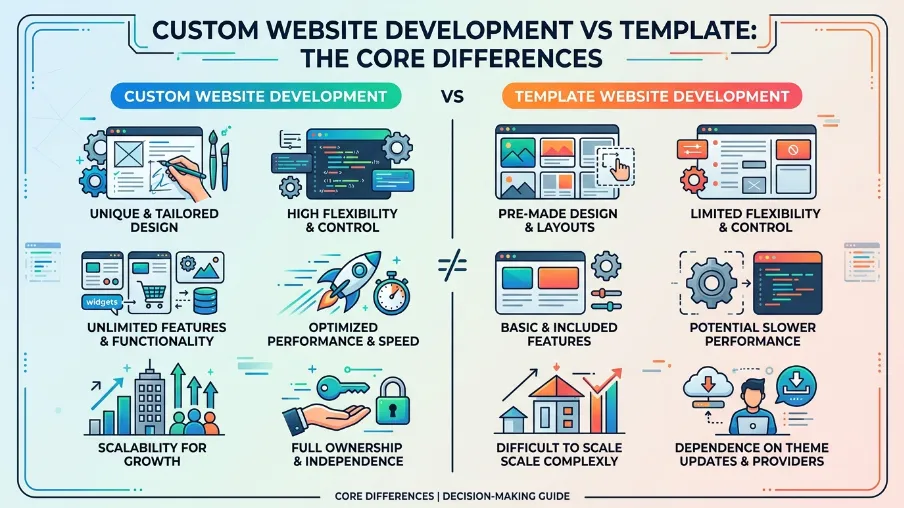
Here's a side-by-side look at what really separates the two.
1. Design and Branding
Template websites limit your design. You can change colors and fonts, but the layout stays boxed in. Thousands of other businesses may use the exact same theme. Your "unique" site starts to look like everyone else's.
Custom website design starts with your brand, not someone else's template. Every section, every button, and every animation is built around what your customers need to see. This is why serious brands move away from generic templates as they grow. A website that looks like a copy makes people trust you less, even if they can't say why.
If your goal is to design a modern website that actually feels current, custom is where you get there. Modern design isn't just trendy colors or a bold font. It's clean layout, smooth interaction, and a site that feels fresh instead of recycled from a theme marketplace.
2. Website Loading Speed Comparison
Speed is not just a "nice to have" anymore. It decides whether people stay or leave.
Template websites often carry extra code you never use. Extra plugins, unused scripts, and bloated themes slow the page down. Many template sites take far longer to load on mobile than they should.
A well-built custom website only loads what it needs. No extra baggage. That means faster pages, happier visitors, and better rankings on Google. A one-second delay in load time can noticeably hurt conversions, so this isn't a small detail. It's often the difference between a sale and a bounce.
3. Template vs Custom Website SEO
Do template websites rank well on Google? Sometimes, yes. A quality theme, set up properly, with good content, can rank fine for smaller keywords.
But custom websites still win where it counts most. You get full control over Core Web Vitals, clean HTML structure, proper heading hierarchy, and structured data. Templates often carry code you can't touch, which limits how deep your SEO (Search Engine Optimization) can go.
If you're chasing competitive keywords in a crowded market, custom-coded architecture gives you more room to win. If you just need a simple local page to show up in search, a good template can be enough.
4. Scalability: Scalable Custom Website vs Template
This is where most business owners get caught off guard.
A template feels perfect on day one. Then your business grows. You add new features. You need a booking system, a custom dashboard, or a unique checkout flow. Suddenly, the template can't keep up. You either hack around it or rebuild the whole site from zero.
A custom website is built to grow with you. Need a new feature next year? Your developer adds it. No platform lock-in. No fighting with theme limitations. This is the biggest reason growing businesses eventually move from templates to custom development.
5. Security and Ownership
With a template, you're often relying on third-party plugins and themes built by someone else. If that developer stops updating their code, your site becomes an open door for hackers. Many WordPress security issues come from outdated plugins, not the core platform itself.
With a custom website, you own the code completely. You control every update. You decide what goes in and what stays out. That ownership matters more than people realize, especially once your website starts handling customer data or payments.
This is really what fast and secure website development solutions come down to. Clean code means fewer weak points for hackers to find. When your developer builds every layer on purpose, security isn't an afterthought bolted on later. It's part of the foundation.
6. Maintenance and Updates
Template websites depend on the platform. If Wix or Squarespace changes its rules, your site changes with it, whether you like it or not.
Custom sites give you full control over website maintenance and updates. You're not stuck waiting on someone else's release schedule. Your developer can fix, update, or expand the site whenever your business needs it.
Either way, keep a simple website maintenance checklist on hand: check page speed monthly, update plugins and dependencies, back up your site regularly, test forms and links, and review security certificates. A custom site makes most of these steps easier, since you're not depending on a third party to push the fix for you.
Pros and Cons of Template Websites
Let's be fair. Templates aren't bad. They're just built for a different purpose.
Pros:
- Lower upfront cost
- Fast to launch, sometimes in days
- No coding needed
- Good for testing a new business idea
Cons:
- Limited design flexibility
- Slower page speed due to unused code
- Harder to scale as you grow
- Security risks from outdated plugins
- Looks similar to competitor sites
Benefits of Custom Website Development
Pros:
- Unique design built around your brand
- Faster loading speed
- Stronger SEO foundation
- Full ownership of your code
- Scales easily as your business grows
- Better long-term security
Cons:
- Higher upfront cost
- Longer build time
- Needs a skilled development team
Custom Website Cost vs Template Website Cost
This is usually the deciding factor, so let's talk numbers honestly.
Template websites can start free or cost a few hundred dollars for a premium theme. But that's rarely the full price. Add plugins, apps, hosting plans, and design tweaks, and the yearly cost adds up quietly.
Custom website development costs more upfront. Depending on complexity, a custom business website can run from a few thousand dollars into five figures for larger projects. It takes longer too, often several weeks instead of a few days.
Here's the part people miss. Template sites often need a redesign or a rebuild within a year or two as the business grows. Custom websites are built to last longer without a full rebuild. When you compare the five-year cost, not just the launch-day price, custom development often works out to be the smarter investment for serious businesses.
Simple way to think about it: if your website is a side project, a template saves you money. If your website is your main sales channel, a custom build protects your revenue.
Custom Website vs WordPress Template vs Website Builder
People often confuse these three, so let's clear it up.
- WordPress template: A pre-made theme installed on WordPress. Fast to launch, but shares limitations with the theme's original code.
- Website builder (Wix, Squarespace): Drag-and-drop tools with built-in templates. Great for beginners, but you're renting space on someone else's platform.
- Custom website: Built from the ground up, hosted wherever you choose, owned entirely by you.
If you want quick and simple, a website builder works. If you want long-term control, custom is the way to go.
Custom Website vs Template for Ecommerce
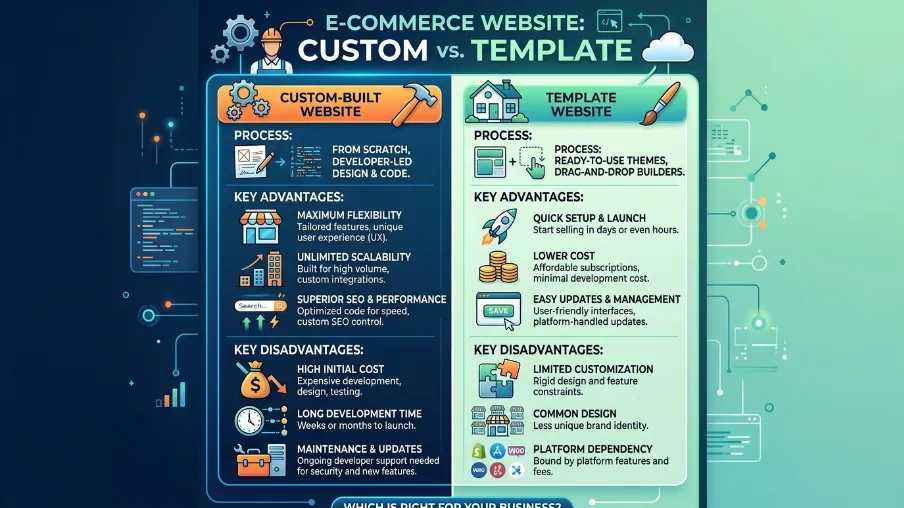
Ecommerce brings its own set of challenges. Product pages, checkout flow, payment gateways, inventory syncing, it all needs to work smoothly together.
Template ecommerce platforms like Shopify themes are great for getting started fast. But once your catalog grows past a few hundred products, or you need custom filtering, loyalty programs, or unique checkout logic, templates start to strain.
A custom ecommerce build gives you full control over the buying experience. That control often translates into higher conversion rates, since every step of the funnel is designed around how your actual customers shop, not a generic pattern.
Custom Website Design for Small Business and Startups
Small businesses often assume custom is out of reach. That's not always true.
If you're validating an idea or need a landing page fast, start with a template. There's no shame in that. Many successful companies launched on a simple template before scaling up.
But if your website is your main way of getting customers, and you plan to grow in the next year or two, custom website design for small business pays off sooner than people expect. You avoid the cost of rebuilding later, and you start ranking better from day one.
Which Is Better: Custom or Template Website
Honestly, there's no single right answer. It depends on where your business stands today.
Choose a template if:
- You need to launch this week
- Your budget is tight
- You're testing an idea before committing
- Your needs are simple: contact form, basic pages, a blog
Choose custom development if:
- Your brand needs to stand out
- You expect real growth in the next 1-2 years
- You need specific features like dashboards, calculators, or integrations
- SEO and page speed are core to your marketing
- Security and full ownership matter to you
A good rule of thumb: templates are for starting. Custom is for scaling.
When to Choose a Custom Website Development Company
If you've read this far, you probably already sense which side you lean toward. Here's a quick gut check.
Ask yourself:
- Will my website need to change a lot in the next year?
- Do I need features no template offers out of the box?
- Is my website my main source of leads or sales?
- Do I care about ranking well for competitive keywords?
- Am I building a brand people should remember?
If you answered yes to two or more, it's time to talk to a custom website development company instead of settling for a theme.
Not sure where your project stands? Our team at CyberCraft Bangladesh's website development service can review your goals and give you honest advice, not a sales script.
Final Thoughts
Your website is often the first thing a customer sees before they ever talk to you. That first impression matters more than most business owners realize.
Templates get you online fast. Custom websites get you online right, built to load fast, rank well, and grow with you instead of against you.
If you're still unsure which path fits your business, don't guess. Talk to people who build both, and can tell you honestly which one you actually need.
Ready to build a website that grows with your business? Get in touch with CyberCraft Bangladesh for a free consultation. We'll look at your goals, your budget, and your timeline, and tell you straight whether custom or template makes more sense for you.
Frequently Asked Questions About custom website vs template website
Is a custom website worth it for a small business?
Yes, if you plan to grow. A custom website costs more upfront but saves you from expensive rebuilds later. If you just need a simple online presence for now, a template can work in the short term.
Do template websites rank well on Google?
Yes, a well-set-up template can rank for less competitive keywords. But for stronger, long-term SEO, custom-coded sites give you more control over speed, structure, and technical details.
How much does a custom website cost compared to a template?
Templates can start from free to a few hundred dollars. Custom websites usually start in the low thousands and go up based on features. The real comparison should look at cost over several years, not just launch day.
Should I build a custom website or use a website builder like Wix?
Use a website builder if you want something simple and fast with no coding. Choose custom if you want full ownership, better performance, and room to grow without platform limits.
Is it better to buy a template or hire a developer?
Buy a template if your needs are basic and your timeline is short. Hire a developer if your website is central to your business and you want it built around your exact goals.

I’m Mitu Das, a JavaScript developer, ERP product architect, and SEO specialist from Bangladesh. I work at CyberCraft Bangladesh, where I help build simple, scalable software, SaaS platforms, and business solutions. My goal is to create technology that helps companies save time, automate daily tasks, and grow faster. I enjoy combining development, product ideas, and SEO strategies to create useful digital solutions for modern businesses.
Writes about
Want this done for you?
Our team builds and ships exactly what this article describes. Send a message and we will reply with a scope.