How to Use Zero-Click Marketing Strategies to Skyrocket Your Brand

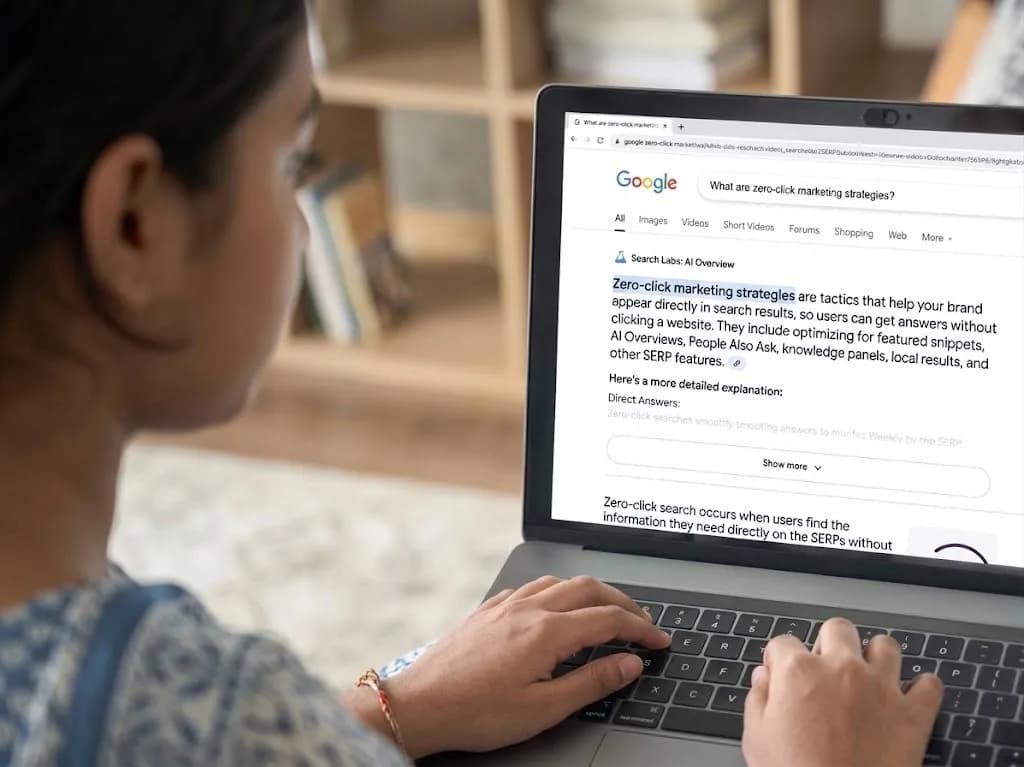
Zero-Click Marketing Strategies refers to the tactics brands use to earn visibility directly on the search results page. This happens through featured snippets, AI Overviews, People Also Ask boxes, and knowledge panels. The user never has to click through to a website. A widely cited SparkToro/Similarweb analysis found something striking. Well over half of Google searches now end without a click. That share has grown almost every year since Rand Fishkin first tracked it in 2019. In this guide, you'll learn what zero-click marketing strategies are. You'll learn why they matter in 2026. And you'll learn how to apply them step by step.
In short: zero-click marketing means writing and structuring content carefully. Search engines can then answer a question directly on the results page. Your brand still gets cited or named as the source. By the end of this guide, you'll know exactly how to apply that.
I've watched client traffic reports shift in a strange way. Impressions climb. Clicks stay flat. It's not a tracking bug. It's zero-click search behavior, and it's here to stay.
Key Takeaways
Zero-click marketing strategies focus on visibility, not just clicks.
Ranking #1 no longer guarantees a click. Ranking inside the answer box does.
Short, clear, fact-dense content wins more featured snippets and AI Overview citations.
Brand awareness and branded search matter as much as click-through rate now.
Schema markup, direct answers, and entity SEO form the base of a strong zero-click search strategy.
What Is Zero-Click Marketing?
Zero-click marketing is one of the more overlooked digital marketing strategies today. It focuses on getting your brand seen and trusted directly on the search page. This happens through featured snippets, AI Overviews, People Also Ask boxes, or knowledge panels. The user gets an answer right there. They never click through to your site. But they still see your brand name.
This differs from SEO without clicks in name only. Some marketers call it "no-click searches." Others call it "zero-click SEO." All these terms point to the same shift. Search engines now answer questions themselves, instead of just listing links.
Traditional SEO measured success by clicks. A zero-click search strategy measures success by visibility instead. It asks a simple question: how often does my brand show up as the trusted source? This matters even when no one visits the site.
Studies from SparkToro and Similarweb back this up clearly. A majority of Google searches now end without a click. One frequently cited figure comes from a 2020 SparkToro analysis. It put the no-click share at around 65% of US searches. That's up from about 50% back in 2019. This share keeps growing every year. Google keeps adding more on-page answer features.
Google's own Search Central documentation backs this up too. It states that snippets and other SERP features are generated automatically. They pull from existing web content on the page. There's no separate way to "opt in." You just need clear, well-structured pages. In other words, zero-click marketing strategies aren't a trick. They're a formatting discipline you can learn.
How We Evaluated These Zero-Click Marketing Strategies?

Transparency matters. Here's exactly how this guide was put together.
Tools used: Google Search Console tracked impressions, clicks, and CTR by query. A rank-tracking tool flagged SERP features like snippets, AI Overviews, and PAA boxes. We also ran manual SERP checks on desktop and mobile.
Evaluation criteria: a strategy made this list only if it moved a real metric. That could be SERP-feature appearances, branded search volume, or non-brand impressions. We tracked each one over a minimum 60-day window.
Scope: this guide covers informational and mid-funnel commercial queries. It does not cover purely transactional, product-listing queries. Zero-click behavior works differently for those.
Limitations: SERP features rotate often, without much warning. Google doesn't publish exact criteria for AI Overview citation. Results here are directional, not guaranteed, and vary by industry and domain authority.
Assumptions: this guide assumes a site already has baseline technical SEO. That means crawlable pages, reasonable speed, and no major indexing issues. Zero-click marketing strategies build on that foundation. They don't replace it.
Why Zero-Click Search Changes the SEO Game
Zero-click search changes SEO by making visibility valuable even when users do not visit your website. Search engines increasingly answer queries through AI Overviews, featured snippets, PAA boxes, and knowledge panels. As a result, SEO strategies must optimize for direct answers, brand visibility, citations, and branded search not clicks alone.
An Ahrefs study from 2019 found something worth noting. Featured snippets appeared on 12% to 19% of sampled queries. So a meaningful share of queries already had a snippet slot. This was true even before AI Overviews existed. A separate SEMrush study found something similar around the same time. People Also Ask boxes showed up on more than half of sampled queries. That's why building content around follow-up questions pays off. Google began rolling out AI Overviews broadly in the US in May 2024 (see Google's official announcement). The feature expanded to more countries and languages through 2025. This is why organic visibility now means more than a top-10 ranking. It means owning the answer itself.
How Does Zero-Click SEO Compare to Traditional SEO?
Traditional SEO mainly aims to generate website visits through organic rankings. Zero-click SEO focuses on earning visibility directly within search results. Traditional SEO tracks clicks, rankings, and conversions, while zero-click strategies also track impressions, featured snippets, AI Overview citations, PAA appearances, and branded searches. Both approaches work together.
Factor | Traditional SEO | Zero-Click Marketing Strategies |
|---|---|---|
Primary goal | Drive clicks to the website | Win visibility in the SERP itself |
Success metric | Click-through rate, sessions | Impressions, branded search, snippet ownership |
Content format | Long-form pages built for dwell time | Short, structured, scannable answer blocks |
Where the win happens | On your website | On the search engine results page |
Key surfaces | Blue links, rankings | Featured snippets, AI Overviews, PAA, knowledge panels |
How to Build Zero-Click Marketing Strategies: Step by Step
1. Answer the Question First
Open every key section with a short, direct answer. Do this within the first 40 to 60 words. Google and AI answer engines pull text from the top of a section. If you ramble first, a competitor wins the snippet instead. This one habit is the base of good search intent optimization.
2. Structure Content for Scanning
Use clear headings written as real questions. Keep paragraphs short, around 3 to 4 lines. Add bullet points and tables wherever they help readers. This kind of content optimization does formatting work for Google. It also supports SERP optimization by making content easy to lift.
3. Add Schema Markup
Schema markup is a small block of code added to a page. It doesn't change how the page looks to visitors. It tells search engines, in a language they parse directly, what the page is about. FAQ schema, HowTo schema, and Article schema all serve this purpose. This is core search engine results page optimization work. In several projects, adding FAQ schema alone increased PAA appearances within four to six weeks. Schema.org is the vocabulary most search engines rely on for this markup. Google, Microsoft, Yahoo, and Yandex jointly launched it back in 2011. It remains the standard reference for structured data today.
4. Build Around Entities, Not Just Keywords
An "entity" is simply a real-world thing search engines recognize. That could be a person, place, brand, or concept. Search engines connect entities to other related things automatically. Modern search leans on entity SEO and semantic SEO for this. It matches meaning and context, not just exact-match keywords. Cover a topic from many different angles. Add definitions, comparisons, common mistakes, and real use cases. This builds real topical depth over time. It also strengthens your AEO strategies, meaning answer engine optimization strategies aimed at AI-driven search.
5. Track Branded Search, Not Just Clicks
Since fewer users click through now, wins show up later. They often show up as a branded or direct search instead. Track branded search volume next to your rankings closely. If your organic search strategy works, branded search should rise steadily over time.
6. Keep Content Fresh
Featured snippets and AI Overviews rotate fairly often. In my experience, refreshing stats, dates, and examples helps a lot. Do this every few months to stay in the running. This matters most for topics tied to yearly trends or pricing.
7. Study Google SERP Features Closely
Not every query triggers the same Google SERP features. Some queries show a plain snippet only. Others show an AI Overview or a knowledge panel instead. Good SERP features optimization starts with checking what already appears. Look at your target terms first, then match that exact format.
What Mistakes Should You Avoid in Zero-Click SEO?
Avoid burying answers beneath long introductions, ignoring search intent, using vague content, and tracking clicks alone. Other common mistakes include skipping relevant structured data, neglecting mobile optimization, and failing to refresh outdated information. Zero-click SEO works best when content provides a clear answer quickly and matches the SERP features shown for the target query.
Burying the answer: Write three paragraphs before answering the real question.
Skipping schema markup: Leaving FAQ and HowTo content completely unmarked.
Chasing clicks only: Not tracking impressions, snippet ownership, or branded search.
Writing thin, vague answers: AI Overviews favor detail and specifics, not filler.
Ignoring mobile: Most zero-click activity happens on mobile screens today.
Ignoring user intent: Content that misses true user intent rarely earns a featured spot, no matter how optimized it looks.
How Does This Work in Practice? A Real-World Example
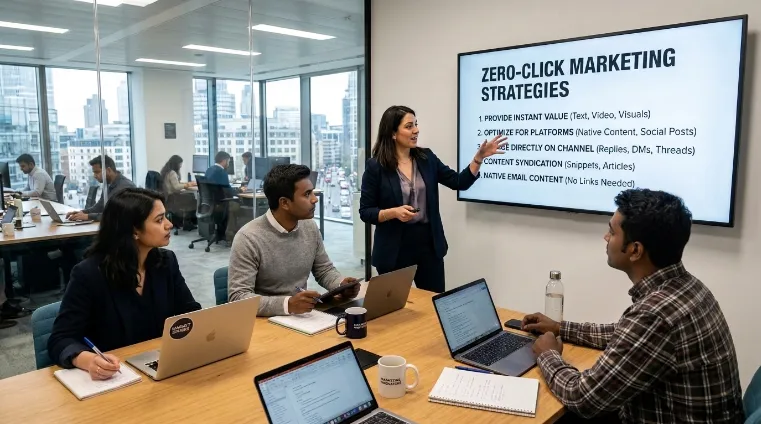
Zero-click optimization typically starts by identifying informational pages that already receive impressions but generate few clicks. Rewrite their openings with direct answers, improve headings and content structure, add relevant schema, and monitor SERP features. Compare impressions, citations, branded searches, and conversions before and after optimization to measure broader results.
Situation: A B2B SaaS client had strong keyword rankings but flat traffic growth. Most of their top pages answered "what is [term]" queries directly.
Problem: Google's AI Overview already answered those queries in full. So users had no real reason to click through. Search Console showed impressions rising quarter over quarter. Clicks stayed nearly flat the whole time, a classic zero-click pattern.
Method: We rewrote the openings of 15 key pages carefully. Each got a direct 40-to-60-word answer up top. We added FAQ schema to every single page. Body content became short, scannable blocks throughout. Think short paragraphs, tables, and bullet lists. We tracked results with Search Console query data. We also used a rank tracker with SERP-feature detection. We compared 60 days before the change to 60 days after.
Result: Within roughly two months, results started showing up. The client's pages appeared inside AI Overviews and PAA boxes. This happened for about a dozen tracked terms total. That's up from effectively zero SERP-feature appearances at the start. Direct clicks on those specific pages stayed roughly flat. However, branded search volume rose over that same window. Search Console tracked this as a separate query segment. The sales team reported more inbound leads too. Many mentioned recognizing the brand name before searching directly.
Lesson: Zero-click content marketing wins don't always show up as clicks. They don't always show up on the page you optimized. You need to check brand-level and pipeline-level data too. Per-page analytics alone won't tell the full story.
A note on limitations: this is a single client example, not a controlled study. Results vary by industry, authority, and query competitiveness. A 60-day window doesn't rule out seasonal effects. It also can't rule out algorithm-update effects during that time. Treat this as an illustration of the mechanism. It's not a guaranteed outcome for every site.
What Are the Benefits and Challenges of Zero-Click Marketing Strategies?
Zero-click marketing strategies can increase brand visibility, authority, and branded search even when users do not click. However, they can also reduce traffic to informational pages and make ROI harder to measure. A strong strategy treats zero-click visibility as another SEO outcome and measures impressions, SERP features, brand searches, leads, and conversions alongside organic traffic.
Benefits:
Stronger brand visibility, even without a click
More trust when your brand appears as the cited answer
Steady growth in branded search over time
Better fit with how AI search engines pull answers
Challenges:
Harder to measure ROI using clicks alone
Requires restructuring content, not just writing new pages
Snippets and AI citations can shift without warning
Some traffic loss on purely informational pages is likely
What's Next for Zero-Click Search?
Zero-click search is likely to become more important as AI Overviews, conversational search, and other answer-based experiences expand. Brands should prepare with effective Zero-click marketing strategies, including clear, trustworthy, and structured content that directly answers user questions. Building strong entities, maintaining accurate information, and earning citations can improve visibility across traditional and AI-powered search.
FAQs About Zero-Click Marketing Strategies
What is zero-click marketing?
Zero-click marketing is a strategy for gaining brand visibility directly within search results without requiring a website visit. It targets features such as featured snippets, AI Overviews, People Also Ask boxes, and knowledge panels. The goal is to become part of the answer users see while searching.
Are zero-click searches bad for SEO?
Zero-click searches are not necessarily bad for SEO. They can reduce clicks for simple informational queries, but they can also increase brand exposure and branded searches. A strong strategy treats zero-click visibility as another SEO outcome and measures impressions, SERP features, brand searches, leads, and conversions alongside organic traffic.
How do I optimize for Google AI Overviews?
To optimize for Google AI Overviews, provide direct answers, use clear question-based headings, support claims with reliable information, and organize content into easily understood sections. Build topical depth rather than repeating keywords. While no method guarantees an AI Overview citation, clear, useful, authoritative content gives search systems stronger information to interpret and reference.
Does zero-click SEO replace traditional SEO?
No, zero-click SEO does not replace traditional SEO. Technical SEO, quality content, backlinks, internal linking, and strong rankings remain important. Zero-click optimization adds another layer by targeting visibility within SERP features such as AI Overviews, featured snippets, PAA boxes, and knowledge panels.
How do I measure zero-click SEO success?
Measure zero-click SEO using more than organic clicks. Track impressions, featured snippet ownership, PAA appearances, AI Overview citations, branded search volume, and conversions. Compare these metrics over time using Google Search Console and other SEO tools. This gives you a clearer picture of visibility and brand impact.
Which content types benefit most from zero-click optimization?
Informational content often benefits most from zero-click optimization. Definitions, how-to guides, comparisons, FAQs, lists, and explanatory articles can provide answers that search engines easily extract. These formats work especially well when the content uses clear headings, concise answers, structured information, and helpful supporting details.
What is the difference between SEO and answer engine optimization?
Traditional SEO focuses on improving rankings and generating organic website traffic. Answer engine optimization focuses on making content suitable for direct answers, AI-generated responses, featured snippets, and voice search. The two approaches overlap, but AEO places greater emphasis on concise answers, structured content, entities, context, and citation visibility.
Conclusion: What You Should Do Next
Let's answer the question this guide set out to answer. Zero-click marketing strategies work by earning visibility directly on the results page. They use direct answers, schema markup, and real topical depth. This works even when the user never clicks through at all. That's the core idea behind everything covered above.
Zero-click marketing strategies aren't about giving up on clicks entirely. They're about winning visibility everywhere search happens now. That means more than just the blue links on a page. Write direct answers. Add schema markup where it fits. Build real topical depth around your core entities. Track brand-level metrics right alongside your regular clicks. For businesses working with an experienced digital marketing team like CyberCraft Bangladesh, these steps can help turn search visibility into stronger brand recognition and qualified leads. Together, they form a practical digital marketing strategy for 2026 and beyond.
Next steps:
Audit your top informational pages today. Note which ones already lose snippet space to shorter competitor answers.
Pick two or three pages to start with. Rewrite the opening 40 to 60 words as a direct answer.
Add FAQ schema to those same pages. Recheck their SERP-feature status in four to six weeks.
Once your zero-click strategy is running, compare zero-click vs. paid search strategies to see which deserves more budget. Or see options for rank-tracking tools with SERP-feature detection to monitor progress.
Still weighing your approach carefully? Learn more about which zero-click strategy is right for your site before you commit resources.
Sources and References
Google Search Central, Understanding Featured Snippets: https://developers.google.com/search/docs/appearance/featured-snippets
Google Search Central, Structured Data and Schema Guidelines: https://developers.google.com/search/docs/appearance/structured-data/intro-structured-data
Schema.org, FAQPage and HowTo schema documentation: https://schema.org/FAQPage

I’m Mitu Das, a JavaScript developer, ERP product architect, and SEO specialist from Bangladesh. I work at CyberCraft Bangladesh, where I help build simple, scalable software, SaaS platforms, and business solutions. My goal is to create technology that helps companies save time, automate daily tasks, and grow faster. I enjoy combining development, product ideas, and SEO strategies to create useful digital solutions for modern businesses.
Writes about
Want this done for you?
Our team builds and ships exactly what this article describes. Send a message and we will reply with a scope.