
Magento vs Shopify for Enterprise: Honest Comparison You Need in 2026

Picking a platform for a big store is scary. One wrong move and you're stuck with a slow site, a huge bill, or a rebuild in two years. I get it. I've watched teams agonize over this exact choice.
So let's talk straight. If you're weighing Magento vs Shopify for enterprise, you're probably looking for more than a feature checklist. You need to know what each platform will actually cost, how it scales, and which option will better support your digital growth. This guide compares Magento vs Shopify Plus for enterprise brands. No fluff. Just real numbers, real trade-offs, and a clear answer for your situation.
By the end, you'll know which platform fits your budget, your team, and your growth plans, so you can make a confident decision that supports long-term digital growth. Let's dig in.
Magento vs Shopify for Enterprise
Here's the short version, since I know you're busy.
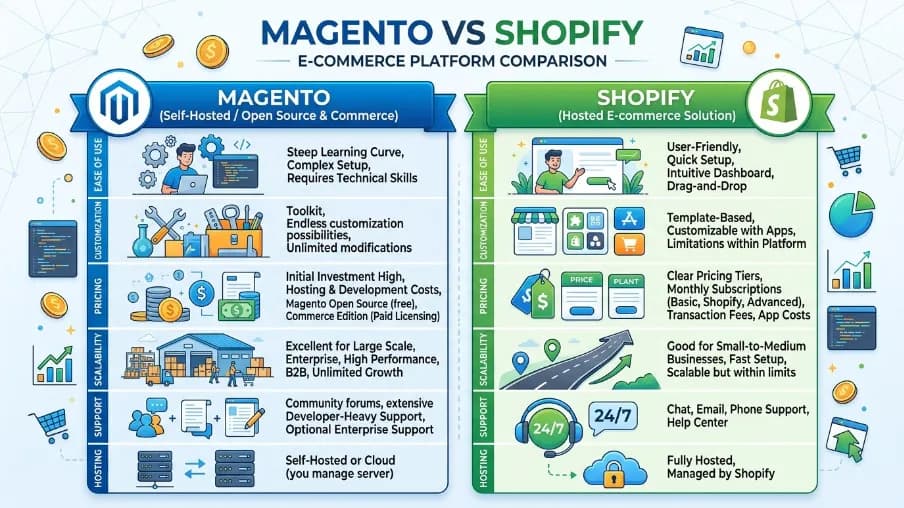
Shopify Plus is the better pick if you want speed to launch, low maintenance, and a managed platform. You pay a predictable fee and let Shopify handle hosting, security, and uptime.
Adobe Commerce (Magento) is the better pick if you need deep customization, complex B2B logic, or full control over your infrastructure. You pay more in development and hosting, but you own the whole stack.
If your team is small and you want to move fast, go Shopify Plus. If you have an in-house dev team and unique business rules, go Adobe Commerce. Now let's look at why.
What "Enterprise Ecommerce" Actually Means
Before we compare platforms, let's define the term. Enterprise usually means:
- $5 million or more in annual revenue
- Complex catalogs with thousands of SKUs
- Multiple stores, currencies, or brands
- B2B and B2C selling from one system
- Integration with ERP, CRM, and PIM tools
If this sounds like your business, this guide is for you. If you're under $1 million in revenue, both platforms may be overkill. Standard Shopify or Magento Open Source might suit you better.
Magento vs Shopify Plus Pricing: The Real Numbers
Let's talk money first. This is where most buyers get surprised.
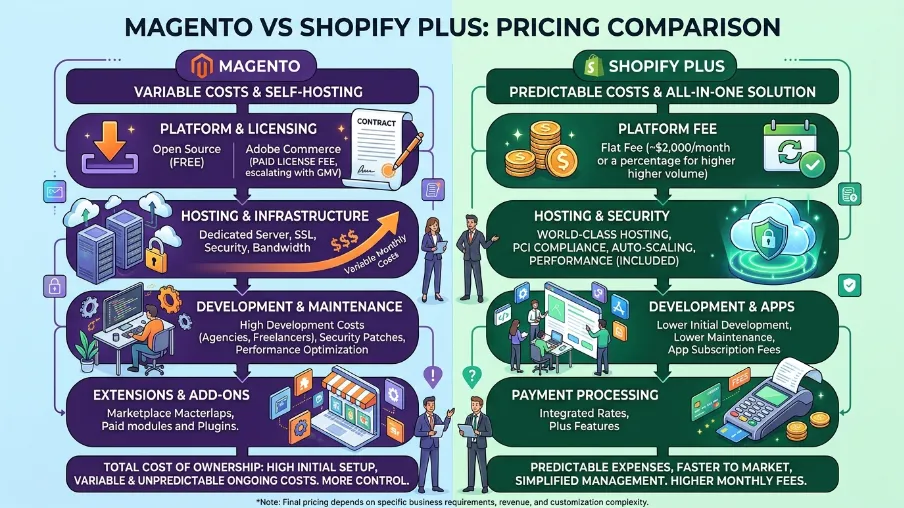
Adobe Commerce Enterprise Pricing
Adobe doesn't publish a fixed price. Adobe Commerce pricing is quote-based and tied to your Gross Merchandise Value (GMV). Based on current market data, here's what to expect:
- License fee: Roughly $22,000 to $125,000+ per year, depending on your GMV
- Adobe Commerce Cloud (managed hosting): Roughly $40,000 to $190,000+ per year for high-GMV stores
- Implementation: $100,000 to $500,000+ for a full enterprise build
- Ongoing maintenance: $4,000 to $50,000+ per year depending on complexity
Magento Open Source, the free version, has no licensing fees. But you still pay for hosting, development, and extensions. That can range from $5,000 to $90,000+ per year for enterprise-grade setups. So "free" rarely stays free once you scale.
Shopify Plus Enterprise Pricing
Shopify Plus is more transparent, but it's not a flat fee either.
- Base subscription: Around $2,300 to $2,500 per month on standard contracts
- Variable fee: Once your monthly GMV crosses roughly $1 million, Shopify shifts to a revenue-share model, often around 0.25% of GMV
- Apps: A mature Shopify Plus app stack often runs $1,000 to $15,000 per month
- Implementation: $50,000 to $500,000+ depending on design and integration complexity
For most mid-size enterprise brands, real all-in Shopify Plus cost lands somewhere between $4,000 and $25,000 per month once you add apps, payments, and development.
Magento vs Shopify Total Cost of Ownership
Here's the honest takeaway on Magento vs Shopify total cost of ownership. Adobe Commerce usually costs more upfront and needs a bigger dev team. Shopify Plus costs less to start but adds up through apps and transaction fees as you scale.
If you're comparing year-one cost only, Shopify Plus often wins. If you're comparing five-year cost with heavy customization, the gap narrows. Some agencies report Shopify running close to 30% lower TCO than Adobe Commerce for comparable stores. Your actual number depends on how custom your build needs to be.
Adobe Commerce vs Shopify Plus: Feature Comparison
Price is only half the story. Let's talk features.
Customization and Flexibility
Adobe Commerce wins here, hands down. It's open architecture. You can rebuild almost any part of the platform. This matters if you have unique pricing rules, complex product configurators, or a workflow no other platform supports.
Shopify Plus gives you Checkout Extensibility and Shopify Functions. These let you customize checkout and business logic without breaking on every platform update. It's more limited than Magento, but it's improved a lot in the last two years.
Magento vs Shopify Performance Comparison
This one surprises people. Shopify runs on a global, managed cloud. It handles massive traffic spikes without you lifting a finger. Shopify Plus advertises the ability to process thousands of checkouts per minute during peak sales events.
Magento performance depends entirely on your hosting and optimization. A well-built Adobe Commerce Cloud store can be just as fast. A poorly optimized Magento store can be painfully slow. The difference is effort. Shopify gives you speed by default. Magento gives you speed if you invest in it.
Magento vs Shopify Scalability
Both platforms scale. But they scale differently.
Shopify Plus scales vertically through Shopify's own infrastructure. You don't manage servers. You just grow, and Shopify handles the load.
Adobe Commerce scales through architecture choices you control. You can add servers, tune databases, and go headless. This gives you more control, but it also means more responsibility.
If your team wants scale without ops work, pick Shopify. If your team wants full control over how you scale, pick Adobe Commerce.
B2B Ecommerce Platform: Magento vs Shopify
B2B is a big deal for enterprise brands. Let's compare.
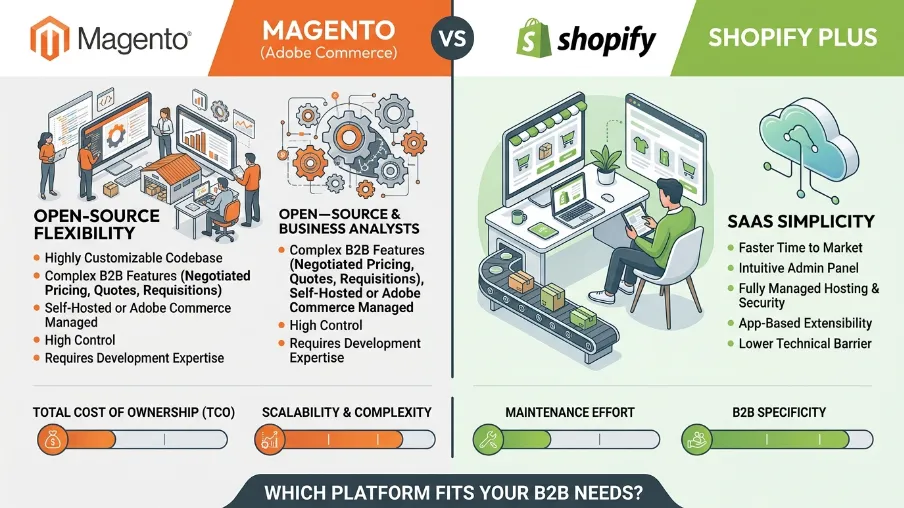
Adobe Commerce has native B2B tools built in. This includes company accounts, custom catalogs, quote requests, and negotiated pricing. It's been a B2B platform for years, so the depth here is real.
Shopify Plus added native B2B functionality directly into the core platform. It now supports wholesale pricing, company profiles, and payment terms without extra apps. It's newer than Magento's B2B tools, but it's closing the gap fast, and it's much easier to set up.
If you run complex B2B logic with many pricing tiers and approval workflows, Adobe Commerce still has an edge. If you want B2B and B2C running smoothly from day one with less setup time, Shopify Plus is compelling.
Headless Commerce: Magento vs Shopify
Going headless means separating your frontend from your backend. Both platforms support it.
Magento offers headless through its GraphQL API and Adobe's App Builder. This gives deep flexibility for custom frontend frameworks.
Shopify offers headless through the Storefront API and Hydrogen, Shopify's own framework for building custom storefronts. It's fast to set up and well documented.
Honestly, both are solid here. The choice comes down to your dev team's comfort level and what frontend stack they already know.
Multi-Store and Multi-Brand Management
If you run several brands or regions, this section matters.
Adobe Commerce lets you manage many websites, stores, and store views from one install. This is powerful for large multi-brand companies with different catalogs and currencies.
Shopify Plus includes multiple expansion stores in your contract, usually up to nine or ten. Each store can have its own domain, currency, and language. It's simpler to set up than Magento's multi-store system, though less deeply configurable.
Magento vs Shopify SEO Comparison
Good news. Both platforms can rank well. SEO success depends more on your content and technical setup than the platform itself.
Magento gives you more control over URL structure, schema markup, and page-level technical SEO. This flexibility is great, but it also means more can go wrong if it's not configured properly.
Shopify has improved its SEO tools a lot. It handles core technical SEO like sitemaps, canonical tags, and mobile speed well out of the box. It's more locked down, so you have less room to break things, but also less room for deep customization.
For most enterprise brands, either platform can support strong SEO with the right team behind it.
Magento vs Shopify Checkout Customization
Checkout is where conversions live or die. Here's the real difference.
Adobe Commerce gives you full checkout control. You can rebuild the entire flow however you want.
Shopify's checkout used to be the biggest limitation. That changed with Checkout Extensibility, which lets Plus merchants add custom fields, upsells, and logic directly into Shopify's checkout. It's not unlimited, but it covers most enterprise use cases now.
Migration: Magento vs Shopify
Thinking about switching platforms? A Magento vs Shopify migration is a big project. Plan for:
- Data migration: products, customers, and order history
- Design rebuild: themes don't transfer between platforms
- App and integration mapping: find Shopify equivalents for your Magento extensions
- SEO redirects: protect your rankings during the switch
- Testing: run both systems in parallel before full cutover
Most enterprise migrations take three to eight months. Budget time for this. Rushing a migration is how brands lose traffic and revenue.
Real-World Case Studies
Numbers only tell half the story. Let's look at real patterns.
Large fashion and consumer brands using Adobe Commerce often cite complex catalog logic and deep B2B needs as their main reason for staying. They've invested years into custom modules, and switching would mean rebuilding that logic elsewhere.
Brands on Shopify Plus, including well-known names in consumer goods and apparel, often point to faster time-to-market and lower ops overhead as the reason they picked it. Many launched in weeks instead of months.
The pattern is clear. Brands with heavy customization needs tend to stick with Magento. Brands that value speed and simplicity tend to pick Shopify Plus.
Shopify Plus vs Custom Ecommerce Platform
Some enterprise teams also consider building a fully custom platform or using Salesforce Commerce Cloud. Here's a quick gut check.
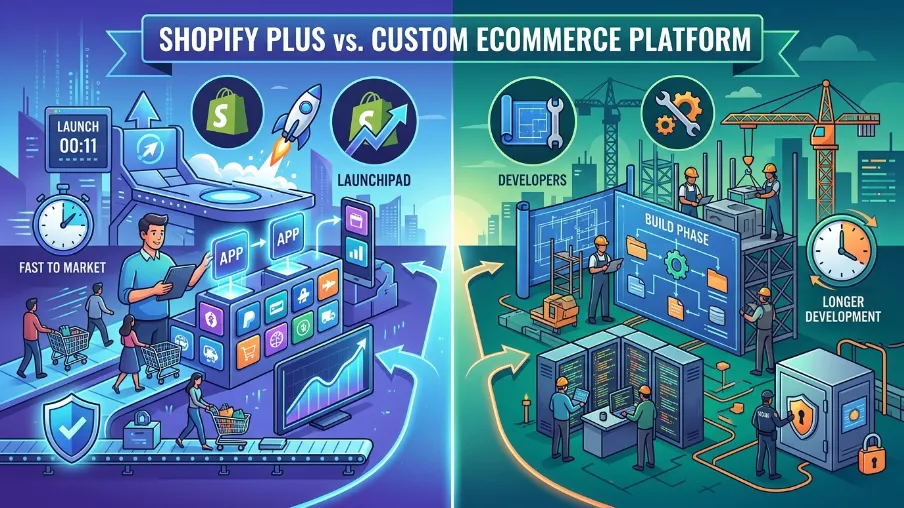
A custom platform gives unlimited flexibility but costs the most and takes the longest to build. Salesforce Commerce Cloud sits in a similar price range to high-end Adobe Commerce Cloud contracts, often reaching into six or seven figures a year.
For most enterprise brands, Magento and Shopify Plus offer the best balance of power and practicality. Fully custom builds make sense only for the largest, most unique operations.
How to Choose: A Simple Decision Framework
Ask yourself these three questions when evaluating magento vs shopify for enterprise.
- Do you have an in-house dev team or agency retainer? If yes, Adobe Commerce becomes realistic. If no, Shopify Plus removes that burden.
- Do you need deep custom logic that no app can solve? If yes, lean Magento. If your needs are common ecommerce patterns, Shopify Plus likely covers them.
- How fast do you need to launch? Shopify Plus implementations often complete in weeks. Magento builds often take months. If speed matters, that's a big factor.
What If You're Not an Enterprise Yet
Maybe you read all this and thought, "I'm not there yet. I just want to start an online store without a six-figure budget." That's fair, and it's a smart question to ask before you commit to either platform.
Not every business needs Adobe Commerce or Shopify Plus on day one. If you're still building your brand, an affordable e-commerce website development approach makes more sense. Standard Shopify plans, Magento Open Source, or a lean custom build can get you selling fast, without the enterprise price tag. You can always migrate up to Adobe Commerce or Shopify Plus later, once your revenue and complexity justify the jump.
The key is choosing a partner who understands both ends of the spectrum. A good agency won't push you into an enterprise platform before you need one, and it won't leave you stuck on a system you'll outgrow in a year.
The E-Commerce Website Development Process, Step by Step
Whether you're launching your first store or migrating a large enterprise catalog, the e-commerce website development process follows a similar path. Here's what it looks like in practice:
- Discovery and planning: We look at your products, your budget, and your growth goals to recommend the right platform.
- Design: We build a storefront that matches your brand and makes buying easy.
- Development: We build out the store, connect payment gateways, and set up your catalog.
- Integrations: We connect your ERP, CRM, or inventory tools so data flows automatically.
- Testing: We check speed, checkout flow, and mobile experience before launch.
- Launch and support: We go live, then monitor performance and fix issues fast.
This process stays the same whether you're on a lean budget or running a multi-million-dollar enterprise catalog. What changes is the depth of customization and the platform you build on.
Final Thoughts
There's no single winner here. It depends on your business. Pick Shopify Plus if you want a managed platform, fast launch, and lower ongoing dev burden.
Pick Adobe Commerce (Magento) if you need deep customization, complex B2B rules, and full control over your stack.
Whatever you choose, don't decide on price alone. Look at your team, your growth plans, and your must-have features first.
If you're still not sure which platform fits your business, I can help. At CyberCraft Bangladesh, we support brands at every stage, from helping a founder start an online store on a lean budget, to guiding established enterprises through a full Magento vs Shopify Plus migration. We follow a clear e-commerce website development process from discovery through launch, and we always recommend the platform that fits your budget and goals, not the one that pays us the most.
Whether you need an affordable e-commerce website development plan to get started or an enterprise build that can handle millions in GMV, talk to our ecommerce team and get a clear, honest recommendation. No guessing. Just the right platform for your growth.
Frequently Asked Questions About Magento vs. Shopify for Enterprise
Is Shopify Plus good enough for enterprise brands?
Yes. Shopify Plus is built specifically for high-growth and enterprise brands. It handles high traffic, supports B2B selling, and includes automation tools that many large companies rely on daily.
Is Adobe Commerce more expensive than Shopify Plus?
Usually, yes. Adobe Commerce license fees alone often start around $22,000 per year and climb with revenue. Add hosting and development, and total cost often lands higher than Shopify Plus for comparable stores.
Can Magento Open Source work for an enterprise store?
It can, but it takes more work. Magento Open Source has no license fee, but you handle hosting, security, and every feature build yourself. Most true enterprise stores eventually need Adobe Commerce's built-in tools.
Which platform is better for B2B selling?
Adobe Commerce has deeper native B2B tools built over many years. Shopify Plus has closed much of that gap and is easier to set up for combined B2B and B2C selling.
How long does a Magento vs Shopify migration take?
Most enterprise migrations, in either direction, take three to eight months. The timeline depends on catalog size, integrations, and how custom your current setup is.

I’m Mitu Das, a JavaScript developer, ERP product architect, and SEO specialist from Bangladesh. I work at CyberCraft Bangladesh, where I help build simple, scalable software, SaaS platforms, and business solutions. My goal is to create technology that helps companies save time, automate daily tasks, and grow faster. I enjoy combining development, product ideas, and SEO strategies to create useful digital solutions for modern businesses.
Writes about