
Why UI/UX Design Matters for Business Growth (2026)

.webp&w=3840&q=75)
When was the last time you left a website because it felt confusing? Maybe the buttons didn't work right. Maybe you couldn't find the "buy now" option. Maybe the page just felt... off.
You didn't complain. You didn't email support. You just left.
That's the moment I want to talk about. Because that one quiet decision, the one where a visitor closes your tab and goes to a competitor instead, happens millions of times a day, across every industry. And most business owners never see it happen. They just see the sales numbers drop and wonder why.
I've spent years watching companies obsess over ads, SEO, and content, while ignoring the one thing that decides whether any of that traffic actually converts: the experience people have once they land on the page. That's UI/UX design. And it's not a design detail. It's a growth lever.
At CyberCraft Bangladesh, we've sat in these conversations with clients more times than I can count. A founder shows us a healthy ad budget and a solid product, but conversions are flat. Nine times out of ten, the problem isn't the offer. It's the three extra clicks between "interested" and "paid customer." That's the pattern this article is built on, not theory, but what we actually see when we redesign a client's flow and watch the numbers move.
In this article, I'll walk you through why UI/UX design matters for business growth, what the real numbers say about UX design ROI, how it affects conversion and retention, and what's changing in 2026. By the end, you'll know exactly why this isn't a "nice to have" anymore.
Key takeaways:
- UI/UX design matters for business growth because it directly shapes conversion rate, retention, and brand trust.
- Forrester found every $1 spent on UX design can return up to $100, a 9,900% ROI.
- Design-led companies grow revenue about 2x faster than industry peers, per McKinsey.
- 88% of users won't return to a site after one bad experience.
- Startups and small businesses often gain the most from good UX, since they have less brand trust to fall back on.
What Is UI/UX Design
Let's clear this up first, because people mix these terms up all the time.
UI (User Interface) is what your product looks like. Colors, buttons, fonts, spacing, layout. It's the visual skin of your app or website.
UX (User Experience) is how your product feels to use. Is it easy? Is it fast? Does it make sense? UX covers the whole journey, from the first click to the final purchase.
Here's a simple way to remember the difference between UI and UX design: UI is the look. UX is the feel. You need both. A beautiful interface with a confusing flow will still lose customers. And a smooth flow with an ugly interface will make people doubt your brand before they even read a word.
Together, UI and UX design shape one thing: trust. And trust is what turns a visitor into a paying customer.
Why UI/UX Design Drives Business Growth
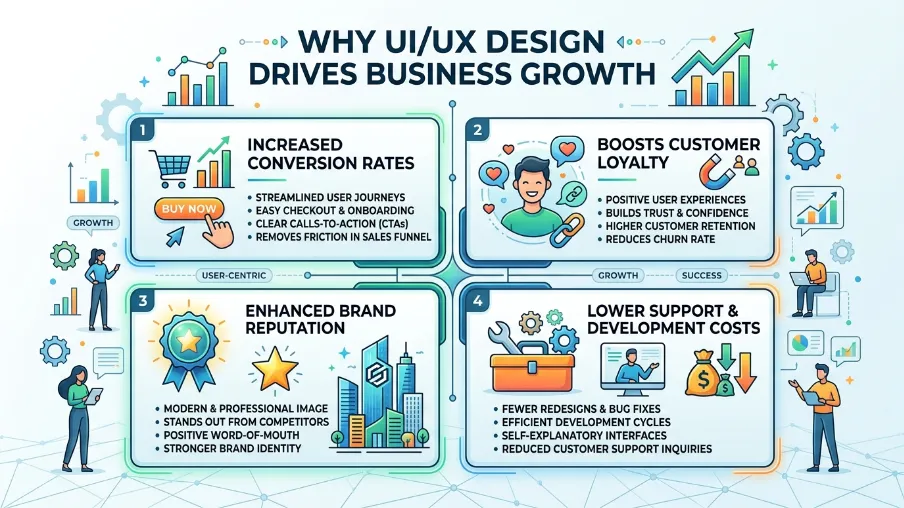
Here's the direct answer, since I know some of you just want this part first.
UI/UX design matters for business growth because it directly affects conversion rates, customer retention, and brand trust, the three things that decide whether your revenue goes up or down. Good design removes friction. Bad design creates it. And friction is the number one silent killer of online sales.
Research backs this up in a big way. Forrester's well-known study found that every $1 invested in UX design can return up to $100, which works out to a 9,900% ROI. That's not a typo. That's one of the highest returns you'll find in any part of a business.
And it's not a one-off stat. McKinsey's research on design-led companies shows they deliver about 2x the revenue growth of their industry peers, along with lower customer acquisition costs. Companies that lead in design have also outperformed the S&P 500 by 228% over a ten-year stretch.
So when I say UI/UX design importance for businesses isn't just a designer's opinion, I mean it. It's measurable. It shows up in the balance sheet.
The Real ROI of UI/UX Design
Let's talk numbers, because numbers make the business case easier to sell to your team or your boss.
- Conversion lift: A well-executed UI can boost conversion rates by around 200%, while strong UX can push that up to 400%.
- Revenue growth: Design-focused companies see about 32 percentage points higher revenue growth and 56 points higher shareholder returns than the rest of their industry.
- Retention gains: Businesses that run continuous UX testing can improve revenue retention by up to 10.8% over three years.
- Speed matters too: Sites that load in one second convert about three times better than sites that take five seconds.
I know these numbers sound almost too good. But think about it logically. If your checkout page confuses people, you lose sales every single day, forever, until you fix it. If you fix it once, you keep that extra revenue every single day, forever, too. That's why UX design ROI compounds. It's not a one-time win. It's a permanent shift in your conversion baseline.
How Good UX Increases Conversion Rate
Conversion rate is where UX design shows up most clearly. Here's how it actually plays out on a real website or app.
1. Clear navigation removes decision fatigue: When people can't find what they need in a few seconds, they leave. A clean menu, obvious buttons, and a logical layout keep them moving toward checkout instead of away from it.
2. Fewer steps mean fewer drop-offs: Every extra field in a form, every extra click before checkout, is a chance for someone to give up. Cutting steps is one of the fastest ways to lift conversions.
3. Speed builds patience: Slow pages test people's patience before they even see your offer. A fast, responsive interface keeps attention long enough for your product to make its case.
4. Trust signals reduce hesitation: Clear pricing, visible reviews, secure checkout badges, these all live inside good UX design. They quietly answer the doubts in a buyer's head before those doubts become an exit.
There's a real example that gets shared often in the UX world. A retailer forced users to create an account before checkout. That single choice cost them buyers. When they let people check out as guests instead, just by changing a button, they added around $300 million in additional sales. One button. Hundreds of millions in impact. That's the kind of leverage we're talking about with UX design conversion optimization.
UI/UX Design and Customer Retention
Getting a customer once is one win. Keeping them is the bigger one. And this is where UI/UX design quietly does its best work.
Think about the apps and sites you use every week without thinking twice. They feel familiar. Predictable. Easy. That comfort is not an accident. It's designed.
Research from Maze shows that improving the experience can lift retention by around 42%, while a single bad interaction can push away as many as 88% of users for good. Read that twice. Most people don't complain about a bad experience. They just quietly stop coming back.
This is also how UX design builds brand trust. Every smooth interaction is a small deposit into a customer's confidence in your brand. Every confusing one is a withdrawal. Do this enough times, and customers start associating your brand with reliability, which matters far more in a market full of near-identical options.
The Cost of Bad UX Design for Business
I want to be honest about the other side of this too, because ignoring UX doesn't mean nothing happens. It means something expensive happens quietly.
- 88% of users say they won't return to a site after a bad experience.
- 70% of online businesses fail, at least partly, due to usability issues.
- Fixing a UX problem after launch can cost roughly 100 times more than fixing it during the design stage.
- Users form an opinion about a site in about 3.5 seconds, and most of that first impression comes from visual design, not content.
Here's the part that stings the most. Bad UX doesn't usually look dramatic. Your site still loads. Your app still technically works. But every day, people quietly bounce, and you never get a clear reason why. That silent bleed is the true cost of bad UX design for business, it doesn't show up as a single crisis. It shows up as a slow, steady leak in your revenue that's easy to miss until a competitor with a smoother experience starts pulling your customers away.
Why UI/UX Design Matters for Startups and Small Businesses
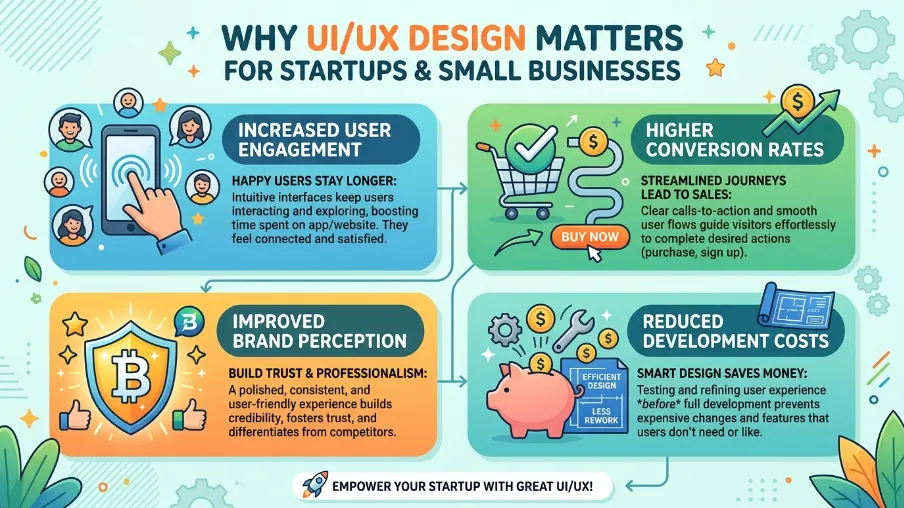
If you're running a startup, I get it, budget is tight, and design can feel like something you'll "get to later." I'd push back on that gently.
For startups, UI/UX design importance for businesses is even higher, not lower. Here's why:
- You don't have brand loyalty yet. First impressions carry more weight when people don't already trust your name.
- You're competing against funded companies with polished products. A clunky experience makes you look smaller and riskier than you are.
- Every visitor costs you money through ads or outreach. Wasting that traffic on a confusing site is money burned.
- Small, early fixes are cheap. Fixing UX problems after you scale is far more expensive, both in dev time and in lost customers.
This is also true for small business growth in general, not just tech startups. A local service business with a clean, easy-to-book website will out-convert a competitor with a cluttered one, even if the competitor has been around longer.
UI/UX Design in Ecommerce
Ecommerce deserves its own quick mention, because here UX and revenue are directly, almost mathematically, connected.
Every screen in an online store is a decision point, product page, cart, shipping info, payment. A well-designed interface alone can lift conversions by 200%, while a strong overall experience can lift them by up to 400%. That's not a small edge in a market where margins are already thin.
Checkout friction is the biggest culprit. Extra form fields, forced account creation, unclear shipping costs, each one adds a reason to abandon the cart. Ecommerce UX design benefits show up fastest right here, in the space between "add to cart" and "order confirmed."
UI/UX Trends 2026: What's Changing
Design doesn't stand still, and 2026 is bringing some real shifts worth knowing about if you're planning a redesign.
- Calmer interfaces: After years of flashy animation and heavy visual effects, 2026 is leaning toward simpler, lower-effort experiences that reduce mental load instead of adding to it.
- AI as a quiet helper, not a takeover: The trend now is AI that supports a task in the background, suggesting, assisting, rather than AI that tries to run the whole show.
- Accessibility as standard, not extra: High-contrast design, screen reader support, and keyboard navigation are becoming baseline expectations, not bonus features.
- Mobile-first, no exceptions: With most web traffic now coming from phones, mobile experience often needs more attention than desktop.
- Purposeful motion: Animation in 2026 is used to guide attention and confirm actions, not just to look impressive.
If you're planning any kind of digital project this year, these UI/UX design trends for 2026 are worth building into your roadmap from day one, not bolting on later.
Hiring a UI/UX Design Agency: What You Should Expect
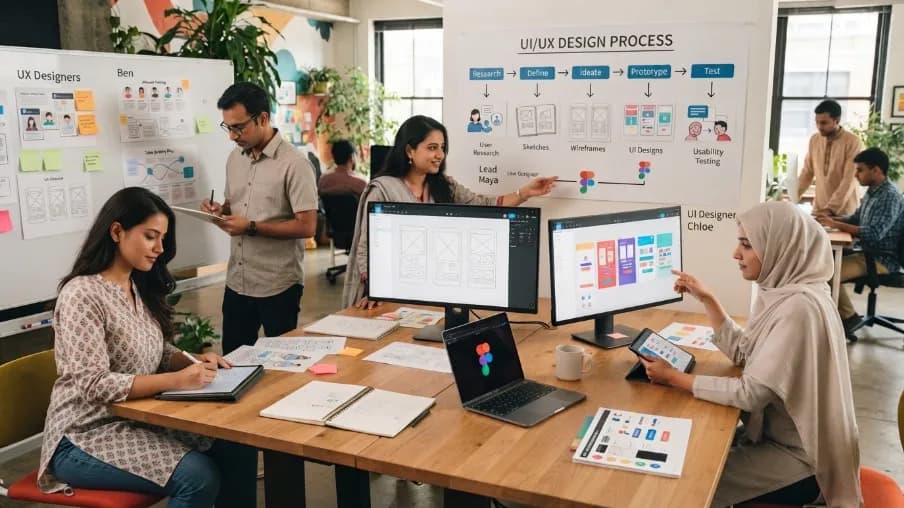
If you're thinking about bringing in outside help, here's what a good UI/UX design service should actually deliver, beyond just pretty screens:
- User research, understanding your real customers, not assumptions about them.
- Wireframes and prototypes, testing the flow before a single line of code is written.
- Usability testing, putting real people in front of the design to catch problems early.
- A design system, consistent components so your product scales without looking patched together.
- Measurable outcomes, clear before-and-after metrics on conversion, drop-off, and engagement.
A serious UI/UX design agency ROI conversation should always come back to these outcomes, not just visual polish. If an agency can't tell you how they'll measure success, that's worth asking about before you sign anything.
Final Thoughts
Here's what I want you to walk away with. UI/UX design isn't about making things look nice. It's about removing every small reason someone has to say "never mind" and leave. Every fixed friction point is money you get to keep. Every ignored one is money you're quietly losing, day after day.
If you've been putting off a redesign, or you're building something new and design feels like a "later" problem, I'd rethink that. The businesses winning right now aren't always the ones with the biggest budgets. They're the ones that make their product effortless to use.
If you're ready to turn your website or app into something that actually converts, our UI/UX design services can help you get there, from research and wireframes to a design system built for growth. Reach out, and let's talk about what a smarter, easier experience could do for your numbers.
That's why UI/UX design matters for business growth: it's the one investment that keeps paying you back, quietly, every single day.
Frequently Asked Questions About Why UI/UX Design Matters for Business Growth
Why is UI/UX design important for a website?
UI/UX design is important for a website because it decides whether visitors stay, trust you, and convert. A confusing or slow website loses customers before they even see your offer, no matter how good that offer is.
What is the ROI of UX design?
Studies from Forrester report that every $1 spent on UX design can return up to $100, a 9,900% ROI, driven by higher conversions, lower support costs, and better retention.
What is the difference between UI and UX design?
UI design is how a product looks, colors, layout, buttons. UX design is how a product feels to use, the flow, ease, and logic of the whole journey. Good products need both working together.
How does UX design affect business growth?
UX design affects business growth by increasing conversion rates, reducing customer churn, and building the kind of trust that turns first-time visitors into repeat customers.
Is UI/UX design worth it for a small business or startup?
Yes. Small businesses and startups often benefit the most, since they're competing for trust against bigger, more established names, and a smooth experience helps level that gap early.

I’m Mitu Das, a JavaScript developer, ERP product architect, and SEO specialist from Bangladesh. I work at CyberCraft Bangladesh, where I help build simple, scalable software, SaaS platforms, and business solutions. My goal is to create technology that helps companies save time, automate daily tasks, and grow faster. I enjoy combining development, product ideas, and SEO strategies to create useful digital solutions for modern businesses.
Writes about
Want this done for you?
Our team builds and ships exactly what this article describes. Send a message and we will reply with a scope.

.webp&w=3840&q=75)