Digital Marketing vs Traditional Marketing: Which One Actually Grows Your Business in 2026

We manage paid, organic, and creative campaigns for clients every day at CyberCraft Bangladesh, so this isn't theory. Everything below comes from real budgets, real campaigns, and real client results, backed by current industry data.
I've spent years watching small business owners argue about this one question. Should you print flyers or run Facebook ads? Buy a billboard or chase SEO rankings? Book a radio spot or build an email list?
Here's my honest answer before we go any further: it's not really "vs." It's about knowing what each one does well, then spending your money where it counts.
In this guide, I'll walk you through the real difference between digital and traditional marketing. You'll see actual numbers, real examples, and a clear way to decide what fits your business right now. No fluff. No guessing.
By the end, you'll know exactly which channels deserve your next marketing dollar.
What Is Traditional Marketing?
Traditional marketing is the offline stuff. It's the marketing that existed long before the internet, and it still works today.
This includes:
- TV commercials
- Radio ads
- Newspaper and magazine print ads
- Billboards and outdoor signs
- Direct mail and flyers
- Event sponsorships
- Cold calling and door-to-door sales
You'll also hear this called offline marketing. It reaches people physically, in places they walk, drive, or sit down to relax.
What Is Digital Marketing?
Digital marketing lives online. It's how you reach people through screens, search engines, apps, and social feeds.
Common digital marketing channels list:
- Search engine optimization (SEO)
- Pay-per-click (PPC) ads on Google
- Social media marketing (Facebook, Instagram, TikTok, LinkedIn)
- Email marketing
- Content marketing (blogs, videos, guides)
- Influencer marketing
- Affiliate marketing
Digital marketing runs on data. You can see who clicked, who bought, and who left without buying. That visibility is the biggest thing that separates it from traditional marketing. It's also why so many businesses treat digital as their main lead generation marketing engine. Every click, form fill, and email signup gets tracked, so you know exactly which channel is actually filling your pipeline.
The Core Difference Between Digital and Traditional Marketing
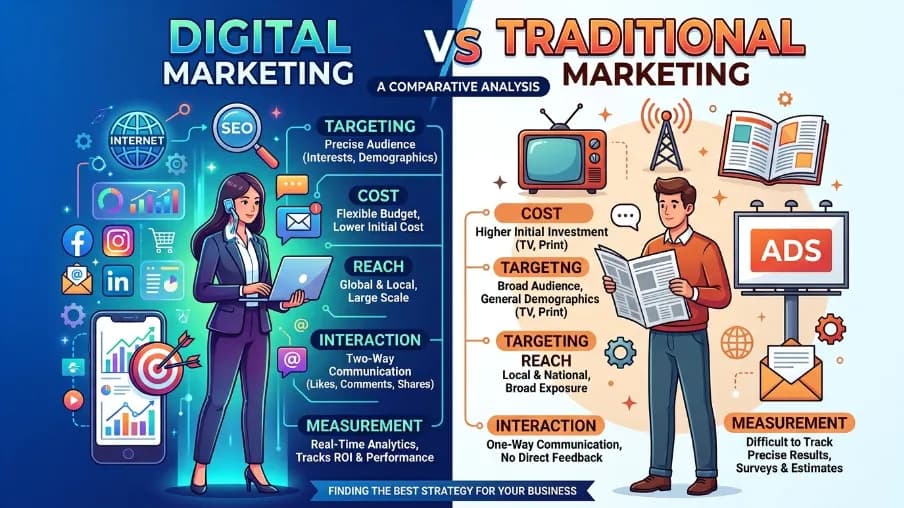
Let me put this simply. Traditional marketing builds broad awareness. Digital marketing lets you target, track, and adjust in real time.
Think about it this way. A billboard shows your ad to everyone who drives past, whether they need your service or not. A Google ad only shows up when someone actually searches for what you sell. That's the whole difference in one sentence.
Here's a side-by-side view:
| Factor | Traditional Marketing | Digital Marketing |
|---|---|---|
| Reach | Broad, local or regional | Global or hyper-local, your choice |
| Targeting | Very limited | Precise (age, interest, location, behavior) |
| Cost | High upfront, fixed | Flexible, start small |
| Tracking | Hard to measure | Real-time data and reports |
| Speed to launch | Weeks to months | Hours to days |
| Lifespan | Fixed campaign window | Content can work for years (SEO, blogs) |
| Best for | Local trust, brand recall | Lead generation, sales, retargeting |
This table alone answers most of what people search for when comparing digital marketing vs traditional marketing pros and cons.
Digital Marketing vs Traditional Marketing: Real Statistics
Numbers tell the story better than opinions do. Here's what the data actually shows in 2026.
Spending is shifting hard toward digital: Digital already makes up the majority of global ad budgets, and Statista projects digital will represent 74.4% of global ad spend. That's not a small tilt. That's most of the pie.
Digital marketing keeps growing fast: The digital marketing industry was worth $531 billion in 2022 and is projected to reach $807 billion by 2026. Businesses aren't chasing a trend here. They're following where customers already are.
ROI numbers favor certain digital channels heavily: Businesses earn an average of $44 for every $1 spent on email marketing, which is one of the highest returns of any channel, digital or traditional. SEO delivers roughly 8x return compared to about 4x for PPC, showing that organic digital work compounds over time.
Marketers themselves are voting with their opinions: Around 66% of marketers believe traditional advertising is less effective than digital advertising. That's two out of three professionals saying digital wins on results.
But traditional isn't dead in the budget conversation: CMO survey data going back years shows a steady pattern: digital marketing spending rises while traditional advertising budgets shrink slightly year after year. It's a slow bleed, not a sudden death.
AI search is now part of this comparison too: This matters for anyone thinking long-term. AI-referred traffic converts about 4.4 times better than traditional organic search, with ChatGPT showing a 15.9% conversion rate versus roughly 1.76% for Google organic. If you're building a digital strategy in 2026, this is why AEO (answer engine optimization) belongs in your plan, not just SEO.
Cost of Digital Marketing vs Traditional Marketing
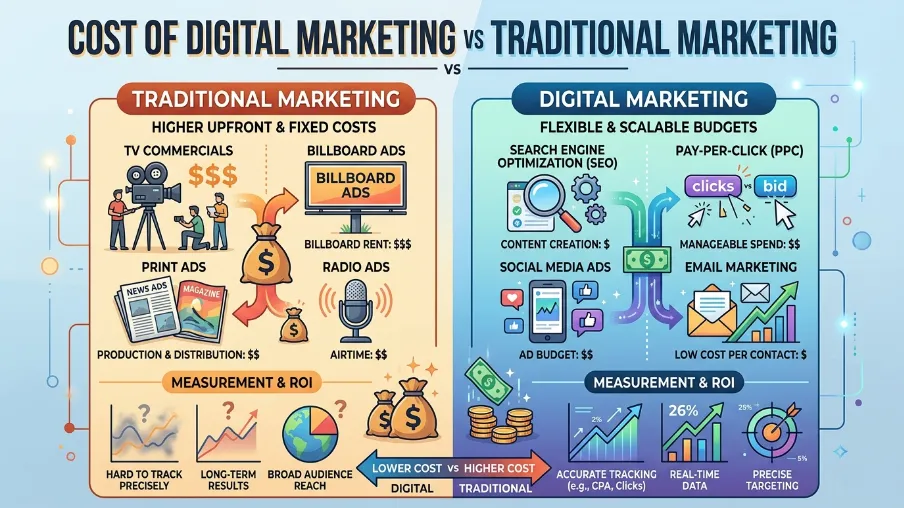
This is usually where the real decision gets made. Let's talk plain numbers.
Traditional Marketing Costs
- Billboards: A billboard typically costs $1,500 to $30,000 per four-week cycle, with static posters running $750 to $4,000 and digital billboards $3,500 to $25,000.
- TV commercials: A 30-second TV commercial can range from $500 to well over $10,000,000 depending on the network, time slot, and audience reach. Local slots stay much cheaper than national ones.
- Local TV ad buys: Local TV advertising runs roughly $15 to $35 CPM, often averaging $20-25.
- Produced commercials: A traditional agency 15-second spot typically runs $5,000 to $15,000 for just one ad in one format.
The pattern here is simple. Traditional marketing asks for a big check upfront, and you pay whether the campaign works or not.
Digital Marketing Costs
- Social and search ads: Many small businesses start with $100 to $500 a month on Facebook or Google Ads, and some platforms let you test with just $1 to $5 a day.
- Click costs stay low on some platforms: TikTok ads average $0.10 to $0.30 per click, while Instagram runs $0.50 to $2.00 per click.
- You control the budget daily: Pause it, boost it, or shift it. Nobody makes you commit to a four-week billboard cycle.
A well-run paid media campaign is often cheaper than people expect, but the budget isn't the whole cost. Good Facebook ad campaign management - meaning someone actually watching the numbers, testing creative, and adjusting targeting, matters more than the ad spend itself. A $500 budget managed poorly can waste money just as fast as a billboard. A $500 budget managed well can outperform a $5,000 print run.
This is the single biggest reason small businesses lean digital first. You don't need a five-figure budget to start seeing results.
Digital Marketing vs Traditional Marketing ROI
Let's make this real with a simple example. This mirrors a real pattern we see often when clients test digital marketing vs traditional marketing side by side for the first time.
A local gym wants more members before summer.
Traditional approach: They print and mail 8,000 postcards offering a 7-day free pass. Cost: around $1,200. They wait two to three weeks. They track results by asking new members, "How did you hear about us?" Some answers are vague. Attribution is rough.
Digital approach: They run a $500 Facebook and Instagram ad campaign targeting people within 5 miles who follow fitness pages. With proper Facebook ad campaign management, someone checks the dashboard daily, swaps out weak creative, and narrows the audience as data comes in. They track clicks, sign-ups, and cost per lead directly on the ads dashboard. If Tuesday's ad flops, they pause it by Wednesday morning. If the weekend version performs, they double the budget instantly.
Neither approach is wrong. But the digital campaign gives the gym owner something priceless: proof. They know exactly what worked, what didn't, and where to spend the next dollar.
This is the heart of every digital marketing vs traditional marketing case study you'll find. Digital wins on measurement. Traditional wins on physical presence and local trust.
Traditional Marketing Techniques Still Effective in 2026
I'm not here to tell you traditional marketing is dead. That's lazy advice. Some traditional channels still pull real weight.
- Direct mail still works well for local service businesses like dentists, roofers, and real estate agents. Physical mail gets noticed because inboxes are crowded but mailboxes aren't.
- Event sponsorships build face-to-face trust that no banner ad can replace.
- Local radio and community newspapers still reach older demographics who trust these formats more than social feeds.
- Billboards near your storefront work great for directional signage. If someone sees "Exit 42, turn right" and needs your service right now, that's an instant win.
The truth is, traditional marketing still earns its place when your audience is local, older, or hard to reach online.
Is Traditional Marketing Dead? Here's My Honest Take
No, it isn't dead. But it has lost its monopoly.
Thirty years ago, TV, radio, and print were basically the only game in town. Today, they're one option among dozens. The businesses that struggle are the ones still spending their entire budget on traditional channels while ignoring where their customers actually spend their time, which is increasingly online.
The businesses that win combine both. That's not a compromise. That's a strategy.
Which Is Better: Digital Marketing or Traditional Marketing
Honestly, this question needs a better question behind it: better for what goal, and better for which business?
Choose digital marketing if:
- You need measurable results fast
- You're working with a smaller budget
- Your customers are searching online for what you sell
- You want to test and adjust campaigns quickly
Choose traditional marketing if:
- Your audience skews older or lives in a specific local area
- You want strong brand credibility and physical presence
- You're targeting a hyper-local market with limited online reach
- You have budget for big, memorable brand moments
Best marketing strategy for small business almost always leans digital-first, simply because of cost control. But it rarely means digital-only.
How to Combine Digital and Traditional Marketing
This is where most businesses find their sweet spot. An integrated marketing strategy uses both channels so they reinforce each other instead of competing for budget.
Here's a simple way to do it:
- Use traditional marketing for local trust: A billboard, a radio spot, or a sponsored community event builds name recognition.
- Use digital marketing to capture that attention: When someone sees your billboard and later searches your business name on Google, make sure your website, reviews, and ads are ready to convert them.
- Retarget offline audiences online: Someone who got your direct mail piece can be shown a matching digital ad later. This is called integrated retargeting, and it multiplies recall.
- Track everything you can: Use unique phone numbers, QR codes, or landing pages for traditional campaigns so you can measure them almost like digital ones.
When done right, this combination gives you the trust of traditional media and the accountability of digital data.
When to Use Traditional Marketing Over Digital
There are moments when traditional marketing genuinely outperforms digital:
- You're opening a new physical location and need immediate local buzz
- Your target customer is 55+ and doesn't spend much time on social media
- You're in a small town with limited digital ad competition, making local print or radio cheap and effective
- You need instant, unmissable visibility for an event happening this week
In these cases, digital marketing simply can't replace the physical presence traditional channels provide.
Affordable Marketing Strategies for Small Business
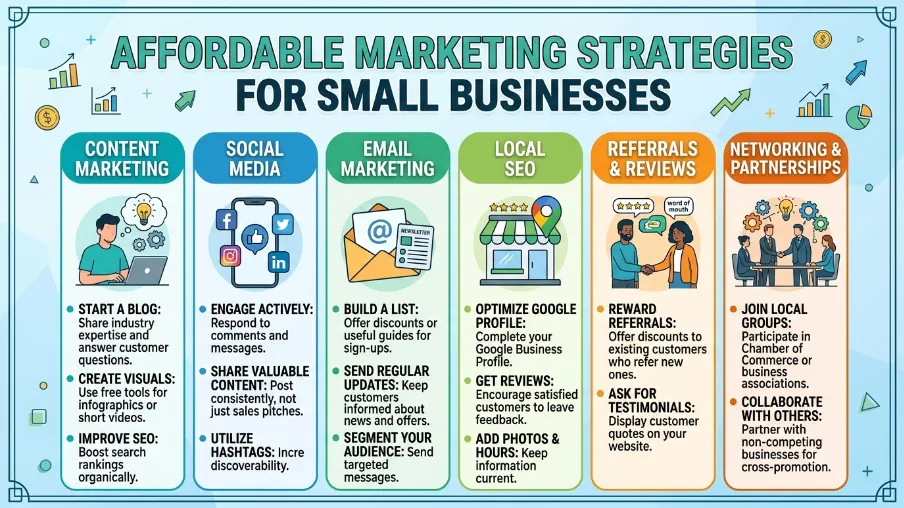
If your budget is tight, here's where I'd start:
- Google Business Profile : Free, and it's often the first thing people see when they search your business.
- Email marketing : Low cost, high return. $44 back for every $1 spent is hard to beat.
- Local SEO and blogging : Slower to build, but it keeps working for years without extra ad spend.
- Small daily-budget social ads : Start at $5-10 a day and scale only what performs.
- Community sponsorships : Cheap, local, and builds real relationships if traditional trust matters in your area.
Mixing two or three of these usually beats putting everything into one channel.
Common Digital Marketing Mistakes to Avoid
Even with a solid budget, I see the same digital marketing mistakes trip up businesses again and again.
- Running ads with no clear goal: Boosting a random post isn't a strategy. Every paid media campaign needs a defined outcome, whether that's leads, sales, or sign-ups.
- Ignoring the creative: People scroll fast. Flat, generic graphics get skipped. Creative digital marketing, meaning thumb-stopping visuals, short videos, and copy that speaks to a real problem, is what actually earns attention in a crowded feed.
- Setting it and forgetting it: Digital only beats traditional marketing when someone is actively managing the campaign. Untouched ads bleed budget fast.
- Chasing vanity metrics: Likes and impressions feel good but don't pay the bills. Track leads, cost per lead, and actual sales instead.
- Skipping the follow-up: Great lead generation marketing means nothing if leads sit untouched in an inbox. Have a plan to follow up within hours, not days.
Avoiding these mistakes usually matters more than which platform you pick.
Final Thoughts
Here's what I want you to walk away with. This was never a fair fight to begin with, because it was never supposed to be a fight.
Digital marketing gives you speed, targeting, and proof. Traditional marketing gives you trust, presence, and reach in places digital can't always touch. The businesses that grow the fastest use both, guided by real data instead of guesswork.
If you're not sure where to start, or you want a team that builds this kind of integrated strategy for you, that's exactly what we do. Explore our digital marketing services and let's build a plan that actually fits your business, your budget, and your goals.
Frequently Asked Questions About Digital Marketing vs Traditional Marketing
What is the main difference between digital and traditional marketing?
Digital marketing lets you target specific people and track exact results in real time. Traditional marketing reaches a broad audience but offers little targeting or measurement.
Is digital marketing cheaper than traditional marketing?
Usually, yes. You can start digital campaigns with a few dollars a day, while traditional channels like TV and billboards often require thousands upfront before you see any results.
Which gives better ROI: digital or traditional marketing?
Digital marketing generally delivers stronger, easier-to-measure ROI. Channels like SEO and email marketing consistently show higher returns than most traditional formats. But traditional channels can still deliver strong local ROI in the right market.
Should a small business focus only on digital marketing?
Not necessarily. Small businesses do well starting digital-first for cost control, but adding traditional elements like local sponsorships or direct mail can strengthen trust, especially in tight-knit communities.
Is traditional marketing still worth it in 2026?
Yes, for the right audience. If your customers are local, older, or respond well to physical media, traditional marketing still earns its place in your budget.

I’m Mitu Das, a JavaScript developer, ERP product architect, and SEO specialist from Bangladesh. I work at CyberCraft Bangladesh, where I help build simple, scalable software, SaaS platforms, and business solutions. My goal is to create technology that helps companies save time, automate daily tasks, and grow faster. I enjoy combining development, product ideas, and SEO strategies to create useful digital solutions for modern businesses.
Writes about
Want this done for you?
Our team builds and ships exactly what this article describes. Send a message and we will reply with a scope.