ERP Software in Bangladesh: Custom ERP Guide for 2026

ERP software in Bangladesh is a single business system that connects accounts, inventory, sales, purchase, HR, payroll and production for a local company, with local needs built in: NBR VAT records, Labour Act payroll rules, taka accounting and local payment gateways. It replaces scattered Excel files and separate tools with one database, one login and live reports for owners.
Last updated: November 2026.
This guide is the starting point of our ERP series. It explains how to choose ERP software in Bangladesh, what it costs, which modules matter for your industry, and how to avoid the mistakes that sink many projects. If you already know you need a system shaped around your workflow, see our ERP development service or read on.
Table of Contents
Key Takeaways
What Is ERP Software and How Does It Work?
Why Are Companies Moving to ERP Software in Bangladesh Now?
What Modules Should an ERP System in Bangladesh Include?
Readymade, Open-Source or Custom: Which ERP Software in Bangladesh Fits You?
Which ERP Software Is Best in Bangladesh for Your Industry?
How Much Does ERP Software Cost in Bangladesh?
Cloud ERP or On-Premise: What Works Better Locally?
How Long Does ERP Implementation Take?
How to Choose an ERP Software Company in Bangladesh
Common ERP Mistakes Bangladeshi Companies Make
Why Work With CyberCraft Bangladesh on Your ERP
Related Guides in This ERP Series
FAQs About ERP Software in Bangladesh
Sources
Final Word: Choosing ERP Software in Bangladesh
Key Takeaways
ERP joins finance, inventory, sales, purchase, HR and production into one database, so every department works from the same numbers.
Good ERP software in Bangladesh must handle local rules: VAT records for NBR, payroll under the Bangladesh Labour Act 2006, and taka-based accounting.
You have three routes: readymade local packages, open-source platforms such as Odoo or ERPNext, or a custom build. Each suits a different size and complexity.
The "best" system is the one that fits your workflow. A garments factory, a construction firm and a hospital need very different modules.
Budget for more than the licence: data migration, training, hosting and yearly support usually add a large share to the first-year cost.
Roll out in phases. Starting with one or two modules and adding more later is safer than a big-bang launch.
Pick a provider by checking process, references you can call, data ownership terms and post-launch support, not by price alone.
What Is ERP Software and How Does It Work?
Direct answer: ERP (Enterprise Resource Planning) software is a system that stores all core business data in one shared database. When a sales officer creates an invoice, stock, accounts receivable and VAT records update at the same moment. Managers see live dashboards instead of waiting for month-end Excel reports from each department.
An ERP system in Bangladesh removes those copies. Each transaction is entered once and flows to every module that needs it. Oracle describes ERP as software that manages day-to-day activities such as accounting, procurement, project management and supply chain operations in one place. That is the core idea, whatever brand you choose.
How does data flow through an ERP?
Direct answer: Data flows through linked documents. A purchase order becomes a goods receipt, then a supplier bill, then a payment. A sales order becomes a delivery, an invoice and a collection. Each step references the last, so you can trace any figure in a report back to the original document and the person who created it.
Why Are Companies Moving to ERP Software in Bangladesh Now?
Direct answer: Local companies are moving to ERP because growth exposes the limits of Excel and separate tools. Digital VAT filing, buyer audits, multi-branch operations and the need for faster financial reporting all push owners toward one system. Mobile payments and cloud hosting have also made ERP practical for smaller firms.
Several local pressures stand out:
Digital tax compliance. The National Board of Revenue runs VAT registration, returns and payment through its online VAT portal. Clean, structured sales and purchase data make filing faster and less risky.
Labour law and payroll. The Bangladesh Labour Act 2006 sets rules on working hours, overtime, leave and service benefits. Calculating these by hand for hundreds of workers invites errors and disputes.
Buyer and lender demands. Export buyers, banks and investors expect accurate costing, traceable stock and timely financial statements.
Multi-location control. Owners want to see every branch, warehouse or project site from one dashboard.
Payment digitisation. Gateways such as SSLCommerz and mobile financial services mean collections can be recorded automatically instead of being typed in later.
What Modules Should an ERP System in Bangladesh Include?
Direct answer: Most companies need finance and accounts, inventory, purchase, sales, and HR with payroll. Many also need CRM, project management and production. Choose modules by the problems costing you money today, then add others in later phases. Every module should share one database and one set of user permissions.
Module | What it handles | Local detail to check |
|---|---|---|
Finance and accounts | Ledger, journals, bank, receivables, payables, financial statements | Taka accounting, VAT and source-tax records, cost centres per branch |
Inventory | Stock in and out, transfers, batches, valuation, reorder levels | Multiple warehouses, landed cost for imports, unit conversions |
Purchase | Requisition, quotation, purchase order, goods receipt, supplier bills | Approval levels, LC and import tracking where relevant |
Sales | Quotation, order, delivery, invoice, collection | VAT invoice data, dealer and distributor pricing, collection through gateways |
HR and payroll | Employee records, attendance, leave, salary, bonus | Labour Act rules, attendance device integration, festival bonus, bank salary sheets |
CRM | Leads, customers, follow-ups, service tickets | SMS or email follow-up, link to sales and dues |
Project management | Projects, tasks, budgets, timesheets | Site-wise cost tracking for construction and real estate |
Production | Bill of materials, work orders, consumption, costing | Style or batch costing, wastage, piece-rate wages |
On top of modules, look for real-time dashboards, automated approval workflows, role-based access control, and integrations with your payment gateway, accounting tools, e-commerce store and other software through APIs. These are the building blocks a well-designed erp solution in Bangladesh should give you.
Do you need ERP software in Bangla?
Direct answer: Not always, but it helps. Accounts and management teams usually work comfortably in English. Store keepers, supervisors and factory staff often prefer Bangla labels and Bangla printouts. If many daily users are on the shop floor, ask whether screens, reports and payslips can be shown in Bangla before you sign.
Searches for erp software in bangla show the demand is real. A mixed setup, English for finance and Bangla for operations, is common and practical.
Readymade, Open-Source or Custom: Which ERP Software in Bangladesh Fits You?
Direct answer: Readymade local packages suit small firms with standard processes and tight budgets. Open-source platforms like Odoo or ERPNext suit companies that can adapt to a global product with some configuration. A custom build suits companies whose workflow is their advantage, or whose industry rules no package handles well.
Factor | Readymade local package | Open-source platform (Odoo, ERPNext) | Custom-built ERP |
|---|---|---|---|
Upfront cost | Lowest | Low to medium (licence or hosting plus setup) | Highest |
Fit to your process | You adapt to the software | Good with configuration, limited by the platform design | Built around your process |
Time to go live | Fast | Medium | Longer, usually phased |
Local rules (VAT, payroll) | Often included, quality varies | Needs local add-ons or customisation | Built to your exact rules |
Ownership | Licence only | Open code, hosted by you or a partner | You can own the code if the contract says so |
Best for | Shops, small traders | Growing firms with fairly standard flows | Factories, multi-unit groups, unusual workflows |
Odoo publishes per-user monthly pricing on its website, and ERPNext is open source under the GPL-3.0 licence, with paid managed hosting from Frappe Cloud. Both are real options. The hidden cost is customisation: once you change a platform heavily, every upgrade becomes harder.
When people search for custom erp software bangladesh, they usually have already tried a package and hit its limits. If that is you, our article on building ERP software that actually fits your business goes deeper, and our comparison of custom ERP vs off-the-shelf software weighs both sides.
Which ERP Software Is Best in Bangladesh for Your Industry?
Direct answer: There is no single best erp software in Bangladesh for everyone. The best choice depends on your industry and workflow. A garments factory needs style costing and piece-rate payroll. A developer needs flat booking and installments. A hospital needs patient billing. Judge each option against your top five daily processes.
Lists of the top 10 erp software company in bangladesh are popular, but they rarely compare fit for your sector. People who search for erp software in bd usually want a name. A better first question is which ERP software in Bangladesh has been shaped for your kind of business. Start with your industry:
Garments and textiles. Order and style tracking, bill of materials, cutting and bundle tracking, piece-rate wages and buyer compliance. See our garments ERP software guide.
Construction. BOQ-based budgets, site materials, subcontractor bills and project-wise profit. See our construction ERP software guide.
Real estate. Land, projects, flat inventory, booking, installment schedules and customer dues. See our real estate ERP software guide.
Manufacturing (non-RMG). BOM, MRP, production orders and unit costing for plastic, steel, food or agro plants. See our manufacturing ERP software guide.
Any company with 50+ staff. Attendance, leave, salary, bonus and tax deductions. See our HR and payroll software guide.
Hospitals and diagnostic centres. OPD, IPD, lab, pharmacy and billing. See our hospital management software guide.
Logistics and distribution. Orders, fleet, warehouses and delivery tracking. See our logistics and supply chain ERP guide.
Schools and colleges. Admissions, fees, results and staff. See our guide to school management software in Bangladesh.
What should a small business look for?
Direct answer: A small business should look for quick setup, simple accounting and inventory, low monthly cost, and room to grow. Avoid paying for modules you will not use for two years. Start with sales, stock and accounts, then add HR or CRM once the core is running smoothly and staff trust the numbers.
Our ERP guide for small businesses covers this stage in detail.
How Much Does ERP Software Cost in Bangladesh?
Direct answer: Costs range widely. Readymade packages can start from a few thousand taka per month. Open-source platforms add hosting and setup fees. A custom-built system for a mid-size company is often a project of several lakh to tens of lakh taka, depending on modules, users, integrations and data migration. Always budget for training and support.
The figures below are planning estimates based on typical project scopes in the local market. They are not quotes. Your real price depends on your requirements.
Route | Typical cost pattern (estimate) | What drives the price |
|---|---|---|
Readymade local package | Monthly subscription or one-time licence; low entry cost for small firms | Number of users, branches and modules |
Odoo | Odoo's pricing page listed per-user monthly plans of roughly US$8.95 (Standard) and US$16.40 (Custom) at introductory rates in November 2026, plus partner setup fees | Users, apps, hosting choice, customisation |
ERPNext | Software is free and open source; Frappe Cloud hosting listed from US$5 per month, plus implementation | Server size, local add-ons, partner fees |
Custom build, small scope (2 to 3 modules) | Often in the low-to-mid lakh taka range | Workflow complexity, reports, integrations |
Custom build, multi-module or multi-unit | Often tens of lakh taka, delivered in phases | Number of units, production logic, migration, mobile apps |
For reference, Bangladesh Bank's exchange rate page showed about ৳124.75 per US dollar on 12 November 2026, so a US$10 per user plan is roughly ৳1,250 per user each month. For 50 users that is over ৳7 lakh a year in licences alone, which is why larger firms often compare subscription totals with a one-time custom build.
For a full line-by-line breakdown, including hidden costs and yearly maintenance, read our ERP software price guide for Bangladesh. If you are an overseas buyer comparing offshore rates, see our post on ERP development cost in Bangladesh, India and the US.
Want a figure for your own scope? Book a free consultation and we will map your processes before giving a quote.
Cloud ERP or On-Premise: What Works Better Locally?
Direct answer: Cloud ERP suits most companies with several branches or remote managers, because users only need a browser and internet. On-premise suits companies with strict data policies or unreliable connectivity at a single site. Many local firms choose cloud hosting with daily backups, plus offline-friendly workflows for factory floors.
Interest in cloud erp bangladesh options keeps growing because owners want to check sales and stock from their phones. Whichever you choose, insist on automated off-site backups, a tested restore process and strict role-based access.
How Long Does ERP Implementation Take?
Direct answer: A readymade package can go live in a few weeks. A configured open-source system often takes one to three months. A custom multi-module system typically takes several months, delivered in phases so the first module is live early. Data clean-up and staff training usually take longer than companies expect.
A phased plan usually looks like this:
Process mapping. Document how orders, stock, money and people move today, and where errors happen.
Design. Agree modules, screens, approval flows, reports and integrations.
Build and test in phases. Launch the highest-value module first, test with real users, then add the next.
Data migration. Import opening balances, items, customers, suppliers and employees after cleaning them.
Training and support. Train each role on its own screens and keep support close during the first months.
Our step-by-step ERP implementation guide explains each stage with checklists.
How to Choose an ERP Software Company in Bangladesh
Direct answer: Choose an ERP software company in Bangladesh that maps your processes before quoting, shows working systems, gives references you can call, agrees in writing who owns the code and data, and offers clear post-launch support. A low price without a discovery phase is a warning sign, not a bargain.
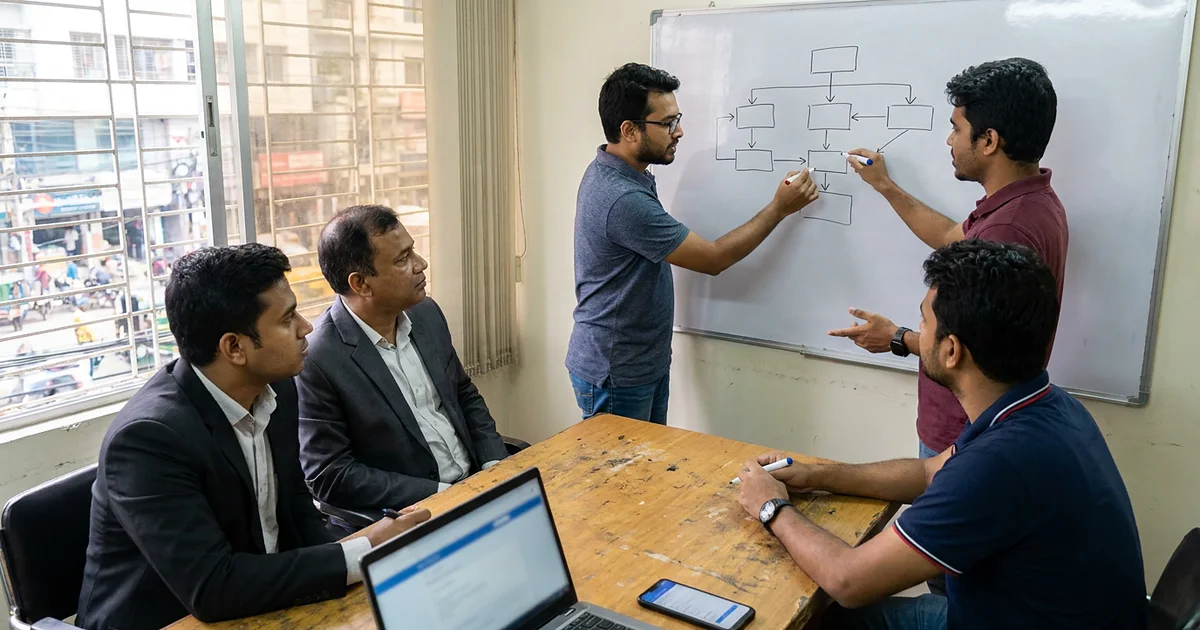
Buying ERP software in Bangladesh is a multi-year relationship, so the vendor matters as much as the product. Use this checklist when you compare each erp software provider in Bangladesh on your shortlist:
Question to ask | Good answer | Red flag |
|---|---|---|
Will you study our process first? | Yes, a paid or free discovery step before the final quote | Fixed price after one short call |
Can we see an erp software demo with our own scenario? | Demo built around one of your real transactions | Only a generic slide deck |
Who owns the source code and data? | Stated clearly in the contract | Vague, or data export costs extra |
How do you handle VAT and payroll rules? | Explains how reports match NBR and Labour Act needs | "Our system handles everything" with no detail |
How is the project delivered? | Phases with sign-off and testing | One big launch at the end |
What happens after go-live? | Defined support terms and response times | No written support plan |
Can it connect to our other tools? | APIs for payment gateways, e-commerce and accounting | Closed system with manual imports only |
A true bangladeshi erp software vendor should also understand local working habits, such as cash-heavy collections, dealer networks and festival bonus cycles. Ask for examples.
Common ERP Mistakes Bangladeshi Companies Make
Direct answer: The most common mistakes are buying on price alone, skipping process mapping, migrating dirty data, launching every module at once, and under-training staff. Owners also forget yearly support costs. Each mistake leads to the same result: staff return to Excel and the ERP becomes an expensive data-entry tool nobody trusts.
Why Work With CyberCraft Bangladesh on Your ERP
Direct answer: CyberCraft Bangladesh builds custom ERP systems around your workflow instead of forcing you into a template. Our service covers HR, finance, inventory, CRM and project management modules, with real-time dashboards, automated workflows, role-based access and integrations with payment gateways, accounting tools, e-commerce platforms and third-party APIs.
Here is how we work, as described on our ERP development service page:
Map your business processes before designing anything.
Design a custom ERP architecture that fits how your teams actually work.
Develop, test and deploy in phases, so you see value early and reduce risk.
Train your team and provide ongoing support after launch.
We are a Dhaka-based team with our office in Shahjadpur, Gulshan, and our trade licence and TIN are listed on our website. We also build websites, e-commerce stores and automation, so your ERP can connect with your online sales channels. If you want a partner that treats ERP software in Bangladesh as a business project, not just a software sale, talk to us about your requirements.
Related Guides in This ERP Series
Manufacturing ERP software in Bangladesh for non-RMG factories
HR and payroll software in Bangladesh: labour-law ready guide
Hospital management software in Bangladesh: HMS and ERP guide
ERP development cost in 2026: Bangladesh vs India vs US rates
FAQs About ERP Software in Bangladesh
Which ERP software is best in Bangladesh?
No single product is best for every company. The right choice depends on your industry, size and workflow. Small traders often do well with readymade packages. Growing firms may suit Odoo or ERPNext. Factories and multi-unit groups often need a custom system. Test each option against your five most important daily processes before deciding.
How much does ERP software cost in Bangladesh?
It depends on the route. Readymade packages can start at a low monthly fee. Open-source platforms add hosting and implementation fees. Custom systems for mid-size companies are usually projects of several lakh taka or more. Include training, data migration, hosting and yearly support in your budget, not just the licence or build price.
Is custom ERP better than Odoo or ERPNext for Bangladeshi companies?
Custom ERP is better when your workflow is unusual, your industry has rules no package handles well, or licence fees across many users become expensive. Odoo or ERPNext can be better when your processes are fairly standard and you want a faster start. Compare total cost over five years, not just year one.
Does ERP support NBR VAT compliance?
A well-designed ERP keeps the sales, purchase and VAT data you need for NBR returns, and can produce the reports your accountant uses for filing. Requirements change, so confirm with your tax adviser which records you must keep, and make sure your vendor can update reports when rules change.
How long does ERP implementation take?
A readymade system may go live in a few weeks. Configured open-source systems often take one to three months. Custom multi-module systems typically take several months, delivered in phases. The longest tasks are usually cleaning old data, agreeing processes internally and training staff, not writing the software itself.
Can ERP software work in Bangla?
Many systems can show labels, reports and printouts in Bangla, but support varies. If store keepers, supervisors or factory staff will use the system daily, ask the vendor to demonstrate Bangla screens and payslips. A mixed setup, English for finance and Bangla for operations, works well for many local companies.
Is cloud ERP safe for Bangladeshi businesses?
Cloud ERP can be safe when it uses encrypted connections, role-based access, strong passwords and automated off-site backups. The bigger risks are usually weak user practices and shared logins. Ask your provider where data is hosted, how often it is backed up, and how quickly they can restore it after a problem.
Can ERP connect with bKash, SSLCommerz or my e-commerce store?
Yes, ERP systems can connect with payment gateways, e-commerce platforms and accounting tools through APIs, so payments and orders are recorded automatically. The exact options depend on what each gateway or platform provides. List every tool you use today during scoping so integration effort is included in the quote.
What is the difference between ERP and accounting software?
Accounting software records financial transactions. ERP covers accounting plus inventory, purchase, sales, HR, payroll, production and more, all in one database. If only your accountant needs the system, accounting software may be enough. If several departments share data and re-type it, ERP removes that duplication.
Sources
Final Word: Choosing ERP Software in Bangladesh
The right ERP software in Bangladesh is the one your team will actually use every day. Map your processes, compare readymade, open-source and custom routes on five-year cost, and roll out in phases. If you want a system built around how your company really works, explore our ERP development service or request a free consultation today.

I'm Johirul Islam, a SaaS entrepreneur, JavaScript developer, ERP product architect, and SEO specialist from Bangladesh. I'm the Founder of CyberCraft Bangladesh, where I focus on building scalable SaaS platforms, enterprise software, and modern web technologies that help businesses automate operations, improve productivity, and accelerate digital transformation.
My expertise spans JavaScript development, Enterprise Resource Planning (ERP), Search Engine Optimization (SEO), Answer Engine Optimization (AEO), AI Search Optimization, software architecture, and cloud-based application development. I enjoy turning complex business processes into intuitive, high-performance software solutions.
I'm currently leading the development of several flagship products, including:
- Construction ERP – An end-to-end platform for construction companies covering estimation, BOQ, procurement, inventory, project management, finance, HR, equipment, and site operations.
- Education Management ERP – A comprehensive SaaS solution for schools, colleges, and educational institutions, managing admissions, academics, attendance, examinations, finance, communication, and administration.
- Power-SEO – A modern JavaScript library for SEO, AEO, and AI search optimization, designed to help developers build websites that perform exceptionally well across search engines and AI-powered search platforms.
Beyond product development, I'm passionate about technical SEO, website performance optimization, web accessibility, structured data, Core Web Vitals, and building search-first web applications using modern JavaScript technologies such as Next.js, React, Node.js, and related ecosystems.
My mission is to build enterprise-grade software products from Bangladesh that compete globally, contribute to the open-source community, and empower businesses through innovative, secure, scalable, and user-friendly technology.
Writes about