PPC Advertising for Beginners: Complete Guide to Getting Started (2026)

I still remember my first ad campaign. I clicked "publish," felt proud, and then watched my budget disappear in two days with zero sales. Honestly, no one warned me about the mistakes. That's why I wrote this guide.
If you're looking for a clear, no-fluff PPC advertising for beginners guide, you're in the right place. I'll walk you through what PPC is and how it works. You'll also learn what it costs and how to launch your first campaign without wasting money on guesswork. Whether you're chasing sales, sign-ups, or lead generation marketing, the basics in this guide apply.
By the end of this beginner PPC guide, you'll know:
What PPC advertising actually means
How the PPC auction works behind the scenes
Which platform to start with (and why)
The real cost of PPC in 2026
A simple step-by-step way to launch your first campaign
Common mistakes that drain beginner budgets fast
Let's get into it.
What Is PPC Advertising?
PPC stands for pay-per-click. It's a form of online advertising where you only pay when someone clicks your ad. In other words, you don't pay for the ad to simply appear. Instead, you pay for the action, the click.
For example, think of it like renting a billboard, but you only pay when a driver actually turns into your parking lot. That's the core idea behind pay-per-click advertising for beginners: you spend money on real interest, not just visibility.
Overall, PPC ads show up in a few common places:
Search ads: text ads on Google or Bing search results
Display ads: banner ads on websites across the internet
Social ads: ads inside Facebook, Instagram, or LinkedIn feeds
Shopping ads: product listings with images and prices
Video ads: ads that play before or during YouTube videos
Most beginners start with search ads, because they show up right when someone is looking for what you sell.
How PPC Advertising Works
Here's the part that confuses most beginners: PPC runs on an auction. But it's not just "highest bid wins." Google and other platforms also grade the quality of your ad.
When someone types a search, the platform looks at:
Your bid: how much you're willing to pay per click
Quality Score: how relevant your ad, keyword, and landing page are to the search
Expected click-through rate: how likely people are to click your ad
Ad relevance and landing page experience
As a result, a smaller business with a well-written ad and a fast, relevant landing page can beat a bigger company that bids more but has a sloppy ad. This is good news if you're just starting out. You don't need the biggest budget. Instead, you need the most relevant ad.
For instance, improving your Quality Score even a little can lower what you pay. Industry data shows that raising Quality Score from a 5 to an 8 can cut your cost per click by roughly a third. So, that's real money saved just by writing better, more relevant ads.
Digital Marketing vs Traditional Marketing: Why PPC Wins for Beginners
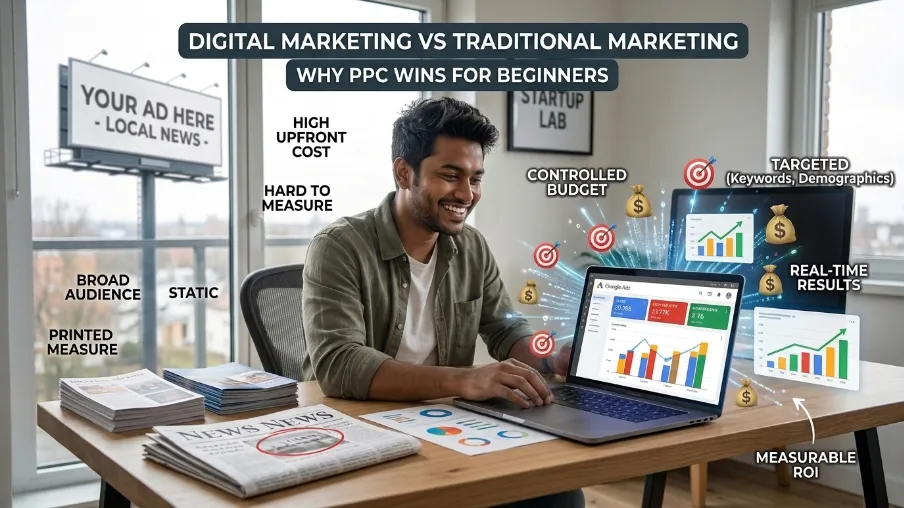
I get this question a lot: why put money into PPC instead of a newspaper ad or a flyer drop? Here's the honest comparison.
Traditional marketing, think print ads, billboards, TV spots, reaches a broad, mostly passive audience. You pay upfront, and you can't easily tell who saw it or whether it worked. So, digital marketing vs traditional marketing really comes down to one word: proof. With PPC, you know exactly how many people saw your ad, clicked it, and bought from you. Plus, you can pause a bad campaign in seconds. You can't pause a billboard.
That's the real advantage for a beginner. Traditional marketing asks you to guess and hope, while digital marketing hands you the data and lets you adjust in real time.
Why Beginners Should Start With Google Ads
There are many PPC platforms out there. But if you're asking how to start PPC advertising for the first time, start with Google Ads.
Here's why:
Google handles the vast majority of the world's search traffic, so your ad reaches people who are actively looking for what you offer.
People searching on Google already have intent. They're not scrolling for fun, they're looking for a solution.
Google Ads gives you control over budget, location, timing, and audience from day one.
Once you understand search ads on Google, moving into Microsoft Ads (Bing), Facebook, or Instagram becomes much easier. After all, the core PPC basics carry over. So, learn the fundamentals in one place first.
PPC Terms Every Beginner Should Know
Before you touch a campaign, learn this short list of terms. I wish someone had handed me this on day one.
Term | What It Means |
|---|---|
CPC (Cost Per Click) | What you pay each time someone clicks your ad |
CTR (Click-Through Rate) | The percentage of people who see your ad and click it |
Conversion Rate | The percentage of clicks that turn into a sale or lead |
Quality Score | Google's rating of your ad's relevance (1 to 10) |
Keyword Match Type | Controls how closely a search must match your keyword |
Negative Keyword | A word you exclude so your ad doesn't show for irrelevant searches |
Ad Rank | The position your ad gets in search results |
Landing Page | The page people reach after clicking your ad |
Knowing these terms makes every dashboard, report, and tutorial easier to understand.
How to Start Your First PPC Campaign: Step-by-Step
This is the part most beginner Google Ads tutorials rush through. Let's slow down.
Step 1: Set One Clear Goal
Before you spend a single dollar, decide what success looks like. Do you want phone calls, website sales, form fills, or foot traffic? One goal keeps your campaign focused. Trying to chase five goals at once is the fastest way to waste budget.
Step 2: Do Simple PPC Keyword Research
Good PPC keyword research isn't complicated at the start. Ask yourself: what would someone type into Google right before they're ready to buy from me?
First, use Google's free Keyword Planner tool to check search volume and competition. Then, look for keywords with clear buying intent, like "emergency plumber near me" instead of broad terms like "plumbing."
Also, build a negative keyword list early. For example, if you sell premium services, add "free" and "cheap" as negative keywords so you don't pay for clicks that were never going to convert.
Step 3: Choose Your Match Types
Google now uses three main match types: broad match, phrase match, and exact match. As a beginner, however, lean toward phrase and exact match. That's because they give you tighter control over who sees your ad, which matters a lot when your budget is small.
Step 4: Write a Focused Ad
Your ad should answer one question: why should someone click you instead of the next result? Keep the headline clear. State your offer. Add a simple call to action like "Get a Free Quote" or "Shop Now."
Step 5: Build a Landing Page That Matches Your Ad
This step gets skipped constantly, and it's costly. For instance, if your ad promises "20% off first order" and your landing page doesn't mention it, people bounce. Instead, your landing page should be fast, mobile-friendly, and focused on one action.
Step 6: Set a Daily Budget You're Comfortable With
Start small. You do not need thousands of dollars to test PPC. A modest daily budget lets you learn what works before you scale up.
Step 7: Launch, Then Watch and Adjust
PPC is not "set it and forget it." Instead, check your campaign after a few days. Then, pause underperforming keywords, add negative keywords, and test new ad copy. Overall, small, steady adjustments beat big, rare ones.
PPC Advertising Costs for Beginners: What to Expect
One of the most common questions I get is simple: how much does PPC actually cost?
Here's the honest, current picture for 2026:
Average cost per click across industries sits around $2.69 to $5.26, depending on the source and industry.
Local service businesses, like plumbing or landscaping, often see costs around $0.68 to $1.12 per click for local searches, though competitive terms run higher.
Legal and insurance keywords can cost $18 to $45+ per click because competition is fierce.
Many small businesses start with a monthly budget between $1,000 and $3,000.
If you hire help, management fees usually run 10% to 20% of your ad spend.
Of course, your real cost depends on your industry, location, and competition. The good news is, you control your daily spend cap. So, you can start with $10 to $20 a day and scale once you see real results.
PPC Advertising Tips That Actually Save Money
These are the tips I'd give my past self before that first painful campaign.
Start narrow, then expand: A tight, relevant keyword list beats a huge, vague one every time.
Never skip negative keywords: This single habit prevents the most wasted spend for beginners.
Match your ad to your landing page: Consistency between what you promise and what people see builds trust and lowers costs.
Track conversions from day one: Clicks feel good, but ultimately, conversions pay the bills. So, set up conversion tracking before you launch, not after.
Use automated bidding carefully: Strategies like Maximize Conversions can work well, but only if you give them enough data and time before judging results.
Test one thing at a time: For example, change your headline, or your bid, or your audience, but not all three at once. Otherwise, you won't know what actually moved the needle.
Invest in creative digital marketing, not just copy: A strong image, a short video, or a bold headline often lifts performance more than a bigger bid. On social platforms especially, creative is the first thing that stops the scroll.
Review weekly, not daily: Daily checking leads to overreacting to normal ups and downs. Weekly reviews give you a clearer, calmer picture.
PPC Advertising Examples for Beginners
Seeing real setups helps more than theory. Here are simple, realistic examples:
A local bakery runs a search ad for "custom birthday cakes near me," pointing to a landing page with photos and an order form.
A software company runs a search ad for "project management tool for small teams," linking to a free trial signup page.
A clothing brand runs shopping ads showing product photos and prices directly in search results.
A law firm runs search ads for "car accident lawyer [city]," sending clicks to a page with a free consultation offer.
In each case, notice the pattern: the ad matches a specific search, and the landing page delivers exactly what the ad promised.
Bringing Social Media Into Your PPC Strategy
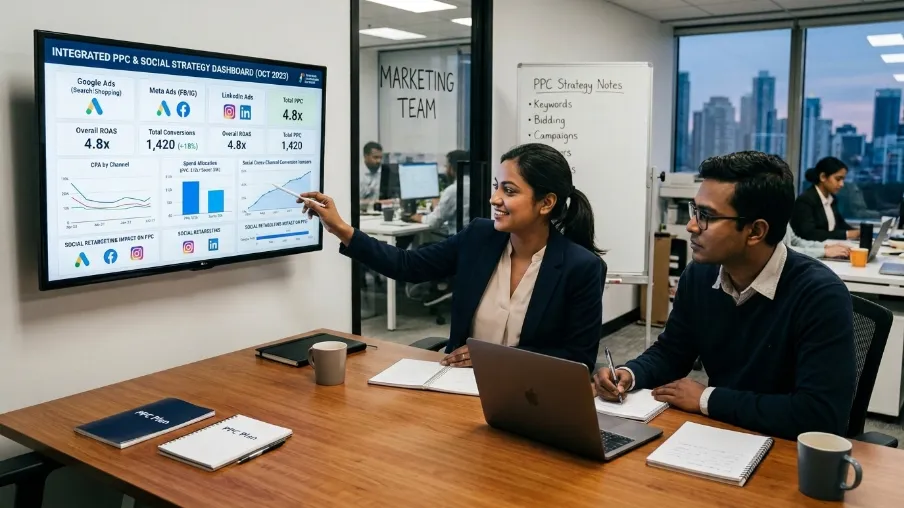
Once search ads feel comfortable, most beginners want to know where PPC fits into a wider social media marketing strategy. Search catches people looking for a solution. Social ads catch people scrolling, so your creative has to work harder to earn the click.
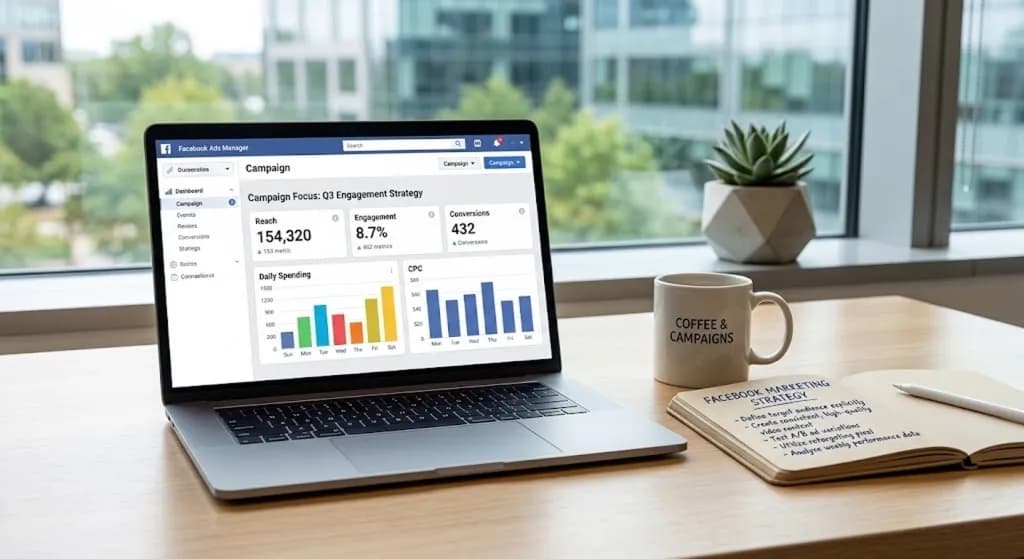
Facebook ad campaign management is usually the easiest next step. That's because Facebook's targeting lets you reach people by interests, location, and behavior, which is great for local businesses and e-commerce brands. So, start with one clear offer, one audience, and one ad set. Also, resist the urge to launch ten ad sets at once, since it just splits your budget and slows down learning.
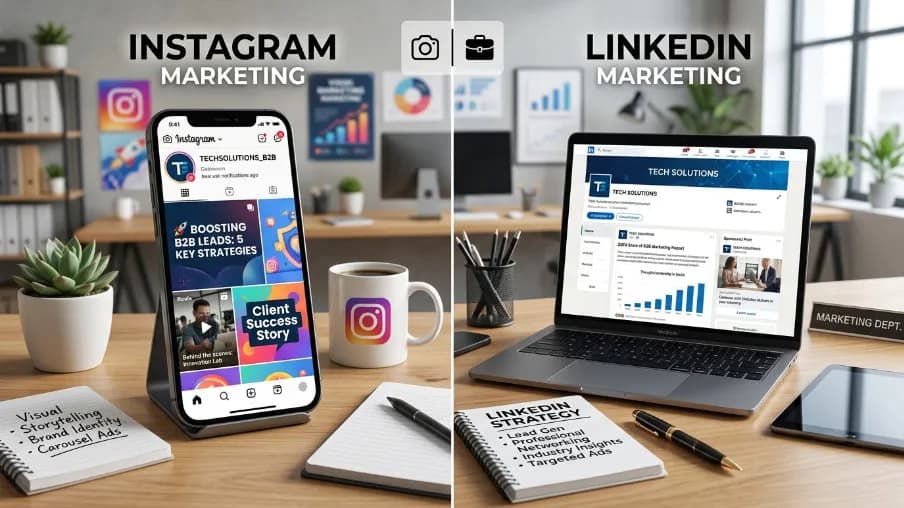
Meanwhile, if you sell to other businesses, the platform choice matters even more. Here's a quick way to think about Instagram vs. LinkedIn marketing for B2B:
Instagram works best when your product is visual, or when you're building brand awareness with a broader, younger audience.
LinkedIn works best when you need to reach a specific job title, industry, or company size. Costs per click run higher on LinkedIn, but the lead quality for B2B offers is usually much stronger.
A simple rule I follow: use Instagram to build awareness, use LinkedIn to generate qualified B2B leads, and use Google Ads to catch the people already searching for what you sell.
Common PPC and Digital Marketing Mistakes to Avoid
I'll be direct here, because these digital marketing mistakes cost real money, whether you're running search ads, Facebook ads, or both.
Bidding on broad, unclear keywords: This burns budget on clicks that were never going to convert.
Sending traffic to a homepage instead of a matching landing page: This tanks conversion rates.
Ignoring mobile experience: Over half of clicks happen on phones. A slow mobile page kills results.
Turning off campaigns too soon: PPC needs a few days of data before it can optimize properly.
Not tracking results at all: Without tracking, you're guessing, not managing.
Ultimately, avoiding just these five mistakes puts you ahead of most beginners.
Final Thoughts
PPC advertising for beginners isn't about knowing everything on day one. Instead, it's about starting small, tracking results, and improving one step at a time. After all, every expert running six-figure ad accounts today started with one small campaign, just like you're about to.
So, you now have the beginner PPC guide I wish I had years ago. Use it, start small, watch your numbers, and adjust often.
That said, if you'd rather skip the trial and error and get expert hands on your campaigns from day one, our team can help you set up, manage, and grow a PPC strategy built around your real business goals.
Ready to launch a PPC campaign that actually converts? Talk to our digital marketing team today and let's build your first winning campaign together.
Frequently Asked Questions About PPC Advertising for Beginners
Is PPC advertising good for beginners?
Yes. PPC gives beginners fast visibility and full control over budget. You can start small, test what works, and scale up once you see real results, without waiting months like you would with SEO.
How much money do I need to start PPC advertising?
You can start with as little as $10 to $20 a day. Most small businesses run comfortably with a monthly budget between $1,000 and $3,000 while they learn and test.
Which platform is best for a beginner, Google Ads or Facebook Ads?
Start with Google Ads. It captures people already searching for what you sell, which usually leads to faster, clearer results for beginners. Facebook and Instagram work well once you understand PPC basics.
How long before PPC ads start working?
Search ads can show results within days, since you appear as soon as your campaign goes live. But give your campaign at least one to two weeks before judging performance, so the platform has enough data to optimize.
Do I need a big team to manage PPC campaigns?
No. Many beginners manage their first campaigns solo using free tools like Google Keyword Planner and Google Ads Editor. As your budget grows, working with a specialist can help you scale without wasting spend.

I'm Johirul Islam, a SaaS entrepreneur, JavaScript developer, ERP product architect, and SEO specialist from Bangladesh. I'm the Founder of CyberCraft Bangladesh, where I focus on building scalable SaaS platforms, enterprise software, and modern web technologies that help businesses automate operations, improve productivity, and accelerate digital transformation.
My expertise spans JavaScript development, Enterprise Resource Planning (ERP), Search Engine Optimization (SEO), Answer Engine Optimization (AEO), AI Search Optimization, software architecture, and cloud-based application development. I enjoy turning complex business processes into intuitive, high-performance software solutions.
I'm currently leading the development of several flagship products, including:
- Construction ERP – An end-to-end platform for construction companies covering estimation, BOQ, procurement, inventory, project management, finance, HR, equipment, and site operations.
- Education Management ERP – A comprehensive SaaS solution for schools, colleges, and educational institutions, managing admissions, academics, attendance, examinations, finance, communication, and administration.
- Power-SEO – A modern JavaScript library for SEO, AEO, and AI search optimization, designed to help developers build websites that perform exceptionally well across search engines and AI-powered search platforms.
Beyond product development, I'm passionate about technical SEO, website performance optimization, web accessibility, structured data, Core Web Vitals, and building search-first web applications using modern JavaScript technologies such as Next.js, React, Node.js, and related ecosystems.
My mission is to build enterprise-grade software products from Bangladesh that compete globally, contribute to the open-source community, and empower businesses through innovative, secure, scalable, and user-friendly technology.
Writes about
Want this done for you?
Our team builds and ships exactly what this article describes. Send a message and we will reply with a scope.